
Special Intensive Revision (SIR) of Electoral Rolls
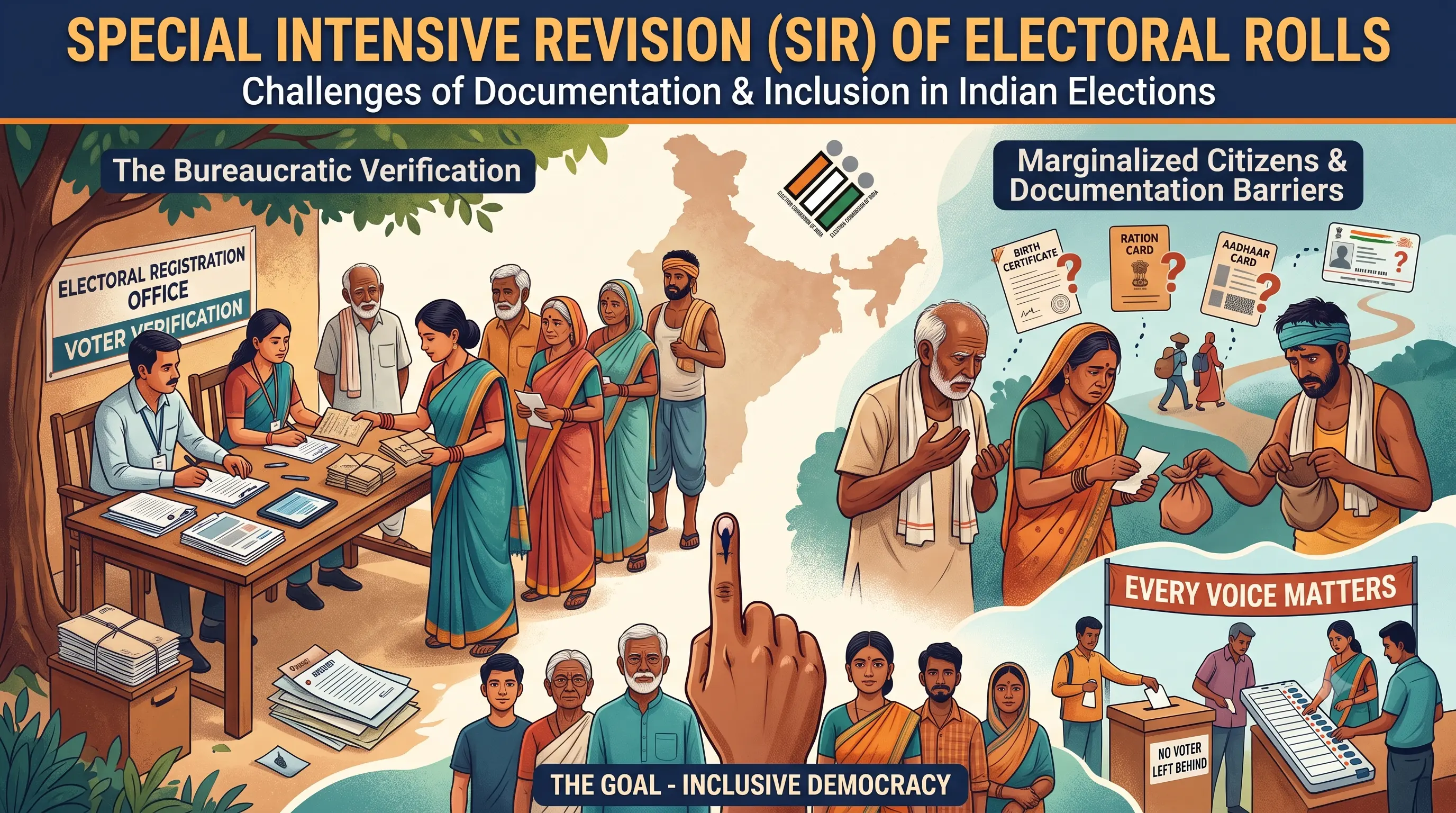
The Election Commission of India (ECI) has clarified that during the Special Intensive Revision (SIR) of electoral rolls, the power to accept or reject the eligibility of electors lies solely with Electoral Registration Officers (EROs), not micro observers. The exercise highlights significant challenges regarding documentation and potential disenfranchisement of marginalized communities.
Introduction
Context & Background
Key Points
- •Final Authority with EROs: Decisions regarding the addition or deletion of names rest exclusively with the Electoral Registration Officer (ERO) or Assistant ERO (AERO).
- •Role of Micro Observers: The EC informed the Supreme Court that micro observers (Central/PSU officers) have no legal authority to decide voter eligibility. Their role is strictly facilitative to ensure procedures are properly followed.
- •Administrative Control: Micro observers function on deputation under the control of the Chief Electoral Officer of the respective state (e.g., West Bengal).
- •Invalid Documents: Family registers maintained at Anganwadi centres cannot be treated as valid proof of eligibility or citizenship during the SIR.
- •Purpose of Scrutiny: The primary goal of document verification is to ensure the accuracy and integrity of electoral rolls, not arbitrary exclusion.
Law Commission Recommendations on Electoral Roll Reforms
| Recommendation | Details & Purpose | Bookmark |
|---|---|---|
| Common Electoral Roll | Consolidate voter lists used for Parliament, State Assemblies, municipal and panchayat polls into a single unified roll. | |
| Simplified Voter Forms | Replace multiple separate forms (Forms 6, 7, 8, etc.) with a single streamlined application for all electoral services. | |
| Enhanced Facilitation | Expand Electoral Service Centres (ESCs) and provide door-step electoral services for PwDs and senior citizens. | |
| Tech-Enabled BLOs | Revamp Booth Level Officer system with dedicated, trained personnel equipped with digital devices and standard photo IDs. | |
| e-EPIC & Aadhaar Linkage | Issue digital EPICs and promote voluntary linkage of Aadhaar to clean up duplicate entries with clear legal safeguards. |
Related Entities
Impact & Significance
- •Risk of Mass Disenfranchisement: Genuine Indian citizens, especially the elderly, migrants, and tribals, may lose their voting rights due to procedural lapses or inability to produce old documents.
- •Exclusion of Youth: A massive number of young voters from rural and lower-income backgrounds (e.g., ~63% in Bihar) are not in older (2003) electoral rolls and now face the burden of proving eligibility.
- •Democratic Integrity: Arbitrary exclusions undermine the universality of adult franchise, a core tenet of the Indian democratic framework.
Challenges & Criticism
- •Documentation Barriers: A large percentage of marginalized individuals lack standard documents like birth certificates (e.g., IHDS data shows only 2.8% of Bihar's 2001-2005 born population possess one).
- •High Out-Migration: Migrant workers living in informal housing often lack stable documentation tied to a fixed location.
- •Disproportionate Impact on SC/STs: Marginalized castes and tribes often lack secure housing, schooling, or formal employment, which limits their access to official documentation.
- •Gender Disparities: Women are less likely to possess personal documents like school certificates. Many are enrolled in welfare schemes via Aadhaar, which is sometimes not accepted as proof of citizenship under specific verification rules.
Future Outlook
- •Clear Legal Framework: Establishing a transparent legal and procedural framework for voter verification to avoid mass exclusions, similar to the issues faced during the Assam NRC.
- •Broader Range of Acceptable Documents: Expanding valid proof to include Aadhaar, MGNREGA job cards, ration cards, and caste certificates, as many marginalized citizens lack birth certificates.
- •Extended Timelines & Phased Rollouts: Allowing sufficient time beyond a single month for document gathering to prevent administrative overload.
- •Door-to-Door Verification: Utilizing Booth Level Officers (BLOs) for house-to-house visits in rural and tribal areas to assist, rather than just verify, citizens.
- •Integration with Welfare Databases: Using existing government databases like PDS, PM-KISAN, and Ujjwala Yojana to cross-verify identity and reduce the documentation burden on citizens.
UPSC Relevance
- • GS-2 (Polity & Governance): Salient features of the Representation of People's Act, functions and responsibilities of the Election Commission, and issues arising out of electoral reforms.
- • GS-2 (Social Justice): Mechanisms, laws, institutions, and Bodies constituted for the protection and betterment of vulnerable sections (Challenges in proving citizenship).
- • Mains Focus: Analyzing the risk of disenfranchisement among marginalized communities due to systemic documentation barriers and evaluating the Law Commission's proposed electoral reforms.
Sample Questions
Prelims
With reference to the Special Intensive Revision (SIR) of electoral rolls, consider the following statements: 1. The final authority to accept or reject the eligibility of an elector lies solely with the Electoral Registration Officer (ERO). 2. Micro observers are appointed with statutory powers to decide on voter eligibility disputes. 3. The Law Commission has recommended the creation of a Common Electoral Roll across all elections by amending the Constitution. Which of the statements given above are correct?
1. Only 1 and 2
2. Only 2 and 3
3. Only 1 and 3
4. All of the above
Answer: Option 1
Explanation: Statement 1 is correct. Statement 2 is incorrect; the ECI has clarified that micro observers hold no statutory powers to decide on eligibility, their role is facilitative. Statement 3 is correct; the Law Commission recommended a Common Electoral Roll requiring amendments to Articles 325, 243K, and 243ZA.
Mains
“Large-scale voter verification drives often disproportionately impact marginalized communities, risking mass disenfranchisement.” Analyze this statement in the context of the Special Intensive Revision (SIR) of electoral rolls and suggest safeguards to ensure inclusive democratic participation.
Introduction: Introduce the ongoing Special Intensive Revision (SIR) of electoral rolls by the ECI. Mention the underlying objective of ensuring accurate voter lists while identifying the constitutional right to vote.
Body:
• Challenges in Verification: Highlight the documentation barriers faced by marginalized communities, high migration rates, and gender disparities (e.g., lack of birth certificates or formal schooling records).
• Issues with the Process: Discuss administrative overload, tight deadlines, exclusion errors (e.g., first-time voters not in old rolls), and the controversy over the limits of micro observers' powers.
• Safeguards & Reforms: Suggest broadening the range of acceptable documents, implementing the Law Commission’s recommendations (common electoral roll, tech-enabled BLOs), extending timelines, and linking with welfare databases.
Conclusion: Conclude by emphasizing that electoral integrity must not come at the cost of exclusion. A rights-based, inclusive approach with strong legal and technological safeguards is essential to uphold the democratic rights of vulnerable populations.