
Supreme Court Urges Government to Examine 'Racial Slur' as Hate Crime
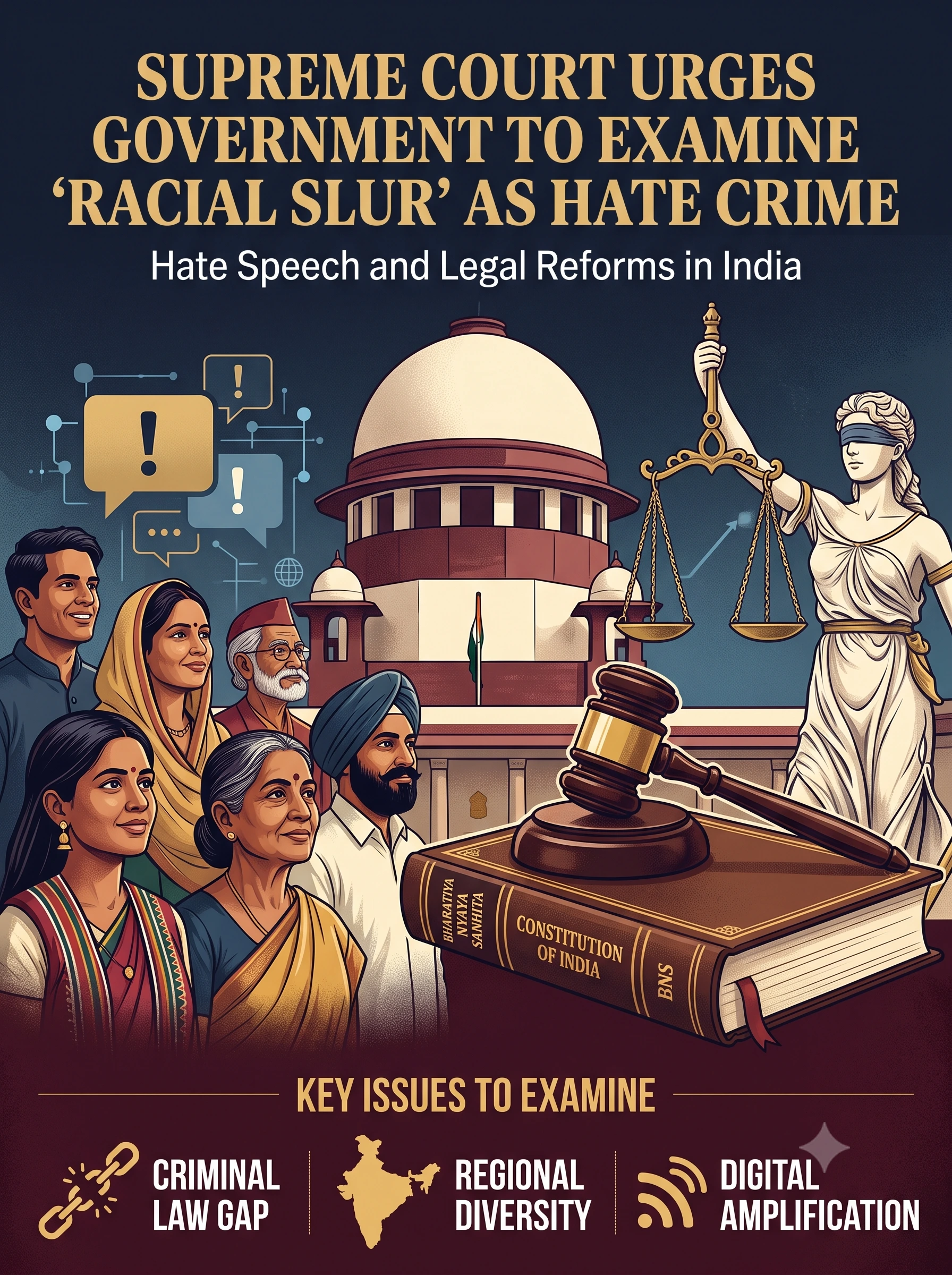
The Supreme Court of India recently directed the Union government to examine a petition seeking the recognition of 'racial slurs' as a distinct category of hate crime. This highlights the current gaps in India's criminal justice system, which treats racially motivated attacks as ordinary crimes, lacking specific statutory definitions and penal provisions for hate speech.
Introduction
Context & Background
Key Points
- •The Core Issue: Indian law currently lacks a precise statutory definition of hate speech. The recent Bharatiya Nyaya Sanhita (BNS) addresses hate-related harms generally but does not recognize 'racial slurs' as a distinct, separate hate offence.
- •Judicial Perspective: While the Supreme Court acknowledged the severity of hate-motivated offences, it cautioned that classifying crimes purely on the victim’s identity might risk social fragmentation. The Court emphasized strengthening national unity through equal treatment.
- •Regional Efforts (Karnataka Bill): In 2025, Karnataka introduced the Hate Speech and Hate Crimes (Prevention) Bill, becoming the first state to provide an explicit definition, proposing 2 to 10 years of imprisonment, collective liability for organizations, and online regulation powers.
- •The Digital Challenge: Roughly 70% of hate content originates from online or social media platforms. The rapid amplification and difficulty in tracing repeat offenders exacerbate the problem.
- •Definition Complexity: The United Nations defines hate speech based on hostility against identity markers (race, religion, gender, etc.). However, objectively defining it in domestic law without over-criminalizing free speech remains a major hurdle.
India's Legal Framework Against Hate Speech
| Legal Provision | Objective/Purpose | Current Status/Limitation | Bookmark |
|---|---|---|---|
| BNS Section 196 (earlier IPC 153A) | Punishes acts promoting hostility between groups on grounds of religion, race, language, etc. | Often invoked, but conviction rates are low (around one-fifth). | |
| BNS Section 299 (earlier IPC 295A) | Penalises intentional and malicious actions aimed at hurting religious sentiments. | Deals specifically with religion, not racial slurs. | |
| BNS Section 353 | Targets statements inciting offences against the State or disrupting public order. | Focuses on public disorder broadly. | |
| IT Act, 2000 Section 66A | Used to regulate offensive online content. | Struck down by the Supreme Court for vagueness. |
Important Supreme Court Judgments on Hate Speech
| Case Name | Key Ruling/Observation | Bookmark |
|---|---|---|
| Pravasi Bhalai Sangathan v. Union of India | Declined to create new criminal provisions without legislation; asked the Law Commission to examine the issue. | |
| Ramji Lal Modi v. State of Uttar Pradesh | Upheld the validity of IPC Section 295A, allowing restrictions on speech deliberately outraging religious feelings. | |
| Shreya Singhal v. Union of India | Invalidated Section 66A of the IT Act for being vague and chilling free speech online. | |
| Tehseen Poonawalla v. Union of India | Directed States to appoint nodal officers to prevent hate crimes, mob violence, and targeted attacks. |
Related Entities
Impact & Significance
- •Erosion of Constitutional Values: Unregulated hate speech challenges the principles of equality, fraternity, and dignity, undermining the core pillar of India's constitutional morality.
- •Psychological Harm: Individuals facing continuous racial slurs or targeted hate suffer trauma, anxiety, and long-term alienation.
- •Law and Order: Repeated hateful narratives frequently escalate into real-world violence, mob lynching, and riots, disrupting public order.
Challenges & Criticism
- •Low Conviction Rates: NCRB data indicates that only about 20% of cases registered under hate speech provisions end in conviction, often due to weak evidence or poor investigation.
- •Over-Criminalization vs. Free Speech: Finding an objective definition of hate speech is difficult. Broad laws risk being misused to stifle legitimate political dissent or free expression.
- •Proving Intent (Mens Rea): Establishing a direct, legally sound link between a speech and subsequent public disorder or establishing the malicious intent of the speaker is highly complex.
Future Outlook
- •Clear Statutory Definition: Implement a harm-based test focusing on incitement and targeted harm, as recommended by the Law Commission’s 267th Report.
- •Independent Nodal Mechanism: Establish monitoring bodies that operate independently of the standard police hierarchy to ensure unbiased hate crime investigations.
- •Digital Compliance Protocols: Mandate strict 48-hour takedown timelines for digital platforms and ensure traceability for repeat online offenders.
- •Forensic Standard Upgrades: Develop robust cyber-forensic protocols for audio/video hate content to counter the extremely low conviction rates currently plaguing hate speech cases.
UPSC Relevance
- • GS-2 (Polity & Governance): Indian Constitution—significant provisions and basic structure; Government policies and interventions for development in various sectors and issues arising out of their design and implementation.
- • GS-2 (Social Justice): Mechanisms, laws, institutions and Bodies constituted for the protection and betterment of vulnerable sections.
- • Essay Topics: 'Freedom of Speech vs. Hate Speech', 'Racism and Social Fragmentation in Modern India'.
Sample Questions
Prelims
With reference to the legal framework governing hate speech in India, consider the following statements: 1. The Indian Constitution explicitly defines 'hate speech' under Article 19(2). 2. Section 66A of the Information Technology Act is currently the primary legal tool to regulate online hate speech. 3. The Supreme Court in the Tehseen Poonawalla case directed states to appoint nodal officers to prevent mob violence and hate crimes. How many of the above statements are correct?
A. Only one
B. Only two
C. All three
D. None
Answer: Option A. Only one
Explanation: Statement 1 is incorrect: The Constitution does not explicitly define hate speech; it only provides reasonable restrictions under Article 19(2). Statement 2 is incorrect: Section 66A of the IT Act was struck down by the Supreme Court in the Shreya Singhal case (2015). Statement 3 is correct: The SC did direct the appointment of nodal officers in the Tehseen Poonawalla judgment.
Mains
Despite several constitutional and legal safeguards, hate speech remains inadequately defined and poorly regulated in India. Discuss this statement in light of the recent Supreme Court observations and the Karnataka Hate Speech Bill, 2025.
Introduction: Define hate speech as per UN guidelines and mention the recent SC directive asking the Union government to examine treating 'racial slurs' as distinct hate crimes.
Body:
• Existing Framework & Gaps: Discuss provisions like BNS Sec 196, 299, and 353. Highlight the lack of a statutory definition and the striking down of Sec 66A of the IT Act.
• Challenges: Low conviction rates, risk of over-criminalization, political misuse, and digital amplification of hate content.
• Recent Developments: Mention the Karnataka Hate Speech Bill, 2025 as a progressive model (collective liability, strict imprisonment, online regulation).
Conclusion: Conclude by advocating for the implementation of the Law Commission's 267th Report recommendations and finding a balance between curbing hate crimes and protecting Article 19(1)(a).