
Transforming India’s SMEs with Artificial Intelligence
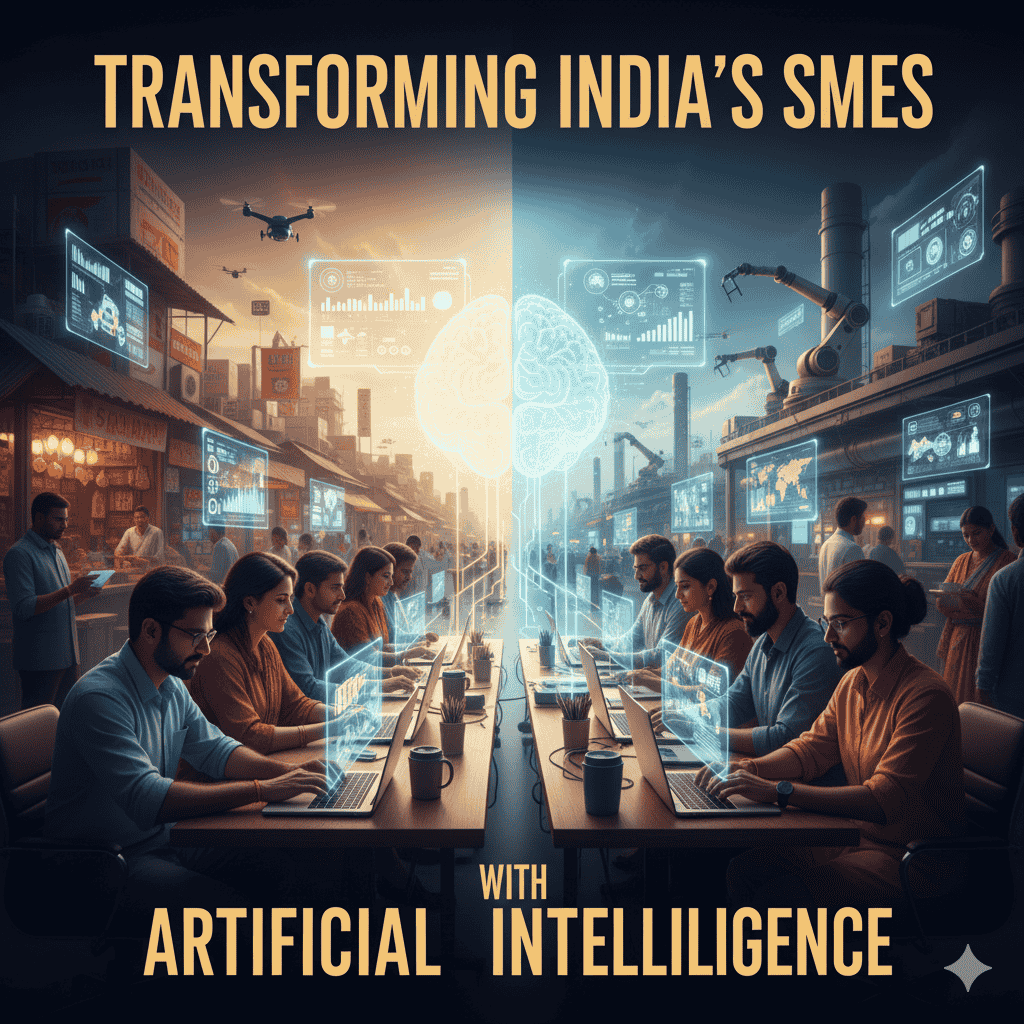
Artificial Intelligence (AI) can transform India’s MSME ecosystem by boosting productivity, reducing costs, improving credit access, and enabling global competitiveness. According to the WEF (2025), AI adoption can unlock $490–685 billion in economic value by 2030.
Introduction
Context & Background
Key Points
- •What are MSMEs? MSMEs are enterprises classified by investment and turnover. They include millions of small shops, manufacturing units, service providers, and home-based businesses. For beginners: MSMEs are simply small businesses that form the majority of India’s industry.
- •Economic Significance: MSMEs contribute 30% to GDP, provide 230 million jobs, and contribute nearly half of India’s exports. This makes them critical for inclusive growth, rural development, and job creation.
- •AI’s Economic Potential: The WEF estimates AI adoption could add $490–685 billion to India’s economy by 2030 — equal to a 45–62% increase over current SME productivity levels.
- •How AI Boosts Productivity: AI tools can automate repetitive tasks, reduce waste, improve quality checks, predict machine failures, and optimise daily operations. Beginners can think of AI as a ‘smart assistant’ helping businesses run faster and cheaper.
- •AI for Cost Reduction: AI-enabled logistics, inventory management, and supply-chain optimisation can reduce operational costs by 20–30%, unlocking $200–300 billion in savings.
- •AI for Financial Inclusion: Only 19% of MSME credit demand is met by banks. AI-based alternative credit scoring (using GST data, cash flows, invoices, and digital behaviour) can help unlock formal loans worth $130–170 billion.
- •Business-Level Benefits: AI can improve labour productivity by 30–40%, cut defect rates up to 99%, improve energy efficiency by 59%, and reduce loan processing time from days to hours.
- •Sectoral Composition of Indian MSMEs: 31% in manufacturing, 33% in services, 36% in trade. AI applications vary — from predictive maintenance in factories to chatbots in service firms.
- •AI Examples for Beginners: Using WhatsApp chatbots for customer orders, AI tools for GST filing reminders, inventory prediction apps, automated quality checks using cameras, or voice-based translation tools for customer support.
MSME Classification in India (2020 Updated)
| Category | Investment Limit | Turnover Limit | Bookmark |
|---|---|---|---|
| Micro | ≤ ₹2.5 crore | ≤ ₹10 crore | |
| Small | ≤ ₹25 crore | ≤ ₹100 crore | |
| Medium | ≤ ₹125 crore | ≤ ₹500 crore |
Potential Benefits of AI for MSMEs (Simple View)
| AI Benefit | Explanation | Impact | Bookmark |
|---|---|---|---|
| Productivity Boost | AI automates routine tasks | 15–20% higher output | |
| Cost Reduction | AI reduces wastage & improves efficiency | 20–30% savings | |
| Credit Access | AI-driven scoring uses alternative data | More loans to MSMEs | |
| Quality Control | AI detects defects instantly | Up to 99% improved accuracy | |
| Faster Decision-Making | AI gives real-time insights | Better planning & forecasting |
Related Entities
Impact & Significance
- •Boost to GDP: AI adoption can add up to $685 billion to India’s economy by 2030, pushing India closer to its $7-trillion economy goal.
- •Improved Global Competitiveness: AI helps Indian MSMEs match global standards in quality, price, and delivery, making them stronger exporters.
- •Enhanced Employment Quality: AI doesn't remove jobs — it changes job types. Workers shift from repetitive tasks to higher-value activities like supervision, digital tools, or machine operation.
- •Better Access to Finance: AI helps banks evaluate SME credit risk more accurately using GST returns, invoices, bank statements, and digital footprints.
- •Inclusive Growth: Women-led enterprises benefit from:(AI-enabled online marketing, digital accounting tools, remote work opportunities)
- •Energy and Resource Savings: AI reduces energy consumption in small factories by predicting load usage and optimizing daily operations.
- •Zero-Defect Manufacturing: AI-based cameras and sensors help detect defects early, improving export readiness and compliance.
- •Supply Chain Resilience: AI forecasting tools help MSMEs manage raw material shortages and price risks.
Challenges & Criticism
- •Awareness Gaps: Many MSME owners are unfamiliar with AI, believe it is too expensive, or think it is only for big companies.
- •Digital Readiness Issues: Many MSMEs still use paper-based accounting, making AI adoption difficult.
- •AI Tools are Costly: Most AI tools cater to large enterprises. MSMEs need cheap, plug-and-play tools.
- •Lack of Skilled Workforce: MSMEs often struggle to hire or retain workers trained in AI, data entry, or digital tools.
- •Poor Data Quality: AI works best with good data. MSMEs lack IoT devices, sensors, ERP systems, or cybersecurity.
- •Ecosystem Gaps: India lacks a dedicated AI Marketplace where MSMEs can easily find and test AI solutions.
- •Regulatory Fear: MSME owners hesitate to digitize because they fear GST scrutiny or compliance penalties.
- •Infrastructure Challenges: Slow internet, power outages, and outdated machines limit AI adoption in rural clusters.
- •Market Access Weakness: Without export linkages or branding, many MSMEs struggle to use AI for global competitiveness.
Future Outlook
- •Improving Access to Finance: Expand CGTMSE, digitize loan processes, scale TReDS for early payments, and use AI to underwrite micro-loans.
- •Digital and AI Infrastructure: Establish AI Experience Centres and Sandboxes so MSMEs can test and adopt solutions before investing.
- •Affordable AI Tools: Promote ‘AI-as-a-Service’ where small firms can subscribe to tools at low cost instead of buying expensive software.
- •Cluster Development: Build AI-enabled MSME parks with shared facilities, testing labs, and logistics support.
- •Unified Digital Portal: Integrate Udyam, GST, GeM, and TReDS for single-window governance.
- •Global Integration: Promote MSME exports through branding support, training, ZED certification, and targeted export hubs.
- •National MSME Council: Coordinate policymaking and monitor AI adoption using real-time dashboards via Udyam Assist.
- •Skill Development: Provide large-scale training in AI tools, digital marketing, cybersecurity, and cloud-based ERP tools.
- •WEF’s IMPACT AI Framework: Focus on: Awareness through AI demo centres, Action through AI Marketplace & Maturity Index, Recognition through SME AI Pioneer Awards.
UPSC Relevance
- • GS-3: Indian Economy, MSMEs, Innovation, AI, Manufacturing, Inclusive Growth.
- • GS-2: Government Policies, Digital Governance.
- • Essay: Technology for Development, AI and Future of Work.
Sample Questions
Prelims
With reference to the adoption of Artificial Intelligence (AI) by MSMEs in India, consider the following statements:
- (a)AI can help reduce defect rates in MSME manufacturing by over 90%.
- (b)Only 19% of MSME credit demand is met through formal banking channels.
- (c)The IndiaAI Mission includes initiatives aimed at supporting MSMEs with AI adoption.
- (d)CGTMSE provides collateral-free loans only to medium enterprises.
Mains
Discuss the potential of Artificial Intelligence (AI) in transforming India’s MSME sector. Highlight key challenges in AI adoption and suggest policy measures to accelerate digital transformation.
Introduction: AI can significantly enhance productivity, competitiveness, and financial inclusion in India’s MSME sector, which forms the backbone of the Indian economy.
Body:
• Potential of AI: Boosts productivity, reduces costs, improves credit access, enhances quality control, strengthens supply chains, and opens doors to global markets.
• Challenges: Awareness deficits, limited digital readiness, poor data quality, high tool costs, lack of skilled workforce, and weak infrastructure.
• Policy Measures: AI experience centres, sandboxes, AI marketplaces, simplified digital governance, cluster development, affordable AI tools, expanded credit guarantees, and stronger export integration.
Conclusion: With strategic reforms, AI can unlock massive economic value and drive a new era of growth, innovation, and competitiveness for India's MSMEs.