
Turning Point of Nuclear Deterrent: Security in the 21st Century
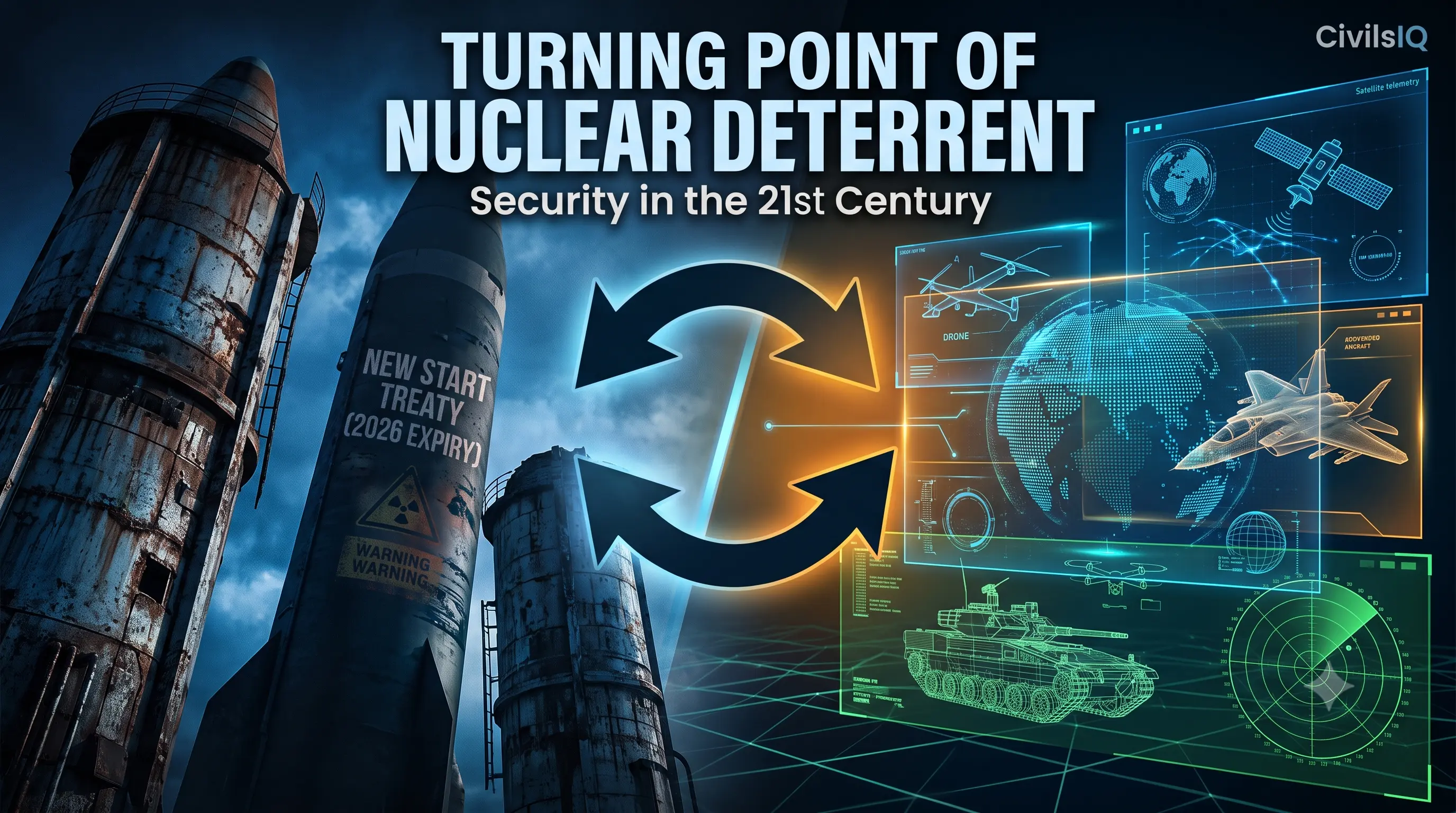
With the expiry of the New START arms control treaty and shifting global security dynamics, the traditional reliance on nuclear deterrence is being fundamentally questioned. This analysis explores the evolution of nuclear strategy, its limitations in modern conflicts, and the necessary shift toward integrated conventional deterrence.
Introduction
Context & Background
Key Points
- •The Core of Nuclear Deterrence: The strategy relies on preventing war by threatening unacceptable damage. It is built on three pillars: Capability (survivable weapons), Credibility (willingness to use them), and Communication (the adversary believing the threat).
- •The Expiry of New START: Signed in 2010, the New START Treaty limited the U.S. and Russia to 1,550 deployed strategic nuclear warheads. Russia suspended its participation in 2023, and the treaty is set to expire on February 5, 2026, marking a crisis in global arms control.
- •Changing Nature of Threats: Nuclear weapons are ill-equipped for 21st-century threats. They cannot deter non-state actors, terrorism, cyberattacks, climate change, pandemics, or economic crises.
- •Lessons from the Ukraine War: The conflict proved that possessing nuclear weapons does not guarantee conventional military victory. Furthermore, deterrence worked without nuclear certainty—Western nations successfully contained escalation through strong conventional support and economic sanctions.
- •Tactical Nuclear Risks: The introduction of low-yield or 'battlefield' nuclear weapons blurs the line between conventional and nuclear warfare, dramatically lowering the threshold for use and increasing the risk of accidental escalation.
- •Revival of the Arms Race: Despite clear limitations, major powers are modernizing their arsenals. China is reportedly adding ~100 warheads annually, and the U.K. has reversed stockpile reduction plans, signaling a dangerous return to Cold War logic.
The Early Nuclear Debate: Certainty vs. Uncertainty
| Deterrence Type | Core Logic | Historical Example | Bookmark |
|---|---|---|---|
| Uncertainty-Based Deterrence | Ambiguity about nuclear retaliation deters aggression; fear of the unknown restrains risky actions. | Israel (policy of ambiguity); India-Pakistan pre-testing era. | |
| Certainty-Based Deterrence | Relies on large stockpiles, tests, and clear doctrines to signal assured and guaranteed retaliation. | Cold War era (U.S. vs. Soviet Union). |
Related Entities
Impact & Significance
- •Strategic Miscalculation: The deployment of low-yield tactical nuclear weapons lowers the psychological threshold for their use, making an accidental full-scale nuclear exchange more likely.
- •Diplomatic Instability: The erosion of arms control frameworks, like New START, removes verification and inspection mechanisms, leading to unchecked arms racing and mutual suspicion.
- •Shifting Alliances: As trust in the U.S. nuclear umbrella wanes, European and allied nations are forced to increase their defense spending and develop independent security architectures.
Challenges & Criticism
- •Irrelevance to Modern Crises: Nuclear weapons provide absolutely no strategic utility against the most pressing modern threats: cyber warfare, economic coercion, and climate-driven instability.
- •Political Coercion over Utility: As seen recently, nuclear arsenals are increasingly leveraged merely for intimidation and political posturing, rather than serving as genuine battlefield deterrents.
- •Resource Diversion: Trillions of dollars are being spent on modernizing nuclear delivery systems (like submarines and hypersonic missiles), pulling vital funding away from conventional forces and climate/economic resilience programs.
Future Outlook
- •Shift to Integrated Deterrence: Nations must reduce overdependence on nuclear weapons by relying more on advanced conventional military strength, space assets, cyber capabilities, and aggressive diplomacy.
- •Reviving Arms Control: Major global powers urgently need to restart arms control negotiations, implement confidence-building measures, and establish nuclear risk-reduction hotlines to prevent miscalculations.
- •Strengthening the Nuclear Taboo: The international norm against the first use of nuclear weapons must be reinforced through strict political commitments and restraint doctrines.
- •Regional Security Autonomy: Regions like Europe should focus on building autonomous, cooperative security architectures to decrease their reliance on a single nuclear-armed guarantor.
UPSC Relevance
- • GS-2 (International Relations): Bilateral, regional and global groupings and agreements involving India and/or affecting India's interests (New START, NATO).
- • GS-2 (Effect of Policies): Effect of policies and politics of developed and developing countries on India's interests (Nuclear Proliferation, arms race).
- • GS-3 (Security): Security challenges and their management in border areas; linkages of organized crime with terrorism, and cyber threats.
- • Mains Focus: The transition from nuclear deterrence to integrated conventional deterrence and the geopolitical fallout of collapsing arms control treaties.
Sample Questions
Prelims
Consider the following statements regarding global nuclear deterrence and arms control:
1. The New START Treaty was a bilateral agreement between the United States and China to limit tactical nuclear weapons.
2. Nuclear deterrence relies on three core pillars: capability, credibility, and communication.
3. The policy of 'nuclear ambiguity' (uncertainty-based deterrence) is strictly prohibited under current UN charters for all non-NPT nations.
Answer: Option 2
Explanation: Statement 1 is incorrect; New START was between the U.S. and Russia, and it limited strategic, not tactical, weapons. Statement 3 is incorrect; nuclear ambiguity is a strategic posture used by nations like Israel and is not explicitly 'prohibited' by UN charters in the way described. Statement 2 is correct.
Mains
“The ongoing global conflicts and the collapse of arms control treaties highlight the limitations of nuclear deterrence in the 21st century.” Analyze this statement and suggest how national security strategies should adapt to modern threats.
Introduction: Define nuclear deterrence (Capability, Credibility, Communication). Mention the context of the New START treaty expiry and the Ukraine war as a catalyst for rethinking global security.
Body:
• Limitations of Nuclear Deterrence: Ineffectiveness against modern non-state threats (cyber, terrorism); The Ukraine war demonstrating that nuclear threats don't guarantee conventional victories; Risks of low-yield tactical nukes blurring escalation lines.
• Collapse of Arms Control: The suspension and imminent expiry of the New START treaty; The renewed nuclear modernization race by the U.S., Russia, and China reflecting outdated Cold War logic.
• Adaptation/Way Forward: Shifting to 'Integrated Deterrence' (cyber, space, precision conventional weapons); Promoting regional autonomous security architectures; Reviving diplomatic risk-reduction mechanisms.
Conclusion: Conclude by emphasizing that while nuclear weapons remain a backdrop of global geopolitics, true 21st-century security requires robust conventional capabilities and a strict adherence to international non-proliferation norms.