
Union Budget 2026-27 Announces Establishment of Chemical Parks
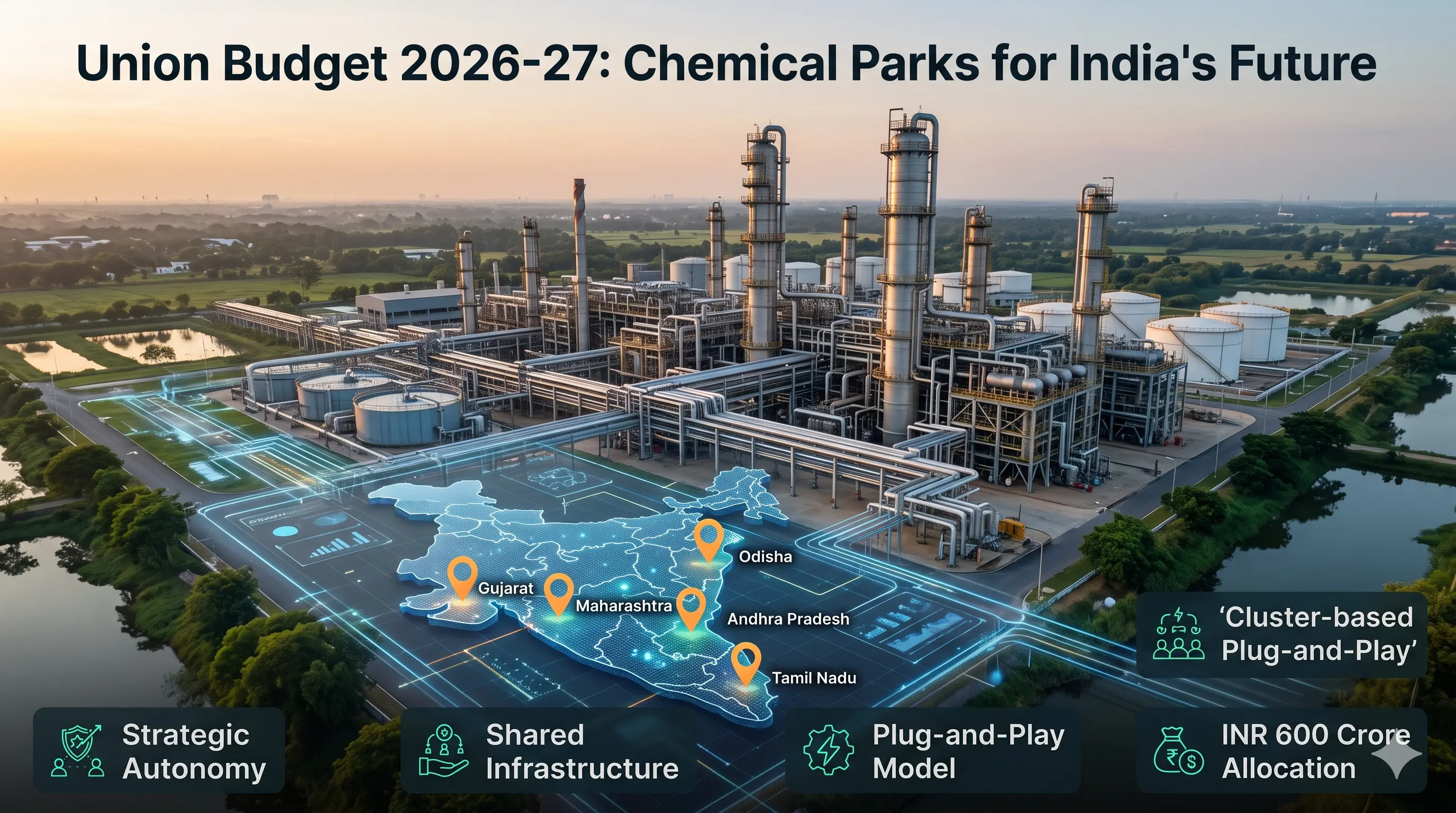
The Union Budget 2026-27 has introduced a new scheme with an allocation of Rs 600 crore to support States in establishing three dedicated Chemical Parks. Utilising a challenge-based, plug-and-play cluster model, these parks aim to boost domestic manufacturing, integrate MSMEs, and create globally competitive chemical ecosystems in India.
Introduction
Context & Background
Key Points
- •Financial Allocation & Selection: The Union Budget 2026-27 has earmarked Rs 600 crore in the Budget Estimates (BE) to set up three dedicated Chemical Parks. The selection will be through a challenge-based mechanism, promoting competitive federalism among States.
- •The 'Plug-and-Play' Model: These parks are built on a specialized 'Cluster Model' that provides ready-to-use infrastructure. This includes centralized utilities like power, steam, and demineralised water, bypassing the traditional hurdles industries face when acquiring land and setting up basic utilities.
- •Strategic Supply Chain Integration: By co-locating feedstock suppliers and downstream units, the parks facilitate seamless backward and forward integration. This reduces logistical overheads and minimizes supply chain vulnerabilities.
- •Regulatory Efficiency: Industrial projects are often delayed by multi-layered bureaucratic approvals. The Chemical Parks promise unified park-level clearances (Environment/Fire), acting as a catalyst to reduce the overall Time to Market.
Core Features of the Chemical Parks Model
| Feature | Description | Primary Benefit | Bookmark |
|---|---|---|---|
| Cluster-based Plug-and-Play | Ready-to-use land and pre-built infrastructure similar to Bulk Drug Parks. | Reduces setup timelines and capital expenditure (CAPEX). | |
| Shared Infrastructure | Common Effluent Treatment Plants (CETPs), solvent recovery, and distillation units. | Lowers environmental compliance costs for individual units. | |
| Production Integration | Co-location of feedstock suppliers alongside downstream chemical units. | Enables seamless backward and forward supply chain integration. | |
| Unified Clearances | Single-window park-level clearances for Environment and Fire safety. | Significantly improves 'Time to Market' for industrial projects. |
India's Chemical Sector: At a Glance
| Indicator | Current Status | Bookmark |
|---|---|---|
| Global Standing | 6th largest globally, 3rd in Asia (after China and Japan). | |
| Economic Contribution | ~7% of GDP; 8.1% of manufacturing Gross Value Added (GVA). | |
| Production Volume | 58,617 thousand metric tonnes in FY25 (CAGR of 2.8% since 2016). | |
| Regional Hubs | Concentrated in Gujarat, Maharashtra, Odisha, Andhra Pradesh, and Tamil Nadu. |
Related Entities
Impact & Significance
- •Strategic Autonomy: By scaling up the domestic production of Key Starting Materials (KSMs) and intermediates, India can buffer itself against the geopolitical shocks of volatile global supply chains.
- •Economies of Scale: Shared utilities and streamlined logistics dramatically lower per-unit production costs, making Indian chemical exports far more competitive on the global stage.
- •Circular Economy: Integrated clusters are ideal environments for 'waste-to-wealth' models, where the hazardous by-product of one manufacturing unit can be seamlessly piped as feedstock for a neighboring facility.
- •MSME Empowerment: The 'plug-and-play' model removes the prohibitive upfront capital expenditure (CAPEX) required for land acquisition and utility setup, allowing smaller MSMEs to easily plug into high-value global supply chains.
- •Environmental Sustainability: Centralized waste management systems, such as large-scale CETPs, ensure stricter, more efficient adherence to environmental norms compared to policing scattered, independent industrial units.
Challenges & Criticism
- •Domino Risks: The spatial concentration of highly hazardous, flammable, and toxic chemical units sharply increases the risk of a 'Domino Effect'—where a fire or explosion in one plant triggers a massive, cluster-wide catastrophe.
- •Infrastructure Pressure: Mega-clusters demand an uninterrupted, massive supply of power and demineralised water, which can strain local municipal resources and create friction with surrounding civilian populations.
- •Compliance Burden: While shared infrastructure helps, the mandate to meet ultra-stringent environmental regulations like Zero Liquid Discharge (ZLD) can still impose heavy operational costs on smaller industrial tenants.
- •Land Acquisition Hurdles: Identifying and securing massive, contiguous land parcels that also meet strict safety buffer requirements away from ecological zones and residential areas remains politically and legally complex.
- •Operational Expertise: Smaller state-level clusters may struggle to attract and retain the highly specialized technical workforce required to maintain complex, centralized hazardous waste treatment facilities safely.
Future Outlook
- •Aligning with 'Viksit Bharat': The scheme is expected to play a critical role in transforming India into a global manufacturing hub, directly supporting the long-term vision of a developed India (Viksit Bharat).
- •Sustainable Green Chemistry: Integrating the parks with parallel budget announcements—such as the Rs 20,000 crore allocation for Carbon Capture, Utilisation and Storage (CCUS)—could position these hubs as pioneers in sustainable, low-emission chemical manufacturing.
- •Global Value Chain Integration: By bridging the gap between bulk, specialty, and downstream chemical segments, India can position its domestic manufacturers to seamlessly integrate into high-value global supply networks.
UPSC Relevance
- • GS-3 (Indian Economy): Growth and development, industrial policy changes, and their effects on industrial growth.
- • GS-3 (Infrastructure): Energy, ports, roads, airports, railways, and industrial corridors/parks.
- • Mains Focus: Analyzing the 'cluster approach' in manufacturing, MSME integration, and transitioning to a circular economy.
Sample Questions
Prelims
Consider the following statements regarding the Chemical Parks scheme announced recently:
1. The Union Budget 2026-27 allocates Rs 600 crore to support the establishment of three dedicated Chemical Parks.
2. The parks will be selected through a challenge-based mechanism among the States.
3. The chemical sector contributes approximately 25% to India's GDP.
4. The Chemical Parks are mandated to solely focus on the pharmaceutical active ingredients (APIs).
Answer: Option 1, Option 2
Explanation: Statements 1 and 2 are correct. Statement 3 is incorrect; the chemical sector contributes approximately 7% to India's GDP, not 25%. Statement 4 is incorrect; the scheme targets the entire chemical value chain (bulk, specialty, downstream), whereas API focus is specific to the older Bulk Drug Parks Scheme.
Mains
Evaluate the significance of the 'Cluster-based Plug-and-Play' model proposed under the Chemical Parks scheme in the Union Budget 2026-27. What are the major challenges in implementing this model?
Introduction: Introduce the Union Budget 2026-27 provision of Rs 600 crore for three Chemical Parks. Briefly define the 'Plug-and-Play' cluster concept.
Body:
• Significance: Promotes Strategic Autonomy by reducing KSM import dependency; achieves Economies of Scale via shared utilities (CETPs, steam); integrates MSMEs without prohibitive land costs; enables a Circular Economy (waste-to-wealth).
• Challenges: Compliance burden of Zero Liquid Discharge (ZLD) on small units; Domino Risk of clustered hazardous units; intense pressure on local resources like demineralised water; hurdles in contiguous land acquisition.
Conclusion: Conclude by emphasizing that while the Chemical Parks scheme is a vital step toward making India a global chemical manufacturing hub, strict safety protocols and sustainable resource management are imperative to prevent cluster-wide disasters and environmental degradation.