
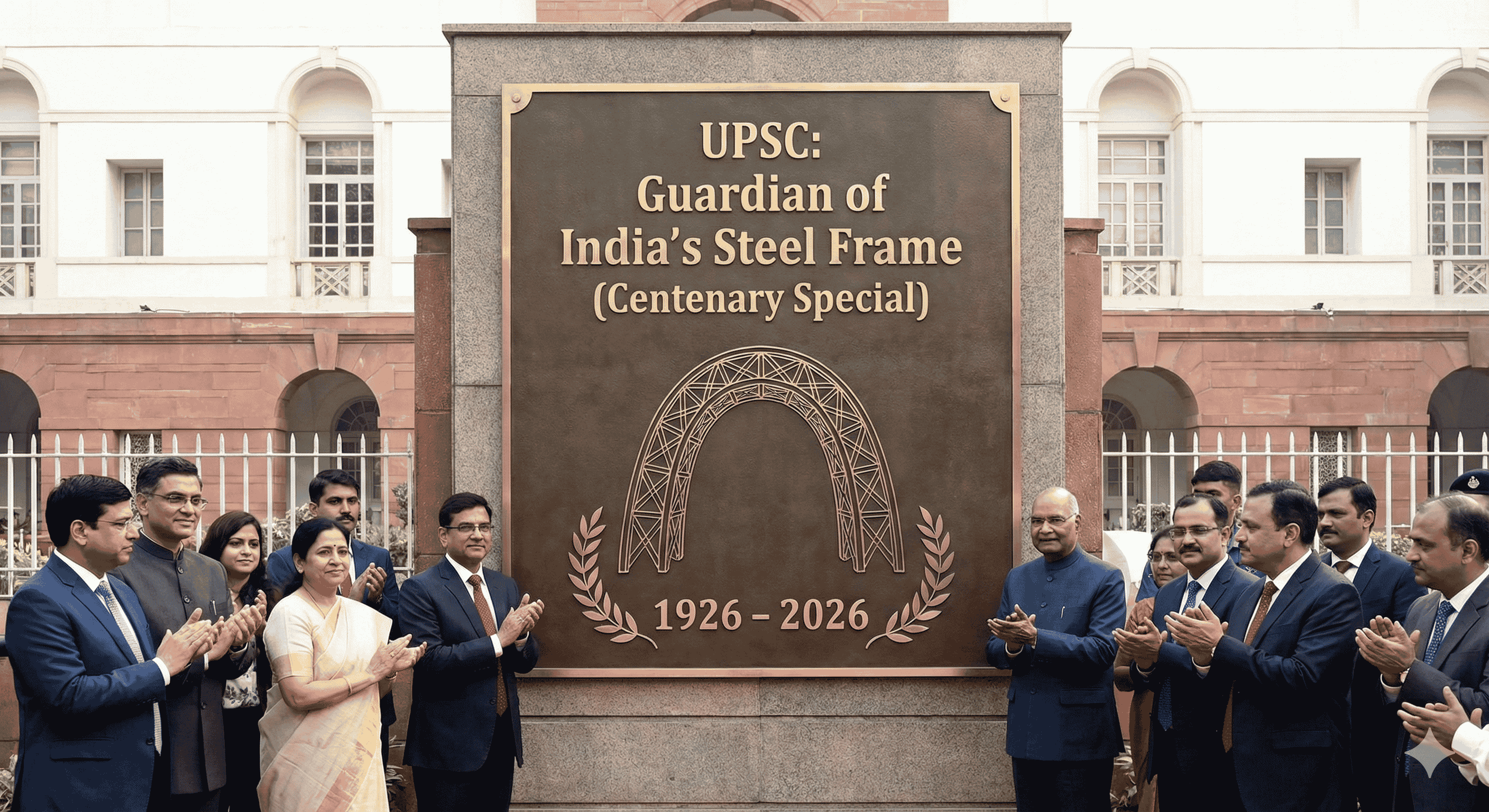
UPSC: Guardian of India’s Steel Frame (Centenary Special)
Celebrating its centenary, the Union Public Service Commission (UPSC) remains the 'watchdog of merit' in India. This topic covers its historical evolution from the colonial-era Public Service Commission to a constitutional body, its mandate under Articles 315–323, institutional safeguards that preserve its independence, appointment and removal of members, key functions, limitations, contemporary debates (like lateral entry) and new initiatives such as PRATIBHA Setu to support talented but non-selected candidates. It also explores how UPSC is expected to evolve from a pure recruiting agency into a knowledge and policy hub for public administration.
Introduction
Context & Background
Key Points
- •Constitutional Status (Articles 315–323): Article 315 provides for a Union Public Service Commission for the Union and State Public Service Commissions for the States. Articles 316–323 lay down the composition, appointment, removal, powers, functions, expenses and reporting obligations of UPSC, making it a full-fledged constitutional authority rather than a mere statutory body.
- •Composition & Appointment (Article 316): The UPSC consists of a Chairperson and other members appointed by the President of India. The Constitution does not fix the number of members; it is decided by the President (in practice usually around 9–11 members). A key provision is that at least half of the members must have held government office for at least 10 years, ensuring administrative experience within the Commission.
- •Tenure & Service Conditions: Members serve for a term of 6 years or until they reach the age of 65 years, whichever is earlier. Their conditions of service cannot be varied to their disadvantage after appointment. To avoid any temptation to please the government for future posts, a member is ineligible for reappointment as member; he or she can only be appointed as Chairperson once, as per Article 319.
- •Removal Process (Article 317): A UPSC member cannot be removed arbitrarily. They can be removed by the President only on specific grounds (misbehaviour or incapacity). In cases of alleged misbehaviour, the President must first request an inquiry by the Supreme Court. If the Court upholds the charges, the President may remove the member. This judicially protected process provides strong security of tenure and guards against political retaliation.
- •Independence of UPSC – Institutional Safeguards:
1. Expenses Charged on CFI: Under Article 322, the salaries and allowances of the Chairperson and members, as well as administrative expenses, are charged on the Consolidated Fund of India, meaning they are not subject to vote in Parliament.
2. Post-Retirement Restrictions (Article 319): The UPSC Chairperson is barred from taking up any further government employment under the Government of India or a State Government; members can be appointed only as Chairperson of UPSC or a State PSC, and not to any other government post. This reduces incentives for favour-seeking.
3. Fixed Tenure & Protection of Conditions: Tenure and service conditions are protected from arbitrary changes. - •Functions (Article 320):
1. Recruitment: Conducts examinations for All-India Services (IAS, IPS, IFoS) and various Central Services (Group 'A' and some Group 'B').
2. Direct Recruitment & Promotions: Advises on methods of recruitment, promotions and transfers for certain categories of posts.
3. Disciplinary Matters: The government must consult UPSC on disciplinary cases affecting persons serving under the Union.
4. Advisory Role: Advises the President on framing recruitment rules, principles to be followed in making appointments, promotions, transfers and suitability of candidates. - •Reporting to the President (Article 323): UPSC submits an Annual Report to the President, which is then laid before both Houses of Parliament along with a memorandum explaining the cases where the government did not accept the Commission's advice. This enhances transparency and parliamentary oversight.
- •UPSC as a Merit Protector: The exam process involves objective-type tests, descriptive papers and an interview (Personality Test). Answer scripts are evaluated in a coded (anonymous) manner, helping to maintain impartiality. The UPSC's reputation for fairness makes it one of the most trusted institutions in India, especially among youth.
- •PRATIBHA Setu Initiative: This is a new, modern initiative. It is a digital platform that creates a database of candidates who reached the Interview stage of the UPSC exam but did not make the final list. Since these candidates are highly capable, PRATIBHA Setu aims to bridge ("setu") them with opportunities in the public sector, private companies, research institutions, think tanks and start-ups. The idea is to reduce the 'wastage of talent' and to signal that success in the CSE is not the only pathway to meaningful public contribution.
- •Centenary Vision: UPSC as Knowledge Hub: During its centenary, the government and UPSC leadership highlighted the need to evolve from a purely exam-centric role to a knowledge and policy hub on public administration, ethics in governance, human resource management and global best practices. This includes systematic documentation of administrative case studies, reforms experiences and training inputs for future officers.
- •UPSC vs Other Recruitment Mechanisms: While UPSC handles higher-level posts (All-India Services, Group 'A' and some Group 'B'), lower-level posts (Group 'C' and 'D') are often recruited through Staff Selection Commission (SSC) or other agencies. Some senior-level lateral entry posts are filled by government directly, which has triggered debates on preserving UPSC's central role in ensuring meritocracy.
- •Limitations of UPSC: The UPSC is fundamentally an 'advisory body'. Its recommendations are not legally binding on the government (although they are generally followed, and deviations must be reported to Parliament). It is also not consulted on policy matters regarding reservations, cadre policy, or large-scale restructuring of services. Further, the exam process is very competitive and long, leading to stress and uncertainty among aspirants.
Key Constitutional Articles Related to UPSC
| Article | Provision | Significance | Bookmark |
|---|---|---|---|
| Article 315 | Provision for UPSC and SPSCs | Creates independent Constitutional Bodies at Union and State levels. | |
| Article 316 | Appointment and Tenure | Ensures fixed term (6 years/65 years) and experienced members; appointed by President. | |
| Article 317 | Removal | Ensures removal is judicial (via Supreme Court inquiry), not at government's whim. | |
| Article 319 | Post-retirement employment | Prevents members from being influenced by post-retirement job offers; Chairperson cannot hold future government posts. | |
| Article 320 | Functions | Defines scope: recruitment, promotions, transfers, disciplinary advice and related matters. | |
| Article 322 | Expenses | Salaries and expenses are charged on Consolidated Fund of India; adds financial independence. | |
| Article 323 | Annual Report | Makes UPSC answerable to Parliament through annual reporting. |
UPSC vs. Government Control
| Area | UPSC Power | Government Limitation | Bookmark |
|---|---|---|---|
| Selection | Sole authority on conducting exams, interviews and preparing merit lists for notified posts. | Cannot interfere in individual evaluation or tamper with merit lists. | |
| Jurisdiction | Parliament and President can expand or clarify UPSC's functions and references. | Government can exclude certain posts from UPSC purview, but such rules must be laid before Parliament. | |
| Advice | Gives recommendations on disciplinary matters, recruitment and promotions when consulted. | May reject advice, but must record reasons and answer to Parliament through memoranda. | |
| Finances & Service Conditions | Protected by Articles 322 and 319; Commission functions with financial security. | Cannot arbitrarily reduce UPSC's sanctioned expenses or worsen members' service conditions. |
UPSC and Other Key Institutions (Comparison Snapshot)
| Institution | Type | Broad Role | Bookmark |
|---|---|---|---|
| UPSC | Constitutional Body | Recruitment, promotions and disciplinary advice for Union civil services. | |
| State PSC | Constitutional Body | Similar role at State level for State services. | |
| Staff Selection Commission (SSC) | Executive/Attached Office | Mass recruitment for Group 'B' (non-gazetted), Group 'C' posts under GoI. |
Related Entities
Impact & Significance
- •Guardian of Meritocracy: In a country marked by diversity, regional imbalances and corruption risks, the UPSC acts as a neutral gatekeeper for entry into top public services. Its transparent, rule-bound and anonymous evaluation processes have built a rare reservoir of trust among citizens.
- •Social Inclusivity: Over the decades, UPSC has expanded exam centres, introduced language options, and aligned with reservation policies. This allows aspirants from remote and disadvantaged backgrounds to compete on near-equal footing with candidates from metropolitan areas.
- •Nation-Building Role: The officers selected through UPSC form the core of the 'Steel Frame' that implements policies, maintains law and order, runs welfare schemes, conducts elections, manages crises and represents India abroad. Thus, UPSC directly shapes the quality of public administration.
- •Standardisation of Recruitment: UPSC creates uniform standards of selection, integrity and competence across various Central Services, and often acts as a benchmark for State Public Service Commissions. Its practices influence exam design and recruitment reform across the public sector.
- •Symbol of Institutional Continuity: Across political changes, coalition governments and policy shifts, the continuous functioning of UPSC as an impartial body reflects the strength of India’s constitutional architecture and the principle of separation between politics and administration.
Challenges & Criticism
- •Advisory Nature: Since the government is not legally bound to accept UPSC’s advice, its role in disciplinary matters or recruitment-related recommendations can sometimes be diluted, especially where the executive has strong preferences.
- •Limited Coverage: Recruitment for many lower-level posts, contractual appointments, public sector enterprises and certain specialised roles lies outside UPSC’s fold. Critics argue that this fragmentation can lead to varied standards and potential politicisation elsewhere.
- •Lateral Entry Debate: The recent push for hiring subject experts from private sector or academia directly into senior posts (lateral entry) has raised concerns among some that it may bypass the rigorous UPSC process and undermine the morale of career civil servants, even though supporters argue it brings fresh expertise.
- •Exam Stress & Coaching Culture: The intense competition (lakhs of candidates for a few hundred posts), length of the process (often over a year), and repeated attempts create enormous psychological pressure. A large, expensive coaching industry has grown around it, raising equity concerns for poor candidates.
- •Need for Dynamic Skill Testing: Governance today requires new skills (data analysis, technology, climate governance, stakeholder management, behavioural insights). The current exam pattern is evolving but is often criticised for being too memory-heavy and not sufficiently testing practical administrative skills.
- •Digital Divide: Increasing digitisation of forms, notifications and information favours those with reliable internet and digital literacy, which can disadvantage aspirants from remote or resource-poor backgrounds if not addressed through supportive measures.
Future Outlook
- •Transition to Policy & Knowledge Hub: UPSC is expected to gradually build in-house expertise and research units that study global best practices in civil services recruitment, training and ethics, thereby advising the government on long-term HR and administrative reforms.
- •Technology-Enabled Evaluation: Use of AI and advanced analytics can in future help with faster processing of applications, detection of malpractice, better question design and possibly adaptive testing, while ensuring human oversight to preserve fairness.
- •Reforms in Exam Pattern: Greater emphasis may be placed on ethical reasoning, problem-solving, case studies, public policy analysis, digital governance and climate-related challenges, moving beyond factual recall towards assessing holistic administrative aptitude.
- •PRATIBHA Setu Expansion: As PRATIBHA Setu matures, it can become a major national talent pool, connecting bright but non-selected candidates to roles in governance-linked think tanks, development sector, private consulting, start-ups and academia.
- •Deeper Coordination with State PSCs: In future, UPSC may provide more structured guidance, capacity building and digital platforms to State Public Service Commissions, helping harmonise recruitment quality across the Union and States.
UPSC Relevance
- • GS-2 (Polity & Governance): Constitutional Bodies, Appointment to various Constitutional posts, Role of UPSC and State PSCs, institutional independence and accountability.
- • GS-4 (Ethics): Integrity, impartiality, non-partisanship, objectivity in public service; role of institutions like UPSC in sustaining an ethical administrative culture.
- • Prelims: Constitutional Articles (315–323), composition, tenure, removal, powers and post-retirement restrictions on UPSC members; basic facts about PRATIBHA Setu.
- • Essay: Themes like meritocracy vs social justice, role of institutions in democracy, reforming the Steel Frame, human resource management in governance.
Sample Questions
Prelims
Consider the following statements regarding the Union Public Service Commission (UPSC):
- (a)The Chairman and members of the UPSC are appointed by the President.
- (b)A member of the UPSC is eligible for reappointment as a member after completing one term.
- (c)The Constitution of India leaves the strength (number of members) of the UPSC to the discretion of the President.
- (d)The expenses of the UPSC are voted annually by Parliament under the Union Budget.
Mains
“For a democracy as large and diverse as India, the UPSC is not just an exam-conducting body, but the institutional guardian of merit and neutrality in administration.” Discuss with reference to its constitutional safeguards, functions and emerging challenges in the 21st century.
Introduction: Briefly introduce UPSC as a constitutional body under Part XIV (Articles 315–323) and recall Sardar Patel’s description of the civil services as the 'Steel Frame of India'.
Body:
• Constitutional Safeguards: Appointment and tenure (Art 316), removal process (Art 317), bar on post-retirement employment (Art 319), expenses charged on Consolidated Fund (Art 322), annual reporting (Art 323). Explain how these ensure independence.
• Functions & Role as Guardian of Merit: Recruitment, promotions and disciplinary advice (Art 320); impartial, anonymous evaluation systems; enabling socially inclusive access through language options and all-India examination structure.
• Challenges: Advisory nature of its recommendations, limited jurisdiction (exclusion from certain posts and reservation policy), debates on lateral entry, exam stress and coaching culture, need for updating exam pattern to new governance challenges.
• Recent Initiatives & Reforms: Digitisation, online processes, the vision to make UPSC a knowledge hub, and new initiatives like PRATIBHA Setu for non-selected but meritorious candidates.
Conclusion: Conclude by arguing that while UPSC has largely preserved its reputation for integrity over a century, it must continuously adapt in structure, processes and exam design to remain a robust guardian of merit and neutrality in an era of rapid technological, social and administrative change.