
Union Cabinet Approves Urban Challenge Fund (UCF) Scheme
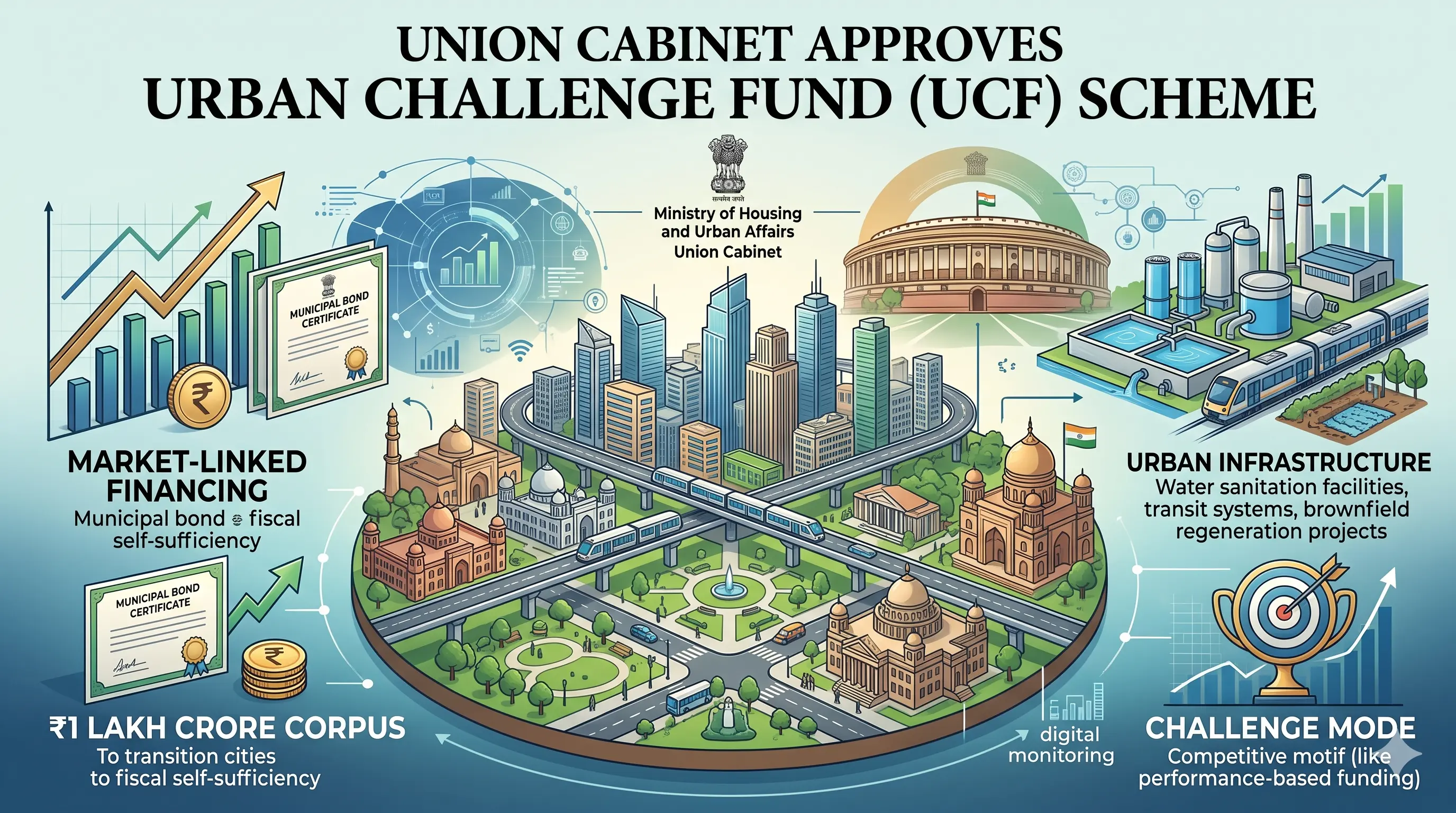
The Union Cabinet has approved the ₹1 lakh crore Urban Challenge Fund (UCF) to transform the financing ecosystem of urban infrastructure in India. Moving away from grant dependence, the scheme institutionalizes market-linked financing to develop 'Cities as Growth Hubs' through competitive project selection and strict reform milestones.
Introduction
Context & Background
Key Points
- •Centrally Sponsored Scheme: The UCF is a ₹1 lakh crore initiative aimed at shifting cities from a grant-dependent model to fiscal self-sufficiency through market-linked development.
- •Nodal Ministry & Monitoring: Operated under the Ministry of Housing and Urban Affairs (MoHUA), the scheme is monitored by a dedicated Project Management Unit (PMU) via a unified digital portal to track disbursements and milestones.
- •Challenge Mode Selection: Funding is not guaranteed; projects are chosen competitively based on financial viability, reform readiness, and third-party verification of outcomes.
- •Implementation Timeline: The scheme will operate from FY 2025-26 to FY 2030-31, with a project execution window extendable up to FY 2033-34.
- •Credit Repayment Guarantee Scheme: A ₹5,000 crore corpus is dedicated to improving creditworthiness for Hilly, North-Eastern, and smaller ULBs (<1 lakh population). The Centre guarantees up to 70% (or ₹7 crore) for first-time borrowers to de-risk market entry.
- •Priority Verticals: Investments will target three key areas: Growth Hubs (economic corridors), Creative Redevelopment (brownfield regeneration), and Water Sanitation (bankable infrastructure).
Financing Mechanism of UCF
| Component | Contribution Share | Source / Details | Bookmark |
|---|---|---|---|
| Central Grant | Up to 25% | Provided by the Central Government as catalytic assistance. | |
| Market Mobilisation | 50% | Mobilised by Urban Local Bodies (ULBs) via Municipal Bonds or commercial loans. | |
| State Share | 25% | Contributed by the State Government or generated through ULB’s internal revenue. |
Eligibility Criteria for Cities
| Criterion | Requirement | Bookmark |
|---|---|---|
| Population | 10 lakh or more (2025 estimates), plus all State/UT capitals and industrial cities >1 lakh. | |
| Financial Health | Must possess audited financial statements for the last three years. | |
| Creditworthiness | Cities must maintain a credit rating of 'BBB-' or higher to access market-linked financing. |
Related Entities
Impact & Significance
- •Catalyzing Private Capital: By mandating a 50% market mobilization, the scheme will unlock thousands of crores from institutional investors for urban development.
- •Performance-Linked Governance: Releasing funds based on third-party verification of reform milestones ensures accountability and prevents fund parking or misallocation.
- •Revitalization of Cities: Focus on creative redevelopment and growth hubs will modernize central business districts, improving the ease of living and doing business.
Challenges & Criticism
- •Capacity of ULBs: Most Indian municipalities lack the technical expertise to draft bankable projects, manage commercial debt, or navigate complex bond markets.
- •Credit Rating Hurdles: Achieving a 'BBB-' rating is difficult for many ULBs due to poor collection of property taxes and inadequate accounting practices.
- •User Charges: To repay commercial loans, ULBs will need to increase user charges for water, sanitation, and parking, which is often politically highly unpopular.
- •Exclusion Risk: The competitive 'challenge mode' might result in already affluent and well-managed cities cornering the bulk of the funds, leaving struggling cities further behind.
Future Outlook
- •Financial Independence of ULBs: Encouraging ULBs to issue Municipal Bonds and seek commercial loans will build long-term institutional capacity for financial management.
- •Infrastructure Upgradation: Targeted funding in water, sanitation, and mobility will create climate-resilient and economically vibrant urban centers.
- •Market-Driven Urbanization: Moving to a market-linked model ensures that only financially viable and highly impactful projects take off, reducing wasteful expenditure.
- •Inclusive Growth: The dedicated guarantee scheme ensures that smaller and geographically disadvantaged cities (like those in the North-East) are not left behind in accessing capital markets.
UPSC Relevance
- • GS-3 (Indian Economy): Mobilization of resources, infrastructure financing, and urbanization.
- • GS-2 (Governance): Role of Urban Local Bodies (74th Amendment), devolution of financial powers, and government policies.
- • Essay Topics: 'Financing India's Urban Future', 'From Grants to Governance: Empowering Local Bodies'.
Sample Questions
Prelims
With reference to the Urban Challenge Fund (UCF), consider the following statements: 1. It provides 100% central funding for the development of urban infrastructure in cities with a population of more than 10 lakh. 2. Participating cities must maintain a credit rating of 'BBB-' or higher to access market-linked financing. 3. The scheme includes a Credit Repayment Guarantee for smaller and North-Eastern Urban Local Bodies. Which of the statements given above is/are correct?
1. 1 and 2 only
2. 2 and 3 only
3. 1 and 3 only
4. 1, 2, and 3
Answer: Option 2
Explanation: Statement 1 is incorrect: The Centre provides up to 25% as catalytic assistance, while 50% is mobilized from the market and 25% is the State/ULB share. Statements 2 and 3 are correct based on the eligibility and Credit Repayment Guarantee Scheme components.
Mains
The Urban Challenge Fund (UCF) represents a paradigm shift from a grant-based model to a market-linked financing approach for urban development. Discuss the significance of this transition and the challenges Urban Local Bodies (ULBs) might face in its implementation.
Introduction: Define the Urban Challenge Fund (UCF) as a ₹1 lakh crore initiative aimed at developing 'Cities as Growth Hubs' through competitive, market-linked infrastructure financing under MoHUA.
Body:
• Significance: Promotes fiscal discipline; reduces reliance on Central/State grants; ensures project viability through the 'Challenge Mode'; attracts private capital via Municipal Bonds.
• Challenges for ULBs: Poor existing financial health (lack of audited statements); low credit ratings preventing market access; capacity constraints in smaller municipalities; political reluctance to raise user charges for loan repayment.
• Mitigation Measures: The ₹5,000 crore Credit Repayment Guarantee Scheme for smaller ULBs; capacity building through the dedicated PMU.
Conclusion: Conclude that while the UCF is a necessary step towards sustainable urbanization, its success heavily depends on the administrative and financial empowerment of ULBs in line with the 74th Constitutional Amendment.