
Urban Growth, Fiscal Gaps: The Paradox in India’s Urban Governance
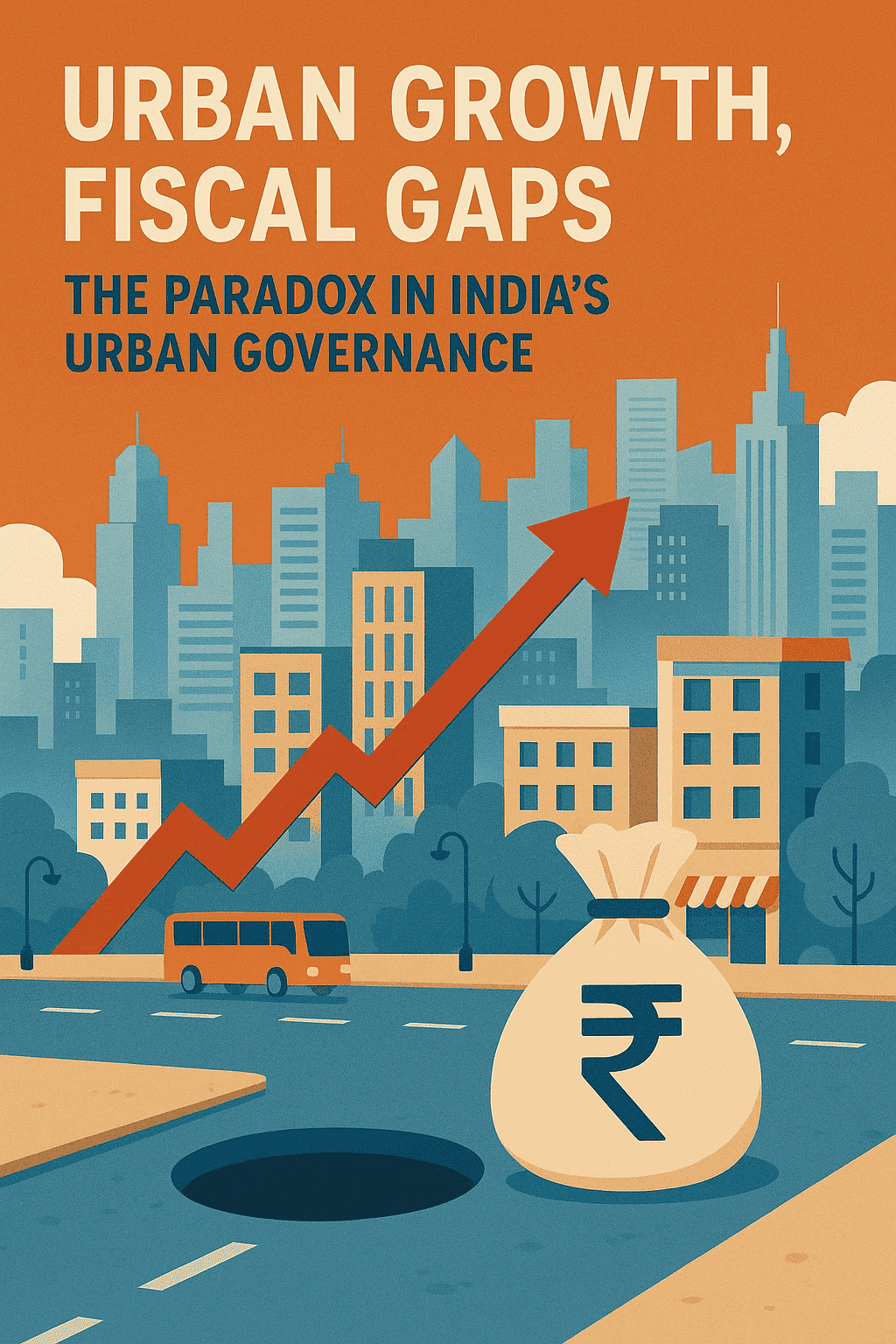
India’s cities generate the bulk of economic output — over 66% of GDP — and are rapidly urbanising. Yet municipal bodies control less than 1% of tax revenue. This structural mismatch between rising urban responsibilities and weak fiscal power has created a deep urban governance paradox that threatens sustainable city development.
Introduction
Context & Background
Key Points
- •74th Constitutional Amendment (1992): Provided constitutional recognition and a framework for ULBs, creating the 12th Schedule listing 18 municipal functions and mandating State Finance Commissions (SFCs) to recommend devolution.
- •Sources of Municipal Revenue: Own sources (property tax, user charges), assigned revenues (share of state taxes), intergovernmental transfers (CFC, SFC grants), and borrowings (bank loans, municipal bonds). For beginners: own revenue = what ULBs collect directly; transfers = money from state/centre.
- •Impact of GST: GST subsumed local taxes like octroi and entry tax, reducing municipal fiscal space. Promised compensation was often insufficient or non-transparent.
- •Property Tax Potential vs Reality: Many ULBs use outdated valuation systems and have low compliance. CAG shows municipal corporations collect only about 56% of property tax demand in many states.
- •High Dependence on Grants: ULB budgets are dominated by conditional central/state schemes such as Smart Cities and AMRUT, which limit local choice.
- •Weak Municipal Bond Market: Bonds are underutilised — only a few cities raised funds through bonds, often via private placements. Green bonds are nascent and expensive to issue.
- •Human Resource and Governance Gap: High vacancy rates (average ~37%), weak training, weak State Election Commissions delaying elections, and marginalised mayoral powers reduce accountability.
- •State Control over Key Functions: Important powers like land-use, planning, and large utilities are retained by state agencies and parastatals, limiting ULB autonomy.
- •RBI & World Bank Findings: RBI (2024) finds many municipal corporations lack financial autonomy, proper accounting, and sufficient capital expenditure capacity. World Bank (2025) highlights the large financing gap for urban infrastructure.
Constitutional Provisions & Practical Gap
| Provision / Schedule | What It Says | Practical Reality | Bookmark |
|---|---|---|---|
| Article 243P–243ZG | Defines structure, composition and powers of ULBs. | Many states have not fully devolved powers; functions often retained by state agencies. | |
| 12th Schedule | Lists 18 municipal functions (water, waste, roads, planning, etc.). | ULBs often lack funds or staff to discharge these functions effectively. | |
| Article 243X & 243Y | State can assign taxes; SFC to recommend devolution. | SFC recommendations are delayed or only partially implemented; transfers unpredictable. | |
| GST (2017) | Subsumed many local taxes into a central/state framework. | Municipal own-revenues shrank; inadequate compensation and limited formula-based sharing. |
Urban Revenue Composition — Typical ULB
| Revenue Source | Share / Issue | Bookmark |
|---|---|---|
| Property Tax | Major own-tax but collection inefficiencies (≈56% demand realized in many MCs) | |
| Grants & Schemes | Large share; often tied and conditional (Smart Cities, AMRUT) | |
| Fees & User Charges | Under-priced due to political resistance; collection shortfalls | |
| Borrowings | Rising but limited market access; municipal bonds underutilized |
Related Entities
Impact & Significance
- •Service Delivery Strain: Poorly financed ULBs cannot provide reliable water, sanitation, drainage, transport, and solid waste management — affecting public health and quality of life.
- •Infrastructure Bottleneck: Low capital expenditure and limited borrowing capacity slow investment in roads, public transport, water and sewerage, and climate-resilient infrastructure.
- •Policy & Planning Mismatch: Fragmented responsibilities between ULBs, parastatals and state departments create coordination failures in city planning and implementation.
- •Social Inequity: Weak local finance often leads to under-provision of services in poorer neighbourhoods — worsening urban poverty and slum conditions.
- •Economic Risk: Cities are engines of growth; fiscal weakness in ULBs undermines economic competitiveness, job creation, and investment climate.
- •Fiscal Fragility: Heavy dependence on unpredictable grants increases vulnerability to macro shocks and political changes.
- •Environmental & Resilience Costs: Inadequate investment in sewage, drainage and coastal protection increases disaster risk and climate vulnerability.
Challenges & Criticism
- •Inadequate Own-Revenues: Property tax systems are often outdated, undervalued, and administratively weak; user charges are politically sensitive and under-priced.
- •Conditional Grants & Project Mode: Central schemes are often vertical and project-focused, leaving little flexible funding for local priorities.
- •Weak Municipal Markets: Municipal bond market suffers from lack of standard credit practices, low investor appetite for small issuers, and procedural complexity.
- •Human Resource & Capacity Constraints: High vacancies, poor training, and weak financial skills hamper municipal functioning and project execution.
- •State Dominance & Parastatals: Key functions like land-use planning and utilities are often controlled by state agencies, fragmenting accountability.
- •Political Economy Issues: Mayors often lack executive power; politics and short electoral cycles push ULBs toward populist, short-term decisions instead of long-term planning.
- •Transparency & Accounting Gaps: Many ULBs do not follow standardized accounting (NMAM), reducing investor confidence and citizen oversight.
- •Equity Concerns: Financing models that rely on user-fees may exclude poor sections unless subsidised or designed progressively.
Future Outlook
- •Boost Own Revenues: Modernise property taxation (GIS mapping, periodic revaluation), digitise payment systems, and strengthen collection to unlock fiscal capacity.
- •Rationalise User Charges: Gradually move to cost-reflective pricing for water and sanitation with targeted subsidies to protect the poor.
- •Predictable, Formula-Based Transfers: Institutionalise inflation-indexed, predictable transfers from states to ULBs tied to transparent criteria and SFC recommendations.
- •Develop Municipal Bond Market: Promote pooled municipal financing, credit enhancement (state guarantees, pooled vehicles), and standardised disclosure to widen investor base.
- •Adopt NMAM & Improve Accounting: Enforce National Municipal Accounting Manual to improve transparency, linking state fiscal support to compliance.
- •Strengthen Institutional Capacity: Scale up training, create municipal finance cadres, and decentralise staffing decisions to ULBs for quicker hiring and retention.
- •Empower Mayors & Executive Mayoral System: Consider models where mayors have executive authority (with checks) for clearer accountability in megacities.
- •Green & Climate Financing: Tap climate funds, green bonds, and multilateral financing for resilient infrastructure (flood control, coastal protection, urban greening).
- •Innovative Financing: Use land value capture, development charges, public-private partnerships (PPPs) with safeguards, and user-fee backed bonds for capital projects.
- •Intergovernmental Coordination: Create city-level development authorities with clear roles or metropolitan governance structures for integrated planning and service delivery.
UPSC Relevance
- • GS-2: Local governance, decentralisation, Constitutional provisions for municipalities (74th Amendment), intergovernmental fiscal relations.
- • GS-3: Public finance, infrastructure financing, urban planning, PPPs, climate resilience in cities.
- • Essay: Urbanisation and governance, decentralisation, sustainable cities and finance.
Sample Questions
Prelims
With reference to Urban Local Bodies (ULBs) in India, consider the following statements:
- (a)The 12th Schedule of the Constitution lists functions for ULBs.
- (b)The 74th Constitutional Amendment mandates State Finance Commissions (SFCs).
- (c)Introduction of GST increased municipal own-revenues by subsuming local taxes into a state pool.
Mains
India’s cities contribute disproportionately to GDP, but municipal bodies control a very small share of tax revenue. Examine the reasons for this fiscal paradox and suggest reforms to strengthen urban finances and governance.
Introduction: India’s rapid urbanisation has increased demands on cities, yet municipal fiscal autonomy remains weak — a paradox that undermines sustainable urban development.
Body:
• Reasons: GST centralisation, weak property taxation, dependence on tied grants, state control over key functions, poor accounting, weak municipal bond market, HR and capacity gaps.
• Effects: Poor service delivery, infrastructure shortfall, social inequity, fiscal fragility and investment bottlenecks.
• Reforms: Modernise property tax, predictable formula-based transfers, expand municipal bonds and pooled finance, NMAM adoption, capacity building, mayoral empowerment, green finance, and better state-ULB coordination.
Conclusion: Bridging the urban fiscal gap requires legal, institutional, and financial reforms that empower ULBs with adequate resources, autonomy, and capacity for accountable urban governance.