
U.S.–India Relations: From “Natural Partners” to Trade Truce
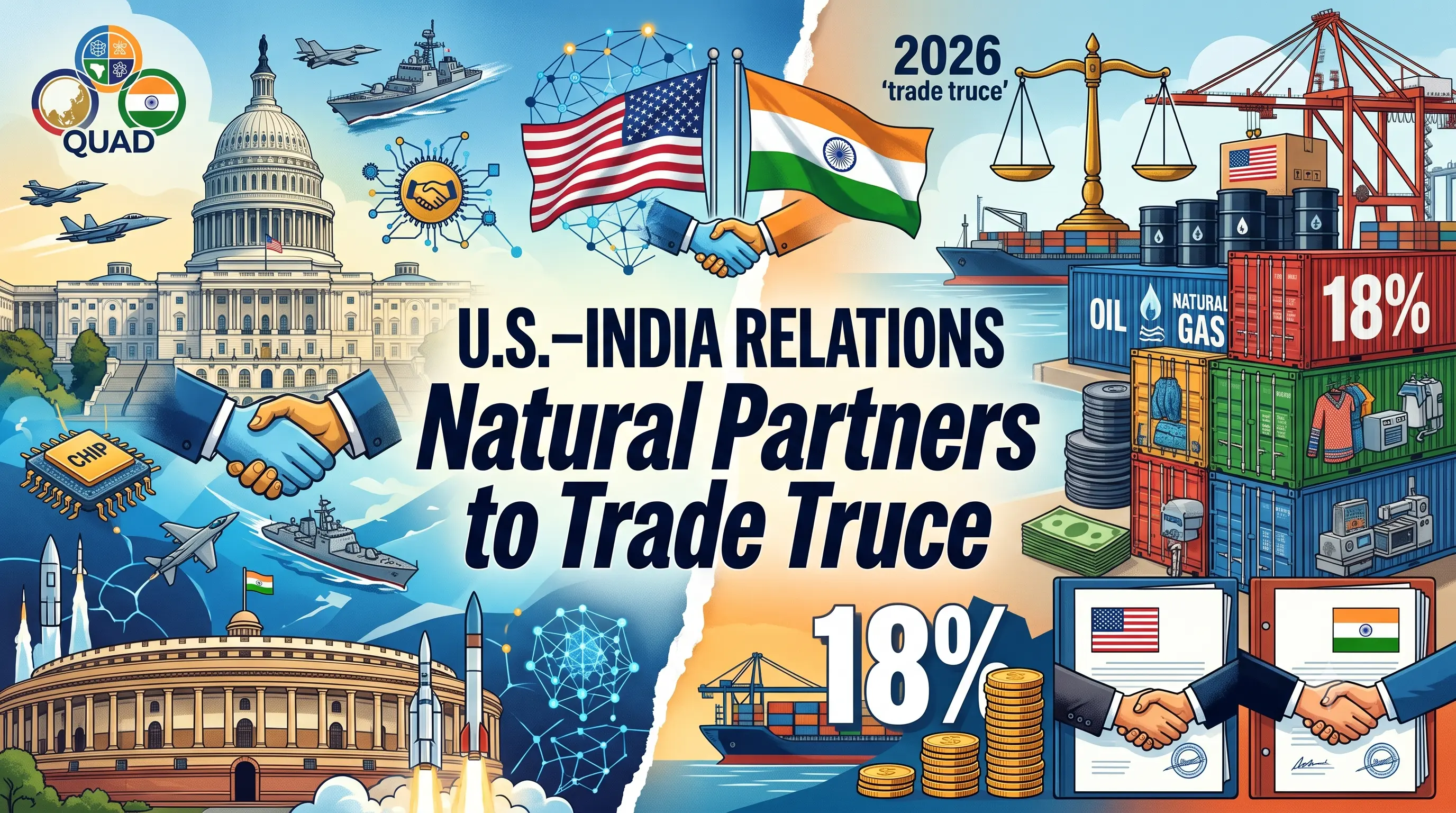
The U.S.–India relationship has evolved over two decades into a consequential partnership. However, recent tariff tensions under President Donald Trump have strained trust. The recent interim trade deal, while easing immediate pressure by reducing U.S. tariffs to 18%, represents a tactical de-escalation rather than a strategic reset.
Introduction
Context & Background
Key Points
- •Post–Cold War Strategic Convergence: After the Cold War, Washington began viewing India as a rising democratic power central to Asian stability, aligning over shared concerns about China's rise.
- •Civil Nuclear Breakthrough: The 2005 civil nuclear initiative ended India’s nuclear isolation, symbolising U.S. willingness to accommodate India’s strategic autonomy.
- •Technology and Industrial Collaboration: Initiatives like iCET promoted cooperation in semiconductors, AI, space, and defence manufacturing, moving ties toward co-development.
- •Tariffs as Geopolitical Leverage: During Trump's second term, the reimposition of tariffs framed trade as a coercive tool, shifting the relationship towards transactionalism.
- •Energy as a National-Security Test: Linking Indian imports of discounted Russian oil to U.S. national-security concerns narrowed India’s independent policy choices.
- •Interim Trade Relief: The recent deal saw the US slash reciprocal tariffs on Indian products from 50% to 18% and drop a 25% penalty, in exchange for India committing to large U.S. energy purchases and halting Russian oil imports.
Key Features of the February 2026 Interim Trade Deal
| Feature | Details | Strategic Implication | Bookmark |
|---|---|---|---|
| Major Tariff Reductions | US slashed reciprocal tariffs on Indian goods from 50% down to 18%. | Provides near-term export relief for India but leaves policy overhang. | |
| Withdrawal of Penalties | Washington dropped a 25% penalty tariff imposed over India's purchase of Russian crude oil. | Eases immediate economic pressure. | |
| Indian Commitment | India pledged to progressively reduce tariff and non-tariff barriers toward zero. | Creates domestic sensitivities; agriculture and dairy sectors are excluded. | |
| Strategic Energy Shift | India agreed to cease imports of Russian oil and increase purchases from the US and potentially Venezuela. | Narrows India's strategic autonomy and links trade directly to energy policy. |
Defence Foundational Agreements
| Agreement | Year Signed | Purpose | Bookmark |
|---|---|---|---|
| LEMOA | 2016 | Institutionalised logistics sharing between the two militaries. | |
| COMCASA | 2018 | Facilitated secure communications and interoperability. | |
| BECA | 2020 | Enabled sharing of geospatial cooperation and intelligence. |
Related Entities
Impact & Significance
- •Credibility Costs for the US: Regional partners in the Indo-Pacific may question the reliability of U.S. commitments if trade is repeatedly used as a coercive tool.
- •Erosion of 'Natural Partner' Narrative: Public pressure tactics reduce the emotional and political capital built over two decades between the two democracies.
- •Impact on Quad Cohesion: Economic coercion between key members risks creating friction that indirectly weakens coordination on regional stability.
- •China’s Strategic Advantage: Visible tensions create diplomatic space for Beijing to portray the U.S. as an unreliable partner in multilateral forums.
Challenges & Criticism
- •Tactical Relief with Strings Attached: Lower tariffs offer near-term relief, but commitments to reduce barriers on U.S. industrial goods create domestic sensitivities for India.
- •Large Purchase Commitments: Pledges to buy over $500 billion in U.S. goods and energy imply significant fiscal and logistical costs.
- •Absence of Binding Concessions: The deal lacks durable guarantees from the U.S., leaving India exposed to future unilateral policy shifts.
- •Departure from WTO Norms: The transactional approach prioritizes bilateral leverage over multilateral, predictable, rules-based trade.
Future Outlook
- •De-risk Through Trade Diversification: India must accelerate FTAs and supply-chain partnerships with the EU, UK, ASEAN, and key Indo-Pacific economies to buffer tariff volatility.
- •Lock in Technology Co-development: Prioritise co-development in sectors like engines, drones, and semiconductors over pure procurement to embed long-term industrial stakes.
- •Institutionalise Predictability: Seek legally binding dispute-resolution mechanisms and clearer guardrails in trade arrangements to reduce the risk of executive overhang.
- •Balance Energy Portfolio: Maintain a diversified energy mix (U.S., Middle East, renewables) to manage price risk and geopolitical exposure.
UPSC Relevance
- • GS-2 (International Relations): Bilateral, regional and global groupings and agreements involving India and/or affecting India’s interests.
- • GS-2 (Effect of Policies): Effect of policies and politics of developed and developing countries on India’s interests.
- • Mains Focus: Analyzing the shift from strategic partnership to transactional diplomacy in India-US relations and its impact on the Indo-Pacific strategy.
Sample Questions
Prelims
Consider the following statements regarding U.S.-India bilateral relations:
1. LEMOA provides for logistics sharing, while BECA enables geospatial cooperation.
2. The iCET initiative was launched exclusively to facilitate agricultural trade between the two nations.
3. The recent 2026 interim trade deal legally binds the US to permanent tariff reductions on Indian goods.
Answer: Option 1
Explanation: Statement 1 is correct; LEMOA (2016) is for logistics, BECA (2020) for geospatial cooperation. Statement 2 is incorrect; iCET promotes cooperation in critical and emerging technologies (AI, space, defense), not agriculture. Statement 3 is incorrect; the 2026 interim trade deal lacks durable, binding guarantees from the U.S.
Mains
“The recent interim trade deal between India and the United States represents a tactical de-escalation rather than a strategic reset.” Critically examine this statement in light of the evolving bilateral ties and its implications for the Indo-Pacific region.
Introduction: Introduce the context of the recent US-India trade deal where tariffs were reduced to 18%, replacing the escalating trade friction.
Body:
• Evolution of Ties: Discuss the trajectory of "Natural Partners" through civil nuclear deals, foundational defense agreements (LEMOA, BECA), and iCET.
• Recent Frictions: Explain the transactional approach in Trump's second term, use of tariffs as leverage, and linking energy imports (Russian oil) to national security.
• Implications for Indo-Pacific: Erosion of trust, credibility costs for the US, impact on Quad cohesion, and potential diplomatic space for China.
Conclusion: Conclude that while the 18% tariff deal provides short-term relief, India must prioritize trade diversification, technology co-development, and a balanced energy portfolio to safeguard its strategic autonomy.