
VB-G RAM G Bill, 2025: A Structural Shift in India's Rural Employment
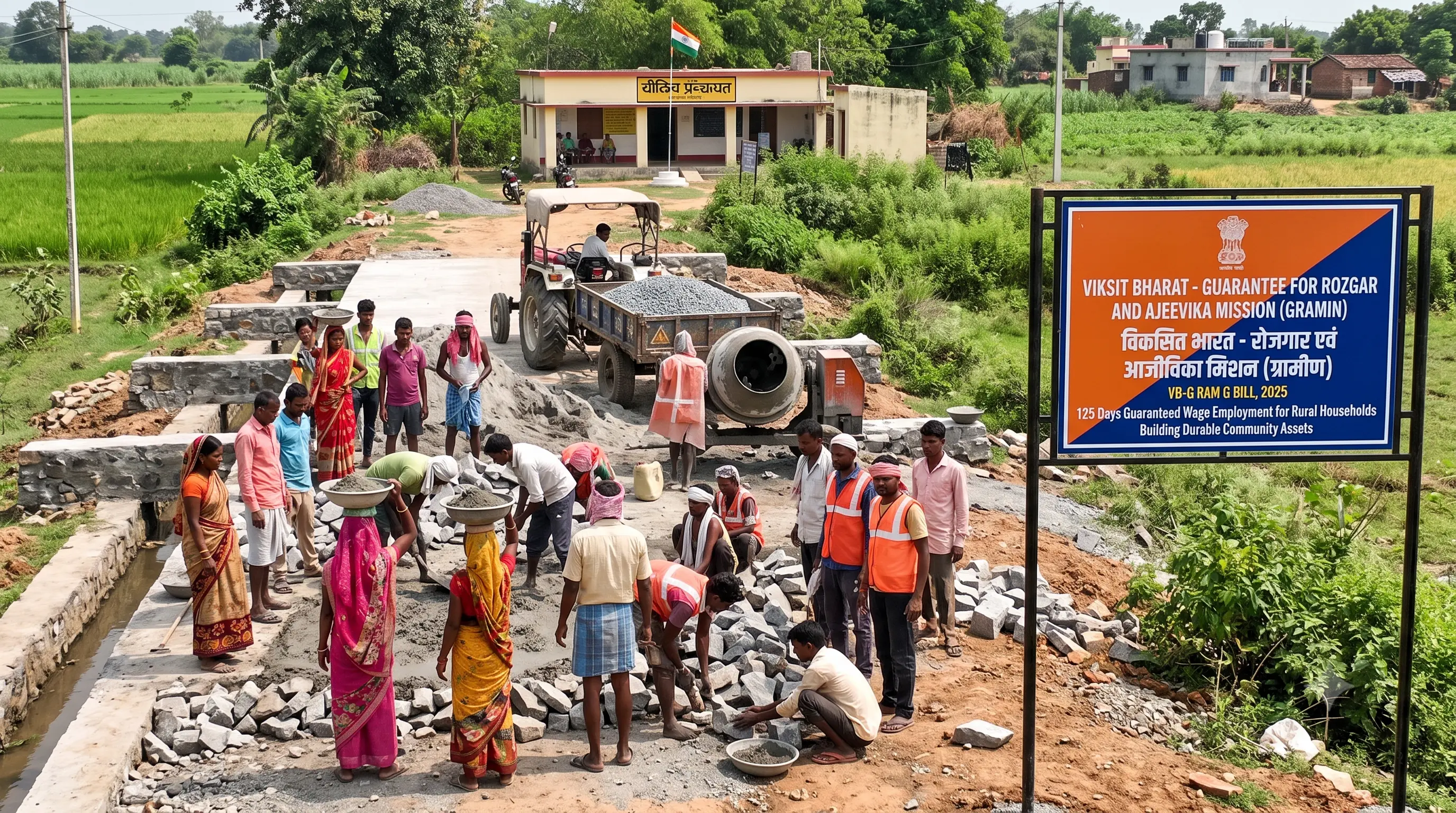
The Government of India has introduced the Viksit Bharat–Guarantee for Rozgar and Ajeevika Mission (Gramin) Bill, 2025, seeking to repeal and replace the landmark MGNREGA Act of 2005. The bill increases guaranteed wage employment to 125 days while introducing a 60:40 Centre-State funding model and aligning rural development with national infrastructure goals.
Introduction
Context & Background
Key Points
- •Enhanced Guarantee: The bill statutorily increases the guaranteed wage employment from 100 days to 125 days per household annually, aiming to bolster livelihood security.
- •Funding Structure Change: A significant shift occurs as the bill introduces a 60:40 Centre-State cost-sharing model for the wage bill, departing from the previous 100% central funding for unskilled wages.
- •Integration with National Priorities: The core vision revolves around aligning rural employment with broader economic goals, integrating Viksit Gram Panchayat Plans with national priorities like PM Gati Shakti.
- •Creation of Durable Assets: Unlike demand-driven digging and filling works, the focus is now on the creation of high-quality, durable assets that contribute directly to the national infrastructure.
- •Agricultural Synchronization: It formally acknowledges seasonal agricultural needs by allowing the suspension of work for up to 60 days during peak agricultural seasons to ensure labour availability for farming.
Differences Between MGNREGA and Proposed VB-G RAM G Bill
| Parameter | MGNREGA (2005) | Proposed VB-G RAM G Bill (2025) | Bookmark |
|---|---|---|---|
| Guaranteed Workdays | Provides a legal guarantee of at least 100 days of wage employment annually | Increases the statutory guarantee to 125 days of wage employment per household | |
| Wage Funding | The central government bears 100% of the cost for unskilled labour wages | Mandates a 60:40 Centre-State cost sharing model for most states' wage bills | |
| Nature of Right | Justiciable Right - Citizens can sue if work is denied; funding is open-ended | Schematic Entitlement - 'Guarantee' is limited by the fixed budget cap | |
| Budgeting Approach | Funding is based on a 'labour budget' reflecting actual demand for work from states | The Centre will determine a fixed, state-wise annual funding allocation | |
| Operational Period | Designed to operate continuously without seasonal pauses | Allows work suspension for up to 60 days during peak agricultural seasons | |
| Payment Frequency | Mandates wages be paid within 15 days of work completion | Envisages paying wages weekly to improve workers' cash flow |
Related Entities
Impact & Significance
- •Federal Financial Dynamics: The shift to a 60:40 funding ratio places a new fiscal burden on State governments, which could heavily impact states with limited revenues but high rural populations.
- •Agricultural Relief: Introducing a 60-day pause addresses a long-standing grievance of the farming community—that employment guarantee schemes cause artificial labour shortages during crucial sowing and harvesting windows.
- •Improved Standard of Living: The enhancement from 100 to 125 guaranteed days directly elevates the potential annual income ceiling for rural households.
- •Macro-Economic Integration: By mandating that rural works integrate with larger initiatives like PM Gati Shakti, the bill attempts to end siloed, localized expenditures in favor of cohesive national asset building.
Challenges & Criticism
- •Dilution of Legal Guarantee: Shifting the scheme from a 'justiciable right' to a budget-capped entitlement means workers may lose the legal basis to sue the state if employment or unemployment allowance is denied due to exhausted budgets.
- •Impact on Marginalized Laborers: While the 60-day agricultural pause benefits land-owning farmers, landless laborers who cannot secure agricultural work during this period may face two months of severe income insecurity.
- •State Capacity Disparities: Economically weaker states may struggle to provide their 40% share of the wage bill, potentially leading to stalled works and delayed payments in the very regions where employment is most needed.
Future Outlook
- •Technology-Driven Monitoring: Implementation is expected to leverage the Viksit Bharat National Rural Infrastructure Stack, utilizing GPS and biometric authentication to ensure transparency and track asset creation.
- •Improved Cash Flow: Transitioning from 15-day payment cycles to a system that envisages paying wages weekly could significantly improve the immediate financial stability of rural workers.
- •Asset-Centric Development: Gram Panchayats will likely shift focus toward structural development, prioritizing water security, climate resilience, and core infrastructure over temporary manual labour tasks.
UPSC Relevance
- • GS-2 (Governance & Social Justice): Welfare schemes for vulnerable sections, mechanisms, laws, and institutions constituted for the protection of these sections.
- • GS-3 (Economy): Inclusive growth, issues relating to planning, mobilization of resources, and employment.
- • Mains Focus: Analyzing the shift from a 'rights-based' framework to a 'schematic entitlement' and evaluating the impact of the 60:40 Centre-State funding model on fiscal federalism.
Sample Questions
Prelims
With reference to the proposed Viksit Bharat–Guarantee for Rozgar and Ajeevika Mission (Gramin) Bill, 2025, consider the following statements: 1. It retains the open-ended funding mechanism of MGNREGA while increasing workdays to 125. 2. It introduces a provision to suspend work for up to 60 days during peak agricultural seasons. 3. The Central Government will bear 100% of the wage bill for unskilled labour under the new framework. Which of the statements given above is/are correct?
1. 1 and 2 only
2. 2 only
3. 2 and 3 only
4. 1, 2, and 3
Answer: Option 2
Explanation: Statement 1 is incorrect; the bill shifts from open-ended funding to a budget-capped 'Schematic Entitlement'. Statement 2 is correct; it introduces a 60-day pause for peak agricultural seasons. Statement 3 is incorrect; it shifts the funding structure to a 60:40 Centre-State cost-sharing model.
Mains
Critically evaluate the structural shift in India's rural employment landscape proposed by the VB-G RAM G Bill, 2025. How does its transition from a 'justiciable right' to a 'schematic entitlement' alter the fundamental nature of the rural safety net?
Introduction: Introduce the VB-G RAM G Bill, 2025, as the intended replacement for MGNREGA, highlighting its dual mandate: guaranteeing 125 days of employment and contributing to national infrastructure.
Body:
• Key Structural Changes: Discuss the increase in workdays (100 to 125), shift to weekly payments, agricultural pause (up to 60 days), and focus on linking local asset creation (Viksit Gram Panchayat Plans) with national infrastructure (PM Gati Shakti).
• Shift in Core Philosophy: Contrast MGNREGA's open-ended, 100% centrally funded (for unskilled wages), rights-based framework with the VB-G RAM G Bill's budget-capped, 60:40 Centre-State shared, normative allocation model.
• Pros and Cons: Pros: Better cash flow, durable assets, synergy with agriculture. Cons: Loss of legal recourse if work is denied, potential fund crunches in poorer states due to the 40% burden, and exclusion of vulnerable groups during the 60-day pause.
Conclusion: Conclude by emphasizing the need to balance the fiscal discipline and infrastructure goals of Viksit Bharat with the core objective of providing an uncompromising social safety net to the poorest rural households.