
Weaponisation of AI
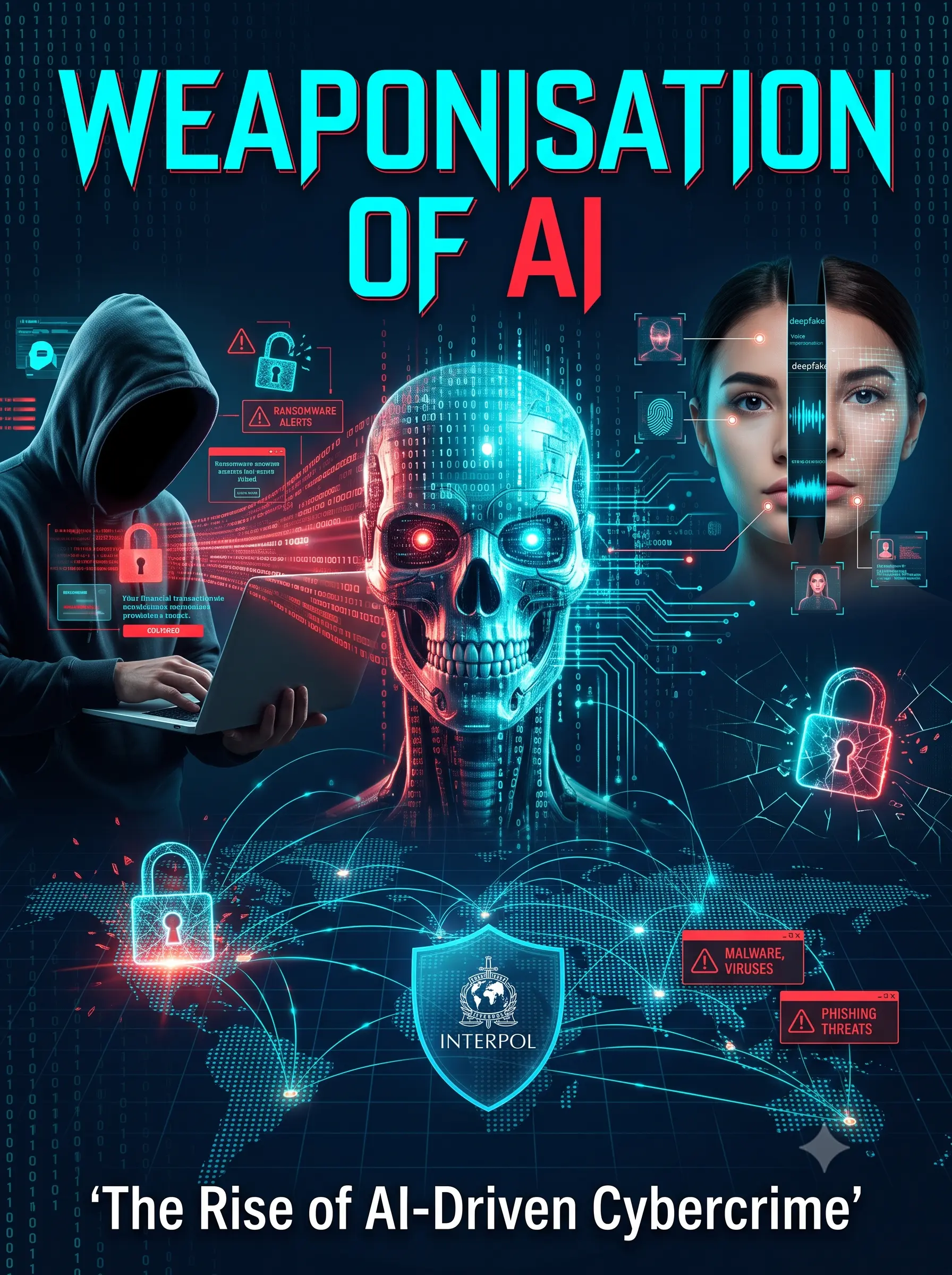
Artificial Intelligence (AI) has transformed global digital ecosystems, but criminal networks are increasingly weaponising AI tools to conduct large-scale cyber fraud, identity theft, ransomware attacks, and misinformation campaigns.
Introduction
Context & Background
Key Points
- •Cyber Fusion Centre Operations: Interpol’s Cyber Fusion Centre in Singapore acts as a real-time intelligence-sharing hub, monitoring global cyber threats and sharing data among member states.
- •Data-Driven Intelligence Analysis: Analysts examine millions of data points—including malicious IP addresses, domain registrations, malware signatures, and hacker aliases—to identify active networks.
- •Digital Forensics Laboratory: Interpol’s advanced labs extract and analyse data from laptops, smartphones, vehicles, and storage devices to support cross-border investigations.
- •Real-Time Command and Coordination: A global monitoring centre tracks emerging cyber developments and coordinates rapid responses across different jurisdictions.
How AI Is Being Utilised by Cybercriminals
| Method | Description & Impact | Bookmark |
|---|---|---|
| Deepfake Scams | AI-generated voice clones and video deepfakes used to impersonate officials or celebrities to promote fake investment schemes. | |
| Phishing Emails | Generation of perfectly structured, context-specific messages tailored to victims to evade detection. | |
| Automated Malware Creation | Using AI tools to write malicious code, customise ransomware variants, and bypass antivirus systems. | |
| Large-Scale Social Engineering | AI chatbots simulating human conversation to build trust and manipulate victims into sharing sensitive information. | |
| Data Mining | Analysing stolen datasets to identify vulnerable individuals (e.g., elderly citizens, small businesses) to increase scam success rates. |
Interpol's Coordinated Global Operations
| Operation Name | Region | Year | Key Outcomes | Bookmark |
|---|---|---|---|---|
| Operation Secure | Asia | 2025 | Dismantled over 20,000 malicious IPs and domains. | |
| Operation Serengeti 2.0 | Africa | 2025 | Arrested 1,209 cybercriminals, dismantled over 11,000 malicious infrastructures, and recovered nearly $97 million. |
Related Entities
Impact & Significance
- •Erosion of Trust: Deepfakes and highly convincing phishing campaigns undermine public trust in digital communications, public figures, and institutions.
- •Financial Devastation: AI-enabled frauds and ransomware attacks cause massive monetary losses to individuals, especially vulnerable groups, and paralyze small businesses.
- •Threat to National Security: Automated malware and misinformation campaigns can be used to disrupt critical infrastructure and manipulate public opinion at a massive scale.
Challenges & Criticism
- •Jurisdictional Limitations: Cybercrime operates seamlessly across borders, but law enforcement authority remains nationally confined, creating massive enforcement gaps.
- •Volume and Speed of Attacks: AI enables automation, meaning attacks occur at an unprecedented scale and speed, entirely overwhelming traditional policing mechanisms.
- •Legal Ambiguity Around AI: Complex liability questions arise (e.g., Who is liable—the programmer, the user, or the platform?), which challenge traditional criminal law frameworks.
- •Deepfake Regulation Difficulty: Detecting deepfakes requires advanced verification systems, and the technology is evolving much faster than regulatory frameworks can adapt.
- •Low Entry Barrier for Criminals: With ready-made AI hacking tools available on the dark web, even amateur criminals can conduct highly sophisticated cyberattacks.
Future Outlook
- •Global Legal Harmonisation: Countries must harmonise cybercrime laws and extradition mechanisms to prevent safe havens for cybercriminals.
- •AI Detection Tools and Counter-AI Systems: Law enforcement and tech companies need to invest in AI systems that can detect deepfakes, anomalous network behaviour, and automated phishing patterns.
- •Public Awareness and Digital Literacy: Governments must run large-scale digital literacy campaigns to educate citizens about deepfakes, scam calls, and phishing tactics.
- •Regulating AI Tool Distribution: Stronger monitoring of AI tool distribution on dark web platforms and stricter oversight of open-source AI misuse is urgently required.
- •Public–Private Collaboration: Technology companies, cybersecurity firms, banks, and law enforcement must share threat intelligence in real time.
- •Ethical AI Governance Frameworks: Developing international standards to ensure AI tools include built-in safeguards against malicious usage.
UPSC Relevance
- • GS-3 (Science and Technology): Dual Use technology, advancements in Artificial Intelligence, and cybersecurity challenges.
- • GS-3 (Internal Security): Basics of cyber security, role of media and social networking sites in internal security challenges.
- • GS-2 (International Relations): Global cooperation and the role of international organizations like Interpol in combating transnational organized crime.
Sample Questions
Prelims
With reference to the global response to cybercrime and the weaponisation of AI, consider the following statements:
1. Interpol's Cyber Fusion Centre, which monitors global cyber threats, is headquartered in Lyon, France.
2. 'Operation Serengeti 2.0' was a globally coordinated Interpol operation specifically targeting cybercriminals in the Asia-Pacific region.
3. AI-driven 'Data Mining' is increasingly used by cybercriminals to analyze stolen datasets and identify vulnerable demographic groups for targeted scams.
Answer: Option 3
Explanation: Statement 1 is incorrect; the Cyber Fusion Centre mentioned is located in Singapore. Statement 2 is incorrect; Operation Serengeti 2.0 was focused on Africa. Statement 3 is correct; AI data mining is used to target vulnerable groups effectively.
Mains
The advent of Artificial Intelligence has lowered the entry barrier for cybercriminals, turning it into a formidable dual-use technology. Discuss the challenges posed by the weaponisation of AI and suggest measures to counter these transnational threats.
Introduction: Define dual-use technology in the context of AI. Mention how legitimate innovation is running parallel to malicious applications like ransomware and identity theft.
Body:
• Emerging Threats (How AI is used): Deepfake scams, highly tailored phishing emails, automated malware creation, and large-scale social engineering. Highlight the availability of 'cybercrime-as-a-service' on the dark web.
• Strategic Challenges: Jurisdictional limitations of law enforcement vs. borderless cybercrime; unprecedented volume and speed of AI-driven attacks; legal ambiguity around AI liability; and the rapid evolution of deepfake technology outpacing regulation.
• Countermeasures (Way Forward): Need for global legal harmonisation, deployment of counter-AI detection systems, fostering public-private partnerships for real-time intelligence sharing, and capacity building in developing nations.
Conclusion: Conclude by emphasizing that since AI-driven cyber threats are global, the response must also be collaborative, relying on ethical AI governance frameworks and unified international action.