
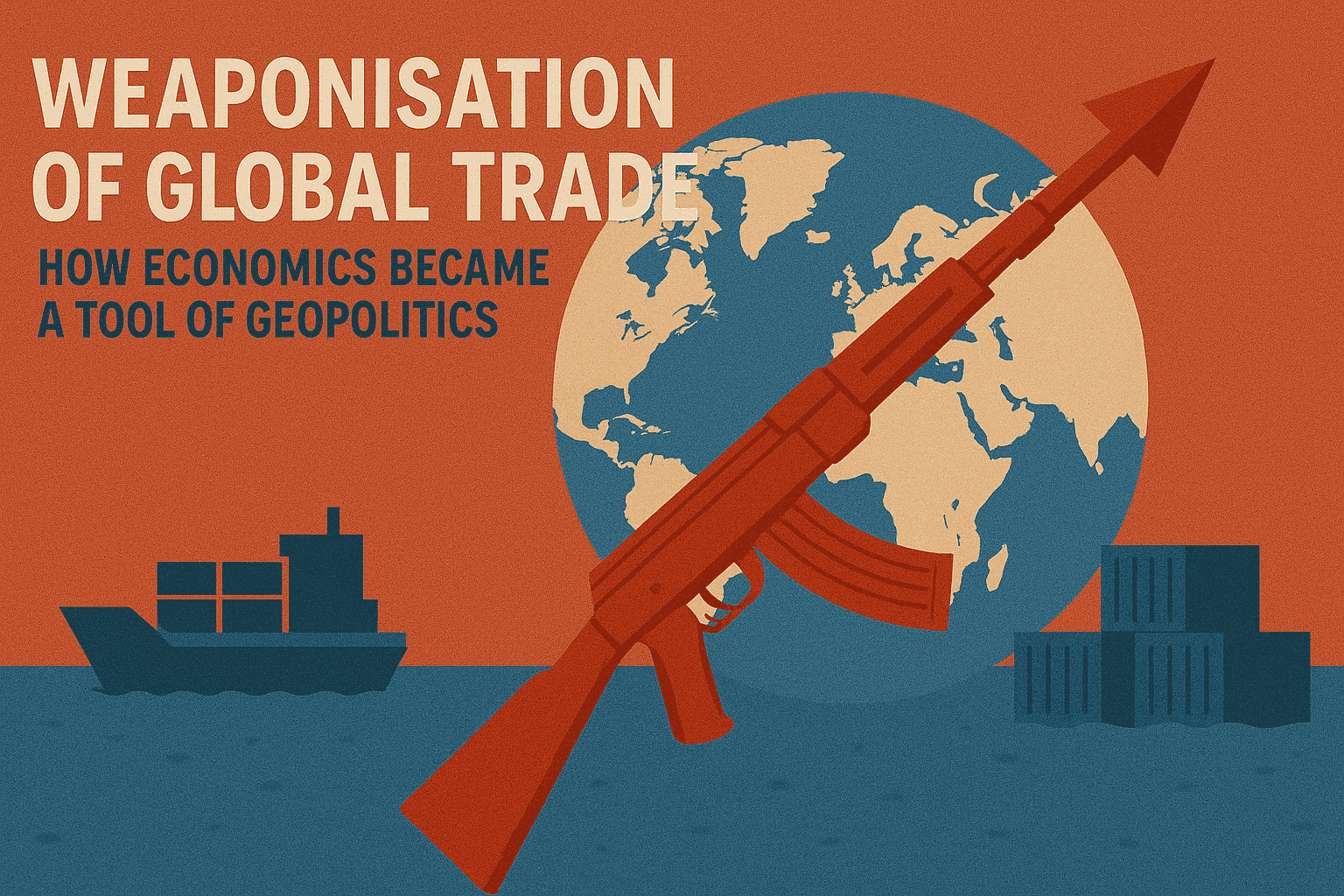
Weaponisation of Global Trade: How Economics Became a Tool of Geopolitics
Trade is increasingly used as a geopolitical tool — tariffs, export controls, sanctions, and green regulations are employed to pursue strategic objectives. This 'weaponisation' forces countries like India to rethink supply chains, industrial policy and strategic autonomy.
Introduction
Context & Background
Key Points
- •Tariffs as Strategic Tools: Tariffs are imposed to make foreign goods expensive. When Country A raises tariffs on Country B, it weakens export competitiveness and can be used to negotiate political concessions. In a weaponised context, tariffs are no longer economic tools alone but levers of coercion.
- •Export Controls & Supply Chain Leverage: Countries controlling critical minerals or high-tech components use export bans to influence rivals. For example, restricting rare earths or semiconductor machinery can slow down entire industries. Export controls thus weaponise dependency vulnerabilities in global supply chains.
- •Non-Tariff Barriers (NTBs): Stringent environmental, safety, or technical standards can act as disguised trade restrictions. While neutral on paper, NTBs often target specific exporters who lack the capacity to comply, creating a pressure mechanism without openly violating WTO rules.
- •Sanctions as Economic Punishment: Sanctions disrupt access to finance, technology, markets, shipping, and SWIFT systems. They are used to isolate states, weaken their economies, and force behavioural change. Comprehensive sanctions have deep social and developmental impacts.
- •Rise of Geo-economic Competition: Growing rivalry in technology, critical minerals, AI, and energy has pushed states to use trade as a tool of national power. Economic policy is increasingly integrated with security policy, making trade a strategic battlefield.
- •Green Regulations as Trade Barriers: Instruments like the EU’s Carbon Border Adjustment Mechanism (CBAM) require carbon transparency and compliance. While climate-focused, they also reshape global trade by raising costs for developing-country exporters, functioning as green protectionism.
- •Chokepoint Control: States dominating key nodes—like semiconductors (Taiwan), rare earths (China), LNG transit routes (Qatar)—hold asymmetric power. Controlling these chokepoints enables countries to influence global markets without military conflict.
- •Technology Restrictions & Digital Trade: Export bans on AI chips, 5G components, and cybersecurity tools reflect the shift towards “techno-nationalism”. Digital regulations, data localisation, and platform restrictions are becoming new fronts in digital trade weaponisation.
- •Fragmentation of Global Value Chains (GVCs): Weaponised trade encourages firms to shift towards friend-shoring, near-shoring, and China-plus-one strategies, reducing dependence on geopolitical rivals. This reorientation raises costs and reduces the efficiency gains of globalisation.
- •Impact on Developing Countries: Compliance-heavy trade measures disproportionately burden MSMEs and emerging economies. Many developing nations lack the technical capacity to meet strict standards, risking loss of market access and marginalisation in global trade.
Common Instruments of Trade Weaponisation (Beginner-friendly)
| Instrument | Simple Description | Real-world impact | Bookmark |
|---|---|---|---|
| Tariffs | Import tax that raises price of foreign goods | Can protect domestic firms but raises costs for consumers and exporters in the target country. | |
| Export controls | Limits on sending out critical materials/tech | Creates supply shortages and forces countries to find alternative suppliers. | |
| Sanctions | Comprehensive restrictions on trade/finance | Isolates target country but can harm global firms and consumers. | |
| Standards/Labels | Rules on product quality or sustainability | Increase compliance cost for exporters; can be used for protection if requirements are too strict. |
How Trade Weaponisation Affects India — Plain View
| Channel | Effect on India | Practical Indian response | Bookmark |
|---|---|---|---|
| Tariffs by partners | Export volumes fall, jobs in export sectors affected | Diversify export markets and add value to goods. | |
| Export curbs on inputs (e.g., APIs, semiconductors) | Manufacturing slowdowns, higher input costs | Build domestic capability, maintain strategic reserves. | |
| Green rules (e.g., CBAM) | Need to measure carbon footprints; small firms struggle | Support MSMEs with tech, finance, and carbon-accounting training. |
Related Entities
Impact & Significance
- •Short-run disruption: Sudden export controls or tariffs can disrupt industries, price stability, and supply chains in importing countries.
- •Manufacturing risk: Countries dependent on a single supplier for critical items (e.g., APIs, rare earths) face national security risks.
- •Higher costs: Compliance with new standards raises costs for producers, which trickle down to consumers.
- •Shift in investment: Firms relocate to politically stable regions, reshaping global investment patterns.
Challenges & Criticism
- •Protectionism: Politically attractive but raises costs and triggers retaliation.
- •Developing-country burden: MSMEs struggle with compliance and certification costs.
- •Politicisation: Standards meant for welfare can be misused as disguised trade barriers.
- •WTO weakening: Excessive unilateral action erodes trust in global rules.
Future Outlook
- •Immediate Indian strategy: Map dependencies, build stockpiles, expand strategic manufacturing.
- •Medium-term: Improve standards compliance, secure MRAs, support MSMEs.
- •Long-term: Build tech alliances, scale semiconductor and electronics ecosystems.
- •Global role: Push WTO reforms and form coalitions to counter arbitrary trade coercion.
UPSC Relevance
- • GS-3: International trade policy, industrial strategy, supply-chain security and economic diplomacy.
- • GS-2: Use of economic tools in foreign policy, sanctions, and trade diplomacy.
Sample Questions
Prelims
Which of the following are instruments of trade weaponisation? 1. Export controls on key inputs, 2. Multilateral tariff liberalisation under WTO, 3. Carbon Border Adjustment measures.
- (a)1 only
- (b)2 only
- (c)1 and 3 only
- (d)1, 2 and 3
Mains
Analyze how the weaponisation of trade affects India. Recommend a strategy that balances economic openness with national security and industrial competitiveness.
Introduction: Trade weaponisation increases uncertainty for exporters and supply chains, requiring India to recalibrate policy.
Body:
• Impact: Market access loss, higher compliance costs, supply disruptions.
• Responses: Build domestic capacity, diversify suppliers, improve compliance, strengthen diplomacy.
• Conclusion: India needs a layered approach combining short-term resilience and long-term industrial upgrading.
Conclusion: undefined