
Art & Culture — UPSC Notes

    Indian Art and Culture notes for UPSC: painting traditions, classical and folk dances, music, theatre and puppetry, temple, rock-cut and Indo-Islamic architecture, and literature.

    Art & Culture

    Indian painting, performing arts, architecture and literature

    Art & Culture Playlist

    4 chapters • 0 completed

    1

    Indian Painting

    2 topics

    2

    Performing Arts

    4 topics

    Practice
    3

    Architecture and Sculpture

    4 topics

    4

    Literature and Heritage

    2 topics

    Progress (0%)
    0 / 4 complete

    Chapter 2: Performing Arts

    Chapter Test
    4 topics•Estimated reading: 12 minutes

    Classical Dances of India

    Key Point

    Indian classical dance traces its principles to Bharata Muni's Natyashastra. The Sangeet Natak Akademi recognises eight classical forms—Bharatanatyam, Kathak, Kathakali, Kuchipudi, Odissi, Manipuri, Mohiniyattam and Sattriya (the Ministry of Culture also lists Chhau). They combine nritta (pure dance), nritya (expressive dance) and natya (drama), and evolved through temple, court and modern stage traditions.
    Indian classical dance traces its principles to Bharata Muni's Natyashastra. The Sangeet Natak Akademi recognises eight classical forms—Bharatanatyam, Kathak, Kathakali, Kuchipudi, Odissi, Manipuri, Mohiniyattam and Sattriya (the Ministry of Culture also lists Chhau). They combine nritta (pure dance), nritya (expressive dance) and natya (drama), and evolved through temple, court and modern stage traditions.

    Classical Dances of India
    Detailed Notes (17 points)
    Tap a card to add note • Use the highlight Listen button to play the full section
    1. Common Principles
    Natyashastra (c. 2nd century BCE–2nd century CE): Rasa theory (nine rasas), abhinaya, music and stagecraft.
    Abhinaya: Angika (body), vachika (speech/song), aharya (costume and make-up), sattvika (emotional expression).
    Tandava (vigorous, masculine) and lasya (graceful, feminine) aspects.
    Abhinaya Darpana by Nandikeshvara is another key text.
    2. The Eight Forms
    Bharatanatyam (Tamil Nadu): Evolved from Sadir/Dasiattam of devadasis; revived by Rukmini Devi Arundale; geometric postures (araimandi).
    Kathak (north India): Storytellers (kathakars); Mughal court influence; chakkars (spins) and footwork; Lucknow, Jaipur, Banaras gharanas.
    Kathakali (Kerala): Dance-drama with elaborate make-up (green 'pacha' for heroes), masculine, themes from epics.
    Kuchipudi (Andhra Pradesh): Named after a village; dancing on the rim of a brass plate (Tarangam); Siddhendra Yogi.
    Odissi (Odisha): Tribhanga posture, Jagannath and Gita Govinda themes; Mahari and Gotipua traditions; temple sculpture links (Konark).
    Manipuri (Manipur): Gentle movements, Radha-Krishna Ras Lila, no ankle bells.
    Mohiniyattam (Kerala): Graceful lasya dance of the enchantress Mohini.
    Sattriya (Assam): Introduced by Srimanta Sankaradeva in Vaishnava monasteries (sattras); recognised as classical in 2000.
    Chhau (Odisha, Jharkhand, West Bengal): Martial, masked dance (Seraikela and Purulia use masks, Mayurbhanj does not); on UNESCO's Intangible Heritage list (2010).
    3. Revival and Challenges
    Colonial-era decline (anti-nautch movement), revival by E. Krishna Iyer, Rukmini Devi, Vallathol (Kerala Kalamandalam, 1930); today challenges include funding, commercialisation and preserving traditional repertoires.

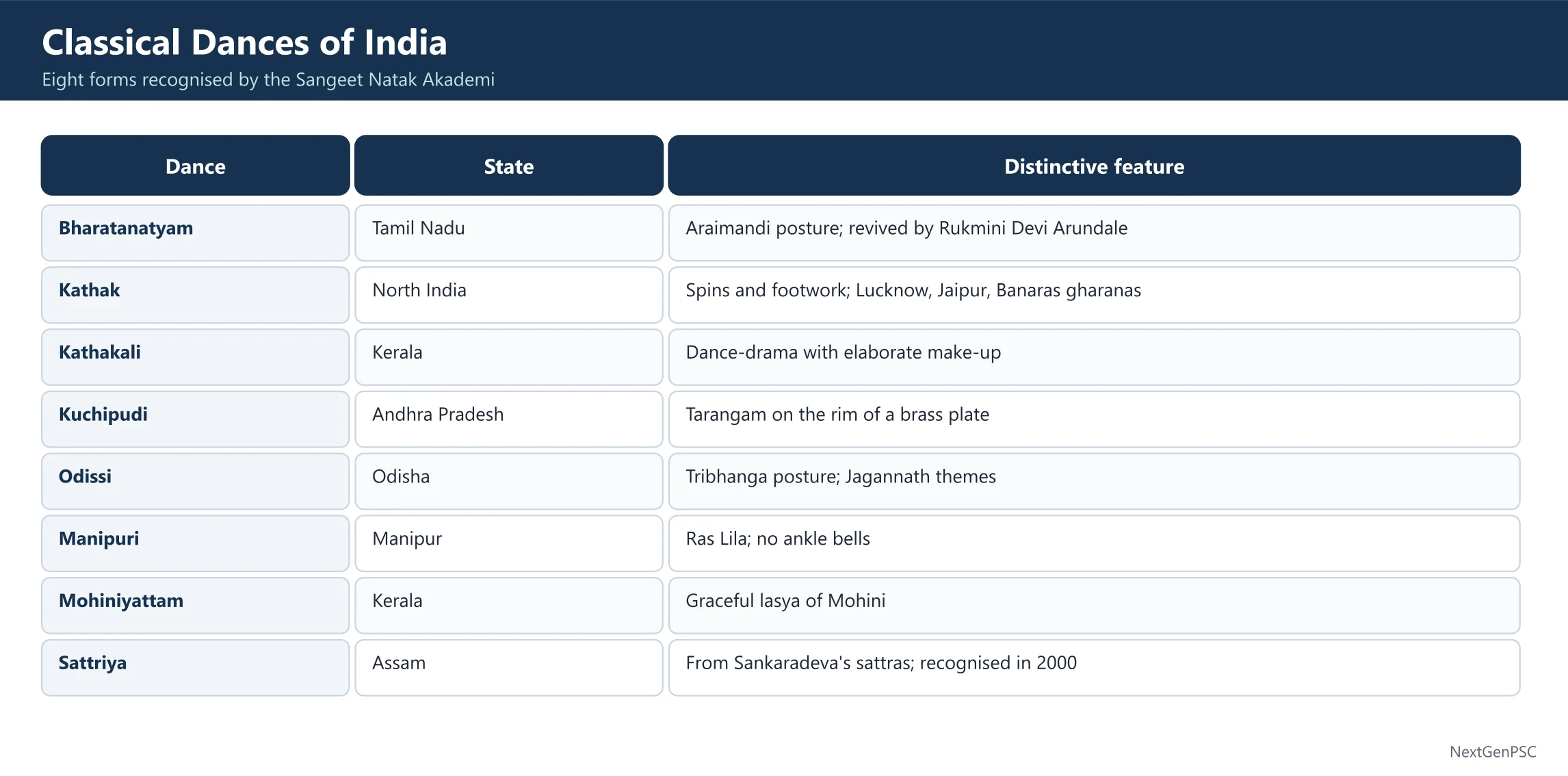
    Classical dances at a glance

    DanceStateDistinctive feature
    BharatanatyamTamil NaduAraimandi posture, revived by Rukmini Devi
    KathakNorth IndiaSpins and footwork, gharanas
    KathakaliKeralaElaborate make-up, dance-drama
    KuchipudiAndhra PradeshTarangam on a brass plate
    OdissiOdishaTribhanga posture
    ManipuriManipurRas Lila, no ankle bells
    MohiniyattamKeralaGraceful lasya
    SattriyaAssamSankaradeva's sattras

    Fun Facts

    The 108 karanas (dance units) of the Natyashastra are carved on the gopurams of the Chidambaram temple.

    Gotipua dancers in Odisha are young boys dressed as girls.

    Kathakali make-up can take several hours to apply.

    Mains Key Points

    Classical dances preserve tradition through codified grammar while adapting to contemporary themes and audiences.
    Their evolution reflects shifts in patronage—from temples to courts to public institutions and global stages.
    The devadasi history raises questions of caste and gender in the 'revival' of classical forms.
    Institutional support, documentation and education are vital to sustain these arts.

    Prelims Strategy Tips

    Sangeet Natak Akademi recognises eight classical dances; Sattriya was added in 2000.
    Natyashastra is attributed to Bharata Muni.
    Kerala has two classical forms: Kathakali and Mohiniyattam.
    Chhau is on UNESCO's Intangible Cultural Heritage list (2010).
    Kerala Kalamandalam was founded by poet Vallathol Narayana Menon (1930).

    Indian Music: Hindustani and Carnatic Traditions

    Key Point

    Indian classical music, with roots in the Samaveda, is built on raga (melodic framework) and tala (rhythmic cycle). From around the 13th century it developed into two streams: Hindustani in the north, shaped by Persian influences and court patronage, and Carnatic in the south, centred on devotional compositions. Folk, devotional and Sufi music enrich this heritage.

    Indian classical music, with roots in the Samaveda, is built on raga (melodic framework) and tala (rhythmic cycle). From around the 13th century it developed into two streams: Hindustani in the north, shaped by Persian influences and court patronage, and Carnatic in the south, centred on devotional compositions. Folk, devotional and Sufi music enrich this heritage.

    Detailed Notes (20 points)
    Tap a card to add note • Use the highlight Listen button to play the full section
    1. Basic Concepts
    Swara: Seven notes (sa re ga ma pa dha ni).
    Raga: A melodic framework with rules of ascent, descent and mood; associated with times of day or seasons.
    Tala: Rhythmic cycle (teentaal of 16 beats in Hindustani; adi tala of 8 beats in Carnatic).
    Ancient texts: Natyashastra, Brihaddeshi (Matanga), Sangita Ratnakara (Sarangadeva, 13th century).
    2. Hindustani Music
    Forms: Dhrupad (oldest, austere; Dagar family), Khayal (imaginative, most popular), Thumri (romantic, light classical), Tappa, Tarana, Dadra, Ghazal.
    Gharanas: Gwalior (oldest khayal gharana), Agra, Kirana, Jaipur-Atrauli, Patiala.
    Figures: Amir Khusrau (qawwali, credited with innovations), Tansen (Akbar's court), Pt. Bhimsen Joshi, Ustad Bismillah Khan (shehnai), Pt. Ravi Shankar (sitar).
    Instruments: Sitar, sarod, tabla, shehnai, santoor, bansuri.
    3. Carnatic Music
    Purandara Dasa (16th century) is called the father of Carnatic music; he systematised teaching.
    Trinity (18th–19th century): Tyagaraja, Muthuswami Dikshitar, Syama Sastri.
    Forms: Varnam, kriti, kirtanam, javali, tillana; strong emphasis on composed pieces and devotion.
    Instruments: Veena, mridangam, violin (adapted), ghatam, nadaswaram.
    Melakarta system: 72 parent ragas.
    4. Other Traditions
    Devotional (bhajan, kirtan, abhang), Sufi qawwali, Rabindra Sangeet, Baul (Bengal, UNESCO 2008), folk songs, film music.
    5. Preservation
    Guru–shishya parampara, Sangeet Natak Akademi, All India Radio archives, music festivals (Tyagaraja Aradhana, Sawai Gandharva), digital platforms.

    Hindustani vs Carnatic

    AspectHindustaniCarnatic
    RegionNorth IndiaSouth India
    InfluencesPersian, court patronageTemple and devotional traditions
    EmphasisImprovisation within ragaComposed kritis, devotion
    Key figuresTansen, Amir KhusrauPurandara Dasa, the Trinity
    InstrumentsSitar, tabla, sarodVeena, mridangam, ghatam

    Fun Facts

    M.S. Subbulakshmi was the first musician to receive the Bharat Ratna (1998).

    Ustad Bismillah Khan played the shehnai at the Red Fort on 15 August 1947.

    Tyagaraja is said to have composed thousands of kritis in Telugu.

    Mains Key Points

    Indian music reflects syncretism—Persian and Indian elements fused in Hindustani music, and Sufi and Bhakti traditions crossed religious boundaries.
    The guru–shishya tradition preserved music orally but also restricted access; institutions and technology have democratised learning.
    Music has been a vehicle of social reform and nationalism (Vande Mataram, Rabindra Sangeet).
    Supporting traditional musicians' livelihoods is key to sustaining the heritage.

    Prelims Strategy Tips

    Purandara Dasa is the father of Carnatic music.
    Carnatic Trinity: Tyagaraja, Muthuswami Dikshitar, Syama Sastri.
    Dhrupad is the oldest surviving Hindustani form.
    Sangita Ratnakara was written by Sarangadeva (13th century).
    Baul songs of Bengal are on UNESCO's Intangible Heritage list.

    Folk Dances, Folk Theatre and Puppetry

    Key Point

    Beyond classical forms, India has a vast repertoire of folk dances (Bihu, Garba, Bhangra, Ghoomar, Lavani), folk theatre (Yakshagana, Nautanki, Tamasha, Jatra, Bhavai, Koodiyattam) and puppetry (string, shadow, rod and glove). Several—Koodiyattam, Ramlila, Chhau, Kalbelia and Garba—are on UNESCO's Intangible Cultural Heritage list.

    Beyond classical forms, India has a vast repertoire of folk dances (Bihu, Garba, Bhangra, Ghoomar, Lavani), folk theatre (Yakshagana, Nautanki, Tamasha, Jatra, Bhavai, Koodiyattam) and puppetry (string, shadow, rod and glove). Several—Koodiyattam, Ramlila, Chhau, Kalbelia and Garba—are on UNESCO's Intangible Cultural Heritage list.

    Detailed Notes (18 points)
    Tap a card to add note • Use the highlight Listen button to play the full section
    1. Folk Dances
    Bihu (Assam): Spring harvest festival dance.
    Garba (Gujarat): Circular dance during Navratri; UNESCO Intangible Heritage (2023).
    Bhangra and Giddha (Punjab), Ghoomar and Kalbelia (Rajasthan), Lavani (Maharashtra), Dandiya (Gujarat), Karma (central Indian tribes), Cheraw (bamboo dance, Mizoram), Theyyam (ritual dance, Kerala).
    2. Folk Theatre
    Koodiyattam (Kerala): Oldest surviving Sanskrit theatre; UNESCO (proclaimed 2001).
    Yakshagana (Karnataka): Dance-drama with elaborate costumes, epic themes.
    Nautanki (Uttar Pradesh), Tamasha (Maharashtra), Jatra (Bengal, Odisha), Bhavai (Gujarat), Swang (Haryana), Therukoothu (Tamil Nadu).
    Ramlila: Enactment of the Ramayana in north India; UNESCO (2008).
    3. Puppetry
    String: Kathputli (Rajasthan), Gombeyatta (Karnataka), Bommalattam (Tamil Nadu, combines rod and string).
    Shadow: Tholu Bommalata (Andhra Pradesh), Togalu Gombeyatta (Karnataka), Ravanachhaya (Odisha), Tolpavakoothu (Kerala).
    Rod: Putul Nachh (West Bengal), Yampuri (Bihar).
    Glove: Pavakoothu (Kerala).
    4. Significance
    Folk arts carry oral history, social commentary and local identity; they have been used for awareness campaigns (health, literacy, elections).
    5. Challenges and Support
    Declining audiences, migration of performers, loss of patronage; support through Sangeet Natak Akademi, Zonal Cultural Centres, Guru-Shishya schemes, festivals and UNESCO listing.

    Types of puppetry

    TypeExamples (state)
    StringKathputli (Rajasthan), Gombeyatta (Karnataka)
    ShadowTholu Bommalata (AP), Ravanachhaya (Odisha), Togalu Gombeyatta (Karnataka)
    RodPutul Nachh (West Bengal), Yampuri (Bihar)
    GlovePavakoothu (Kerala)

    Fun Facts

    Kathputli artists of Delhi's Kathputli Colony became internationally known.

    Theyyam performers are believed to embody deities during the ritual.

    Shadow puppets in Andhra Pradesh are made from translucent dyed leather.

    Mains Key Points

    Folk arts are democratic and community-owned, reflecting the everyday life and beliefs of ordinary people.
    They have been powerful tools for social messaging and can be used in public campaigns.
    Their survival depends on livelihood support for performers and integration with education and tourism.
    UNESCO listing raises visibility but must be followed by community-led safeguarding.

    Prelims Strategy Tips

    Koodiyattam is the oldest surviving Sanskrit theatre form.
    Garba was added to UNESCO's Intangible Heritage list in 2023.
    Yakshagana is associated with Karnataka.
    Ravanachhaya is a shadow puppetry form of Odisha.
    Kalbelia (Rajasthan) and Chhau were inscribed by UNESCO in 2010.

    Martial Arts of India

    Key Point

    India has a rich tradition of martial arts that combine combat, physical training, ritual and performance—Kalaripayattu (Kerala), Silambam (Tamil Nadu), Gatka (Punjab), Thang-ta (Manipur), Mardani Khel (Maharashtra), Mallakhamb and others. Several influence classical and folk dances (Kathakali, Chhau), and four were added to the Khelo India Youth Games in 2021.

    India has a rich tradition of martial arts that combine combat, physical training, ritual and performance—Kalaripayattu (Kerala), Silambam (Tamil Nadu), Gatka (Punjab), Thang-ta (Manipur), Mardani Khel (Maharashtra), Mallakhamb and others. Several influence classical and folk dances (Kathakali, Chhau), and four were added to the Khelo India Youth Games in 2021.

    Detailed Notes (21 points)
    Tap a card to add note • Use the highlight Listen button to play the full section
    1. South India
    Kalaripayattu (Kerala): One of the oldest martial arts; training in a kalari; includes strikes, kicks, weapons and healing (marma knowledge); influenced Kathakali.
    Silambam (Tamil Nadu): Bamboo staff fighting mentioned in Sangam literature.
    Kuttu Varisai (Tamil Nadu): Unarmed combat with grappling and strikes.
    2. North and West India
    Gatka (Punjab): Sikh martial art with sticks and swords, performed in religious processions.
    Mardani Khel (Maharashtra): Armed martial art associated with the Marathas; known for the patta (gauntlet sword).
    Mallakhamb (Madhya Pradesh, Maharashtra): Gymnastics and wrestling holds on a wooden pole or rope; MP's state sport (2013).
    Musti Yuddha (Varanasi): Ancient form of boxing.
    Thoda (Himachal Pradesh): Archery-based contest.
    Sqay (Kashmir): Sword and shield art.
    3. East and North-East India
    Thang-ta (Manipur): 'Sword and spear' art of the Meiteis; Sarit Sarak is its unarmed form.
    Cheibi Gad-ga (Manipur): Sword and shield fighting.
    Inbuan wrestling (Mizoram): Wrestling within a circle.
    Lathi Khela (West Bengal): Stick fighting.
    Paika Akhada (Odisha): Training of Paika warriors; linked to the Paika Rebellion (1817).
    Pari-khanda (Bihar): Sword and shield; steps used in Chhau.
    4. Significance and Promotion
    Physical fitness, self-defence, cultural identity and links with dance and theatre.
    Khelo India Youth Games (2021): Gatka, Kalaripayattu, Thang-ta and Mallakhamb added, along with Yogasana.

    Martial arts and states

    Martial artStateFeature
    KalaripayattuKeralaAncient art with weapons and healing
    SilambamTamil NaduBamboo staff fighting
    GatkaPunjabSikh stick and sword art
    Thang-taManipurSword and spear
    Mardani KhelMaharashtraMaratha armed art, patta sword
    MallakhambMadhya Pradesh, MaharashtraPole gymnastics

    Fun Facts

    Kalaripayattu practitioners learn marma points—vital spots used both for combat and healing.

    Mallakhamb competitions are held on a vertical wooden pole as well as a hanging rope.

    The Paika Rebellion of 1817 in Odisha is sometimes called an early war of independence.

    Mains Key Points

    Martial arts are living heritage linking physical culture, ritual and performance.
    Their influence on Kathakali and Chhau shows the deep connection between combat training and dance.
    Inclusion in Khelo India gives these arts a modern sporting future and livelihoods for practitioners.
    Documentation and certified training are needed to prevent dilution and injuries.

    Prelims Strategy Tips

    Kalaripayattu is from Kerala; Silambam from Tamil Nadu.
    Thang-ta is the martial art of Manipur.
    Gatka is associated with the Sikhs of Punjab.
    Mallakhamb is the state sport of Madhya Pradesh.
    Paika Akhada is associated with Odisha.

    Chapter Complete!

    Ready to move to the next chapter?