
Art & Culture Playlist
4 chapters • 0 completed
Indian Painting
2 topics
Performing Arts
4 topics
Architecture and Sculpture
4 topics
Literature and Heritage
2 topics
Chapter 3: Architecture and Sculpture
Chapter TestTemple Architecture: Nagara, Dravida and Vesara Styles
Hindu temple architecture developed from simple Gupta-era shrines into three broad styles: Nagara in the north (curvilinear shikhara), Dravida in the south (pyramidal vimana and towering gopurams), and Vesara in the Deccan, which blends both. Regional dynasties—Chandelas, Gangas, Solankis, Pallavas, Cholas, Chalukyas, Hoysalas, Vijayanagara—created distinct sub-styles.
Hindu temple architecture developed from simple Gupta-era shrines into three broad styles: Nagara in the north (curvilinear shikhara), Dravida in the south (pyramidal vimana and towering gopurams), and Vesara in the Deccan, which blends both. Regional dynasties—Chandelas, Gangas, Solankis, Pallavas, Cholas, Chalukyas, Hoysalas, Vijayanagara—created distinct sub-styles.
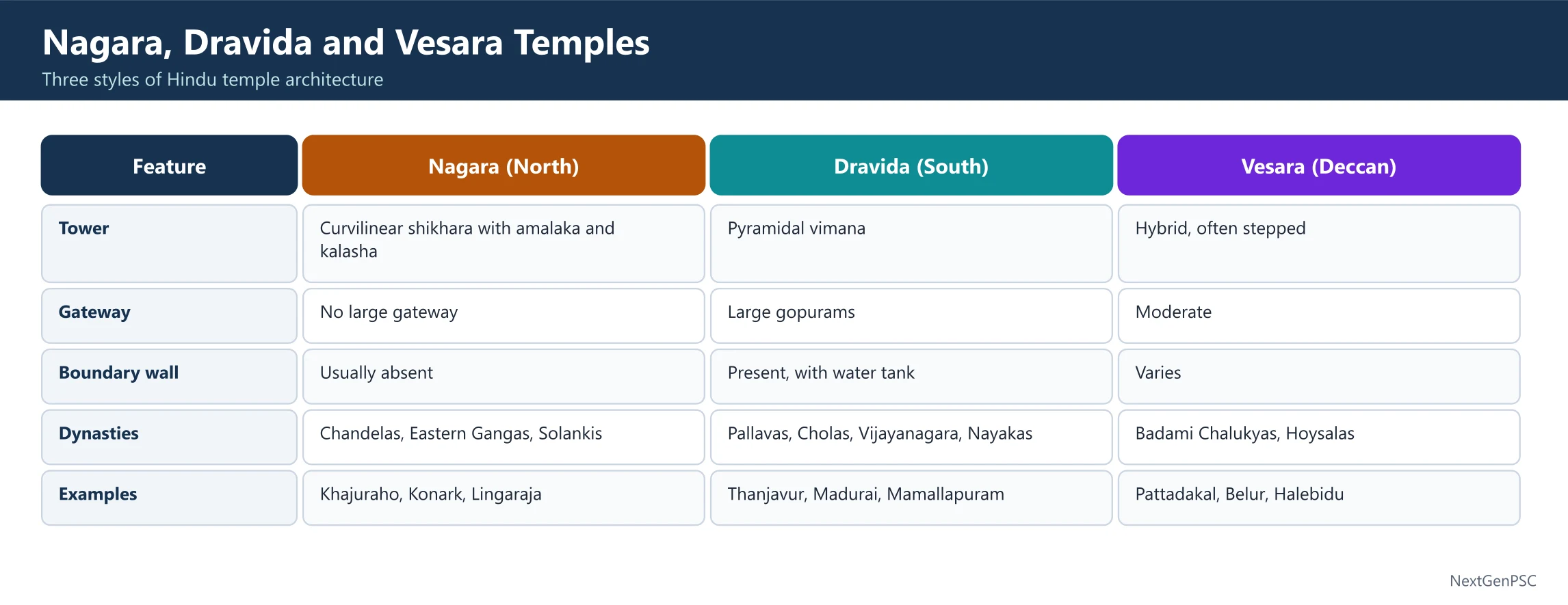
Nagara vs Dravida vs Vesara
| Feature | Nagara | Dravida | Vesara |
|---|---|---|---|
| Region | North India | South India | Deccan |
| Tower | Curvilinear shikhara | Pyramidal vimana | Mixed, often stepped |
| Gateway | No major gateway | Large gopurams | Moderate |
| Boundary wall | Usually absent | Present | Varies |
| Examples | Khajuraho, Konark | Thanjavur, Madurai | Pattadakal, Belur |
Fun Facts
The shadow of the Brihadeeswara vimana is popularly (but wrongly) said never to fall on the ground at noon.
Konark Sun Temple is designed as a giant chariot with 24 carved wheels.
Europeans called Konark the 'Black Pagoda' and Puri's Jagannath temple the 'White Pagoda'.
Mains Key Points
Prelims Strategy Tips
Rock-Cut Architecture, Stupas and Buddhist-Jain Art
Early Indian monumental art was largely Buddhist and Jain: stupas (Sanchi, Bharhut, Amaravati), rock-cut chaityas (prayer halls) and viharas (monasteries) at Karla, Bhaja, Ajanta, and Jain caves at Udayagiri-Khandagiri. Rock-cut tradition reached its peak at Ellora (Buddhist, Hindu and Jain caves, with the monolithic Kailasa temple) and Elephanta. Sculpture evolved through the Gandhara, Mathura and Amaravati schools.
Early Indian monumental art was largely Buddhist and Jain: stupas (Sanchi, Bharhut, Amaravati), rock-cut chaityas (prayer halls) and viharas (monasteries) at Karla, Bhaja, Ajanta, and Jain caves at Udayagiri-Khandagiri. Rock-cut tradition reached its peak at Ellora (Buddhist, Hindu and Jain caves, with the monolithic Kailasa temple) and Elephanta. Sculpture evolved through the Gandhara, Mathura and Amaravati schools.
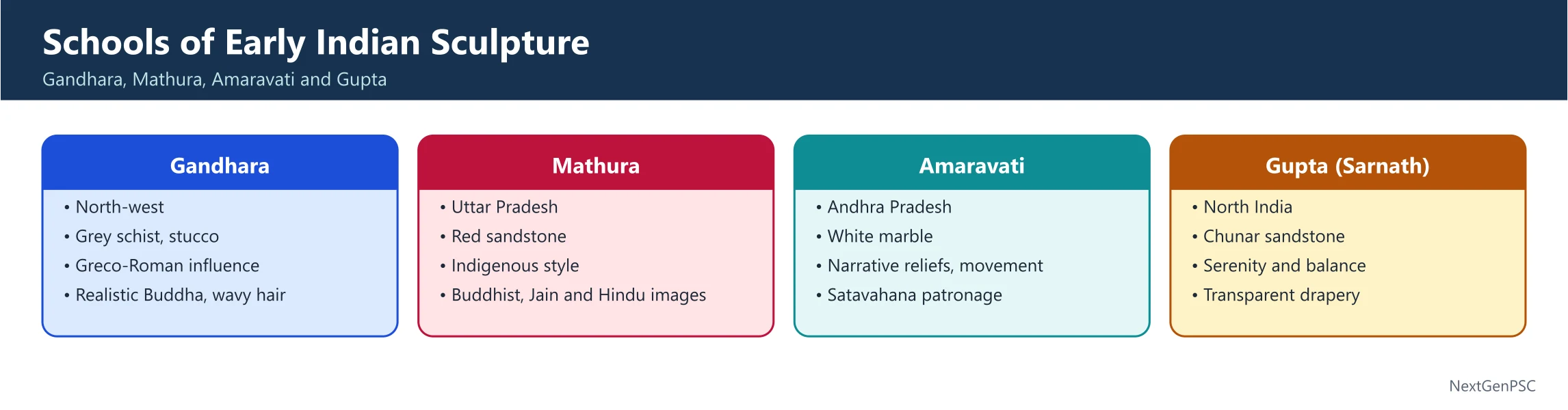
Schools of sculpture
| School | Region | Material | Features |
|---|---|---|---|
| Gandhara | North-west | Grey schist, stucco | Greco-Roman, realistic |
| Mathura | Uttar Pradesh | Red sandstone | Indigenous, robust figures |
| Amaravati | Andhra Pradesh | White marble | Narrative reliefs, movement |
| Gupta (Sarnath) | North India | Chunar sandstone | Serenity, transparent drapery |
Fun Facts
The Kailasa temple at Ellora was carved top-down from a single basalt cliff.
The Sarnath lion capital was adopted as India's national emblem on 26 January 1950.
Ajanta and Ellora were among India's first UNESCO World Heritage Sites (1983).
Mains Key Points
Prelims Strategy Tips
Indo-Islamic, Mughal and Colonial Architecture
From the 13th century, Indo-Islamic architecture introduced the true arch, dome, minaret, calligraphy and geometric ornament, blending them with Indian craftsmanship. It developed through the Delhi Sultanate, regional sultanates and the Mughals (Humayun's Tomb, Fatehpur Sikri, Taj Mahal). Colonial rule brought Indo-Saracenic, Gothic and neo-classical styles, and Lutyens' New Delhi.
From the 13th century, Indo-Islamic architecture introduced the true arch, dome, minaret, calligraphy and geometric ornament, blending them with Indian craftsmanship. It developed through the Delhi Sultanate, regional sultanates and the Mughals (Humayun's Tomb, Fatehpur Sikri, Taj Mahal). Colonial rule brought Indo-Saracenic, Gothic and neo-classical styles, and Lutyens' New Delhi.
Milestones of Indo-Islamic architecture
| Monument | Ruler/period | Significance |
|---|---|---|
| Qutub Minar | Aibak, Iltutmish | Early Sultanate tower |
| Alai Darwaza | Alauddin Khalji (1311) | First true arch and dome |
| Humayun's Tomb | Akbar's reign (1570) | First garden tomb with charbagh |
| Itimad-ud-Daulah | Jahangir | Extensive pietra dura |
| Taj Mahal | Shah Jahan | Peak of Mughal architecture |
| Gol Gumbaz | Adil Shahis, Bijapur | Huge dome, whispering gallery |
Fun Facts
The Supreme Court created the Taj Trapezium Zone (1996) to protect the Taj Mahal from pollution.
Gol Gumbaz's whispering gallery carries a whisper across the dome.
Rashtrapati Bhavan has about 340 rooms and was completed in 1929.
Mains Key Points
Prelims Strategy Tips
Pottery Traditions of India: Prehistoric to Modern
Pottery is one of archaeology's most important clues: distinct pottery cultures—Harappan red ware, Ochre Coloured Pottery (OCP), Painted Grey Ware (PGW), Northern Black Polished Ware (NBPW), black-and-red ware and rouletted ware—help date sites and trace cultures. Living traditions such as Jaipur blue pottery, Nizamabad black pottery, Longpi pottery, Khurja ware and Bankura terracotta continue this heritage.
Pottery is one of archaeology's most important clues: distinct pottery cultures—Harappan red ware, Ochre Coloured Pottery (OCP), Painted Grey Ware (PGW), Northern Black Polished Ware (NBPW), black-and-red ware and rouletted ware—help date sites and trace cultures. Living traditions such as Jaipur blue pottery, Nizamabad black pottery, Longpi pottery, Khurja ware and Bankura terracotta continue this heritage.
Pottery cultures and periods
| Pottery | Period | Association |
|---|---|---|
| Harappan red ware | c. 2600–1900 BCE | Mature Harappan cities |
| Ochre Coloured Pottery | c. 2000–1500 BCE | Ganga–Yamuna doab, copper hoards |
| Painted Grey Ware | c. 1200–600 BCE | Later Vedic period |
| Northern Black Polished Ware | c. 700–200 BCE | Mahajanapadas, Mauryas |
| Rouletted ware | Early centuries CE | Indo-Roman trade (Arikamedu) |
Fun Facts
Kulhads (clay cups) were promoted on Indian Railways as an eco-friendly alternative to plastic.
The Bankura horse became an emblem of Indian handicrafts.
Jaipur's blue pottery craft is believed to have come through Persian and Mughal influences.
Mains Key Points
Prelims Strategy Tips
Chapter Complete!
Ready to move to the next chapter?