
Essay Writing — UPSC Notes

    UPSC Essay paper guide: decoding topics, structure, introductions and conclusions, and theme-wise content banks with arguments, examples and quotes.

    Essay Writing

    UPSC Essay paper: method, structure and theme-wise content

    Essay Writing Playlist

    2 chapters • 0 completed

    1

    Essay Writing Method

    2 topics

    Practice
    2

    Essay Themes and Content Bank

    6 topics

    Progress (0%)
    0 / 2 complete

    Chapter 1: Essay Writing Method

    Chapter Test
    2 topics•Estimated reading: 6 minutes

    Understanding the Topic, Brainstorming and Structuring the Essay

    Key Point

    The UPSC Essay paper carries 250 marks: candidates write two essays of about 1,000–1,200 words, one from each section, in three hours. Topics are often philosophical quotes or abstract statements. High scores come from correctly decoding the topic, brainstorming multiple dimensions, building a logical structure and supporting arguments with examples—not from memorised facts alone.
    The UPSC Essay paper carries 250 marks: candidates write two essays of about 1,000–1,200 words, one from each section, in three hours. Topics are often philosophical quotes or abstract statements. High scores come from correctly decoding the topic, brainstorming multiple dimensions, building a logical structure and supporting arguments with examples—not from memorised facts alone.

    Understanding the Topic, Brainstorming and Structuring the Essay
    Detailed Notes (20 points)
    Tap a card to add note • Use the highlight Listen button to play the full section
    1. Choosing the Topic
    Spend 5–10 minutes reading all options; choose a topic you understand clearly and can support with varied examples, not just one you have 'content' for.
    2. Decoding the Topic
    Identify key words and their meaning; for quotes, ask: What is the literal meaning? What is the deeper meaning? Do I agree fully, partly, or disagree?
    Rephrase the topic in your own words in one sentence—this becomes your thesis.
    3. Brainstorming (20–30 minutes)
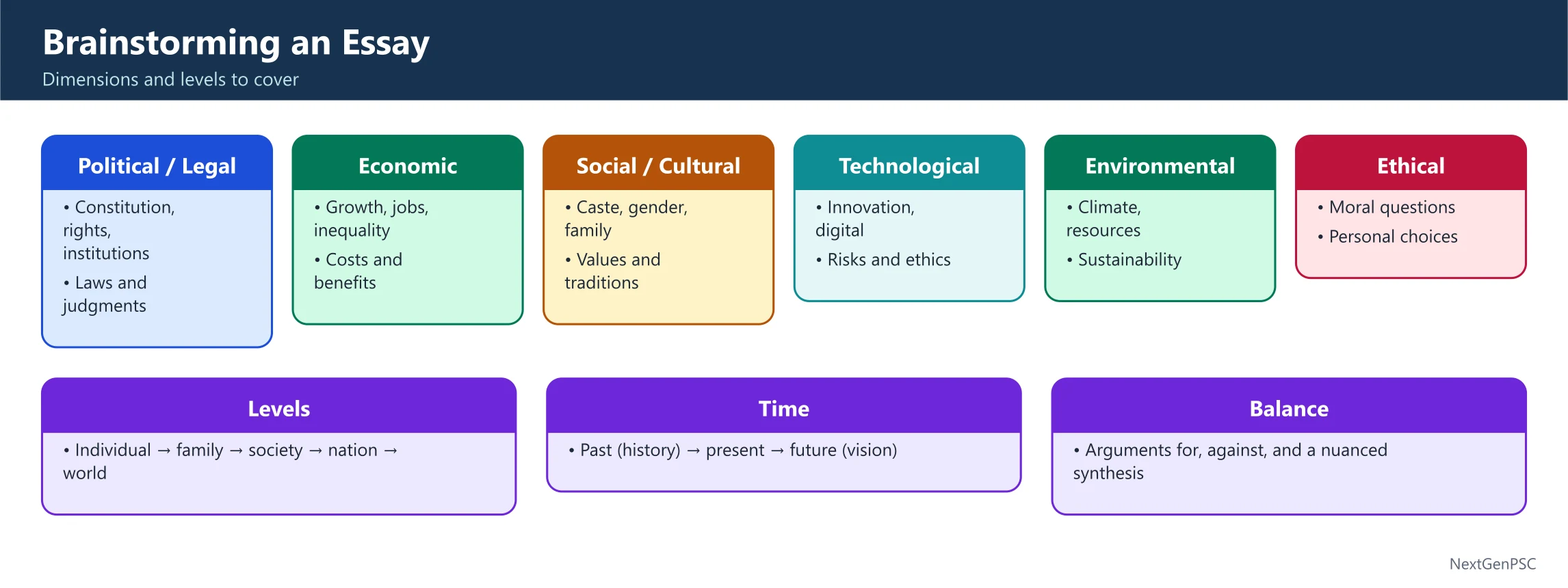
    Dimensions (PESTLE+): Political, Economic, Social, Technological, Legal, Environmental, ethical, cultural, historical, international, individual.
    Levels: Individual, family, society, nation, world.
    Time: Past, present, future.
    Counter-view: Note arguments against your thesis and how you will address them.
    4. Structure
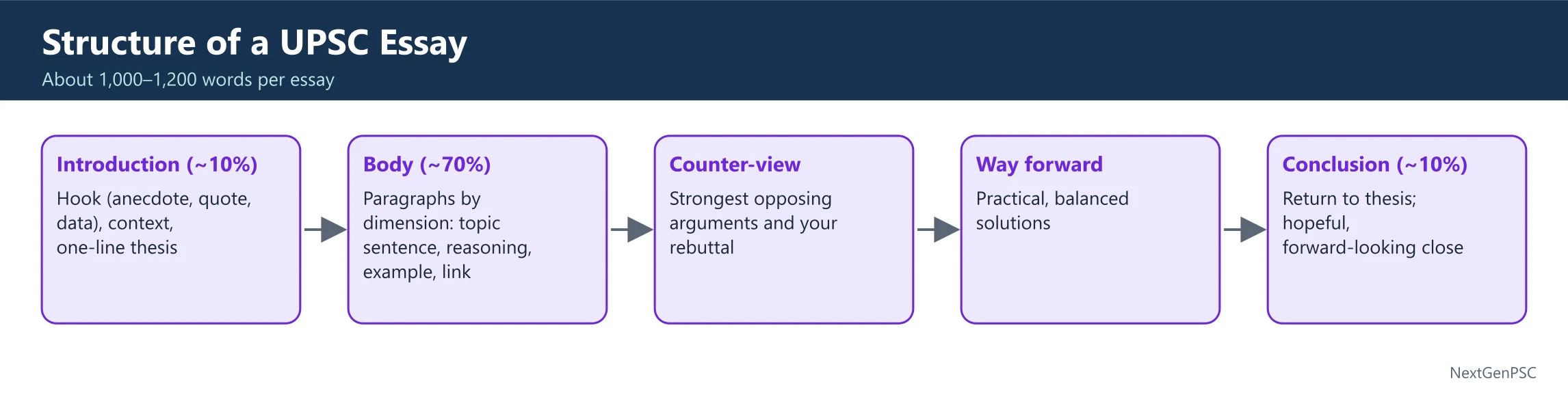
    Introduction (about 10%): Hook (anecdote, quote, story, data), context, thesis.
    Body (about 80%): Paragraphs organised by dimension or theme, each starting with a clear topic sentence, explained with reasons and examples, linked smoothly to the next.
    Counter-arguments and their rebuttal, showing balance.
    Way forward: Practical solutions.
    Conclusion (about 10%): Return to the thesis, positive and forward-looking, ideally linking back to the opening hook.
    5. Flow and Coherence
    Use linking words (however, moreover, in contrast, therefore); avoid listing facts without argument; maintain one central line of thought.
    6. Time Plan (per essay, ~90 minutes)
    10 minutes decoding, 20 minutes brainstorming and outline, 55 minutes writing, 5 minutes revision.

    Essay structure at a glance

    PartShareContent
    IntroductionAbout 10%Hook, context, thesis
    BodyAbout 70–80%Dimensions with arguments and examples
    Counter-viewPart of bodyOpposing arguments and rebuttal
    Way forwardPart of bodyPractical solutions
    ConclusionAbout 10%Return to thesis, optimistic close

    Fun Facts

    Since 2018 the Essay paper has often featured short philosophical quotations rather than direct issue-based topics.

    Many toppers write a rough outline on the question paper or the last pages of the answer booklet.

    The word 'essay' comes from the French 'essayer', meaning 'to try'.

    Mains Key Points

    An essay is judged on depth of understanding and coherence, not on the quantity of facts.
    A balanced view with counter-arguments shows maturity; extreme or one-sided essays lose marks.
    Philosophical topics should be connected to concrete examples from history, society and current affairs.
    Regular practice with timed writing is the only way to build structure and speed.

    Prelims Strategy Tips

    Essay paper: 250 marks, two essays (one from each section), three hours.
    Recommended length: about 1,000–1,200 words per essay.
    Use PESTLE plus ethical and individual dimensions for brainstorming.
    Write a one-line thesis before outlining.
    Leave 5 minutes for revision of each essay.

    Writing Introductions and Conclusions; Enriching the Essay with Examples

    Key Point

    The introduction sets the tone and the conclusion leaves the final impression—both deserve careful drafting. Strong essays use a mix of anecdotes, quotes, data, case studies, historical examples, constitutional values and current affairs, chosen to support the argument rather than to display knowledge.
    The introduction sets the tone and the conclusion leaves the final impression—both deserve careful drafting. Strong essays use a mix of anecdotes, quotes, data, case studies, historical examples, constitutional values and current affairs, chosen to support the argument rather than to display knowledge.

    Writing Introductions and Conclusions; Enriching the Essay with Examples
    Detailed Notes (21 points)
    Tap a card to add note • Use the highlight Listen button to play the full section
    1. Types of Introduction
    Anecdote or story: A short real or imagined story illustrating the theme (e.g. a girl in a village who becomes the first graduate, for an essay on education).
    Quote: Relevant and correctly attributed; explain it, do not just place it.
    Contrast or paradox: 'India is the world's pharmacy, yet millions cannot afford medicines.'
    Question or definition: Use sparingly; avoid dictionary definitions.
    Data: One striking statistic, not a list.
    End the introduction with your thesis and a hint of the structure.
    2. Writing a Strong Conclusion
    Summarise the core argument without repeating paragraphs; offer a balanced, hopeful vision; link to constitutional values or the idea of a New India; return to the opening anecdote for a circular structure.
    Avoid introducing new arguments or ending on a negative note.
    3. Sources of Enrichment
    History: Freedom struggle, reform movements, ancient and medieval examples.
    Thinkers: Gandhi, Ambedkar, Tagore, Vivekananda, Buddha, Kautilya, Aristotle, Kant, Rawls, Sen.
    Constitution: Preamble, Fundamental Rights and Duties, DPSP.
    Current affairs: Government schemes, court judgments, reports (Economic Survey, UN reports).
    Global examples: Policies of other countries, international events.
    Literature and culture: Proverbs, poems, films (used carefully).
    4. Language and Presentation
    Simple, clear sentences; paragraphs of 100–150 words; avoid jargon and slang; neat handwriting; underline sparingly; no headings or bullet points in the essay body (it should read as continuous prose).
    5. Common Mistakes
    Deviating from the topic, writing a GS answer instead of an essay, too many quotes, factual errors, extreme views, ignoring the second part of a topic, poor time management.

    Introduction techniques

    TechniqueBest used for
    AnecdoteSocial and philosophical topics
    QuoteAbstract or value-based topics
    Paradox/contrastDevelopment and inequality topics
    Striking dataEconomic and environmental topics
    Historical referencePolity, nationalism, international topics

    Fun Facts

    Montaigne, the 16th-century French writer, is credited with popularising the essay as a literary form.

    Gandhi's 'Hind Swaraj' (1909) is written as a dialogue—an unusual essay form.

    Many UPSC topics are drawn from the writings of Indian and world thinkers.

    Mains Key Points

    Examples should be diverse—local, national and global; historical and contemporary—to show breadth.
    An essay is an argument, so every example must serve the thesis.
    Clarity of language matters more than ornate vocabulary.
    Building a personal 'bank' of anecdotes, quotes and data by theme saves time in the exam.

    Prelims Strategy Tips

    Essay body should be continuous prose without headings or bullets.
    Each paragraph: topic sentence, explanation, example, link.
    Quotes must be accurate and correctly attributed.
    A circular structure links the conclusion back to the introduction.
    Avoid ending on a negative or pessimistic note.

    Chapter Complete!

    Ready to move to the next chapter?