
Ethics, Integrity & Aptitude (GS IV) Playlist
7 chapters • 0 completed
Ethics and Human Interface
5 topics
Attitude
2 topics
Aptitude and Foundational Values
2 topics
Moral Thinkers
2 topics
Ethics in Public Administration
2 topics
Probity in Governance
2 topics
Case Studies
2 topics
Chapter 1: Ethics and Human Interface
Chapter TestEthics: Essence, Determinants and Consequences
Ethics is the systematic study of what is right and wrong, good and bad in human conduct. GS IV asks for its essence, determinants and consequences in human actions. Ethics differs from law (externally enforced) and morality (personal or social code), and is shaped by family, society, religion, education, law and conscience.
Ethics is the systematic study of what is right and wrong, good and bad in human conduct. GS IV asks for its essence, determinants and consequences in human actions. Ethics differs from law (externally enforced) and morality (personal or social code), and is shaped by family, society, religion, education, law and conscience.
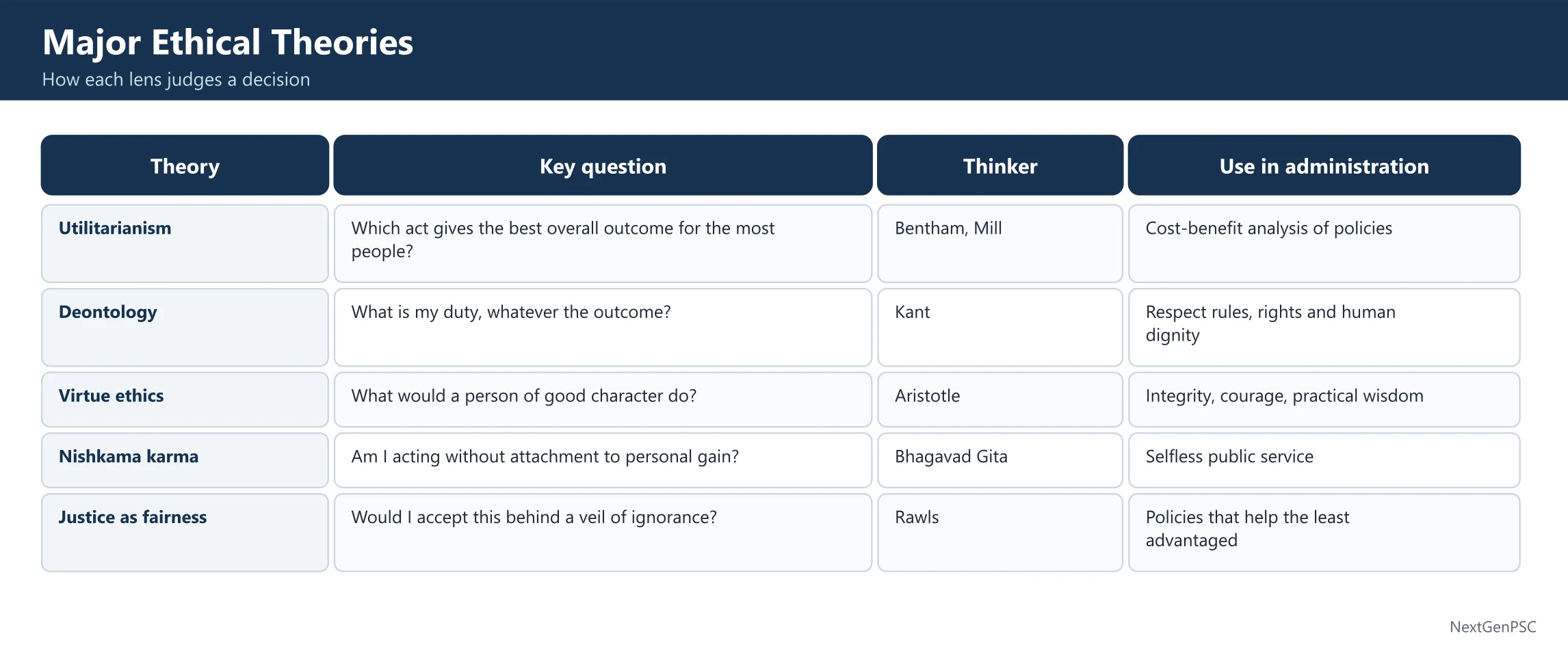
Major ethical theories
| Theory | Key question | Thinker |
|---|---|---|
| Utilitarianism | Which act produces the best overall outcome? | Bentham, Mill |
| Deontology | What is my duty, whatever the outcome? | Kant |
| Virtue ethics | What would a person of good character do? | Aristotle |
| Nishkama karma | Am I acting without attachment to results? | Bhagavad Gita |
Fun Facts
The word 'ethics' comes from the Greek 'ethos', meaning character or custom.
The Ethics paper (GS IV) was introduced in the UPSC Mains from 2013.
Ashoka's edicts are among the earliest state-issued codes of ethical conduct (dhamma).
Mains Key Points
Prelims Strategy Tips
Private and Public Ethics; Role of Family and Society in Inculcating Values
Private ethics governs personal relationships (honesty with family, loyalty to friends), while public ethics governs the conduct of those who hold public trust (impartiality, accountability, use of public resources). Values are first learnt in the family, then shaped by schools, society and institutions. A public servant's private conduct also affects public trust.
Private ethics governs personal relationships (honesty with family, loyalty to friends), while public ethics governs the conduct of those who hold public trust (impartiality, accountability, use of public resources). Values are first learnt in the family, then shaped by schools, society and institutions. A public servant's private conduct also affects public trust.
Private vs public ethics
| Aspect | Private ethics | Public ethics |
|---|---|---|
| Sphere | Family, friends | Office, citizens |
| Basis | Affection, personal virtue | Rules, public trust |
| Key values | Loyalty, kindness | Impartiality, accountability |
| Risk | Hypocrisy | Nepotism, misuse of power |
Fun Facts
Gandhi said his mother's religious devotion and fasting deeply shaped his values.
Lal Bahadur Shastri resigned as Railway Minister in 1956 taking moral responsibility for a train accident.
The Nolan Committee (UK, 1995) set out the 'Seven Principles of Public Life'.
Mains Key Points
Prelims Strategy Tips
Integrity, Courage of Conviction and Conscience
Integrity means consistency between values, words and actions—being honest even when no one is watching. Courage of conviction is the willingness to act on one's beliefs despite pressure or risk. Conscience is the inner moral voice; when it conflicts with law or orders, a public servant must weigh legality, morality and consequences.
Integrity means consistency between values, words and actions—being honest even when no one is watching. Courage of conviction is the willingness to act on one's beliefs despite pressure or risk. Conscience is the inner moral voice; when it conflicts with law or orders, a public servant must weigh legality, morality and consequences.
Integrity vs honesty vs courage
| Value | Meaning | Example |
|---|---|---|
| Honesty | Telling the truth | Reporting accurate data |
| Integrity | Consistency of values and action | Refusing a bribe when unobserved |
| Courage of conviction | Acting on values despite risk | Exposing a scam despite threats |
Fun Facts
T.N. Seshan, as Chief Election Commissioner (1990–96), enforced the Model Code of Conduct strictly and transformed elections.
E. Sreedharan is known as the 'Metro Man' for completing projects on time and within budget.
Satyendra Dubey Memorial Award is given by IIT Kanpur alumni for integrity in public life.
Mains Key Points
Prelims Strategy Tips
Ethical Dilemmas and the Ethics of Care
An ethical dilemma arises when two or more moral duties conflict and choosing one means compromising another—for example, loyalty to a superior vs honesty to the public, or rules vs compassion. Structured reasoning helps resolve them. The ethics of care (Carol Gilligan, Nel Noddings) adds that moral decisions should consider relationships, vulnerability and responsibility, not just abstract rules.
An ethical dilemma arises when two or more moral duties conflict and choosing one means compromising another—for example, loyalty to a superior vs honesty to the public, or rules vs compassion. Structured reasoning helps resolve them. The ethics of care (Carol Gilligan, Nel Noddings) adds that moral decisions should consider relationships, vulnerability and responsibility, not just abstract rules.
Tests for resolving dilemmas
| Test | Question to ask |
|---|---|
| Legality | Is it lawful and within rules? |
| Public interest | Does it serve the larger public good? |
| Gandhi's talisman | How will it affect the poorest and weakest? |
| Newspaper test | Would I be comfortable if this were on the front page? |
| Reversibility | Would I accept this decision if I were on the other side? |
Fun Facts
The 'trolley problem' is a famous thought experiment contrasting utilitarian and deontological intuitions.
Gandhi's talisman was written in 1947 as a guide for decision-makers.
Many UPSC GS IV case studies are drawn from real administrative situations in districts.
Mains Key Points
Prelims Strategy Tips
Media Ethics, Corporate Governance and Ethics in International Relations
Ethics applies beyond government. Media ethics demands truthfulness, fairness and respect for privacy amid paid news and fake news. Corporate governance ensures companies are run transparently and accountably for shareholders and society (CSR under the Companies Act, 2013). Ethics in international relations asks how states should balance national interest with justice, human rights and global responsibilities such as climate action and humanitarian aid.
Ethics applies beyond government. Media ethics demands truthfulness, fairness and respect for privacy amid paid news and fake news. Corporate governance ensures companies are run transparently and accountably for shareholders and society (CSR under the Companies Act, 2013). Ethics in international relations asks how states should balance national interest with justice, human rights and global responsibilities such as climate action and humanitarian aid.
Applied ethics at a glance
| Field | Core value | Key concern |
|---|---|---|
| Media | Truth and fairness | Fake news, paid news, privacy |
| Corporate | Transparency and accountability | Fraud, shareholder rights, CSR |
| International relations | Justice and humanity | Interventions, refugees, climate justice |
Fun Facts
India was the first country to make CSR spending mandatory by law.
The phrase 'Vasudhaiva Kutumbakam' comes from the Maha Upanishad.
Under Vaccine Maitri (2021), India supplied COVID-19 vaccines to many developing countries.
Mains Key Points
Prelims Strategy Tips
Chapter Complete!
Ready to move to the next chapter?