
Ethics, Integrity & Aptitude (GS IV) Playlist
7 chapters • 0 completed
Ethics and Human Interface
5 topics
Attitude
2 topics
Aptitude and Foundational Values
2 topics
Moral Thinkers
2 topics
Ethics in Public Administration
2 topics
Probity in Governance
2 topics
Case Studies
2 topics
Chapter 3: Aptitude and Foundational Values
Chapter TestFoundational Values for Civil Services: Integrity, Impartiality, Objectivity and Dedication
Aptitude is the potential to acquire skills; for civil services it must be combined with foundational values—integrity, impartiality and non-partisanship, objectivity, dedication to public service, empathy, tolerance and compassion towards the weaker sections. These values distinguish a competent officer from an ethical one.
Aptitude is the potential to acquire skills; for civil services it must be combined with foundational values—integrity, impartiality and non-partisanship, objectivity, dedication to public service, empathy, tolerance and compassion towards the weaker sections. These values distinguish a competent officer from an ethical one.
Foundational values in practice
| Value | In practice |
|---|---|
| Integrity | Declaring assets, refusing gifts with strings attached |
| Impartiality | Same treatment for influential and ordinary applicants |
| Non-partisanship | Frank, evidence-based advice to any elected government |
| Objectivity | Decisions based on data and documented reasons |
| Dedication | Working through disasters and emergencies |
Fun Facts
Sardar Patel urged civil servants to give fearless advice, saying they should not be afraid to express their views.
The 2nd ARC's 4th Report is titled 'Ethics in Governance' (2007).
Many training academies use simulations and case studies to build ethical aptitude.
Mains Key Points
Prelims Strategy Tips
Emotional Intelligence, Empathy and Compassion in Administration
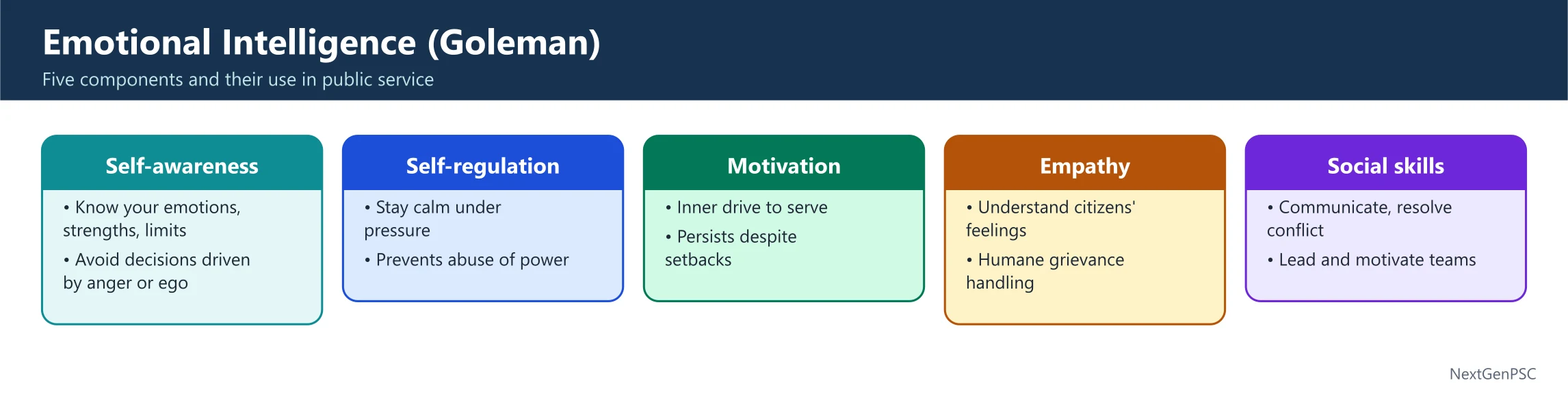
Emotional intelligence (EI)—popularised by Daniel Goleman—is the ability to recognise, understand and manage one's own emotions and those of others. Its components are self-awareness, self-regulation, motivation, empathy and social skills. In administration, EI helps officers handle stress, resolve conflicts, lead teams and treat citizens—especially the vulnerable—with empathy and compassion.
Emotional intelligence (EI)—popularised by Daniel Goleman—is the ability to recognise, understand and manage one's own emotions and those of others. Its components are self-awareness, self-regulation, motivation, empathy and social skills. In administration, EI helps officers handle stress, resolve conflicts, lead teams and treat citizens—especially the vulnerable—with empathy and compassion.
Sympathy, empathy and compassion
| Quality | Meaning | Administrative example |
|---|---|---|
| Sympathy | Feeling pity | Expressing sorrow to a flood victim |
| Empathy | Understanding their perspective | Seeing why the victim cannot fill forms |
| Compassion | Acting to relieve suffering | Setting up camps to process relief on the spot |
Fun Facts
Goleman argued that EI matters more than IQ for leadership success.
'Ahimsa' in Gandhian thought includes active compassion, not just non-violence.
Many civil-service academies include stress management and mindfulness in training.
Mains Key Points
Prelims Strategy Tips
Chapter Complete!
Ready to move to the next chapter?