
Indian Society · UPSC Notes
Salient Features and Diversity of Indian Society — UPSC Indian Society Notes
Free, exam-focused notes for UPSC Prelims and Mains, with Prelims tips and Mains points for every topic. 2 topics.
Open in the interactive reader: bookmarks, progress tracking and read-aloud.
Salient Features of Indian Society and Unity in Diversity
Indian society is marked by extraordinary diversity—of religion, language, caste, tribe, region and culture—held together by shared history, civilisational values and the Constitution. Its salient features include continuity with change, the caste system, the joint family, religious pluralism, a large tribal population and the coexistence of tradition and modernity. Diversity can enrich democracy or, when politicised, fuel regionalism and conflict.
1. Salient Features
Diversity: All major world religions, 22 scheduled languages and hundreds of dialects, over 700 notified Scheduled Tribes, varied cuisines, dress and festivals.
Caste and hierarchy: Birth-based stratification that persists despite constitutional equality.
Family and kinship: Strong family ties; transition from joint to nuclear families.
Rural base: About two-thirds of people lived in villages (Census 2011), though urbanisation is rising.
Patriarchy: Gender inequality in property, work and decision-making, alongside rapid change.
Tolerance and syncretism: Bhakti and Sufi traditions, shared festivals and shrines.
Unity amidst diversity: Geographical unity, shared epics and pilgrimage circuits, freedom struggle, Constitution, democratic institutions.
2. Bonds of Unity
Geographical (Himalayas to seas), religious (pilgrimage centres across the country), cultural (shared epics, art forms), political (Constitution, single citizenship, All India Services), economic (national market).
3. Challenges of Diversity
Regionalism (sons-of-the-soil, separate statehood demands), linguistic conflicts, communalism, casteism, ethnic conflicts in the North-East, inter-state disputes.
4. Regionalism: Positive and Negative
Positive: Assertion of cultural identity, demand for balanced development, deepening of federalism.
Negative: Parochialism, discrimination against migrants, secessionist tendencies.
5. Managing Diversity
Constitutional safeguards (Articles 29–30, Fifth and Sixth Schedules, Article 371), linguistic states, reservations, federalism, secularism, and programmes like Ek Bharat Shreshtha Bharat (pairing of states for cultural exchange).
| Type | Examples | Constitutional response |
|---|---|---|
| Religious | Hindu, Muslim, Christian, Sikh, Buddhist, Jain, Parsi | Secularism, Articles 25–30 |
| Linguistic | 22 scheduled languages | Eighth Schedule, linguistic states |
| Ethnic/tribal | Over 700 Scheduled Tribes | Fifth and Sixth Schedules, PESA |
| Caste | Thousands of jatis | Article 17, reservations |
| Regional | Distinct regional cultures | Federalism, Article 371 |
Prelims tips
- The Eighth Schedule lists 22 languages.
- Ek Bharat Shreshtha Bharat (2015) pairs states for cultural exchange.
- Articles 29–30 protect cultural and educational rights of minorities.
- Sixth Schedule provides autonomous councils in Assam, Meghalaya, Tripura and Mizoram.
- Census 2011: about 31% urban, 69% rural population.
Mains points
- Indian unity is not uniformity; accommodation of diversity through federalism and rights has sustained the nation.
- Diversity becomes divisive when identity is politicised for electoral gain.
- Balanced regional development reduces the economic roots of regionalism.
- Shared civic identity built on constitutional values complements cultural identities.
Did you know?
- The People of India project (Anthropological Survey of India) identified over 4,600 communities.
- Pilgrimage circuits like the Char Dham link the four corners of India.
- Nehru described India as an 'ancient palimpsest' in The Discovery of India.
Caste System and Social Change in India
Caste is a hereditary, endogamous system of social stratification with ritual hierarchy and traditional occupations. Constitutional equality, reservations, education, urbanisation and democratic politics have weakened ritual hierarchy, but caste persists in marriage, politics, discrimination and economic inequality. Sociologists describe change through Sanskritisation, Westernisation and the dominant caste (M.N. Srinivas).
1. Features of the Caste System
Hereditary membership, endogamy, hierarchy based on purity and pollution, restrictions on food and social interaction, traditional occupations, and the practice of untouchability.
Varna vs jati: Four varnas are a textual scheme; thousands of jatis are the real social units.
2. Concepts of Change
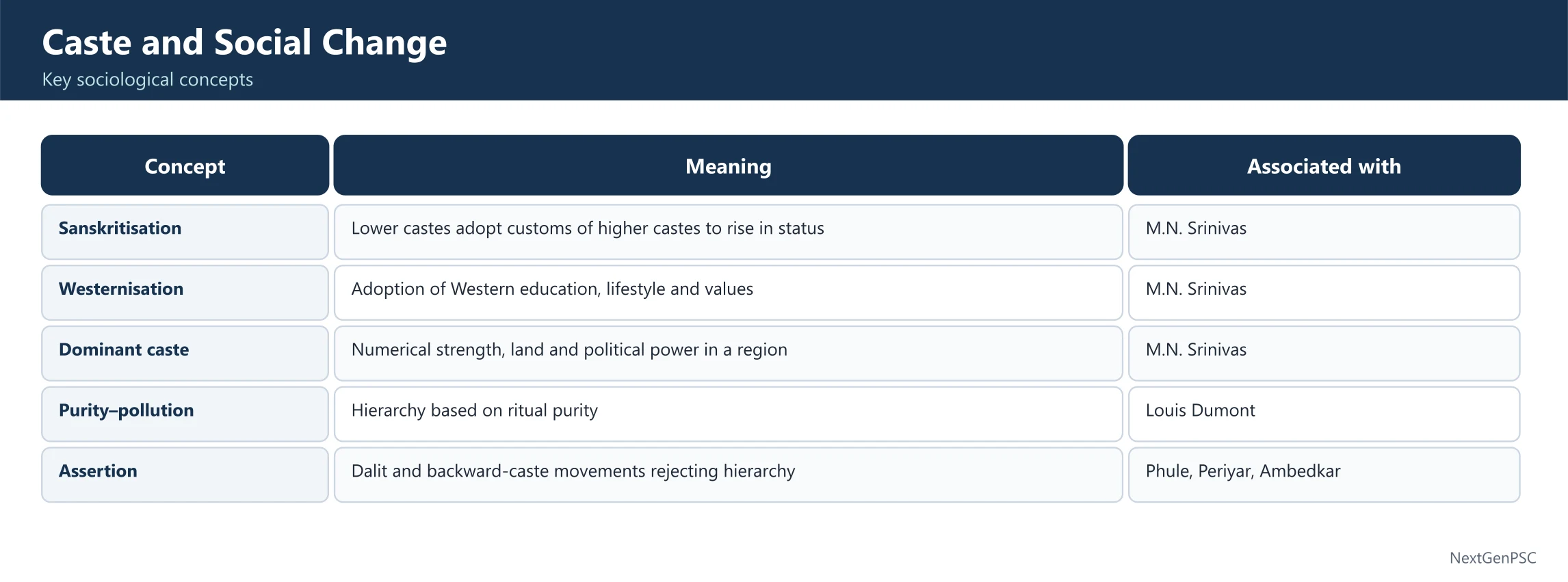
Sanskritisation (M.N. Srinivas): Lower castes adopting customs of higher castes to rise in status.
Westernisation: Adoption of Western lifestyles, education and values.
Dominant caste: A caste that is numerically strong, owns land and has political power in a region.
De-Sanskritisation and assertion: Dalit and backward-caste movements rejecting Brahminical norms.
3. Forces of Change
Constitution (Articles 14–17, 46), reservations, land reforms, education, urbanisation and industrialisation, democratic politics and caste-based parties, reform movements (Phule, Periyar, Ambedkar, Narayana Guru), market economy.
4. Persistence of Caste
Marriage: Most marriages remain within caste; honour crimes against inter-caste couples.
Discrimination: Atrocities against Dalits, manual scavenging, untouchability in rural areas.
Politics: Caste-based mobilisation and vote banks.
Economy: Gaps in land ownership, assets and representation in top jobs.
5. Policy Responses
Protection of Civil Rights Act, 1955; SC/ST (Prevention of Atrocities) Act, 1989; Prohibition of Employment as Manual Scavengers Act, 2013; reservations; scholarships; caste data (Bihar caste survey 2023, and the Centre's 2025 decision to enumerate caste in the next Census).
6. Way Forward
Education and economic mobility, inter-caste marriage incentives, strict enforcement of anti-atrocity laws, and social reform from within communities.
| Concept | Meaning | Proposed by |
|---|---|---|
| Sanskritisation | Imitating higher-caste customs to gain status | M.N. Srinivas |
| Westernisation | Adopting Western lifestyle and values | M.N. Srinivas |
| Dominant caste | Numerical, economic and political dominance in a region | M.N. Srinivas |
| Purity–pollution | Hierarchy based on ritual purity | Louis Dumont (Homo Hierarchicus) |
Prelims tips
- Article 17 abolishes untouchability.
- M.N. Srinivas coined 'Sanskritisation'.
- SC/ST (Prevention of Atrocities) Act was enacted in 1989.
- Manual scavenging was prohibited by the 2013 Act.
- Louis Dumont wrote 'Homo Hierarchicus' on the caste system.
Mains points
- Caste has changed from a ritual hierarchy to a basis of political identity and interest-group competition.
- Urbanisation weakens some caste practices but can reproduce caste in housing, networks and jobs.
- Reservations have created a Dalit and backward-caste middle class but benefits are uneven within groups.
- Social change requires both legal enforcement and attitudinal change within families and communities.
Did you know?
- Jyotiba Phule founded the Satyashodhak Samaj in 1873 to fight caste discrimination.
- Narayana Guru's motto was 'One caste, one religion, one God for humankind'.
- The Vaikom Satyagraha (1924–25) fought for the right of lower castes to use temple roads.
Indian Society: All chapters
- Salient Features and Diversity of Indian Society
- Women, Population and Family
- Globalisation, Communalism and Secularism
- Poverty and Social Empowerment