
Indian Society Playlist
4 chapters • 0 completed
Salient Features and Diversity of Indian Society
2 topics
Women, Population and Family
3 topics
Globalisation, Communalism and Secularism
3 topics
Poverty and Social Empowerment
1 topics
Chapter 1: Salient Features and Diversity of Indian Society
Chapter TestSalient Features of Indian Society and Unity in Diversity
Indian society is marked by extraordinary diversity—of religion, language, caste, tribe, region and culture—held together by shared history, civilisational values and the Constitution. Its salient features include continuity with change, the caste system, the joint family, religious pluralism, a large tribal population and the coexistence of tradition and modernity. Diversity can enrich democracy or, when politicised, fuel regionalism and conflict.
Indian society is marked by extraordinary diversity—of religion, language, caste, tribe, region and culture—held together by shared history, civilisational values and the Constitution. Its salient features include continuity with change, the caste system, the joint family, religious pluralism, a large tribal population and the coexistence of tradition and modernity. Diversity can enrich democracy or, when politicised, fuel regionalism and conflict.
Forms of diversity in India
| Type | Examples | Constitutional response |
|---|---|---|
| Religious | Hindu, Muslim, Christian, Sikh, Buddhist, Jain, Parsi | Secularism, Articles 25–30 |
| Linguistic | 22 scheduled languages | Eighth Schedule, linguistic states |
| Ethnic/tribal | Over 700 Scheduled Tribes | Fifth and Sixth Schedules, PESA |
| Caste | Thousands of jatis | Article 17, reservations |
| Regional | Distinct regional cultures | Federalism, Article 371 |
Fun Facts
The People of India project (Anthropological Survey of India) identified over 4,600 communities.
Pilgrimage circuits like the Char Dham link the four corners of India.
Nehru described India as an 'ancient palimpsest' in The Discovery of India.
Mains Key Points
Prelims Strategy Tips
Caste System and Social Change in India
Caste is a hereditary, endogamous system of social stratification with ritual hierarchy and traditional occupations. Constitutional equality, reservations, education, urbanisation and democratic politics have weakened ritual hierarchy, but caste persists in marriage, politics, discrimination and economic inequality. Sociologists describe change through Sanskritisation, Westernisation and the dominant caste (M.N. Srinivas).
Caste is a hereditary, endogamous system of social stratification with ritual hierarchy and traditional occupations. Constitutional equality, reservations, education, urbanisation and democratic politics have weakened ritual hierarchy, but caste persists in marriage, politics, discrimination and economic inequality. Sociologists describe change through Sanskritisation, Westernisation and the dominant caste (M.N. Srinivas).
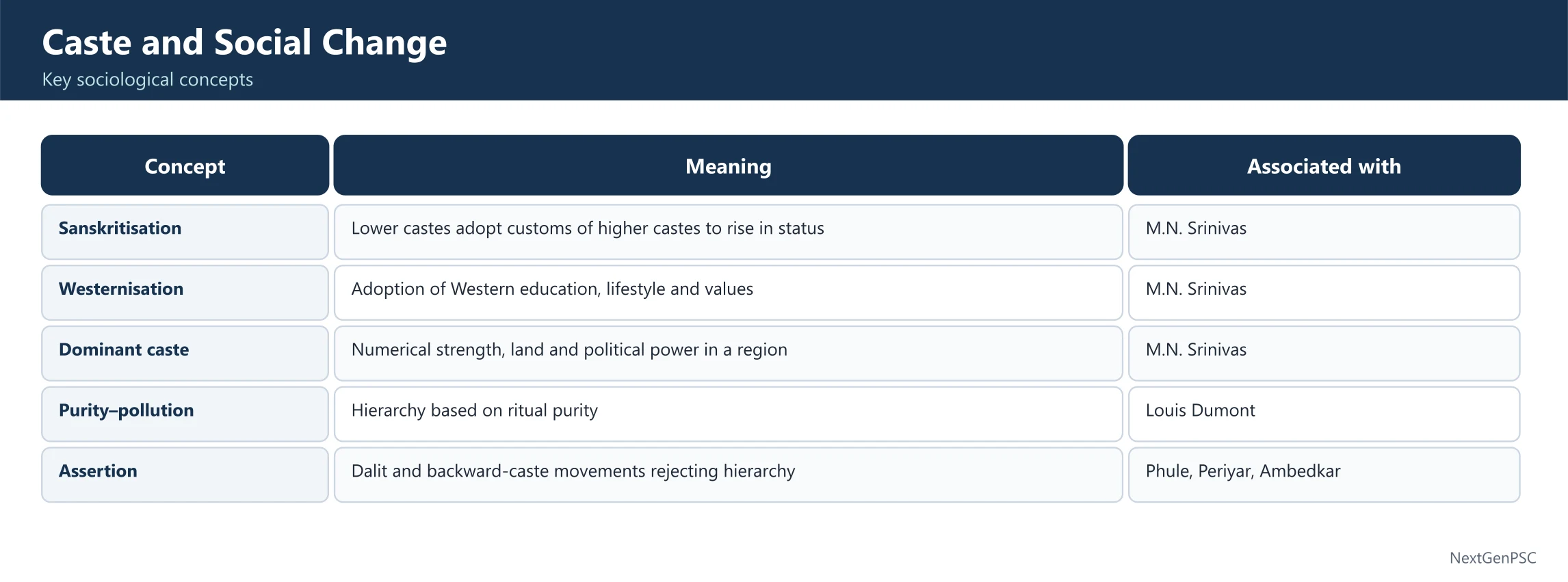
Sociological concepts of caste change
| Concept | Meaning | Proposed by |
|---|---|---|
| Sanskritisation | Imitating higher-caste customs to gain status | M.N. Srinivas |
| Westernisation | Adopting Western lifestyle and values | M.N. Srinivas |
| Dominant caste | Numerical, economic and political dominance in a region | M.N. Srinivas |
| Purity–pollution | Hierarchy based on ritual purity | Louis Dumont (Homo Hierarchicus) |
Fun Facts
Jyotiba Phule founded the Satyashodhak Samaj in 1873 to fight caste discrimination.
Narayana Guru's motto was 'One caste, one religion, one God for humankind'.
The Vaikom Satyagraha (1924–25) fought for the right of lower castes to use temple roads.
Mains Key Points
Prelims Strategy Tips
Chapter Complete!
Ready to move to the next chapter?