
Indian Society Playlist
4 chapters • 0 completed
Salient Features and Diversity of Indian Society
2 topics
Women, Population and Family
3 topics
Globalisation, Communalism and Secularism
3 topics
Poverty and Social Empowerment
1 topics
Chapter 2: Women, Population and Family
Chapter TestRole of Women and Women's Organisations; Women and Work
Women's status in India has improved in education, health and political participation, yet gaps remain in work participation, wages, safety and decision-making. Women's organisations—from the All India Women's Conference (1927) to SEWA and today's SHGs—have driven reform. Female labour force participation has risen in recent PLFS rounds, but much of women's work remains unpaid or informal.
Women's status in India has improved in education, health and political participation, yet gaps remain in work participation, wages, safety and decision-making. Women's organisations—from the All India Women's Conference (1927) to SEWA and today's SHGs—have driven reform. Female labour force participation has risen in recent PLFS rounds, but much of women's work remains unpaid or informal.
Key laws for women
| Law | Year | Purpose |
|---|---|---|
| Dowry Prohibition Act | 1961 | Bans giving and taking dowry |
| Protection of Women from Domestic Violence Act | 2005 | Civil remedies against domestic violence |
| POSH Act | 2013 | Prevention of sexual harassment at the workplace |
| Maternity Benefit (Amendment) Act | 2017 | 26 weeks paid maternity leave |
| Constitution (106th Amendment) | 2023 | One-third seats for women in legislatures |
Fun Facts
Savitribai Phule is regarded as India's first woman teacher; she opened a girls' school in Pune in 1848.
Women were at the forefront of the Chipko movement, led by figures like Gaura Devi.
Kerala's Kudumbashree is one of the world's largest women's networks.
Mains Key Points
Prelims Strategy Tips
Population and Associated Issues: Demographic Dividend and Ageing
India became the world's most populous country in 2023 (UN estimates). With fertility now at about replacement level (TFR 2.0, NFHS-5), India enjoys a demographic dividend from a large working-age population, but it is also ageing: the UNFPA India Ageing Report 2023 projects the share of people aged 60+ to roughly double from about 10% (2022) to over 20% by 2050, with sharp regional differences.
India became the world's most populous country in 2023 (UN estimates). With fertility now at about replacement level (TFR 2.0, NFHS-5), India enjoys a demographic dividend from a large working-age population, but it is also ageing: the UNFPA India Ageing Report 2023 projects the share of people aged 60+ to roughly double from about 10% (2022) to over 20% by 2050, with sharp regional differences.
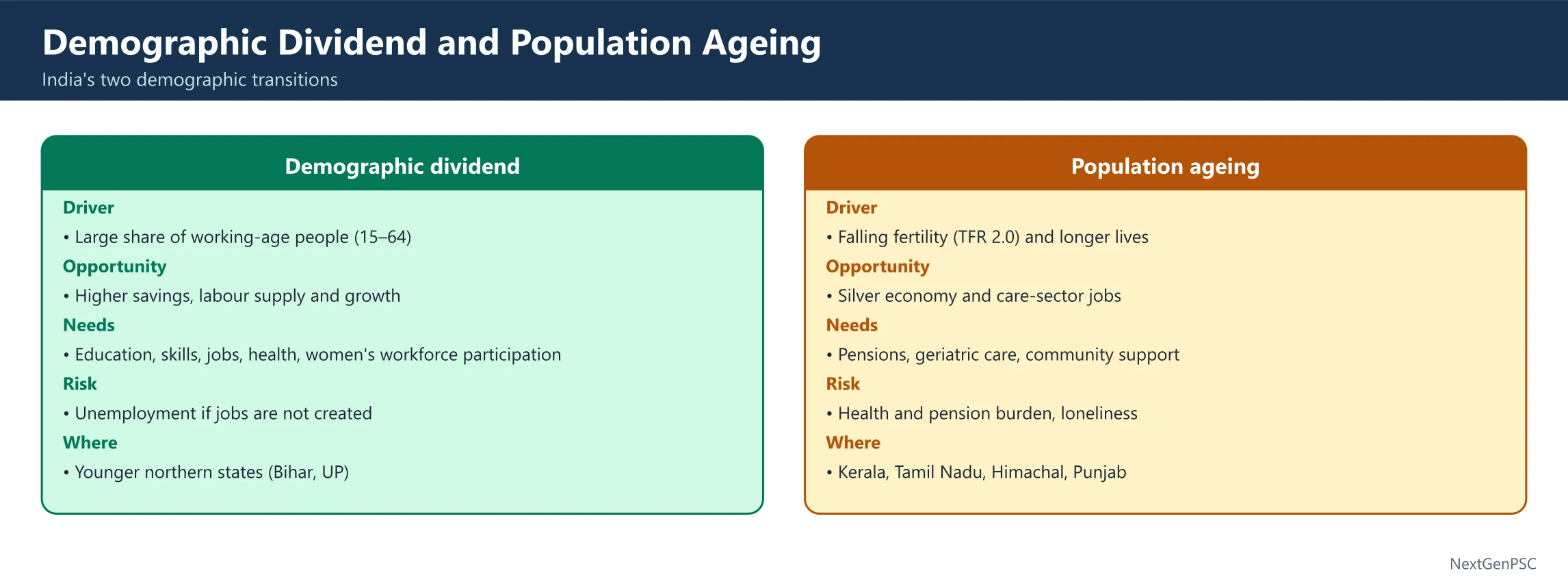
Dividend vs ageing
| Aspect | Demographic dividend | Population ageing |
|---|---|---|
| Main driver | Large working-age share | Low fertility, longer life |
| Opportunity | Higher savings and growth | Silver economy, care sector jobs |
| Risk | Unemployment if jobs are lacking | Pension and health burden |
| Where now | Northern states | Southern states, Himachal, Punjab |
Fun Facts
India launched the world's first national family planning programme in 1952.
Kerala's TFR fell below replacement level in the late 1980s.
1 October is observed as the International Day of Older Persons.
Mains Key Points
Prelims Strategy Tips
Urbanisation, Family and Social Change
Urbanisation is changing Indian society: families are becoming nuclear, women are entering education and work, caste practices loosen in public life, and new middle classes and consumer cultures emerge. But cities also produce slums, loneliness, crime and new forms of segregation. The GS I syllabus asks about urbanisation, its problems and remedies from a social angle.
Urbanisation is changing Indian society: families are becoming nuclear, women are entering education and work, caste practices loosen in public life, and new middle classes and consumer cultures emerge. But cities also produce slums, loneliness, crime and new forms of segregation. The GS I syllabus asks about urbanisation, its problems and remedies from a social angle.
Joint vs nuclear family
| Aspect | Joint family | Nuclear family |
|---|---|---|
| Structure | Several generations together | Parents and children |
| Authority | Elder (often male) head | More shared decision-making |
| Support | Built-in care for elderly and children | Depends on paid or public care |
| Individual freedom | Lower | Higher |
Fun Facts
Delhi's 'urban villages' like Hauz Khas and Shahpur Jat were once agricultural villages absorbed by the city.
India's average household size has been declining with each Census.
Resident Welfare Associations (RWAs) have become important civic actors in Indian cities.
Mains Key Points
Prelims Strategy Tips
Chapter Complete!
Ready to move to the next chapter?