
International Relations — UPSC Notes

    International Relations notes for UPSC GS II: India–China, Neighbourhood First, India–US, India–Russia, West Asia, Indo-Pacific and Quad, UN reforms and global policies affecting India.

    International Relations

    GS II: India and its neighbourhood, major powers, the Indo-Pacific and global institutions

    International Relations Playlist

    3 chapters • 0 completed

    1

    India and Its Neighbourhood

    2 topics

    2

    India and Major Powers

    3 topics

    Practice
    3

    Indo-Pacific and Global Institutions

    3 topics

    Progress (0%)
    0 / 3 complete

    Chapter 2: India and Major Powers

    Chapter Test
    3 topics•Estimated reading: 9 minutes

    India–US Relations: A Comprehensive Global Strategic Partnership

    Key Point

    From Cold War estrangement, India–US ties transformed after 2000 through the civil nuclear deal (2008), defence partnership and shared concerns about China. They now span defence, technology (iCET, now TRUST), trade, energy, education and a large diaspora. Frictions remain over tariffs and trade (sharp US tariff increases in 2025), immigration (H-1B), Russia ties and India's strategic autonomy.
    From Cold War estrangement, India–US ties transformed after 2000 through the civil nuclear deal (2008), defence partnership and shared concerns about China. They now span defence, technology (iCET, now TRUST), trade, energy, education and a large diaspora. Frictions remain over tariffs and trade (sharp US tariff increases in 2025), immigration (H-1B), Russia ties and India's strategic autonomy.

    India–US Relations: A Comprehensive Global Strategic Partnership
    Detailed Notes (19 points)
    Tap a card to add note • Use the highlight Listen button to play the full section
    1. Evolution
    Cold War distance (US–Pakistan alliance, 1971 USS Enterprise episode); sanctions after Pokhran-II (1998).
    Turnaround: Clinton's visit (2000), Next Steps in Strategic Partnership (2004), civil nuclear agreement (2005 framework, 2008 NSG waiver), Comprehensive Global Strategic Partnership (2020).
    2. Defence and Security
    Major Defence Partner (2016); STA-1 status (2018) for high-tech exports.
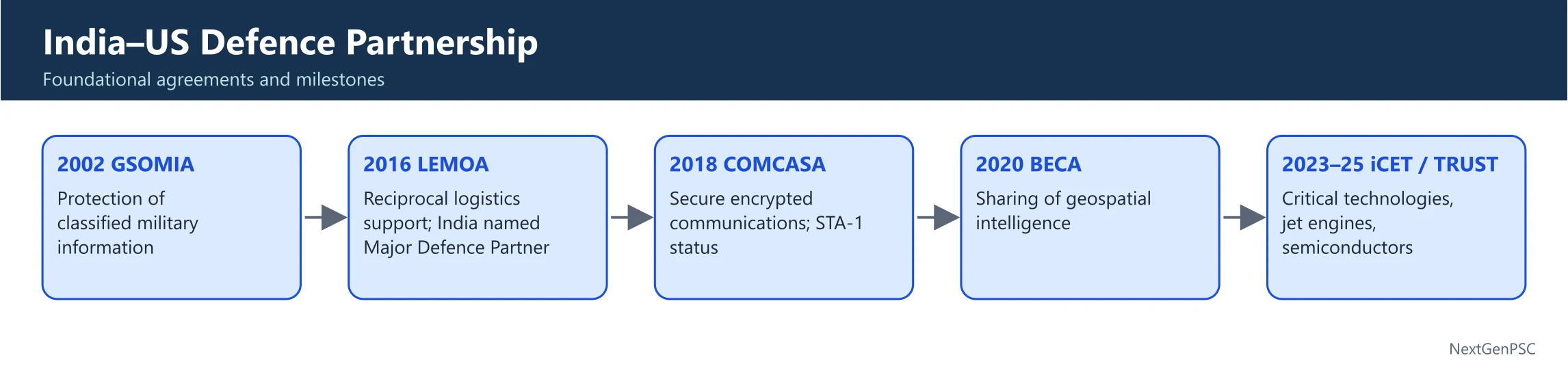
    Foundational agreements: GSOMIA (2002), LEMOA (2016, logistics), COMCASA (2018, secure communication), BECA (2020, geospatial data).
    Platforms: C-17, P-8I, Apache, MQ-9B drones; co-production of GE F414 jet engines for Tejas Mk2; exercises such as Malabar, Yudh Abhyas.
    3. Technology and Economy
    iCET (2023), renamed TRUST (2025): Semiconductors, AI, quantum, space, critical minerals.
    The US is among India's largest trading partners and a top export destination; negotiations on a bilateral trade agreement.
    2025 tariff shock: The US raised tariffs on many Indian goods to 50%, including a penalty linked to India's purchase of Russian oil, straining ties.
    4. People and Diaspora
    Large Indian-American community; Indian students are among the largest groups of foreign students in the US; H-1B visa changes affect Indian professionals.
    5. Global and Regional Cooperation
    Quad, Indo-Pacific, counter-terrorism, climate and clean energy, space (NISAR satellite, launched 2025), health.
    6. Frictions
    Trade disputes and tariffs, market access, data localisation, India's Russia ties (S-400, oil) and CAATSA concerns, religious freedom reports, immigration policies.
    7. Assessment
    A partnership based on converging interests rather than alliance; India seeks technology and investment while preserving strategic autonomy.

    India–US foundational defence agreements

    AgreementYearPurpose
    GSOMIA2002Protection of classified military information
    LEMOA2016Reciprocal logistics support
    COMCASA2018Secure, encrypted communication equipment
    BECA2020Sharing of geospatial intelligence

    Fun Facts

    Swami Vivekananda's speech at the Parliament of the World's Religions in Chicago (1893) is a landmark in India–US cultural ties.

    Kalpana Chawla, born in Haryana, was the first woman of Indian origin in space (NASA, 1997).

    The Tarapur nuclear plant (1969) was built with US assistance.

    Mains Key Points

    Convergence on China and the Indo-Pacific drives the partnership, but India avoids a formal alliance to preserve autonomy.
    Technology transfer and co-production (jet engines, semiconductors) are the real test of the partnership's depth.
    Trade frictions and tariffs show that economic interests can strain strategic ties; a trade agreement could stabilise relations.
    The diaspora is a bridge, but immigration policies can become irritants.
    Balancing ties with the US and Russia is central to India's multi-alignment.

    Prelims Strategy Tips

    India was designated a Major Defence Partner of the US in 2016.
    BECA (2020) was the last of the four foundational agreements.
    The 123 Agreement governs India–US civil nuclear cooperation.
    NISAR is a joint NASA–ISRO Earth observation satellite.
    CAATSA is a US law that can sanction countries buying major Russian arms.

    India–Russia Relations: A Special and Privileged Strategic Partnership

    Key Point

    India and Russia share a time-tested partnership dating back to Soviet support for India's industrialisation, defence and diplomacy (the 1971 Treaty). Upgraded to a 'Special and Privileged Strategic Partnership' (2010), it rests on defence, nuclear energy, space and, since 2022, large oil imports. Russia's closeness to China and Western sanctions after the Ukraine war create new challenges for India's strategic autonomy.

    India and Russia share a time-tested partnership dating back to Soviet support for India's industrialisation, defence and diplomacy (the 1971 Treaty). Upgraded to a 'Special and Privileged Strategic Partnership' (2010), it rests on defence, nuclear energy, space and, since 2022, large oil imports. Russia's closeness to China and Western sanctions after the Ukraine war create new challenges for India's strategic autonomy.

    Detailed Notes (18 points)
    Tap a card to add note • Use the highlight Listen button to play the full section
    1. Historical Foundations
    Soviet help with heavy industry (Bhilai steel plant), defence supplies, veto support on Kashmir at the UN, Indo-Soviet Treaty of Peace, Friendship and Cooperation (1971).
    Strategic Partnership (2000), upgraded in 2010; annual summits.
    2. Defence
    Russia has been India's largest arms supplier historically, though its share has fallen as India diversifies.
    Key systems: Su-30MKI, T-90 tanks, INS Vikramaditya, S-400 air defence (2018 deal), AK-203 rifles (made in Amethi), BrahMos (joint venture).
    3. Energy
    Oil: After 2022, Russia became India's largest crude supplier, offering discounted oil.
    Nuclear: Kudankulam Nuclear Power Plant (Tamil Nadu).
    Investments in Russian oil fields (Sakhalin-1, Vankor).
    4. Connectivity and Trade
    International North–South Transport Corridor (INSTC) via Iran; Chennai–Vladivostok Eastern Maritime Corridor; trade reached record levels but is heavily imbalanced in Russia's favour; payment and rupee-rouble settlement challenges.
    5. Challenges
    Russia–China closeness; Western sanctions and US pressure (CAATSA, tariff penalties); delays in defence spare parts; India's growing ties with the US; Russia's outreach to Pakistan; trade imbalance.
    6. India's Position on Ukraine
    Calls for dialogue and diplomacy ('this is not an era of war'), abstained on several UN votes, humanitarian aid to Ukraine, continued engagement with Russia.
    7. Way Forward
    Diversify trade (pharmaceuticals, machinery, labour mobility), joint production under Make in India, use connectivity corridors, keep Russia from becoming overly dependent on China.

    Pillars of India–Russia ties

    PillarExamples
    DefenceSu-30MKI, S-400, BrahMos, AK-203
    EnergyDiscounted crude oil, Kudankulam, Sakhalin-1
    ConnectivityINSTC, Chennai–Vladivostok corridor
    MultilateralBRICS, SCO, RIC

    Fun Facts

    Rakesh Sharma flew to space aboard a Soviet Soyuz spacecraft in 1984.

    India's first satellite, Aryabhata (1975), was launched on a Soviet rocket.

    Raj Kapoor's films were hugely popular in the Soviet Union.

    Mains Key Points

    Russia remains important for India's defence readiness and energy security, even as India diversifies.
    India's refusal to take sides in the Ukraine war reflects strategic autonomy but invites Western pressure.
    Russia's deepening dependence on China is a strategic concern; engaging Russia helps keep it from becoming a junior partner to China.
    Trade imbalance and payment issues must be solved for the partnership to be sustainable.

    Prelims Strategy Tips

    Indo-Soviet Treaty of Peace, Friendship and Cooperation: August 1971.
    India–Russia ties were upgraded to 'Special and Privileged Strategic Partnership' in 2010.
    Kudankulam nuclear plant is built with Russian cooperation.
    INSTC connects India to Russia via Iran and the Caspian region.
    BrahMos is an India–Russia joint venture missile.

    India and West Asia: Gulf, Israel and Iran

    Key Point

    West Asia is vital to India for energy, remittances, trade and the safety of about nine million Indians living in the Gulf. India has moved from a 'Look West' approach to a Think West / Act West policy, balancing ties with Saudi Arabia and the UAE, Israel and Iran despite their rivalries. New frameworks—I2U2 and the India–Middle East–Europe Economic Corridor (IMEC)—sit alongside challenges from conflicts such as the Gaza war and Red Sea attacks.

    West Asia is vital to India for energy, remittances, trade and the safety of about nine million Indians living in the Gulf. India has moved from a 'Look West' approach to a Think West / Act West policy, balancing ties with Saudi Arabia and the UAE, Israel and Iran despite their rivalries. New frameworks—I2U2 and the India–Middle East–Europe Economic Corridor (IMEC)—sit alongside challenges from conflicts such as the Gaza war and Red Sea attacks.

    Detailed Notes (21 points)
    Tap a card to add note • Use the highlight Listen button to play the full section
    1. Why West Asia Matters
    Energy: A large share of India's crude oil and LPG comes from the Gulf.
    Diaspora and remittances: Gulf countries host the largest group of Indian migrant workers and are a major source of remittances.
    Trade and investment: UAE and Saudi Arabia are top trading partners and investors; India–UAE CEPA (2022).
    Security: Counter-terrorism cooperation, maritime security in the Arabian Sea and Red Sea.
    2. Gulf States
    UAE: Comprehensive Strategic Partnership, CEPA (2022), rupee-dirham trade, BAPS temple in Abu Dhabi (2024).
    Saudi Arabia: Strategic Partnership Council (2019), energy and investment.
    India–GCC FTA negotiations; Qatar (LNG), Oman (Duqm port access).
    3. Israel and Palestine
    Full diplomatic ties since 1992; strong defence, agriculture and water technology cooperation; PM's visit to Israel (2017).
    India supports a two-state solution and sends humanitarian aid to Palestinians while condemning terrorism (7 October 2023 attacks).
    4. Iran
    Chabahar port: India's gateway to Afghanistan and Central Asia bypassing Pakistan; 10-year operating agreement signed in 2024; vulnerable to US sanctions.
    INSTC partner; energy imports curtailed by sanctions; cultural and historical ties.
    5. New Frameworks
    I2U2 (India, Israel, UAE, US, 2022): Food security, clean energy, water.
    IMEC (announced at the G20 New Delhi summit, 2023): Rail and shipping corridor linking India, the Gulf, Israel and Europe.
    Abraham Accords (2020) normalised Israel's ties with some Arab states, enabling minilateral cooperation.
    6. Challenges
    Regional conflicts (Gaza war, Israel–Iran hostilities, Yemen), Houthi attacks on Red Sea shipping, oil price volatility, labour rights of migrants (kafala), balancing rival partners, evacuations (Operation Ajay, Operation Kaveri).

    India's West Asia partnerships

    PartnerKey cooperation
    UAECEPA 2022, investment, rupee trade, diaspora
    Saudi ArabiaEnergy, Strategic Partnership Council, investment
    IsraelDefence, agriculture, water technology
    IranChabahar port, INSTC
    MinilateralI2U2, IMEC

    Fun Facts

    The BAPS Hindu Mandir in Abu Dhabi, inaugurated in 2024, is the first traditional stone Hindu temple in the UAE.

    Indian troops fought in the Battle of Haifa (1918); Delhi's Teen Murti Haifa Chowk commemorates it.

    Operation Raahat (2015) evacuated thousands from war-torn Yemen.

    Mains Key Points

    India's West Asia policy is a model of balancing rival powers through de-hyphenated bilateral ties.
    Energy, diaspora and trade make regional stability a direct Indian interest.
    Connectivity projects (Chabahar, IMEC, INSTC) can boost India's reach but are vulnerable to conflict and sanctions.
    Protecting migrant workers' rights and ensuring rapid evacuation capacity are key responsibilities.
    India's principled support for a two-state solution coexists with strong ties to Israel.

    Prelims Strategy Tips

    India established full diplomatic relations with Israel in 1992.
    India–UAE CEPA came into force in 2022.
    IMEC was announced at the G20 summit in New Delhi (2023).
    I2U2: India, Israel, UAE, USA.
    Chabahar port is in Iran's Sistan-Baluchestan province on the Gulf of Oman.

    Chapter Complete!

    Ready to move to the next chapter?