
International Relations Playlist
3 chapters • 0 completed
India and Its Neighbourhood
2 topics
India and Major Powers
3 topics
Indo-Pacific and Global Institutions
3 topics
Chapter 3: Indo-Pacific and Global Institutions
Chapter TestThe Indo-Pacific and the Quad
The Indo-Pacific links the Indian and Pacific Oceans into one strategic space, reflecting the shift of global economic and military weight to Asia. India's vision—free, open, inclusive and rules-based, with ASEAN centrality—is expressed through SAGAR (2015)/MAHASAGAR (2025), the Indo-Pacific Oceans Initiative (2019) and the Quad with the US, Japan and Australia, which focuses on practical cooperation rather than military alliance.
The Indo-Pacific links the Indian and Pacific Oceans into one strategic space, reflecting the shift of global economic and military weight to Asia. India's vision—free, open, inclusive and rules-based, with ASEAN centrality—is expressed through SAGAR (2015)/MAHASAGAR (2025), the Indo-Pacific Oceans Initiative (2019) and the Quad with the US, Japan and Australia, which focuses on practical cooperation rather than military alliance.
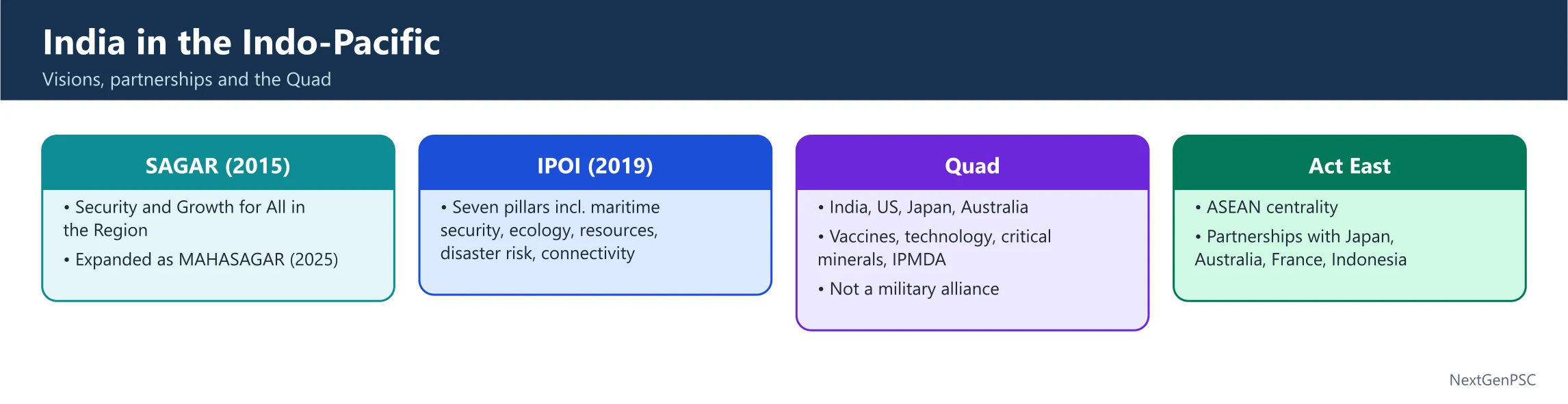
India's Indo-Pacific instruments
| Instrument | Year | Focus |
|---|---|---|
| SAGAR | 2015 | Security and growth for all in the region |
| IPOI | 2019 | Seven pillars of maritime cooperation |
| Quad leaders' summits | Since 2021 | Vaccines, technology, maritime awareness |
| MAHASAGAR | 2025 | Expanded vision covering the Global South |
Fun Facts
Japanese PM Shinzo Abe's 'Confluence of the Two Seas' speech in India's Parliament (2007) helped popularise the Indo-Pacific idea.
The Indian Navy is often the first responder in Indian Ocean disasters.
About 95% of India's trade by volume (around 70% by value) moves by sea.
Mains Key Points
Prelims Strategy Tips
UN Reforms and India's Bid for a Permanent Seat
The UN Security Council still reflects the power structure of 1945, with five permanent members holding a veto. India, along with the G4 (Brazil, Germany, Japan), seeks expansion in both permanent and non-permanent categories. Reform is blocked by the Uniting for Consensus group, divisions over the veto and the need for P5 ratification under Article 108 of the UN Charter.
The UN Security Council still reflects the power structure of 1945, with five permanent members holding a veto. India, along with the G4 (Brazil, Germany, Japan), seeks expansion in both permanent and non-permanent categories. Reform is blocked by the Uniting for Consensus group, divisions over the veto and the need for P5 ratification under Article 108 of the UN Charter.
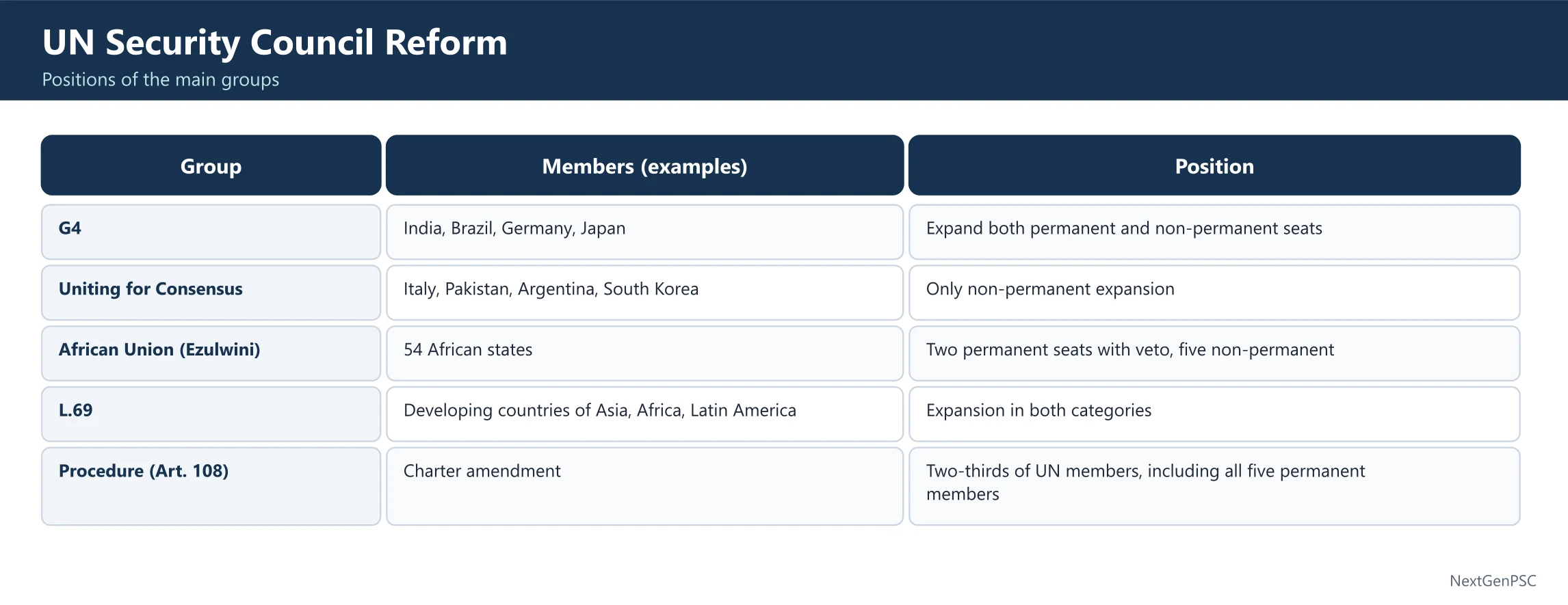
Positions on UNSC reform
| Group | Members (examples) | Position |
|---|---|---|
| G4 | India, Brazil, Germany, Japan | Expand permanent and non-permanent seats |
| Uniting for Consensus | Italy, Pakistan, Argentina, South Korea | Only non-permanent expansion |
| African Union | 54 African states | Two permanent seats with veto, five non-permanent |
| L.69 | Developing countries from Asia, Africa, Latin America | Expansion in both categories |
Fun Facts
India was among the founding members of the UN in 1945, before independence.
Vijaya Lakshmi Pandit was the first woman President of the UN General Assembly (1953).
India deployed the first all-women formed police unit for UN peacekeeping in Liberia (2007).
Mains Key Points
Prelims Strategy Tips
Effect of Policies and Politics of Developed and Developing Countries on India's Interests
The GS II syllabus asks how policies and politics of other countries affect India. Key examples include protectionism and tariffs, immigration rules (H-1B visas), the EU's Carbon Border Adjustment Mechanism (CBAM), sanctions on Russia and Iran, China's export controls on critical minerals, the paralysis of the WTO, climate finance politics and debt crises in developing countries. India responds through diversified trade agreements, self-reliance and Global South leadership.
The GS II syllabus asks how policies and politics of other countries affect India. Key examples include protectionism and tariffs, immigration rules (H-1B visas), the EU's Carbon Border Adjustment Mechanism (CBAM), sanctions on Russia and Iran, China's export controls on critical minerals, the paralysis of the WTO, climate finance politics and debt crises in developing countries. India responds through diversified trade agreements, self-reliance and Global South leadership.
External policies and their impact on India
| Policy | Country/bloc | Impact on India |
|---|---|---|
| Tariff increases | USA | Pressure on exports and jobs |
| CBAM | European Union | Costs for steel and aluminium exporters |
| H-1B changes | USA | Effect on IT professionals and remittances |
| Export controls on rare earths | China | Supply risks for EVs and electronics |
| Sanctions on Iran/Russia | USA, EU | Energy, Chabahar and defence payment issues |
Fun Facts
EFTA comprises Switzerland, Norway, Iceland and Liechtenstein.
India hosted the first Voice of the Global South Summit virtually in January 2023.
The WTO replaced GATT in 1995.
Mains Key Points
Prelims Strategy Tips
Chapter Complete!
Congratulations! You've completed all chapters.