
Assessing five decades of the bonded labour system (Abolition) Act, 1976
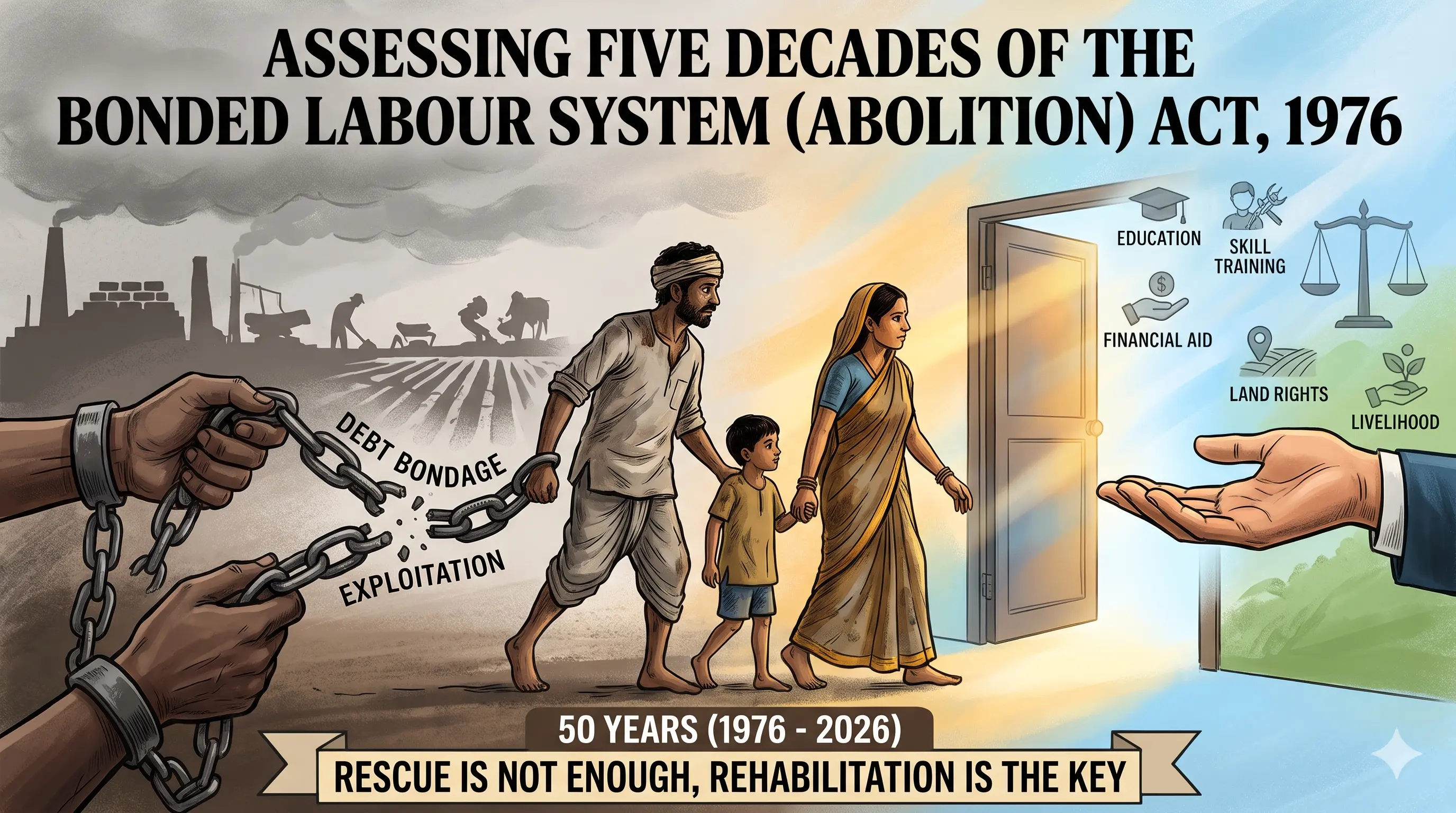
The Bonded Labour System (Abolition) Act, 1976 marked its 50th anniversary in 2026. This article assesses its five-decade journey, highlighting that while legal frameworks and rescue operations have improved, systemic issues like poverty, caste-based vulnerability, and delayed rehabilitation continue to perpetuate cyclical and inter-generational bondage in India's informal sectors.
Introduction
Context & Background
Key Points
- •Abolition and Debt Extinguishment: The Act legally extinguishes all forms of bonded labour, renders such arrangements void, and explicitly cancels all inherited or coercive financial liabilities (bonded debts).
- •Protection from Displacement: Freed labourers are legally protected from being evicted from homesteads or lands they previously occupied due to their bonded arrangements.
- •District-Level Implementation: Enforcement is entrusted to District Magistrates, who are assisted by Vigilance Committees responsible for the identification, release, and monitoring of bonded labourers.
- •Comprehensive Rehabilitation Mandate: The legal framework goes beyond mere rescue; it mandates financial assistance, housing support, land allotment, and livelihood rehabilitation to prevent individuals from falling back into bondage.
- •Statutory and Penal Network: Alongside the 1976 Act, forced labour is severely criminalised under Section 143 of the Bharatiya Nyaya Sanhita, and supported by safeguards in the Juvenile Justice Act and the SC/ST (Prevention of Atrocities) Act.
Constitutional Safeguards Against Forced Labour
| Article | Provision | Significance | Bookmark |
|---|---|---|---|
| Article 23 | Prohibits human trafficking, begar, and all forms of forced labour. | Direct prohibition with penal consequences for violations. | |
| Article 24 | Forbids employment of children below 14 years in factories, mines, etc. | Protects child rights in hazardous and exploitative environments. | |
| Article 39(e) & (f) | Directs the State to protect workers and children from exploitation. | Ensures conditions consistent with human dignity and healthy development. | |
| Article 21 | Right to life expanded to include the right to live with dignity. | Judicial interpretation provides overarching protection from exploitative labour. |
Government Initiatives for Eradication
| Scheme/Initiative | Focus Area | Objective | Bookmark |
|---|---|---|---|
| Central Sector Scheme for Rehabilitation | Financial & Legal Support | Provides graded financial assistance (₹1–3 lakh), skill development, and legal aid. | |
| Anti-Human Trafficking Units | Enforcement & Rescue | State-level units for investigation, rescue, and inter-agency coordination. | |
| Ujjawala Scheme | Trafficking Victims | Focuses on prevention, rescue, rehabilitation, and reintegration of victims. | |
| Integrated Child Protection Scheme | Child Welfare | Ensures care and rehabilitation of trafficked and exploited children. | |
| Skill India Mission & PMKVY | Livelihood Generation | Enhances employability of vulnerable populations, including released labourers. |
Related Entities
Impact & Significance
- •Inter-generational Poverty: Bondage traps families in a vicious cycle where debts and obligations are passed down, denying successive generations access to education, fair wages, and social mobility.
- •Erosion of Human Dignity: The practice severely compromises the fundamental rights guaranteed under Article 21, stripping individuals of their freedom of choice and bodily autonomy.
- •Exploitation in the Informal Sector: The persistence of bondage fuels the unregulated informal economy, particularly in sectors like brick kilns, quarries, and agriculture, which rely heavily on suppressed labour costs.
- •Reinforcement of Social Hierarchies: It perpetuates deep-seated caste inequalities, as marginalized communities—especially Dalits and backward classes—disproportionately constitute the vulnerable workforce.
Challenges & Criticism
- •Poverty and Indebtedness: Low, irregular incomes and lack of formal credit systems push vulnerable households into taking coercive financial advances from employers.
- •Implementation and Enforcement Deficit: Despite robust laws, there are abysmally low conviction rates, and many cases remain entirely unreported due to the hidden nature of bondage.
- •Delayed Rehabilitation: Significant lags in providing financial compensation and livelihood support often force rescued labourers to re-enter exploitative work simply to survive.
- •Caste and Sectoral Collusion: Entrenched social discrimination against marginalized groups, combined with certain industries' heavy reliance on cheap, tied labour, creates strong resistance to regulatory reform.
Future Outlook
- •Robust Enforcement: Ensuring strict compliance with statutory mandates through regular inspections and robust accountability mechanisms for enforcing agencies.
- •Proactive Identification: Conducting targeted surveys and executing rescue operations in high-risk sectors (like brick kilns and quarries) and vulnerable regions.
- •Time-Bound Rehabilitation: Delivering immediate financial assistance, skill training, and social security linkages to prevent victims from relapsing into exploitative work.
- •Awareness and Legal Literacy: Empowering vulnerable communities to recognize exploitative practices and report them without fear.
- •Inclusive Development Strategy: Addressing root causes through rural employment generation, universal education, and strengthening comprehensive social protection networks.
UPSC Relevance
- • GS-1 (Indian Society): Issues related to poverty, developmental issues, and the societal impact of caste inequalities.
- • GS-2 (Social Justice & Governance): Welfare schemes for vulnerable sections, mechanisms, laws, institutions, and Bodies constituted for the protection and betterment of these vulnerable sections.
- • Essay Topics: 'Social justice is a mirage without economic empowerment', '50 years of anti-bondage laws: Successes and Failures'.
- • Mains Focus: Analyzing the gap between the statutory abolition of bonded labour and the reality of its persistence in the informal sector.
Sample Questions
Prelims
Consider the following statements regarding the legal and constitutional safeguards against forced labour in India:
- (a)Article 23 of the Indian Constitution expressly prohibits human trafficking, begar, and other similar forms of forced labour.
- (b)Under the Bonded Labour System (Abolition) Act, 1976, extinguished debts can still be recovered through civil courts.
- (c)District Magistrates are solely responsible for rehabilitation without the involvement of any external or local committees.
Mains
Despite the completion of 50 years of the Bonded Labour System (Abolition) Act, 1976, cyclical and inter-generational bondage remains a reality in India. Analyze the structural causes behind this persistence and suggest measures for effective eradication.
Introduction: Introduce the Bonded Labour System (Abolition) Act, 1976 and its core objectives. Mention that while 50 years have passed, reports of ongoing bondage in informal sectors highlight a persistent gap between legislation and ground reality.
Body:
• Structural Causes: Deep-rooted poverty and indebtedness; Informalisation of work lacking regulatory protection (as noted by NSSO); Caste-based vulnerabilities disproportionately affecting Dalit and backward communities.
• Implementation Failures: Weak enforcement resulting in low conviction rates (NCRB data); The hidden nature of bondage in sectors like agriculture and brick kilns; Delayed rehabilitation pushing victims back into exploitative work.
• Measures for Eradication: Robust, proactive identification through targeted surveys; Time-bound delivery of comprehensive rehabilitation (financial and livelihood); Enhancing legal literacy and pursuing inclusive development strategies.
Conclusion: Conclude by emphasizing that while legislation provides the necessary legal framework, the actual eradication of bonded labour requires a holistic approach that simultaneously tackles the socio-economic vulnerabilities—such as poverty and caste discrimination—that fuel the system.