
Booster Shot for Education and Skilling: Union Budget 2026–27
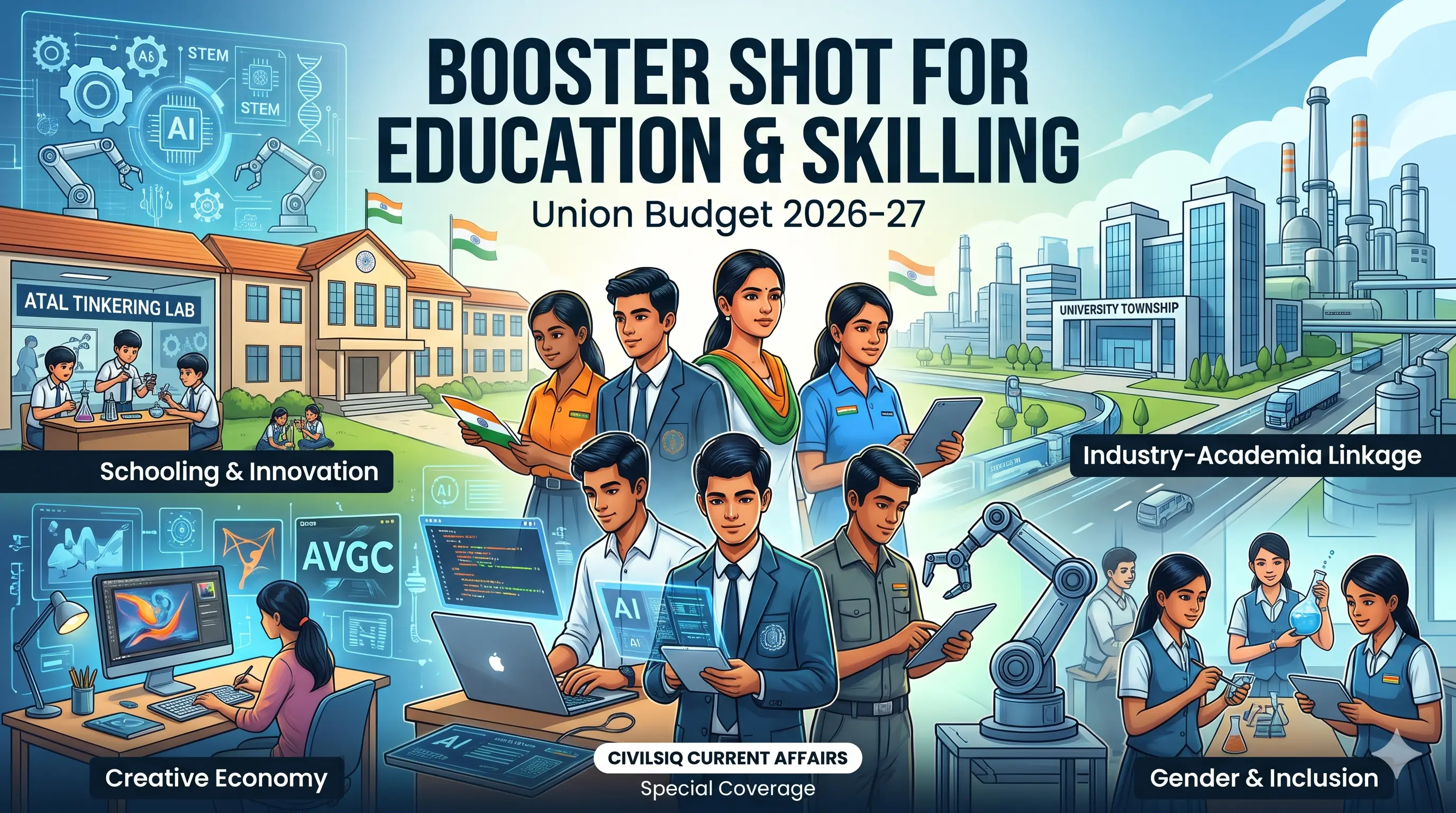
The Union Budget 2026–27 places a strategic emphasis on education and skilling to harness India's demographic dividend. Highlighting massive allocation hikes for the Education Ministry and Skill Development, the budget introduces forward-looking initiatives like University Townships, Content Creator Labs for the AVGC sector, and increased funding for Atal Tinkering Labs to align formal education with emerging labour market demands.
Introduction
Context & Background
Key Points
- •Unprecedented Financial Push: An allocation of ₹1.39 lakh crore to the Education Ministry (a 14.21% rise) and a massive 62% jump for the Ministry of Skill Development (₹9,885.8 crore) highlight a clear fiscal prioritization of human capital formation.
- •Innovation at the Core (Atal Tinkering Labs): The budget for ATLs saw a massive ₹2,700 crore jump. This emphasizes early exposure to emerging technologies like AI and robotics to align school learning with future industry needs.
- •Education-to-Employment Linkages: The establishment of five University Townships near industrial corridors aims to bridge the gap between academic theory and real-world industrial demands through internships and applied research.
- •Boosting the Creative Economy: Recognizing the boom in digital media, the setup of Content Creator Labs in 15,000 secondary schools and 500 colleges targets the high-growth AVGC sectors, promoting digital entrepreneurship.
- •Tax Relief for Global Exposure: The reduction of Tax Collected at Source (TCS) from 5% to 2% for students studying abroad eases the financial burden on middle-class families and encourages global knowledge transfer.
- •Institutional Capacity Building: Upgrading SCERTs and Teacher Training Institutes focuses on improving pedagogical quality and shifting towards modern, learner-centric teaching methods.
Key Fiscal Allocations and Enhancements (Budget 2026-27)
| Sector / Scheme | Allocation / Increase | Primary Objective | Bookmark |
|---|---|---|---|
| Ministry of Education | ₹1.39 lakh crore | 14.21% increase for strengthening school education, innovation, and employability. | |
| Ministry of Skill Development (MSDE) | ₹9,885.8 crore | 62% increase to address youth unemployment and market-aligned skill certification. | |
| Samagra Shiksha Scheme | + ₹4,100 crore | Infrastructure support, digital learning expansion, and teacher training. | |
| Atal Tinkering Labs (ATL) | ₹3,200 crore (from ₹500 cr) | Promoting AI, robotics, coding, and design thinking in schools. | |
| PM Poshan Scheme | + ₹2,150 crore | Strengthening nutritional support to improve student attendance and health. |
New Initiatives and Institutional Strengthening
| Initiative | Scale / Location | Strategic Purpose | Bookmark |
|---|---|---|---|
| University Townships | 5 Clusters | Located near industrial corridors to enhance industry-academia collaboration and applied research. | |
| Content Creator Labs | 15,000 schools & 500 colleges | Mainstreaming AVGC (Animation, Visual Effects, Gaming, Comics) skills for the creative economy. | |
| Girls in STEM Hostels | Every district | Reducing socio-economic barriers and boosting female participation in STEM fields. | |
| National Institute of Design (NID) | Eastern India | Ensuring regional balance in design education for manufacturing and fashion. |
Related Entities
Impact & Significance
- •Tackling Youth Unemployment: The 62% rise in the MSDE budget directly addresses the urgent need to certify and place youth in market-relevant jobs.
- •Bridging the Gender Gap: By constructing dedicated girls' hostels in every district, the budget directly attacks the socio-economic and safety barriers that prevent adolescent girls from pursuing higher education in STEM.
- •Alleviating Middle-Class Burden: The reduction of the TCS rate for foreign education makes global skill acquisition significantly more accessible to middle-income families.
- •Holistic Child Development: The substantial hike in the PM Poshan scheme acknowledges that cognitive development and learning outcomes are inextricably linked to childhood nutrition.
Challenges & Criticism
- •Implementation Bottlenecks: Education is on the Concurrent List. The success of initiatives like SCERT upgrades and Samagra Shiksha heavily relies on the financial and administrative cooperation of State Governments.
- •Quality of Training vs. Infrastructure: While building University Townships and ATLs is a positive step, finding adequately trained teachers and instructors for AI, robotics, and AVGC sectors remains a massive hurdle.
- •The Digital Divide: Though digital and blended learning are prioritized, deep infrastructural deficits (like stable internet and electricity) in rural India might limit the reach of high-tech initiatives to urban and semi-urban centers.
Future Outlook
- •Curriculum Overhauls: Guided by the newly proposed High-Powered Standing Committee, curricula from the school level upward will increasingly integrate AI, emerging technologies, and entrepreneurship.
- •Mainstreaming the Gig and Creator Economy: By formally integrating AVGC training into schools, India aims to build a globally competitive workforce for the media, entertainment, and digital content sectors.
- •Industry-Academia Symbiosis: The success of University Townships could serve as a blueprint for scaling integrated higher-education clusters nationwide, dramatically improving graduate employability.
UPSC Relevance
- • GS-2 (Social Justice): Issues relating to development and management of Social Sector/Services relating to Education, Human Resources.
- • GS-3 (Economy): Indian Economy and issues relating to planning, mobilization of resources, growth, development and employment.
- • Essay Topics: 'Demographic Dividend or Demographic Disaster?', 'The Role of Technology and Innovation in Transforming Indian Education'.
- • Mains Focus: Analyzing the shift from rote-learning infrastructure to employability-linked education (NEP 2020 alignment).
Sample Questions
Prelims
Consider the following statements regarding the education and skilling initiatives highlighted in the Union Budget 2026-27:
- (a)The PM Skilling and Employability Transformation Programme is administered by the Ministry of Education.
- (b)Atal Tinkering Labs (ATLs) aim to provide hands-on exposure to emerging technologies like robotics and AI at the school level.
- (c)The Union Budget 2026-27 increased the Tax Collected at Source (TCS) on foreign education remittances to discourage studying abroad.
Mains
The Union Budget 2026-27 represents a paradigm shift from prioritizing educational access to ensuring market-aligned employability and innovation. Discuss the key initiatives introduced in the budget to facilitate this transition.
Introduction: Define the context—India's demographic dividend and the chronic issue of unemployable graduates. Mention the ₹1.39 lakh crore allocation as a statement of intent.
Body:
• Innovation & Future Skills: Massive jump in Atal Tinkering Labs (ATL) funding; establishment of Content Creator Labs for AVGC sectors to harness the digital economy.
• Industry-Academia Linkage: Creation of 5 University Townships near industrial corridors; the High-Powered Standing Committee for structured education-to-employment pathways.
• Inclusion & Quality: Girls' hostels for STEM in every district to bridge the gender gap; upgrading SCERTs; ₹2,150 crore hike in PM Poshan for retention.
Conclusion: Conclude by highlighting that while the financial commitments are historically significant, the true realization of the demographic dividend will depend on cooperative federalism and the effective on-ground implementation by state governments.