
Circular Economy in Agriculture
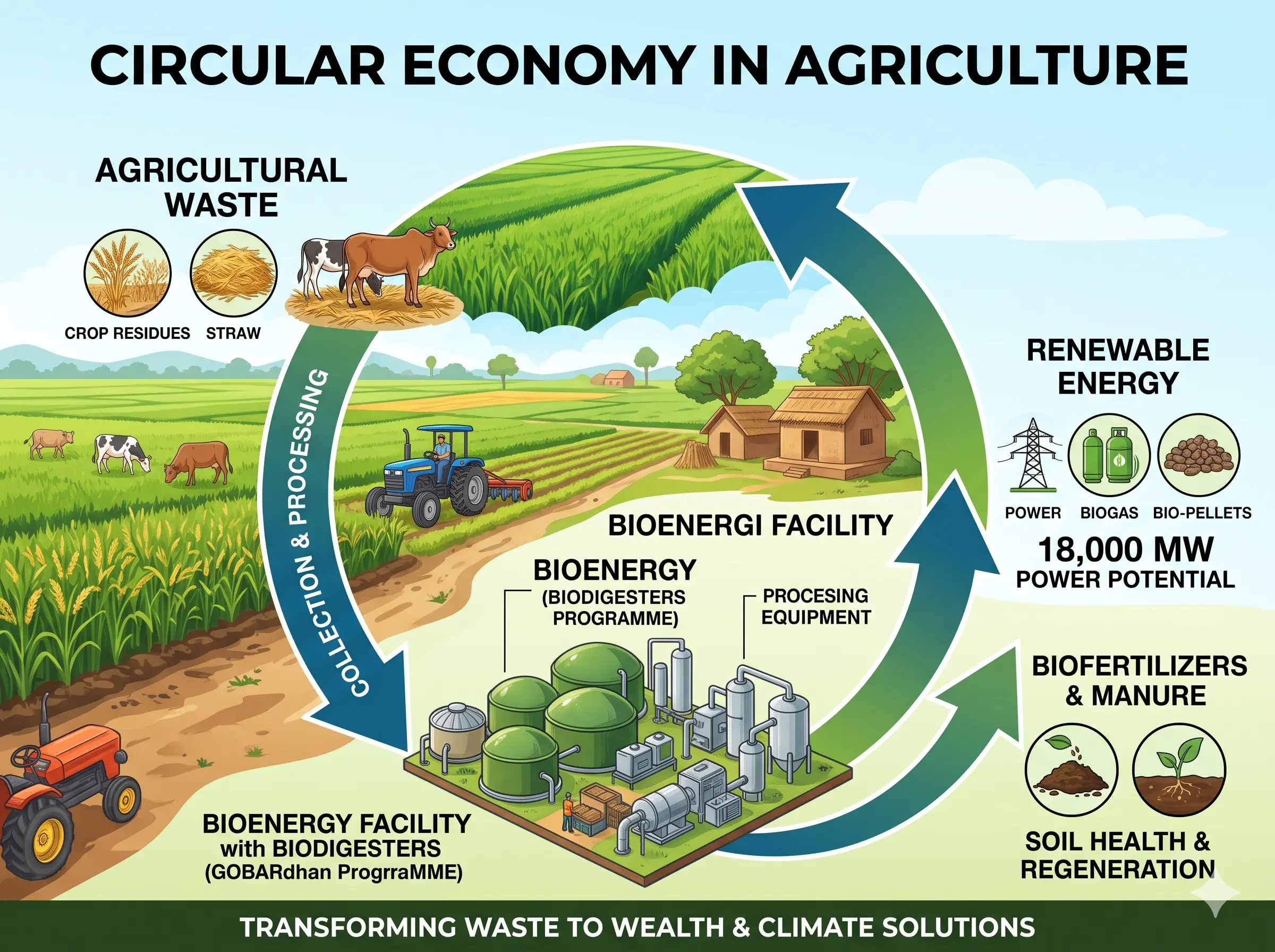
India’s rising agricultural waste demands sustainable management; transitioning to a circular economy can convert 350 million tonnes of waste into energy, income, and climate solutions, targeting a $2 trillion market by 2050.
Introduction
Context & Background
Key Points
- •Rural Economic Growth: Converting waste into bioenergy and biofertilizers can boost farmer incomes and create rural employment opportunities.
- •High Waste Generation: India produces nearly 350 million tonnes of agricultural waste annually, much of which is underutilised or burnt.
- •Renewable Energy Potential: Agricultural residues can generate over 18,000 MW of power, reducing dependence on coal-based energy.
- •Biomass Availability: India has around 228 million tonnes of surplus biomass annually, sufficient for large-scale bioenergy use.
- •Climate Concerns: Globally, 1.3 billion tonnes of food are wasted annually, contributing significantly to methane emissions.
Current Scenario & Potential
| Indicator | Status / Potential | Bookmark |
|---|---|---|
| Waste Burden | 350 million tonnes of agricultural waste generated annually. | |
| Power Potential | Can generate over 18,000 MW of renewable energy. | |
| Implementation Gap | Only 1.62 MMT used against the 38.55 MMT mandated. | |
| Economic Vision | Targets a $2 trillion market and 10 million jobs by 2050. |
Key Government Measures
| Scheme / Policy | Objective | Bookmark |
|---|---|---|
| GOBARdhan Programme | Converts cattle dung and crop residues into compressed biogas (CBG) and organic manure. | |
| Crop Residue Management (CRM) | Prevents stubble burning via subsidised machinery (e.g., Happy Seeders) and decentralised management. | |
| Agriculture Infrastructure Fund (AIF) | Reduces post-harvest losses by financing storage and agro-processing infrastructure. | |
| Biomass Co-firing Policy | Mandates 5–7% agro-residue use in coal plants to cut emissions. |
Related Entities
Impact & Significance
- •Energy Security: Tapping into the 18,000 MW power potential can significantly reduce the country's dependence on coal.
- •Rural Livelihoods: The sector has the potential to grow into a $2 trillion market, generating up to 10 million rural jobs by 2050 through waste collection and processing.
- •Climate Action: Effective residue management mitigates greenhouse gas emissions from open burning and rotting waste.
- •Soil Restoration: Processing waste into organic manure helps replenish soil nutrients and organic carbon lost to intensive farming practices.
Challenges & Criticism
- •Logistical Barriers: Dispersed and seasonal waste generation makes aggregation, transport, and storage highly expensive.
- •Co-firing Deficit: Weak supply chains and inadequate pellet manufacturing capacity lead to massive shortfalls in meeting biomass co-firing targets.
- •Technology & Infrastructure Gaps: Limited deployment of biochar and underutilization of cold storages limit value addition.
- •Coordination Deficit: Overlapping jurisdictions of multiple ministries result in poor outcome-based monitoring for schemes like biogas plants.
- •Market Uncertainty: Lack of assured procurement and fluctuating pellet prices (₹1.8–2.3 per 1,000 kcal) deter farmers and entrepreneurs from participating.
Future Outlook
- •Outcome Monitoring: Shift from mere fund allocation to tracking measurable indicators like the actual reduction in stubble burning and biomass utilisation rates.
- •Supply Strengthening: Expand pellet manufacturing capacity beyond the current 30,000 tonnes per day and secure storage to meet the 38.55 MMT co-firing demand.
- •Regulatory Clarity: Establish national boiler compatibility standards and clearly earmark environmental compensation funds for corrective action.
- •Enforcement Consistency: Ensure uniform compliance across states through strict penalties and coordinated inter-ministerial implementation.
UPSC Relevance
- • GS-3 (Economy & Agriculture): Economics of animal-rearing, direct/indirect farm subsidies, and technology in the aid of farmers.
- • GS-3 (Environment): Conservation, environmental pollution (stubble burning), and renewable energy resources.
- • Mains Focus: Analyzing the logistical and policy hurdles in implementing a circular economy in Indian agriculture.
Sample Questions
Prelims
Consider the following statements regarding agricultural waste management in India:
- (a)The Biomass Co-firing Policy mandates the use of 25-30% agro-residue in all coal plants.
- (b)The GOBARdhan scheme aims to manage cattle dung and crop residues to produce Compressed Biogas (CBG).
- (c)India currently utilizes its entire agricultural waste for renewable energy generation without any implementation gap.
Mains
Transitioning to a circular economy in agriculture is essential not just for environmental sustainability, but for rural economic empowerment. Discuss the challenges hindering this transition in India and suggest a suitable way forward.
Introduction: Define circular economy in the context of agriculture. Mention the current context of India generating 350 million tonnes of agricultural waste annually.
Body:
• Economic & Environmental Potential: Discuss the 18,000 MW renewable energy potential, creation of 10 million jobs, and reduction in methane/black carbon emissions.
• Current Challenges: Highlight logistical barriers (transporting 350M tonnes of waste), co-firing deficits (only 1.62 MMT used), technology gaps, and market uncertainty.
• Way Forward: Emphasize outcome-based monitoring, supply chain strengthening for pellets, regulatory clarity, and uniform enforcement across states.
Conclusion: Conclude that shifting from a 'take-make-dispose' model to a circular approach is vital for achieving India's climate goals and doubling farmers' incomes.