
Denotified Tribes and the 2027 Census: Demand for Separate Recognition
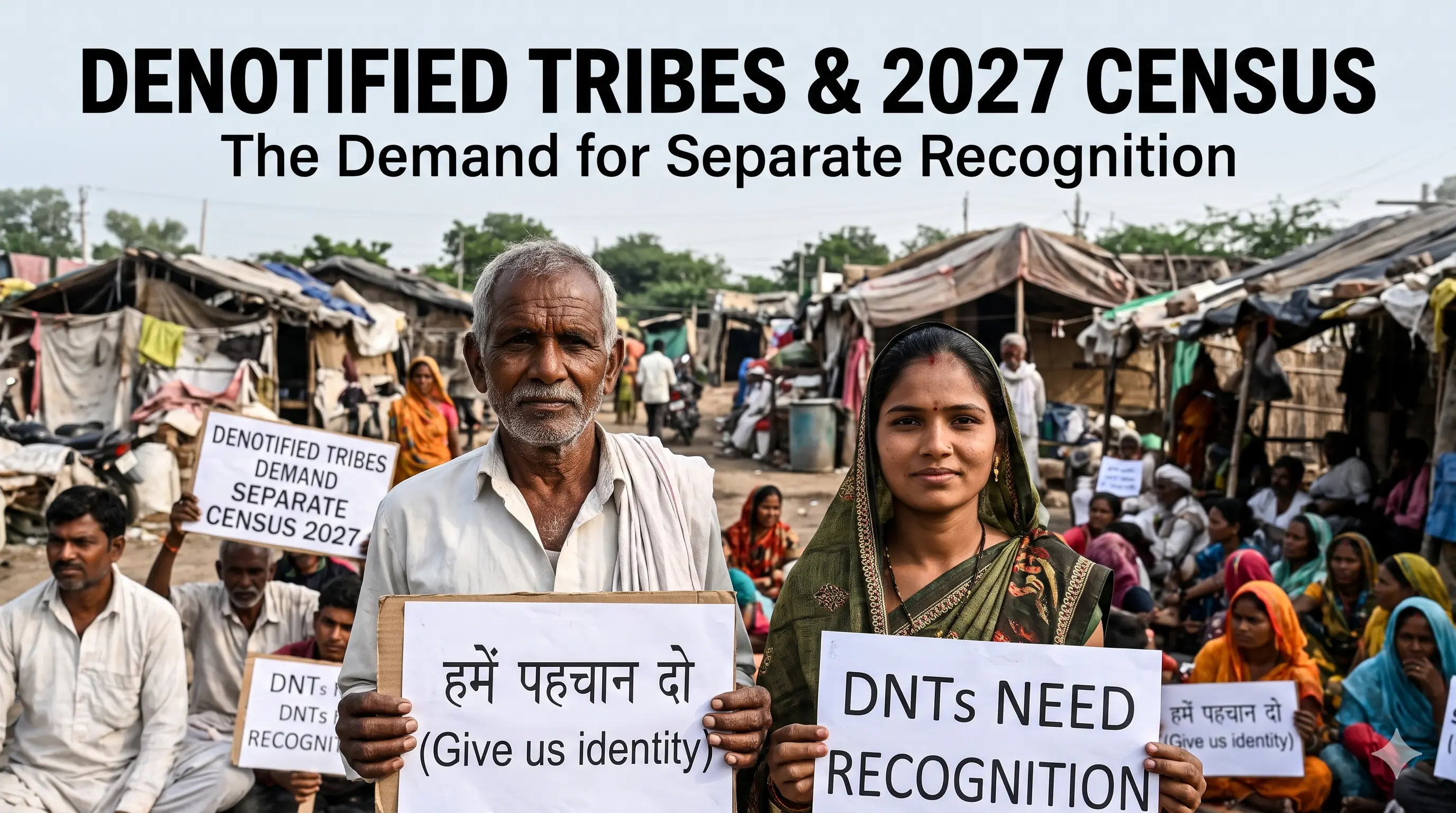
Denotified, Nomadic, and Semi-Nomadic Tribes (DNTs, NTs, SNTs) are demanding distinct constitutional recognition and a separate column in the 2027 Census. Historically stigmatized under colonial legislation, these marginalized groups face severe misclassification and administrative hurdles that prevent equitable access to targeted welfare schemes.
Introduction
Context & Background
Key Points
- •Colonial Legacy & Criminal Tribes Act, 1871: Nomadic and semi-nomadic groups were arbitrarily stamped as 'hereditary criminals' under British colonial law. Although the Act was repealed in 1952, deep-seated societal stigma and police harassment have endured across generations.
- •Misclassification & Entitlement Dilution: The Idate Commission (2017) mapped 1,526 communities and revealed that nearly 269 groups do not figure in SC, ST, or OBC lists. Even when included, they compete against far more socio-politically organized groups, effectively crowding them out of reservations and welfare.
- •The 2027 Census Imperative: In the absence of an official, nationwide empirical baseline of the DNT population, policies remain poorly targeted. A dedicated census category or code is required to accurately map their socio-economic realities and allocate fiscal budgets proportionally.
- •Administrative Hurdles & Certificate Bottlenecks: Obtaining official DNT certificates from state administrations remains excessively difficult, serving as the single largest structural barrier preventing access to schemes like SEED.
- •Supreme Court Precedent on Sub-Classification: The landmark 2024 Supreme Court verdict validating sub-classification inside reserved quotas strengthens the legal and policy basis for addressing severe internal inequalities between settled and nomadic groups.
Key Milestones in DNT Rights and Governance
| Initiative / Event | Year | Significance / Impact | Bookmark |
|---|---|---|---|
| Criminal Tribes Act, 1871 | 1871 | Colonial legislation that systematically notified hundreds of nomadic communities as 'born criminals', institutionalizing social exclusion and generational stigma. | |
| Repeal of Criminal Tribes Act | 1952 | Formally 'denotified' these groups; however, they were absorbed haphazardly into existing categories without distinct constitutional safeguards. | |
| Idate Commission Report | 2017 | Identified 1,526 DNT, NT, and SNT communities, highlighting that 269 communities remain completely outside SC, ST, and OBC classifications. | |
| Scheme for Economic Empowerment of DNTs (SEED) | 2022 | Targeted central welfare initiative with ₹200 crore allocation; witnessed gross underutilization (only ₹69.3 crore spent between 2020 and 2025). | |
| Supreme Court Sub-Classification Ruling | 2024 | Permitted sub-classification within reserved categories, bolstering arguments for addressing unequal levels of deprivation among DNT communities. |
Major Government Initiatives and Welfare Frameworks
| Scheme / Mechanism | Objective & Components | Implementation Gaps / Limitations | Bookmark |
|---|---|---|---|
| SEED Scheme (2022) | Livelihood support, competitive exam coaching, health insurance, and housing assistance via DWBDNC. | Only ₹69.3 crore utilized out of ₹200 crore allocation (2020–2025) due to certification delays and low awareness. | |
| Dr. Ambedkar Pre- and Post-Matric Scholarships | Educational financial support for DNT students not covered under standard SC, ST, or OBC lists. | Constrained reach caused by lack of recognized identity documentation. | |
| Nanaji Deshmukh Hostel Scheme | Residential accommodation support for DNT students pursuing higher education. | Uneven geographical reach and lack of institutionalized tracking. | |
| Development and Welfare Board for DNTs (DWBDNC) | Implementing welfare interventions under the Ministry of Social Justice and Empowerment. | Functioning as a board rather than an autonomous permanent statutory commission. |
Related Entities
Impact & Significance
- •Eradication of Generational Stigma: Official enumeration and distinct recognition are crucial steps toward decoupling these communities from deep-rooted societal bias and routine police harassment.
- •Data-Driven Targeted Budgeting: Eliminates the policy void by establishing hard demographic numbers, allowing state and union governments to tailor resource outlays to empirical reality.
- •Equitable Distribution of Affirmative Action: Mitigates intra-category competition where dominant groups inside broad OBC/SC clusters capture reservation quotas.
- •Access to Basic Citizenship Enablers: Standardized classification streamlines the issuance of caste identity certificates, facilitating land rights, formal housing, and educational access.
Challenges & Criticism
- •Inter-State Discrepancies: The same community is often classified as SC in one state, ST in another, OBC in a third, and left unclassified elsewhere, severely complicating national enumeration.
- •Low Welfare Uptake: Programmatic funds under the SEED initiative have seen over 65% unspent allocations due to strict documentation criteria, lack of community awareness, and administrative apathy.
- •Internal Heterogeneity: Striking economic and lifestyle gaps between fully settled DNT groups and perpetually wandering Nomadic groups create divergent developmental needs that generic policies fail to address.
- •Absence of Statutory Teeth: The DWBDNC operates merely as a board without the investigative powers, constitutional protection, and autonomy enjoyed by statutory national commissions.
Future Outlook
- •Nationwide Comprehensive Enumeration: Finalizing a dedicated enumeration code in the 2027 Census to eliminate data invisibility and establish an accurate baseline for policy planning.
- •Expedited Certification Process: Launching targeted state-level administrative drives with simplified documentation standards to issue standardized DNT identity certificates.
- •Permanent Statutory Body: Implementing the core recommendation of the Idate Commission to transition the DWBDNC into an autonomous, permanent statutory commission with investigative and oversight powers.
- •Decentralized Grievance Redressal: Establishing district-level monitoring cells and partnering with local grassroots NGOs to bridge information deficits around the SEED scheme.
UPSC Relevance
- • GS-1 (Indian Society & Social Empowerment): Vulnerable sections, historical marginalization of nomadic and denotified groups, and tribal issues.
- • GS-2 (Social Justice & Governance): Welfare schemes for vulnerable sections, mechanisms, laws, and institutions constituted for their protection and betterment.
- • Essay Topics: 'The invisible citizens: Bridging historical injustice', 'Data deficit and the dilemma of targeted affirmative action'.
- • Mains Focus: Evaluating the Idate Commission recommendations, gaps in the SEED scheme, and the constitutional arguments for separate enumeration.
Sample Questions
Prelims
With reference to Denotified, Nomadic, and Semi-Nomadic Tribes (DNTs, NTs, SNTs) in India, consider the following statements:
- (a)The Criminal Tribes Act of 1871 was enacted under Lord Ripon's administration and repealed immediately upon Independence in 1947.
- (b)The Scheme for Economic Empowerment of DNTs (SEED) is implemented through the Development and Welfare Board for DNTs (DWBDNC).
- (c)All 1,526 communities identified by the Idate Commission are currently protected under the Scheduled Castes category.
Mains
“The historical criminalisation of Denotified Tribes continues to manifest in contemporary administrative and socio-economic exclusion.” Critically examine the structural challenges faced by DNTs and evaluate the rationale behind demanding a separate enumeration category in the upcoming Census.
Introduction: Define Denotified, Nomadic, and Semi-Nomadic Tribes (DNTs/NTs/SNTs) and highlight their historical branding under the Criminal Tribes Act of 1871, noting the persistent lack of official empirical data post-1952.
Body:
• Historical Stigma and Administrative Barriers: Generational social ostracism, harassment by law enforcement, and acute hurdles in procuring caste certificates at the state level.
• Classification Dilemma & Policy Deficits: Arbitrary distribution across SC/ST/OBC categories creating uneven competition; exclusion of 269 communities from all lists; underutilization of the SEED scheme (only ₹69.3 cr spent out of ₹200 cr).
• Need for Census Recognition: Enables data-driven policy targeting, equitable budgetary allocations, alignment with SC sub-classification jurisprudence, and restoring distinct cultural identity.
Conclusion: Emphasize that granting a separate enumeration column in the Census, combined with establishing a permanent statutory commission, is vital to transition from symbolic denotification to substantive justice.