
Economic Survey Recommends Aligning Policies for $100 Bn Agri-Export
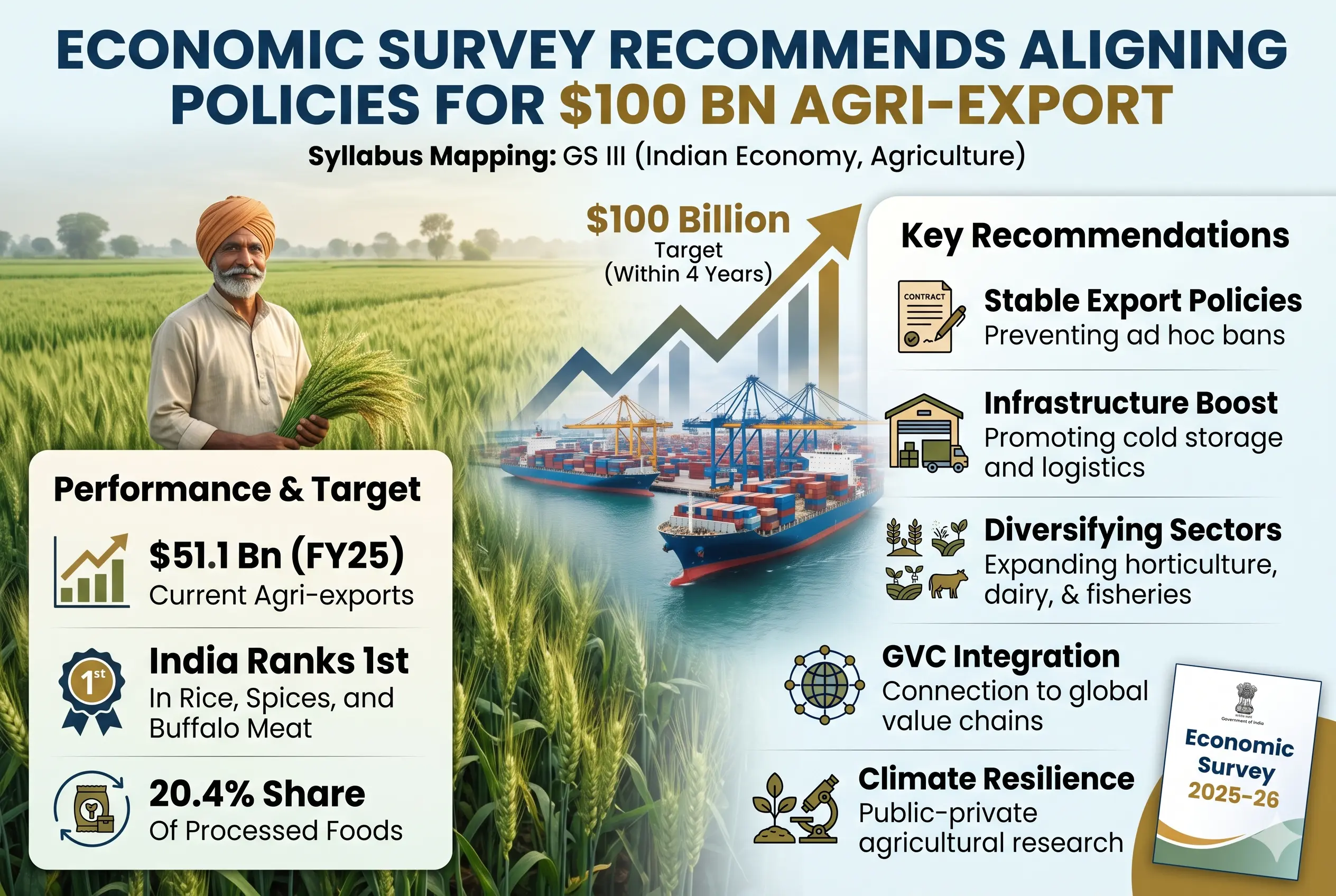
The Economic Survey 2025-26 recommends establishing a stable agricultural export policy to achieve USD 100 billion in exports within four years. While India's agri-exports reached USD 51.1 billion in FY25, challenges like policy uncertainty, infrastructure gaps, and climate risks must be addressed through private investment and global value chain integration.
Introduction
Context & Background
Key Points
- •Export Growth Outpacing Merchandise: India’s agricultural exports reached USD 51.1 billion in FY25, growing at a CAGR of 8.2% (FY20-FY25), which is faster than the overall merchandise export CAGR of 6.9%.
- •The Global Paradox: Despite being the world’s second-largest agricultural producer, India accounts for a mere 2.2% of global agricultural exports, ranking eighth overall.
- •Shifting Export Basket: There is a positive trend in value addition, with the share of processed food exports rising steadily to 20.4% of the total agri-food export basket in FY25.
- •Top Global Contributor: India currently holds the first position globally in the export of critical commodities like rice, spices, and buffalo meat.
- •Trade Surplus Under Threat: While agriculture registered a trade surplus of USD 13.4 billion in FY25, rising imports of vegetable oils and pulses are eroding this positive balance.
Performance of India's Agricultural Exports
| Indicator | Current Status | Key Details | Bookmark |
|---|---|---|---|
| Export Value (FY25) | USD 51.1 billion | 8.2% CAGR from FY20 to FY25 (Outpaced overall merchandise export growth of 6.9%) | |
| Global Standing | 8th Largest Exporter | Accounts for only 2.2% of global agricultural exports despite being the 2nd largest producer | |
| Lead Exports | Rank 1 Globally | India is the top exporter of rice, spices, and buffalo meat | |
| Processed Food | 20.4% Share | Steady rise in the share of processed food in the agri-food export basket | |
| Trade Balance | USD 13.4 billion surplus | Surplus is shrinking due to faster growth in imports of vegetable oils and pulses |
Related Entities
Impact & Significance
- •Farmers' Income: Doubling exports to $100 billion directly correlates with better price realization and higher incomes for farmers.
- •Foreign Exchange & Trade Balance: A robust agri-export sector acts as a buffer for India's overall trade deficit, counteracting the rising import bills for vegetable oils and pulses.
- •Rural Employment: Shifting towards processed foods (value addition) and developing cold chain infrastructure will generate massive non-farm rural employment.
- •Global Supplier Credibility: Establishing a stable export policy positions India as a dependable partner in global food security.
Challenges & Criticism
- •Policy Uncertainty: Ad hoc and sudden export bans on essential commodities like wheat, rice, and sugar undermine India's credibility as a reliable global supplier.
- •Infrastructure Gaps: Severe lack of post-harvest infrastructure, particularly cold storage, severely limits access to high-value export markets and causes wastage.
- •Climate & Yield Vulnerabilities: Fragmented landholdings and climate change (erratic rainfall, heatwaves) threaten crop yields, keeping them below global averages.
- •Market Access Barriers: Stringent sanitary and phytosanitary (SPS) standards in Western and developed markets often block Indian agricultural exports.
- •Policy Trade-offs: Expansion of maize-based ethanol production risks diverting crops away from food and feed, potentially increasing reliance on food imports.
Future Outlook
- •Private Investment: A strong push to strengthen private participation in food processing, cold chains, and logistics to dramatically improve export competitiveness.
- •Diversification of Growth Sectors: Shifting focus to high-growth areas such as horticulture, agroforestry, dairy, poultry, and fisheries to diversify the export basket.
- •Global Value Chain (GVC) Integration: Transitioning from a restrictive 'buy Indian' approach to deeper and more seamless integration into global value chains.
- •Market & Climate Systems: Enhancing price discovery through platforms like e-NAM and the Agriculture Infrastructure Fund (AIF), alongside coordinated public-private research for climate resilience.
UPSC Relevance
- • GS-3 (Indian Economy & Agriculture): Issues related to direct and indirect farm subsidies, agricultural marketing, and export policies.
- • GS-3 (Food Processing): Scope and significance, location, upstream and downstream requirements, supply chain management.
- • Mains Focus: Analyzing the paradoxical nature of Indian agriculture (high production vs. low export share) and suggesting policy alignments.
Sample Questions
Prelims
With reference to India's agricultural exports as per the Economic Survey 2025-26, consider the following statements:
- (a)India accounts for more than 5% of global agricultural exports.
- (b)The share of processed food in India’s agri-food export basket has increased to over 20%.
- (c)India currently faces a trade deficit in agricultural commodities.
Mains
Despite being the world's second-largest agricultural producer, India accounts for only a fraction of global agricultural exports. Analyze the constraints hindering India's agri-export potential and discuss the recommendations of the Economic Survey 2025-26 to achieve the $100 billion export target.
Introduction: Briefly state India's current agri-export status ($51.1 billion in FY25, 2.2% global share) and introduce the Economic Survey 2025-26 target of reaching $100 billion in four years.
Body:
• Constraints: Policy uncertainty (ad hoc export bans on wheat/rice); Infrastructure gaps (inadequate cold storage/logistics); Climate risks (erratic rainfall); Stringent sanitary and phytosanitary (SPS) market access barriers; Yield constraints.
• Recommendations: Stable export policies to build supplier credibility; Enhancing private investment in food processing and cold chains; Focusing on high-growth sectors (horticulture, dairy); Integrating into Global Value Chains (GVCs).
• Market Integration: Utilizing e-NAM and the Agriculture Infrastructure Fund (AIF) for better price discovery and post-harvest management.
Conclusion: Conclude by stating that a paradigm shift from ad hoc domestic food security measures to a balanced, long-term export strategy is essential to double farmers' income and secure India's position as a reliable global food supplier.