
Fertiliser Sector Regulation in India
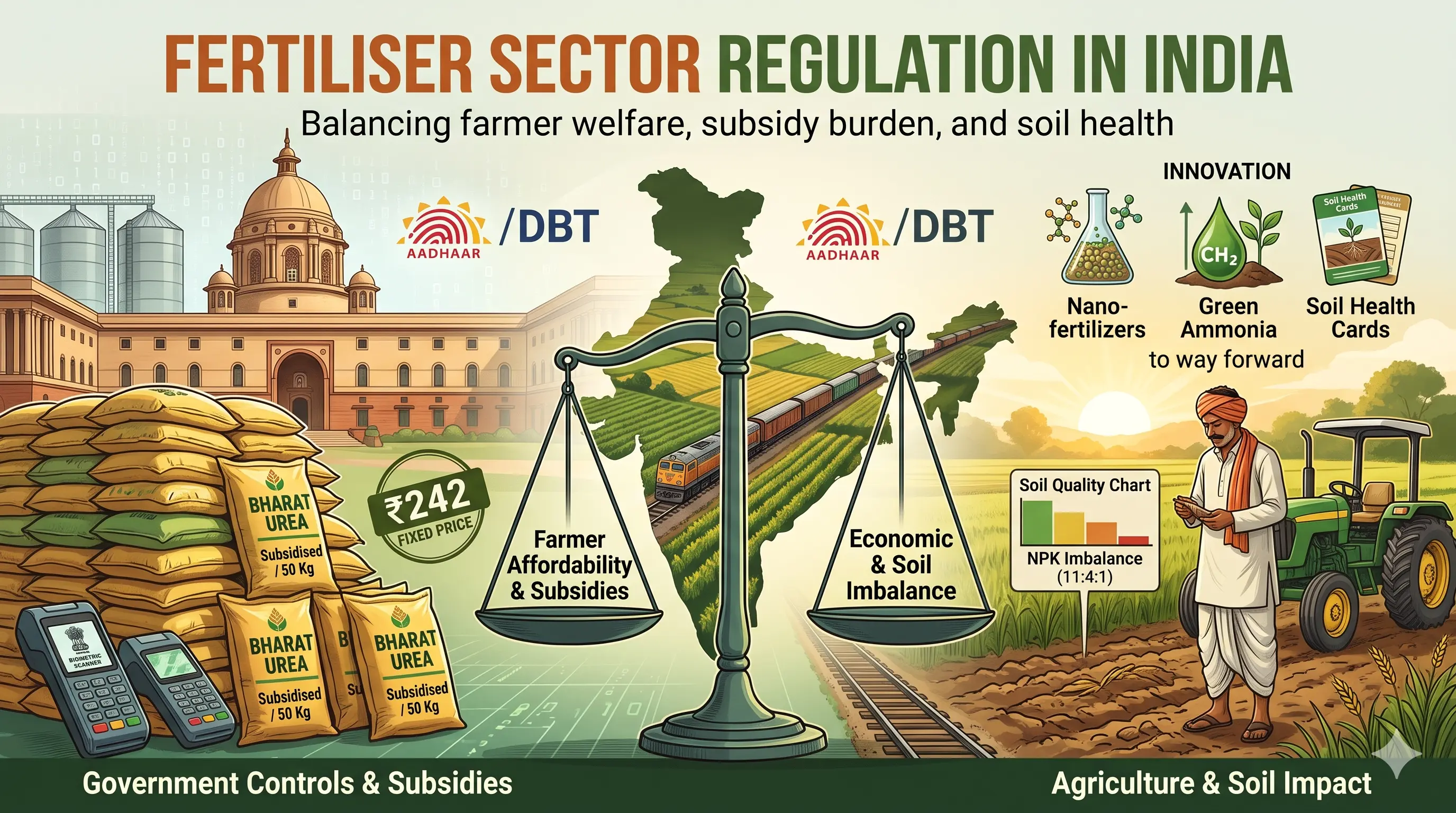
The Uttar Pradesh Government's recent ban on the sale of non-subsidised speciality nutrients by authorised fertiliser dealers has reignited discussions on India's fertiliser regulatory regime, highlighting the delicate balance between farmer protection, subsidy management, and market innovation.
Introduction
Context & Background
Key Points
- •Inflation Insulation: Fixed urea pricing shields the domestic cost of cultivation and the MSP regime from global volatility in natural gas and phosphoric acid prices.
- •Equitable Distribution: Centralised “rake” allocation ensures adequate supply in remote or logistically unviable districts that a purely profit-driven market might underserve.
- •Anti-Tagging Safeguard: Regulatory restrictions on “tied-in” sales protect marginal farmers from the coercive bundling of essential urea with high-margin, non-subsidised nutrients.
- •Leakage Reduction: Aadhaar-linked Point of Sale (PoS) verification successfully curbs the diversion of agricultural urea to industrial sectors such as plywood, resins, and synthetic milk.
- •Quality Standardisation: Uniform “Bharat” branding and stringent central oversight reduce the proliferation of spurious or sub-standard fertiliser mixtures in local markets.
Current Regulatory Framework for Fertilisers
| Regulatory Tool | Description | Impact / Implication | Bookmark |
|---|---|---|---|
| Statutory Pricing | Central Government legally fixes pan-India MRP of urea at ₹242 per 45 kg bag. | Shields domestic costs from global volatility but encourages overuse. | |
| Administrative Oversight | Enforces “Reasonableness of MRP” on P&K fertilisers under Nutrient-Based Subsidy (NBS). | Ensures affordability while managing government subsidy outflow. | |
| Logistical Command | Fertiliser Movement Control Order 1973 allows DoF to determine rail destinations. | Ensures equitable supply across states, preventing regional shortages. | |
| Branding Uniformity | PMBJP mandates a single brand name, “Bharat”, for all subsidised fertilisers. | Standardizes quality but dilutes private brand equity and R&D incentives. | |
| Digital Accountability | DBT system releases 100% subsidy post Aadhaar-authenticated PoS sales. | Curbs diversion of agricultural urea to industrial sectors. |
Related Entities
Impact & Significance
- •Agricultural Productivity: Regulated access to affordable fertilisers remains a cornerstone for sustaining high crop yields and national food security.
- •Fiscal Burden: The fertiliser subsidy is one of the largest components of India's revenue expenditure, making it highly sensitive to global geopolitical shocks and natural gas prices.
- •Environmental Health: Pricing controls directly dictate farming habits; currently, the heavy subsidization of urea promotes unscientific application, leading to severe soil degradation and groundwater pollution.
- •Market Dynamics: Rigid government controls limit the ability of the private sector to differentiate their products, innovate, and invest in precision agriculture technologies.
Challenges & Criticism
- •Nutrient Imbalance: The disproportionate urea subsidy has skewed the national N:P:K ratio to 11:4:1 against the ideal 4:2:1, accelerating soil fatigue and degrading long-term fertility.
- •Innovation Suppression: State-level prohibitions on stocking unsubsidised speciality nutrients at subsidised fertiliser outlets discourage private R&D in precision farming tools like water-soluble NPKs.
- •Brand Dilution: The 'Bharat' brand mandate converts differentiated products into generic commodities, removing the incentive for firms to invest in extension services or localised soil testing.
- •Regulatory Uncertainty: Sudden, retrospective prohibitions on legally approved non-subsidised products signal unpredictability and deter private investment.
- •Liquidity Crunch: The post-sale subsidy reimbursement model ties up working capital for extended periods, making firm solvency heavily dependent on government disbursement cycles.
Future Outlook
- •NBS Integration: Gradually transition urea into the Nutrient-Based Subsidy (NBS) framework to correct the nitrogen bias and restore balanced fertilisation.
- •DBT 2.0 Reform: Shift from “post-sale company subsidy” to direct-to-farmer bank transfers to enable market-based pricing while preserving purchasing power.
- •Precision-Linked Subsidy: Integrate Soil Health Card data with the PoS system to discourage wasteful over-application and promote tailored nutrient use.
- •Nano & Green Shift: Scale up Green Ammonia and Nano-fertilisers to reduce the fiscal burden of LNG imports and the logistical “rake” costs of bulk urea.
- •Speciality Liberalisation: De-link non-subsidised speciality nutrients from the restrictive Essential Commodities Act to foster precision-farming innovation.
UPSC Relevance
- • GS-3 (Indian Economy): Issues related to direct and indirect farm subsidies, agricultural pricing, and the fiscal deficit.
- • GS-3 (Agriculture): E-technology in the aid of farmers, sustainable agriculture, and the environmental impact of current farming practices.
- • Essay Topics: 'Balancing Food Security with Ecological Sustainability', 'The role of technology and deregulation in modernizing Indian agriculture'.
- • Mains Focus: Analyzing the necessity of fertiliser controls versus the resulting ecological and economic distortions, and charting a roadmap for DBT 2.0.
Sample Questions
Prelims
Consider the following statements regarding the fertiliser sector in India: 1. The retail price of urea is deregulated and determined by market forces. 2. Under the PMBJP scheme, all subsidised fertilisers are mandated to be sold under the single brand name 'Bharat'. 3. The Direct Benefit Transfer (DBT) system in fertilisers transfers the subsidy amount directly into the bank accounts of the farmers.
- (a)1 and 2 only
- (b)2 only
- (c)2 and 3 only
- (d)1, 2 and 3
Mains
“While fertiliser subsidies have been crucial for maintaining food security in India, excessive regulatory controls have inadvertently caused severe ecological and economic imbalances.” Analyze this statement and suggest reforms to modernize the fertiliser sector.
Introduction: Define the current regulatory regime (Statutory pricing, NBS, PMBJP, FMCO) and state its primary objective of shielding farmers from global price volatility.
Body:
• Negative Imbalances: Explain the skewed N:P:K ratio (11:4:1) causing soil degradation; massive fiscal burden; suppression of private R&D due to branding and stocking rules; and liquidity crunches for firms.
• Necessity of Controls: Briefly mention why some controls remain vital (anti-tagging protection, preventing industrial diversion via PoS, ensuring supply to remote areas).
• Reforms Needed: Discuss transitioning urea into the NBS, launching DBT 2.0 (direct cash transfers to farmers), linking subsidies to Soil Health Cards, and promoting Nano-fertilisers.
Conclusion: Conclude by emphasizing that moving from an input-subsidy approach to an investment-driven, precision-agriculture model is essential for long-term sustainability.