
India’s Rice Production Surge Raises Food Security & Sustainability Concerns
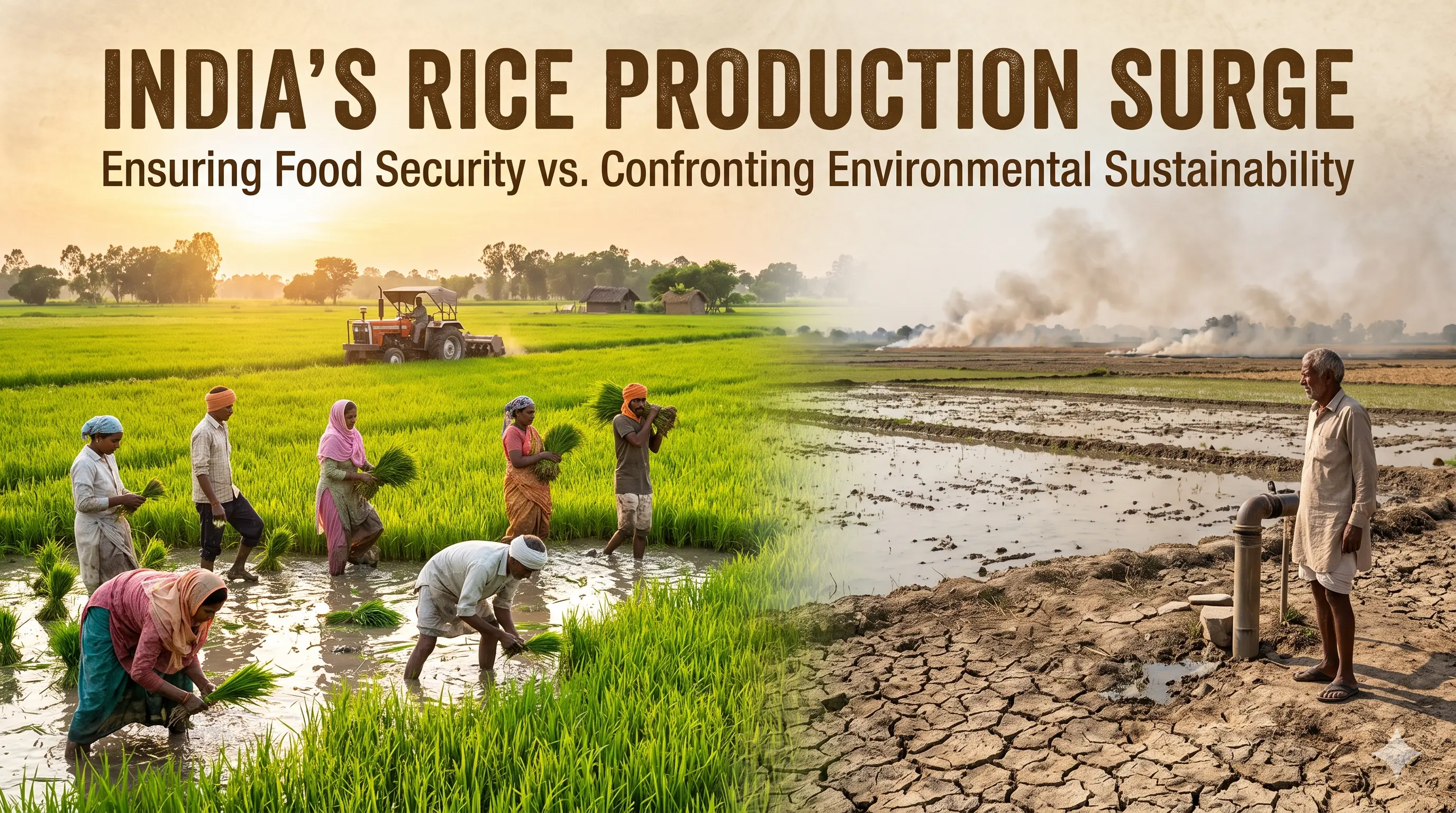
India has recently overtaken China to become the world’s largest rice producer, yielding a record 150.18 MT in 2024-25. While this solidifies its position as a global agricultural powerhouse, it has sparked serious concerns regarding water stress, methane emissions, stagnant yields, and long-term food security, necessitating urgent strategic interventions.
Introduction
Context & Background
Key Points
- •Production & Export Dominance: India produced a record 150.18 MT in 2024-25 and controls nearly 40% of the global rice trade, overtaking China as the top producer.
- •Key Producing States: West Bengal, Uttar Pradesh, and Punjab traditionally lead in volume. Punjab boasts the highest yield, along with Tamil Nadu, Telangana, and Andhra Pradesh.
- •Water Stress & Depletion: Rice is highly water-intensive (3,000–4,000 litres per kg). In states like Punjab and Haryana, groundwater extraction exceeds recharge by 35–57%, leading to severe water table drops.
- •Environmental Footprint: Flooded paddies promote methanogenic bacteria, contributing to 15–20% of India’s agricultural GHG emissions. Additionally, shortened harvest windows lead to stubble burning, severely worsening northern India's air quality.
- •Yield Driven by Area, Not Productivity: India's growth in rice production is largely driven by expanding the cropped area rather than productivity gains, with average yields trailing significantly behind China.
- •Policy & Market Volatility: Domestic production shocks frequently result in export bans to stabilize local prices, which undermines India's credibility as a reliable global trading partner.
India's Rice Production Landscape
| Metric | Data | Significance/Comparison | Bookmark |
|---|---|---|---|
| Total Production (2024-25) | 150.18 MT | >28% of global output | |
| Cropped Area | 51–52 million hectares | Largest cropped area in India | |
| Average Yield | ~2,929 kg/hectare | Well below China's ~7,100 kg/hectare | |
| Global Trade Share | ~40% | World's largest rice exporter |
Related Entities
Impact & Significance
- •Water Crisis: Groundwater extraction in Northwestern India severely outpaces natural recharge, pushing the region towards desertification.
- •Climate Feedback Loop: Agriculture is both a victim and a culprit. Rising temperatures could reduce yields by 6-10%, while traditional paddy farming emits 12% of global agricultural greenhouse gases.
- •Public Health (Air Quality): Policy mandates delaying paddy sowing to save pre-monsoon water have drastically shortened the window before wheat planting, forcing farmers to burn stubble. This chokes northern India with severe air pollution every winter.
- •Nutritional Deficits: The overwhelming dominance of rice and wheat monocultures has marginalized the cultivation of pulses and oilseeds, driving up import bills and contributing to widespread micronutrient deficiencies (like anemia).
Challenges & Criticism
- •Infrastructure Deficit: 90% of Indian farmers are marginal or smallholders, making the adoption of expensive machinery and modern water-smart technologies financially unviable without aggressive state support.
- •Policy Paralysis: MSP and open-ended procurement policies are heavily skewed towards rice and wheat, creating a massive disincentive for farmers to diversify into ecologically suitable crops like millets.
- •Stagnant Productivity: India's production surge is a result of expanding the area under cultivation rather than scientific yield improvements, hiding underlying inefficiencies in agricultural R&D.
- •Soil Degradation: Over-irrigation combined with heavily subsidized urea has heavily skewed the NPK ratio in Indian soils, causing severe micronutrient deficiencies and long-term land degradation.
Future Outlook
- •Water-Smart Technologies: Scaling up Direct Seeded Rice (DSR) and the System of Rice Intensification (SRI) can save up to 50% more water while maintaining or increasing yields.
- •Crop Diversification: Implementing the Johl Committee recommendations to shift 20% of paddy areas to millets or oilseeds. This should be supported by replacing input subsidies with direct income support.
- •Methane Mitigation: Expanding Alternate Wetting and Drying (AWD) irrigation and utilizing the Carbon Credit Trading Scheme (CCTS) to financially reward farmers for lowering their greenhouse gas footprints.
- •Policy Refinement ('Purvodaya'): Shifting the 'rice bowl' to the naturally water-abundant regions of Eastern India, while implementing schemes like PM-PRANAM for balanced, sustainable fertilizer use.
- •Ecological Restoration & Mechanization: Establishing Custom Hiring Centres (CHCs) for small farmers, promoting 'Happy Seeders' for in-situ residue management to stop stubble burning, and integrating fisheries with rice farming (IFS).
UPSC Relevance
- • GS-3 (Agriculture): Major crops cropping patterns in various parts of the country, different types of irrigation, e-technology in the aid of farmers.
- • GS-3 (Environment): Conservation, environmental pollution and degradation (GHG emissions, groundwater depletion, stubble burning).
- • GS-3 (Economy): Issues of buffer stocks and food security, technology missions, economics of animal-rearing.
Sample Questions
Prelims
Consider the following statements regarding Rice cultivation in India:
- (a)Flooded paddy fields in India are a major source of nitrous oxide emissions, but not methane.
- (b)The System of Rice Intensification (SRI) requires significantly less water compared to traditional continuous flooding.
- (c)India's average rice yield per hectare is currently higher than that of China due to the Green Revolution.
Mains
“India’s status as the world’s largest rice producer is a double-edged sword that guarantees immediate food security but threatens long-term environmental sustainability.” Analyze this statement and suggest strategic interventions to make India's rice cultivation sustainable.
Introduction: Briefly mention India overtaking China in rice production (2024-25 data). Define the paradox between agricultural surplus and ecological deficit.
Body:
• The Achievement (Food Security): Record production (150.18 MT), massive export share (40%), employment generation, and fulfilling PDS requirements.
• Sustainability Concerns: Water stress (3000-4000L/kg, over-extraction in Punjab/Haryana); GHG Emissions (methane from flooded paddies); Soil degradation (salinization, NPK imbalance); Air pollution (stubble burning); Nutritional imbalance due to monoculture.
• Strategic Interventions: Adoption of DSR and SRI for water efficiency; Crop diversification (Johl committee recommendations); Carbon Credit Trading Scheme (CCTS) for methane mitigation; PM-PRANAM for soil health; Shifting the rice bowl to Eastern India (Purvodaya).
Conclusion: Conclude that India must transition from 'yield-centric' to 'sustainability-centric' agriculture. Promoting climate-smart agriculture and 'Nutri-cereals' (millets) will ensure both ecological balance and nutritional security.