
Integrated Farming Models for Small Farmers
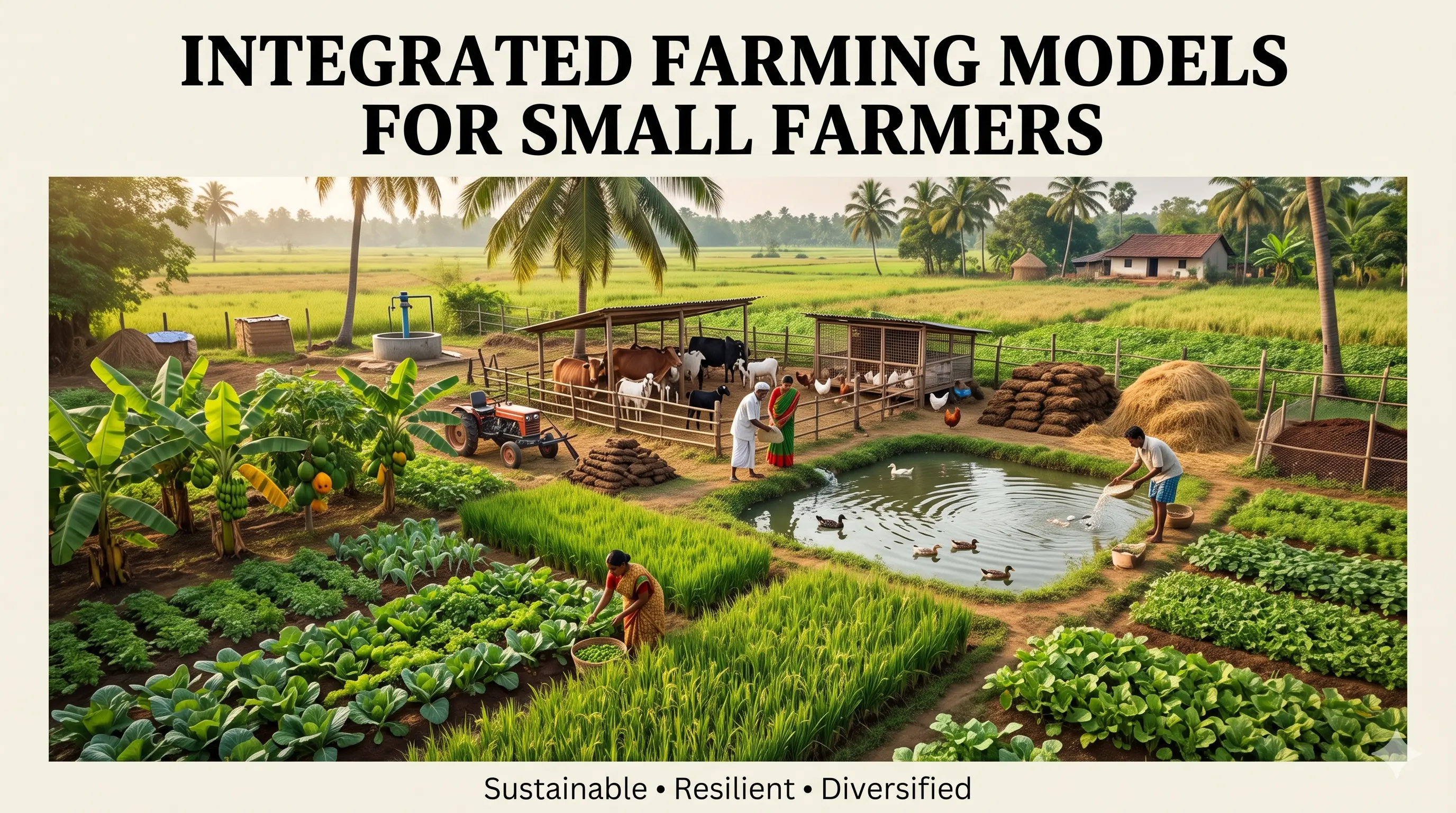
The Union Agriculture Minister recently emphasized the need for Agri-scientists to develop Integrated Farming Models (IFMs). IFMs offer a sustainable farm-system approach combining crops, livestock, and allied sectors to boost smallholder income, build climate resilience, and enhance resource efficiency.
Introduction
Context & Background
Key Points
- •Concept of IFMs: An Integrated Farming Model is a farm-system approach that deliberately combines crops, livestock, fisheries, poultry, and horticulture on the same holding. The goal is to maximize income and resource efficiency through synergy.
- •Income Maximization: Diversifying farm outputs through integrated systems raises net farm income by 30–60% compared to traditional cereal monocropping.
- •Climate and Price Resilience: By not relying on a single crop, farmers adopting mixed crop–livestock systems experience ~20–25% lower income variability during droughts and market price shocks.
- •Employment Generation: IFMs are highly labor-absorptive, generating 250–350 person-days/ha/year compared to just 120–150 days under cereal monocropping, which optimizes the use of family labor.
- •Cost and Resource Efficiency: The recycling of on-farm waste (e.g., livestock manure for crops, crop residue for animal feed) cuts chemical fertilizer and commercial feed costs by 15–25%.
- •Nutritional Security: Beyond economics, IFM households demonstrate a 15–20% higher dietary diversity, directly combating rural malnutrition by improving protein and micronutrient intake.
Impact and Benefits of Integrated Farming Models (IFMs)
| Benefit Parameter | Quantified Impact | Source | Bookmark |
|---|---|---|---|
| Higher Farm Income | 30–60% increase vs monocropping | ICAR field studies | |
| Risk Reduction | ~20–25% lower income variability during droughts/shocks | NITI Aayog | |
| Employment Generation | 250–350 person-days/ha/year (vs 120-150 in monocropping) | ICAR | |
| Cost Efficiency | 15–25% cut in chemical fertiliser and feed costs | FAO–ICAR | |
| Nutritional Security | 15–20% higher dietary diversity (protein/micronutrients) | NFHS-linked rural studies |
Way Forward and Institutional Support
| Strategy | Focus Area | Related Scheme/Initiative | Bookmark |
|---|---|---|---|
| Cluster Scaling | Agro-climatic, location-specific IFM clusters with common infrastructure. | National Mission for Sustainable Agriculture (RAD) | |
| Flexible Financing | Funding customized IFM assets like sheds, ponds, and fodder units. | Rashtriya Krishi Vikas Yojana (RKVY) | |
| Nutrient Cycling | Organic nutrient loops linking livestock and crops to cut input costs. | Paramparagat Krishi Vikas Yojana (PKVY) | |
| Lab-to-Land | Deploying scientists in villages for adaptive trials and demonstrations. | Viksit Krishi Sankalp Abhiyan |
Related Entities
Impact & Significance
- •Economic Empowerment: IFMs transform smallholdings into multi-revenue streams, significantly reducing poverty and agrarian distress.
- •Dietary & Health Impacts: Direct access to varied farm produce (milk, eggs, fish, vegetables) combats hidden hunger and malnutrition in rural households.
- •Climate Change Mitigation: By reducing the reliance on synthetic fertilizers and promoting organic nutrient loops, IFMs lower the carbon footprint of agricultural activities.
- •Employment Stability: Monocropping offers seasonal work, whereas integrated farming requires year-round labor, directly curbing seasonal distress migration.
Challenges & Criticism
- •Capital Intensive: Establishing multiple components (cattle sheds, ponds, poultry coops) requires 20–30% higher upfront capital than traditional farming, acting as a massive barrier for poor farmers.
- •Credit Bottlenecks: Banks are often reluctant to lend for integrated allied activities, leaving nearly 45% of smallholders without access to formal credit.
- •Siloed Government Schemes: Agricultural schemes are highly fragmented (separate departments for crops, fisheries, and livestock). Only about ~30% of districts have managed effective convergence of these schemes at the ground level.
- •Knowledge and Extension Gap: Managing multiple enterprises requires high technical know-how. The slow 'lab-to-land' transfer of scientific knowledge leaves many farmers relying on outdated methods.
Future Outlook
- •Cluster Scaling: Promoting location-specific IFM clusters based on local agro-climatic conditions with shared infrastructure and advisory services.
- •Flexible Financing: States must utilize schemes like RKVY to provide flexible grants for customized IFM assets (e.g., cattle sheds, farm ponds, pack-houses).
- •Nutrient Cycling: Strengthening organic nutrient loops that link livestock and crops to improve long-term soil health and reduce reliance on synthetic inputs.
- •Compressing Technology Transfer: Accelerating the 'Lab-to-Land' timeline by deploying agricultural scientists directly into villages for hands-on trials and demonstrations.
UPSC Relevance
- • GS-3 (Agriculture & Economy): Cropping patterns, economics of animal-rearing, direct and indirect farm subsidies, and e-technology in the aid of farmers.
- • GS-3 (Environment): Conservation, environmental degradation, and climate-resilient agriculture.
- • Essay Topics: 'Doubling Farmers' Income: Myth or Reality?', 'Climate-Smart Agriculture: The Need of the Hour'.
- • Mains Focus: Analyzing the viability of IFMs for smallholders and evaluating government schemes promoting crop diversification.
Sample Questions
Prelims
Consider the following statements regarding Integrated Farming Models (IFMs) in India. Which of the statements is correct?
- (a)IFMs require lower initial upfront investment compared to traditional single-crop systems.
- (b)The National Mission for Sustainable Agriculture (NMSA) strictly focuses on single-crop cereal monoculture.
- (c)IFMs can reduce chemical fertilizer and feed costs by recycling manure and farm residues.
- (d)Household dietary diversity decreases under IFMs due to a shift towards commercial non-food crops.
Mains
“Integrated Farming Models (IFMs) offer a sustainable pathway to double smallholder incomes and ensure climate resilience.” Discuss the benefits and challenges associated with the widespread adoption of IFMs in India.
Introduction: Define Integrated Farming Models (IFMs) as a holistic, multi-enterprise approach combining crops, livestock, fisheries, etc. Highlight the recent push by the Union Agriculture Minister to develop these models.
Body:
• Benefits of IFMs: Economic (30-60% income rise, 20-25% lower risk variability); Ecological (recycling of waste, 15-25% cut in chemical fertilizers); Social (250-350 person-days of employment/ha/year, better nutritional security).
• Challenges in Adoption: Credit constraints (45% smallholders lack formal credit for allied activities); High initial capital (20-30% higher upfront costs than monocropping); Poor institutional coordination (only ~30% districts show effective scheme convergence).
• Way Forward: Cluster-based scaling via NMSA-RAD; flexible financing through RKVY; boosting organic loops via PKVY; faster lab-to-land extensions.
Conclusion: Conclude by stating that transitioning from monocropping to IFMs is essential for the sustainable future of Indian agriculture, requiring convergence of policies, accessible credit, and robust extension services.