
Maharashtra Moves Towards a 'Caste-Free' Village: A Case Study of Soundala
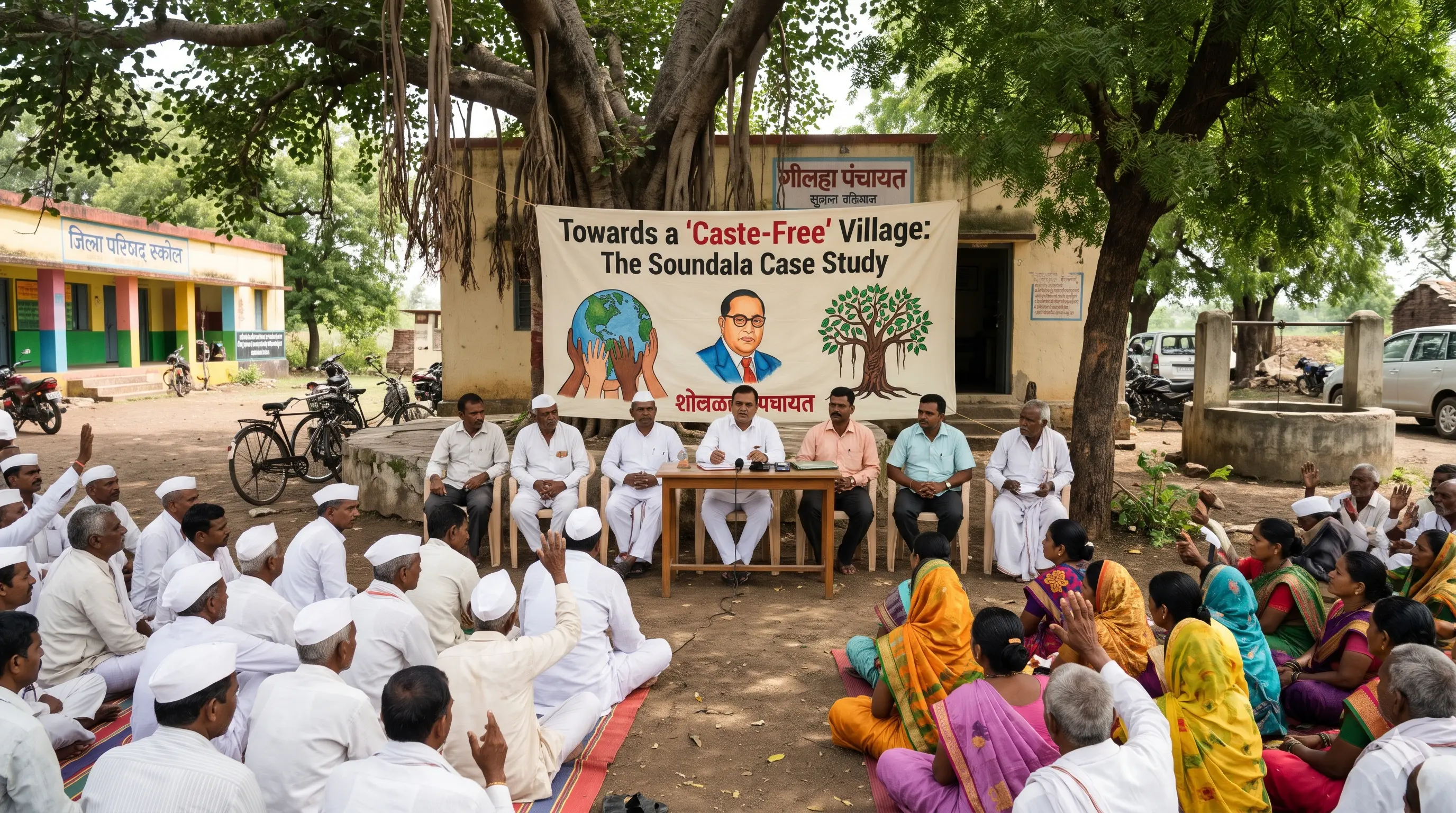
Soundala, a small village in Maharashtra, recently passed a gram sabha resolution to declare itself 'caste-free', aiming to eliminate discrimination and strengthen social harmony. The initiative, led by local leadership, focuses on equal access to public spaces, monitoring digital divisions, and fostering inclusive education and grassroots constitutionalism.
Introduction
Context & Background
Key Points
- •Core Resolution Provisions: Passed on February 5, the gram sabha resolution explicitly bans discrimination based on caste, religion, creed, or race, mandating equal treatment in all aspects of public life.
- •Universal Public Access: Guarantees barrier-free access for all residents to public spaces, including temples, crematoriums, schools, water sources, government services, and community events.
- •Preemptive Leadership: Led by Sarpanch Sharad Argade under the principle 'My religion - humanity'. It acts as a precaution against the social polarization observed in neighboring regions, despite the village having no registered atrocity cases in a decade.
- •Digital Vigilance: Authorities have committed to penalizing and taking action against social media posts that could stoke caste tensions, demonstrating an awareness of modern digital drivers of social conflict.
- •Institutional Inclusion: The head of the village dispute resolution committee (tanta-mukti samiti) belongs to the Mahar community (a Scheduled Caste), reflecting deliberate and inclusive local governance.
- •Influence of Reformist Activism: The initiative is deeply shaped by the Sarpanch’s father, Baba Argade, who has a strong association with rationalist and anti-superstition movements.
Demographics of Soundala Village
| Community / Category | Percentage / Count | Notes | Bookmark |
|---|---|---|---|
| Maratha | 65% | Majority community | |
| Scheduled Castes | 20% (approx. 60 families) | Some families follow Christianity | |
| Muslims | 3 families | Residing harmoniously within the village | |
| Total Population | ~2,500 residents | Overall demographic baseline |
Recent Progressive Measures in Soundala
| Measure / Initiative | Year Introduced | Purpose / Impact | Bookmark |
|---|---|---|---|
| Financial Assistance for Widow Remarriage | 2024 | ₹11,000 assistance to counter social stigma and promote dignity. | |
| Ban on Abusive Language Against Women | 2024 | Prohibition of derogatory curse words targeting women, backed by fines. | |
| Caste-Free Village Resolution | February 5 | Declaration eliminating discrimination and ensuring equal public access. |
Related Entities
Impact & Significance
- •Grassroots Constitutionalism: Demonstrates how local self-governments (PRIs) can successfully operationalize constitutional values like equality and fraternity through active community consensus.
- •Preventive Social Governance: Serves as a model for anticipatory governance, showing how communities can proactively inoculate themselves against emerging social polarization before violent conflicts occur.
- •Intersection of Gender and Caste: By previously banning abusive language against women and financially supporting widow remarriage, the village highlights how caste equality and gender justice are intrinsically linked at the grassroots level.
- •Educational Renaissance: Upgrading the Zilla Parishad school to include smart classrooms proves that strengthening inclusive public institutions naturally fosters social integration among youth.
Challenges & Criticism
- •Sustainability of Norms: Maintaining these inclusive norms relies heavily on the current leadership. The challenge is ensuring these values survive leadership transitions.
- •Financial Constraints: The village's progressive public spaces, such as its school, face severe space and funding shortages, requiring external CSR support to sustain their appeal and capacity.
- •Deep-Rooted Social Barriers: While public discrimination has been outlawed by the resolution, private spheres (such as the limited number of inter-caste marriages) indicate that complete eradication of caste consciousness requires long-term, multi-generational behavioral change.
Future Outlook
- •Navigating External Influences: Sustaining inclusive norms will be challenging as younger generations leave for higher education and engage with wider, potentially polarized social environments.
- •Sustaining Community Participation: The long-term success of the 'caste-free' model relies heavily on continuous community engagement, strict monitoring, and the survival of these values past the current leadership.
- •Educational Infrastructure Expansion: With rising demand (over 190 students and a waitlist of 57), securing Corporate Social Responsibility (CSR) funds to expand the Zilla Parishad school is critical to maintaining it as a hub of early social integration.
- •Promoting Inter-Caste Marriages: Local leaders acknowledge that inter-caste marriages remain limited but view them as a vital next step for permanently reducing entrenched caste barriers.
UPSC Relevance
- • GS-1 (Society): Social empowerment, communalism, regionalism, and the caste system; contemporary changes in rural society.
- • GS-2 (Social Justice & Governance): Grassroots democracy (PRIs), mechanisms for the protection of vulnerable sections, and constitutional operationalization.
- • GS-4 (Ethics): Case studies on social persuasion, ethical governance, leadership, and emotional intelligence in preventing social conflicts.
- • Essay Topics: 'Grassroots democracy as the bedrock of social empowerment', 'Eradicating caste: Constitutional promises and societal realities'.
Sample Questions
Prelims
With reference to local governance and social empowerment in India, consider the following statements: 1. The Gram Sabha has the authority to pass community resolutions aimed at maintaining social harmony and preventing discrimination at the village level. 2. The 'tanta-mukti samiti' in Maharashtra is a statutory body operating directly under the Union Ministry of Social Justice and Empowerment. Which of the statements given above is/are correct?
- (a)1 only
- (b)2 only
- (c)Both 1 and 2
- (d)Neither 1 nor 2
Mains
Discuss the role of grassroots governance institutions in realizing the constitutional ideal of a 'caste-free' society. Illustrate your answer with recent examples.
Introduction: Define the constitutional vision of a caste-less society (Articles 14, 15, 17). Introduce the role of Panchayati Raj Institutions (PRIs) not just as developmental bodies, but as agents of social transformation, citing the recent example of Soundala village in Maharashtra.
Body:
• Potential of Grassroots Governance (Gram Sabhas): Can pass binding social resolutions; localized monitoring (e.g., checking social media hate); ensuring universal access to public goods (water, schools, crematoriums).
• Preventive Social Governance: PRIs can act proactively to prevent polarization rather than just reacting to atrocities. Example: Soundala's proactive caste-free declaration and prior bans on gender-abusive language.
• Challenges: Lack of sustained funding for inclusive spaces (like ZP schools); vulnerability to broader regional political polarization; deep-rooted patriarchal and caste hierarchies resisting change.
Conclusion: Conclude that while constitutional laws provide the framework for equality, 'grassroots constitutionalism'—driven by local leadership and community consensus—is essential to operationalize social justice in everyday rural life.