
The Maternity Benefit Act in India: Legal Safeguards vs. Workplace Realities
An in-depth analysis of India's Maternity Benefit Act, tracing its evolution from 1961 to the progressive 2017 amendments. The article examines key legal provisions, ongoing challenges like the unorganized sector divide and employer financing burdens, and the urgent need for a cultural shift toward shared caregiving.
Introduction
Context & Background
Key Points
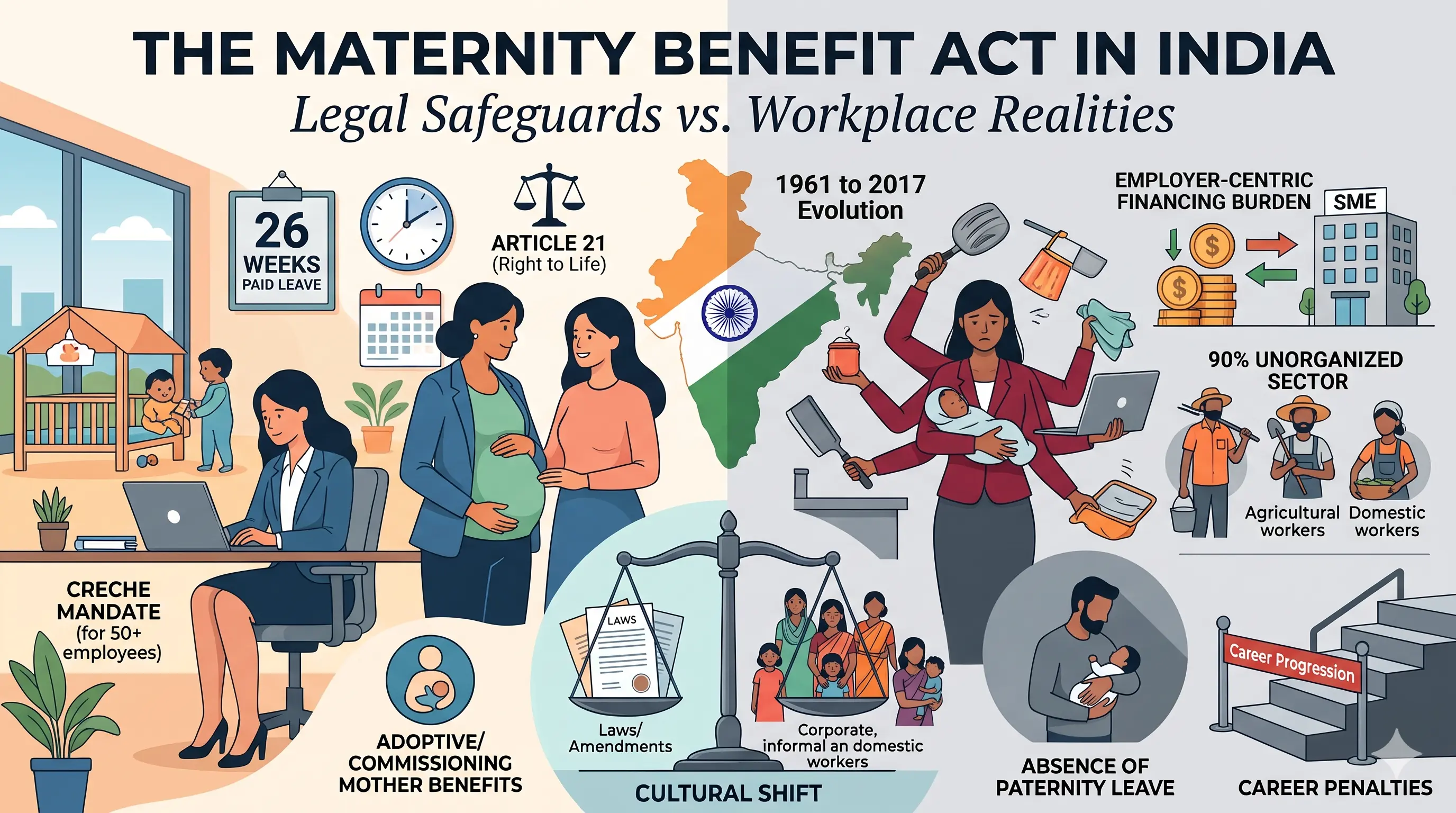
- •Applicability and Scope: The Act covers women in private, government, and heavy industries (employing 10+ workers), but completely excludes the self-employed.
- •Progressive Inclusions: The 2017 amendment acknowledged modern family structures by granting 12 weeks of leave to adoptive and commissioning mothers.
- •Work-from-Home Provision: Introduced a mutually agreeable WFH option post-maternity leave, if the nature of the duties permits.
- •International Standing: India is among 42 countries exceeding the ILO-mandated minimum of 18 weeks, offering 26 weeks of paid leave.
- •Financing Discrepancy: Globally, 44% of countries finance maternity benefits through social security, whereas India is among the 15% relying entirely on employer funding.
- •Fundamental Right: The Supreme Court affirmed that maternity benefits are inseparable from women's dignity, health, and equality, falling directly under Article 21 (Right to Life) of the Constitution.
Evolution of Maternity Benefits: 1961 Act vs. 2017 Amendment
| Provision | Maternity Benefit Act, 1961 | Maternity Benefit (Amendment) Act, 2017 | Bookmark |
|---|---|---|---|
| Maternity Leave Duration | Up to 12 weeks | 26 weeks for the first two children; 12 weeks for the third child onwards | |
| Eligibility Criteria | Worked for at least 160 days in the preceding 12 months | Worked for at least 80 days in the preceding 12 months | |
| Adoptive/Commissioning Mothers | No specific provision | Entitled to 12 weeks of maternity leave | |
| Crèche Facility | Not mandated | Mandatory for establishments with 50 or more workers (4 visits allowed/day) |
Major Initiatives Supporting Maternity Financing
| Scheme / Initiative | Key Features | Bookmark |
|---|---|---|
| Pradhan Mantri Matru Vandana Yojana (PMMVY) | Cash incentive of ₹5,000 to pregnant and lactating women for the first live birth. | |
| Employees' State Insurance Corporation (ESIC) | Contributory model providing 100% wage compensation for 26 weeks (formal sector). | |
| Dr. Muthulakshmi Reddy Maternity Scheme (TN) | State-level scheme offering ₹18,000 in staggered payments. |
Related Entities
Impact & Significance
- •Legal Recognition: Strengthened the legal recognition of motherhood as a legitimate phase in a woman's working life, rather than a professional interruption.
- •Health Outcomes: Improved maternal and child health outcomes by enabling adequate recovery time and infant care without the anxiety of lost wages.
- •Global Benchmarking: Positioned India among countries with relatively generous statutory maternity protections, far exceeding global minimums on paper.
- •Caregiving Acknowledgement: Forced formal workplaces to officially acknowledge caregiving responsibilities as a core part of employment relations.
Challenges & Criticism
- •The Unorganized Sector Divide: Over 90% of working women are in agriculture, domestic work, and informal contracts, completely outside the scope of statutory benefits.
- •Employer-Centric Financing: Because the entire cost is borne by employers, it actively discourages the hiring of women, especially by Small and Medium Enterprises (SMEs).
- •Absence of Paternity Leave: The framework provides no parallel leave for fathers, perpetuating traditional gender roles and disproportionately affecting women's workforce participation.
- •Career Penalties: Women returning from maternity leave frequently face reduced responsibilities, slower career progression, and diminished promotion prospects (the 'motherhood penalty').
Future Outlook
- •Shift in Organizational Culture: Move from mere statutory compliance to empathetic workplace cultures that proactively support working mothers.
- •Flexible Work Frameworks: Institutionalize return-to-work programs, flexible arrangements, and transparent, unbiased promotion pathways.
- •Childcare Infrastructure: Invest in accessible, affordable, and quality childcare facilities, which in turn creates new employment opportunities for women.
- •Shared Caregiving: Promote shared caregiving responsibilities within families through social awareness campaigns and supportive public policies like paternity leave.
- •Shared Financing Models: Establish a Maternity Benefit Fund to support SMEs and informal workers through shared financing by the government, employers, and employees.
UPSC Relevance
- • GS-1 (Society): Role of women and women's organizations, changing family structures, and caregiving norms.
- • GS-2 (Social Justice): Welfare schemes for vulnerable sections, mechanisms, laws, and institutions constituted for the protection and betterment of women.
- • GS-3 (Economy): Female Labour Force Participation Rate (FLFPR), formal vs. informal sector employment, and unorganized sector challenges.
- • Essay Topics: The 'DINK' lifestyle as a socio-economic response; Motherhood vs. Professional Ambition.
Sample Questions
Prelims
Which of the following statements is correct regarding the Maternity Benefit (Amendment) Act, 2017?
- (a)It is applicable to all unorganized sector workers.
- (b)Establishments with 50 or more employees must provide a crèche facility.
- (c)Adoptive mothers are entitled to 26 weeks of maternity leave.
- (d)The entire cost of maternity leave under the Act is funded by the Central Government.
Mains
“While the Maternity Benefit (Amendment) Act, 2017 is a progressive step, its heavy reliance on employer-centric financing and exclusion of the unorganized sector limits its true potential.” Analyze the statement and suggest reforms to create an equitable working environment for women.
Introduction: Define the context of the Maternity Benefit (Amendment) Act, 2017. Mention that while India provides generous leave (26 weeks) compared to the ILO minimum, systemic gaps remain.
Body:
• Positive Impacts: Increased leave to 26 weeks, inclusion of adoptive/commissioning mothers, crèche mandate, and alignment with ILO standards.
• Limitations & Challenges: 90% workforce in unorganized sector left out; Employer-only funding discourages SMEs from hiring women; Lack of paternity leave reinforces gender roles; Rise of 'DINK' lifestyle due to career stagnation fears.
• Reforms & Way Forward: Introduction of a state-supported Maternity Benefit Fund; Mandating Paternity Leave; Extending PMMVY coverage; Shifting to social insurance models (like ESIC expansion).
Conclusion: Conclude by quoting the Supreme Court's stance on maternity as a Fundamental Right under Article 21, emphasizing that legal provisions must be accompanied by a societal shift toward shared caregiving.