
National Self-Reliance in Pulses Mission
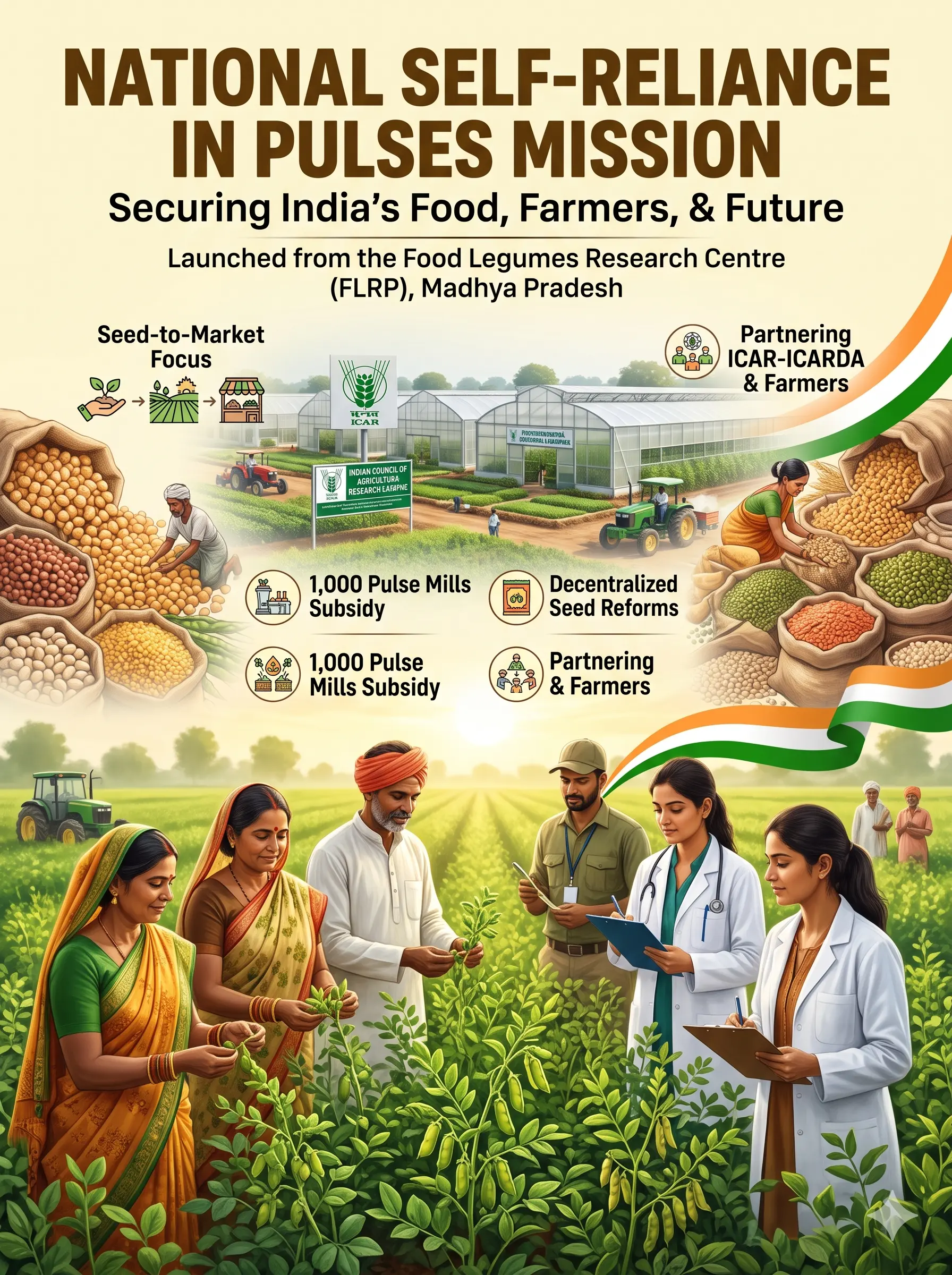
The National Self-Reliance in Pulses Mission was launched to address India's persistent yield gaps and high import dependence in pulses. It adopts an end-to-end value chain approach, cluster-based farming, and decentralised processing to boost domestic production and ensure remunerative prices for farmers.
Introduction
Context & Background
Key Points
- •Seed-to-Market Focus: The Mission adopts an end-to-end value chain approach covering seed research, on-farm practices, assured procurement, processing, and organised market access.
- •Cluster Model: Pulses cultivation is organised in geographically contiguous clusters to enable collective input supply, common agronomy practices, and direct linkage with processors and markets.
- •Seed Reforms: Seed release and distribution are decentralised to states and farmer networks, ensuring location-specific varieties and faster dissemination.
- •Research–Farmer Linkage: The FLRP campus integrates ICAR–ICARDA research directly with farmers, enabling rapid adoption of high-yielding and disease-resistant pulse varieties.
- •Value Addition Orientation: The Mission explicitly shifts focus from raw pulses to protein-rich value-added products, encouraging local processing and branding.
Current Status of Pulses in India
| Parameter | Context | Data/Statistics | Bookmark |
|---|---|---|---|
| Global Share | Producer, Importer & Consumer | 24–25% (Prod), 27% (Cons), 13–15% (Imp) | |
| Foodgrain Share | Area vs. Output | 20% Area, but only 7–9% Output | |
| Seasonal Pattern | Kharif vs. Rabi | Rabi accounts for 60–62% (Gram & Lentil) | |
| Productivity Gap | India vs. Global Average | 850–900 kg/ha vs. 1,200–1,300 kg/ha | |
| FY25 Import Surge | Highest in nearly a decade | ~6.5–6.8 million tonnes |
Key Challenges in the Pulses Sector
| Challenge | Description & Impact | Bookmark |
|---|---|---|
| Declining Acreage | Area fell from 29.3 million ha (2016–17) to ~27.4 million ha (2023–24). | |
| Price Volatility | In bumper years, chana/tur prices fall 20–30% below MSP. | |
| Processing Deficit | Less than 10% of pulses are processed near the farm gate. | |
| Yellow Pea Dependence | Accounts for 30–32% (~2.0 MT) of total FY25 imports due to duty-free access. |
Related Entities
Impact & Significance
- •Forex Savings: Curbing the massive import surge (~2.8–3 million tonnes historically, jumping to over 6.5 MT in FY25) will protect domestic markets from global volatility and save significant foreign exchange.
- •Farmer Remuneration: Localised processing (1,000 new mills) and direct market linkages will protect farmers from price crashes, which currently see market rates dip 20–30% below MSP during bumper harvests.
- •Nutritional Security: Shifting focus from raw pulses to protein-rich value-added products will help address hidden hunger and protein deficiency in India.
- •Climate Resilience: Investing in early-maturing and disease-resistant varieties of chickpea, lentil, and moong mitigates the risks of climate change on rain-fed agriculture.
Challenges & Criticism
- •Declining Acreage: Area under pulses has actively fallen from 29.3 million hectares in 2016–17 to roughly 27.4 million hectares in 2023–24, indicating a shift toward more lucrative or stable crops.
- •Stagnant Productivity: The average pulses yield in India is stuck at 850–900 kg/ha, trailing far behind the global average of 1,200–1,300 kg/ha due to poor input usage and irrigation deficits.
- •Processing Deficits: Less than 10% of pulse production is processed near the farm gate. This forces farmers to bear long-distance transport costs and shrinks their share of the end-consumer price.
- •Import-Driven Price Shocks: Heavy reliance on imports, specifically the sudden duty-free influx of Yellow Peas, creates price arbitrage that harms the competitive pricing of domestic crops.
Future Outlook
- •Pulse Mills Expansion: Establish 1,000 pulse mills nationwide with up to ₹25 lakh subsidy per unit, enabling decentralised processing, reduced transport costs, and local employment creation.
- •Farmer Incentives: Farmers in identified clusters will receive quality seed kits and ₹10,000 per hectare assistance for model farming to encourage pulses acreage and technology adoption.
- •Productivity Enhancement: Focused R&D on chickpea, lentil, pigeon pea, urad, and moong through early-maturing and disease-resistant varieties to raise yields and reduce climate risk.
- •Centre–State Coordination: States will prepare crop- and region-specific pulses roadmaps aligned with agro-climatic needs, strengthening cooperative federalism in agriculture.
UPSC Relevance
- • GS-3 (Indian Economy & Agriculture): Major crops cropping patterns, direct and indirect farm subsidies, and MSP issues.
- • GS-3 (Food Security): Economics of animal-rearing and food processing industries in India—scope and significance.
- • Mains Focus: Analyzing the reasons for India's high import dependence in pulses and evaluating the 'Cluster Model' and 'Decentralised Processing' as solutions.
- • Prelims Focus: Kharif vs. Rabi share in pulses, global production/import rankings, and specifics of the new Pulses Mission.
Sample Questions
Prelims
Consider the following statements regarding the status of pulses in India:
- (a)India accounts for more than half of the global production and consumption of pulses.
- (b)Kharif season pulses contribute to over 60% of the total pulse production in India.
- (c)Pulses occupy roughly 20% of India’s total foodgrain area but contribute less than 10% to the total foodgrain output.
Mains
Despite being the world's largest producer of pulses, India remains highly dependent on imports. Analyze the underlying causes for this paradox and discuss how the newly launched 'Self-Reliance in Pulses Mission' aims to address these structural bottlenecks.
Introduction: Provide context using data: India produces ~24-25% of global pulses but imports 13-15% (reaching ~6.5-6.8 MT in FY25). Briefly introduce the Self-Reliance in Pulses Mission.
Body:
• The Paradox (Causes of Import Dependence): Declining acreage (29.3m ha in 2016 to 27.4m ha in 2023); Low productivity due to rain-fed dependence (850-900 kg/ha vs global 1,200 kg/ha); Processing deficit (under 10% near farm gates); Price volatility discouraging farmers even when MSP is announced.
• Mission Interventions: End-to-end value chain focus; Organizing cultivation into 'Cluster Models'; Decentralizing seed reforms; Bridging the Research-Farmer gap via FLRP and ICAR-ICARDA.
• Roadmap Solutions: Subsidy for 1,000 decentralised pulse mills (up to ₹25 lakh); Financial incentives (₹10,000/ha); Focus on early-maturing, climate-resilient varieties.
Conclusion: Conclude by stating that achieving self-reliance in pulses is not just an economic imperative to save forex, but a nutritional necessity and an ecological requirement for climate-resilient agriculture in India.