
Next Phase for Rural Women Entrepreneurship: Transitioning to Market Integration
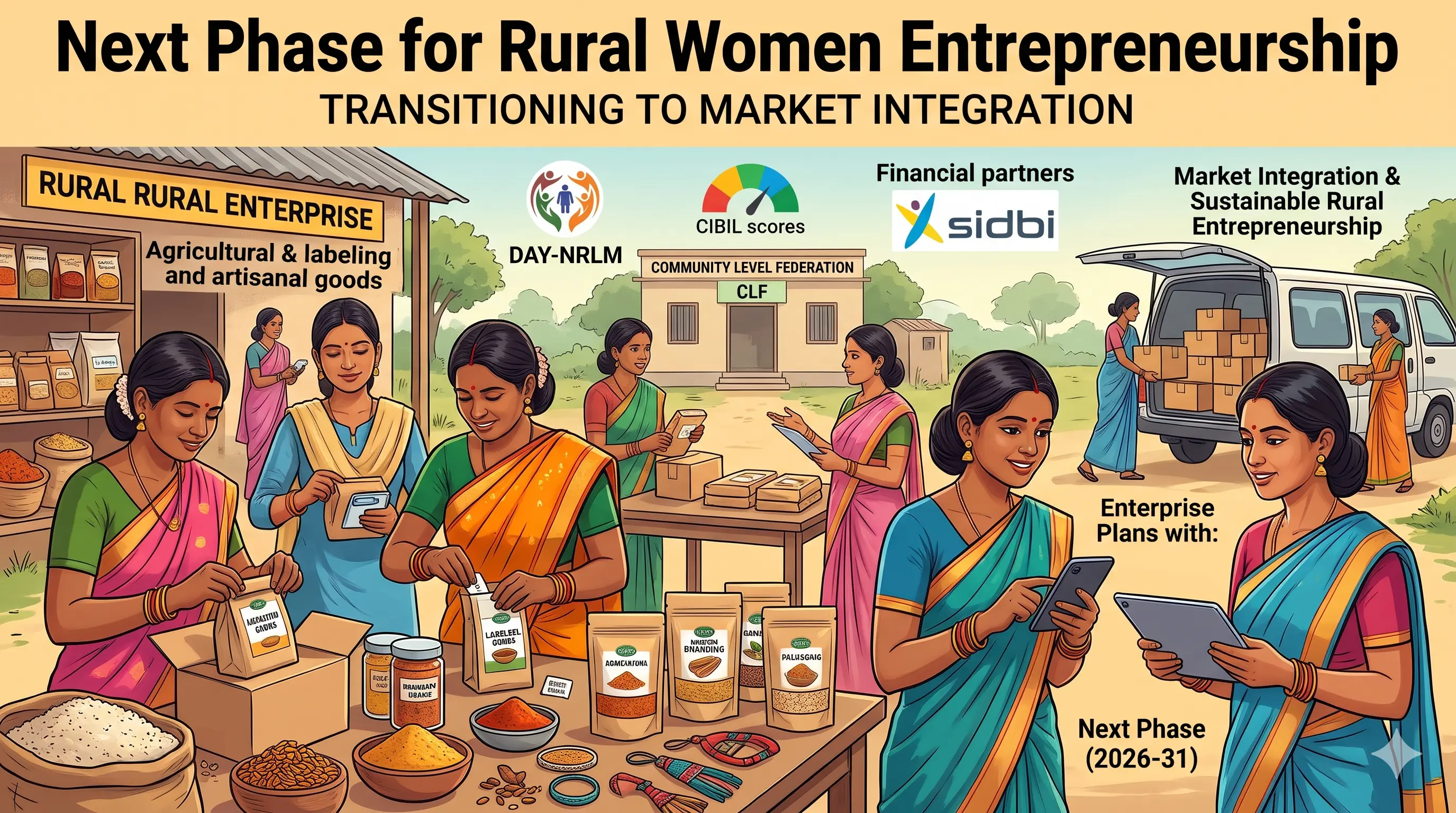
With the DAY-NRLM successfully mobilizing over 10 crore households into Self-Help Groups (SHGs), the initiative is entering a new phase (2026–31). The focus is shifting from basic financial inclusion to enterprise scaling, market integration, and sustainable rural entrepreneurship for women through structural reforms and innovative financing.
Introduction
Context & Background
Key Points
- •Empowering CLFs: Cluster Level Federations (CLFs) are being transformed into autonomous, community-owned institutions to lead local enterprise development, shifting away from functioning merely as government extensions.
- •Building Individual Credit Histories: A major structural shift is the generation of CIBIL scores for individual SHG members, enabling them to access higher individual loans from formal financial markets.
- •Governance and Accountability: The introduction of robust social and statutory audits will ensure transparency and the effective use of large, community-level funds.
- •Innovative Financing Beyond Loans: The integration of equity, venture capital, and blended finance will provide diverse funding sources to support enterprise growth.
- •Strategic Institutional Partnerships: Collaborations with SIDBI, NBFCs, and neo-banks are being established to design custom, flexible financial products that match the risk profiles of rural women entrepreneurs.
- •Integrated Livelihood Planning: Utilizing Village Poverty Reduction Plans (VPRPs) to draft annual, bottom-up livelihood action plans at State and UT levels.
DAY-NRLM: Strategic Shift to New Phase (2026-2031)
| Parameter | Previous Phase | New Phase (2026-31) | Bookmark |
|---|---|---|---|
| Primary Goal | Financial inclusion and mobilizing households into SHGs. | Enterprise scaling and sustainable rural entrepreneurship. | |
| Funding Model | Microcredit and basic savings loans. | Equity, venture capital, blended finance, and flexible products. | |
| Role of CLFs | Acting as extensions of government machinery. | Autonomous, community-owned business hubs. | |
| Market Approach | Local sales and unorganized market presence. | Dedicated national/state marketing entities and digital commerce. |
Related Entities
Impact & Significance
- •Economic Autonomy: By scaling enterprises, women transition from basic subsistence to generating wealth and creating local employment.
- •Financial Formalization: Generating CIBIL scores brings millions of rural women into the formal banking and credit ecosystem, unlocking larger capital.
- •Market Competitiveness: Dedicated branding, packaging, and state-level market entities will allow rural products to compete with established private brands.
- •Institutional Synergy: Streamlining livelihood planning via VPRPs and NITI Aayog will reduce overlapping schemes and wastage of government funds.
Challenges & Criticism
- •Implementation Bottlenecks: Transforming CLFs from quasi-government extensions into genuinely autonomous, profitable business hubs requires intensive capacity building.
- •Financial Literacy Gap: Introducing complex products like equity, venture capital, and blended finance requires high levels of financial literacy that many rural entrepreneurs currently lack.
- •Audit and Transparency: As community funds grow larger, the risk of mismanagement increases; ensuring rigorous social and statutory audits at the grassroots level will be difficult.
- •Market Logistics: Bridging the gap between remote rural production centers and urban/digital markets involves solving complex supply chain and cold-storage challenges.
Future Outlook
- •National Marketing Vertical: A dedicated unit will be created to standardize branding, packaging, quality norms, pricing strategies, and logistics for SHG products nationwide.
- •State-Level Market Entities: Specialized professional agencies will be set up to bridge the gap between SHG enterprises, private markets, and modern digital commerce platforms.
- •CLFs as Business Hubs: Moving forward, CLFs will act as one-stop centers offering finance, training, advisory services, and market linkages directly to rural entrepreneurs.
- •NITI Aayog-led Convergence Cell: An institutional mechanism will be established to align and streamline various livelihood schemes across multiple ministries, ensuring cohesive grassroots impact.
UPSC Relevance
- • GS-1 (Indian Society): Role of women and women's organizations, women empowerment.
- • GS-2 (Governance): Development processes and the development industry — the role of NGOs, SHGs, various groups and associations.
- • GS-3 (Economy): Inclusive growth and issues arising from it, poverty alleviation programs, rural development.
- • Essay Topics: 'Financial independence as the true metric of women empowerment', 'Rural entrepreneurship: The next engine of India's growth'.
Sample Questions
Prelims
Consider the following statements regarding the evolving framework of rural women entrepreneurship under DAY-NRLM:
- (a)DAY-NRLM aims to mobilize rural households solely for political empowerment at the Panchayat level.
- (b)Under the new guidelines, Cluster Level Federations (CLFs) are being dismantled to promote individual businesses.
- (c)The integration of individual CIBIL scores for SHG members is a key priority to enable access to higher formal credit.
Mains
“The transition from financial inclusion to enterprise scaling is imperative for the sustainable empowerment of rural women.” Evaluate this statement in the context of the proposed 2026–31 phase of DAY-NRLM.
Introduction: Introduce the DAY-NRLM's foundational success in building a nationwide SHG network. Highlight the core objective of the new phase: graduating from inclusion to sustainable entrepreneurship.
Body:
• Successes of Financial Inclusion: Mobilization of 10 crore households into SHGs; increased access to microcredit; success of the 'Lakhpati Didi' scheme.
• Need for Enterprise Scaling: Limitations of basic loans; saturation of local markets; need for higher income generation and formal market integration.
• Reforms in the New Phase (2026-31): Generating individual CIBIL scores; establishing CLFs as business hubs; introducing VC/blended finance; NITI Aayog Convergence Cell; creation of a National Marketing Vertical.
Conclusion: Conclude that moving beyond basic thrift and credit to building robust, market-linked enterprises will transform rural women from passive beneficiaries to active drivers of India's macroeconomic growth.