
Profiling India’s Waste Pickers: Caste, Gender, and the NAMASTE Scheme
Recent data under the government's NAMASTE scheme highlights the deep-rooted caste and gender dimensions of sanitation work in India. With 84.5% of the 1.52 lakh profiled waste-pickers belonging to marginalized communities, this data underscores the urgent need for formal recognition, safety, and integration into urban governance frameworks.
Introduction
Context & Background
Key Points
- •Entrenched Occupational Segregation: Data from 2026 reveals that 84.5% of the 1.52 lakh profiled waste-pickers across 35 States/UTs belong to SC, ST, and OBC communities, starkly highlighting how sanitation labour remains linked to caste.
- •State-Level Outliers: While the national average shows heavy marginalized community participation, states like Delhi and Goa show General category workers outnumbering SC, ST, and OBC workers combined. In West Bengal, General category workers constitute a significant 42.4%.
- •NAMASTE Scheme Expansion: Originally designed for sewer and septic tank workers, the scheme's scope was formally extended in June 2024 to include informal waste-pickers, aligning with the AMRUT urban framework across 500 cities.
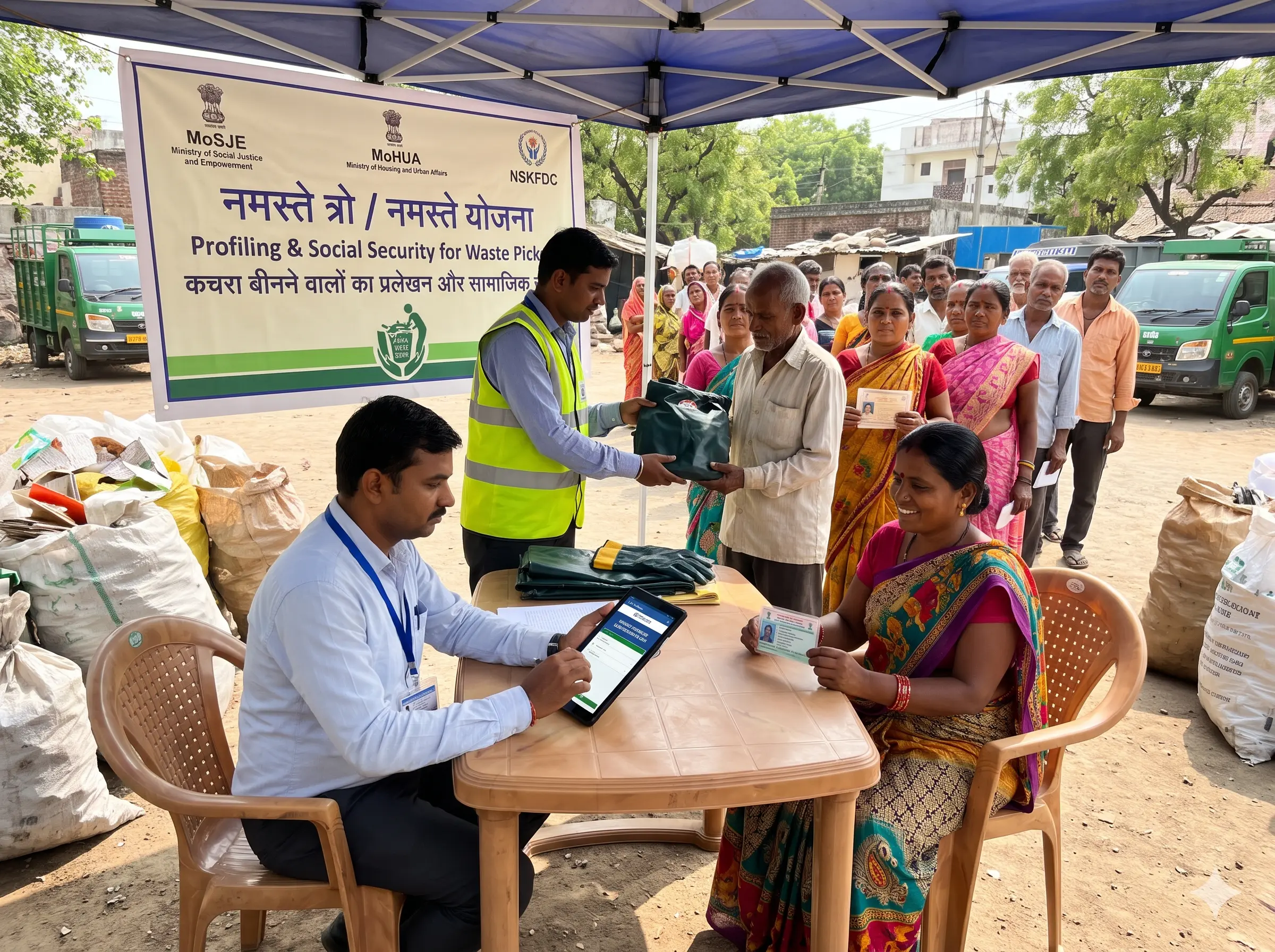
- •Digital Enumeration Drive: The Waste Picker Enumeration App is targeting the profiling of 2.5 lakh waste pickers to issue occupation-based ID cards, bringing them into the formal urban governance ecosystem.
- •Hazardous Cleaning Toll: Alongside waste pickers, 89,000 sewer and septic tank workers have been enumerated (91% from SC/ST/OBC). Since 2014, 859 deaths have been officially reported due to hazardous sewer and septic tank cleaning.
Social Composition of Profiled Waste-Pickers
| Community Category | Share (%) | Key Observation | Bookmark |
|---|---|---|---|
| Scheduled Castes (SC) | 60.3% | Reflects historical linkage between sanitation labour and caste. | |
| Other Backward Classes (OBC) | 13.7% | Indicates overlapping vulnerabilities of caste and informal work. | |
| Scheduled Tribes (ST) | 10.5% | Significant participation representing marginalized migration. | |
| General Category | 10.7% | Minority nationally, but majorities in specific outlier states. |
Gender Profile of the Workforce
| Gender | Share (%) | Significance | Bookmark |
|---|---|---|---|
| Women | 48.7% | Points to the profound feminisation of informal waste labour. | |
| Men | 51.3% | Forms the slight majority of the profiled workforce. | |
| Transgender Persons | 0.007% | Nearly invisible in data, indicating massive gaps in inclusion. |
Related Entities
Impact & Significance
- •Formal Identity: Providing occupation-based identity cards transforms waste pickers from 'unrecognized labor' to 'formal municipal stakeholders'.
- •Social Security: Integrating these vulnerable populations directly into existing safety nets like Ayushman Bharat offers protection against the severe health hazards they face daily.
- •Gender Empowerment: With nearly half the workforce being women, formalizing this sector acts as a direct tool for female economic empowerment and safety.
- •Data-Driven Governance: Having exact demographic data (like the anomaly in Delhi/Goa) allows the government to tailor socio-economic interventions rather than using a one-size-fits-all approach.
Challenges & Criticism
- •Transgender Exclusion: The profiling revealed that transgender persons make up only 0.007% of the data, pointing to structural barriers preventing their inclusion even in informal sectors.
- •Pace of Mechanisation: Despite schemes being in place, the reliance on manual labour for hazardous cleaning remains a harsh reality, evidenced by ongoing fatalities.
- •Ground-Level Implementation: Distributing ID cards is only the first step; ensuring that local municipal bodies integrate these collectives effectively into daily city waste management remains a bureaucratic challenge.
- •Regional Anomalies: State-level deviations (like high General category participation in WB, Delhi, and Goa) suggest that localized economic distress may be pushing non-traditional groups into waste picking, requiring localized study.
Future Outlook
- •Waste Picker Collectives: The initiative plans to support the formation of collectives to manage 750 dry waste collection centres, turning individual informal workers into structured micro-entrepreneurs.
- •Mechanisation and Safety: A primary goal remains eradicating deaths from hazardous cleaning entirely through mechanisation and the mandatory use of protective equipment.
- •Livelihood Upgradation: Providing financial assistance for waste collection vehicles and skill training programmes to ensure stable, sustainable, and dignified incomes.
- •Comprehensive Welfare Net: Expanding health insurance coverage under Ayushman Bharat to all enumerated workers to offset occupational health hazards.
UPSC Relevance
- • GS-1 (Society): Social empowerment, role of women and women's organization, caste system and its modern manifestations.
- • GS-2 (Social Justice): Welfare schemes for vulnerable sections of the population by the Centre and States and the performance of these schemes.
- • GS-3 (Environment/Economy): Inclusive growth, solid waste management, employment in the informal sector.
- • Essay Topics: 'The invisible workforce: Intersections of caste, gender, and labor in India'.
Sample Questions
Prelims
Consider the following statements regarding the NAMASTE Scheme:
- (a)It is a Central Sector Scheme jointly implemented by MoSJE and MoHUA.
- (b)Its scope is strictly restricted to sewer and septic tank workers only.
- (c)The scheme covers all rural and urban local bodies across India.
Mains
“The informal sanitation and waste management sector in India continues to reflect deep-rooted caste and gender inequalities.” Analyze this statement in light of recent findings. How does the NAMASTE scheme attempt to bridge these vulnerabilities?
Introduction: Define the informal waste management sector. Introduce the recent profiling of 1.52 lakh waste pickers under the NAMASTE scheme as the context.
Body:
• Socio-Economic Realities: Highlight the MoSJE data (84.5% from SC/ST/OBC; 60.3% SC alone). Mention the feminisation of waste labour (48.7% women) and the near invisibility of transgender persons.
• Challenges faced: Lack of legal identity, occupational hazards, structural caste segregation, and deaths related to hazardous cleaning (859 since 2014).
• NAMASTE Interventions: Digital profiling via the Enumeration App, issuing occupational IDs, Ayushman Bharat health coverage, PPE kits, and forming collectives for dry waste centres.
Conclusion: Conclude by stating that formal recognition is the first step toward social justice, moving waste-pickers from marginalized scavengers to formally recognized 'green workers' and municipal partners.