
Schemes to Support Livelihood, Assistive Devices for Persons with Disabilities
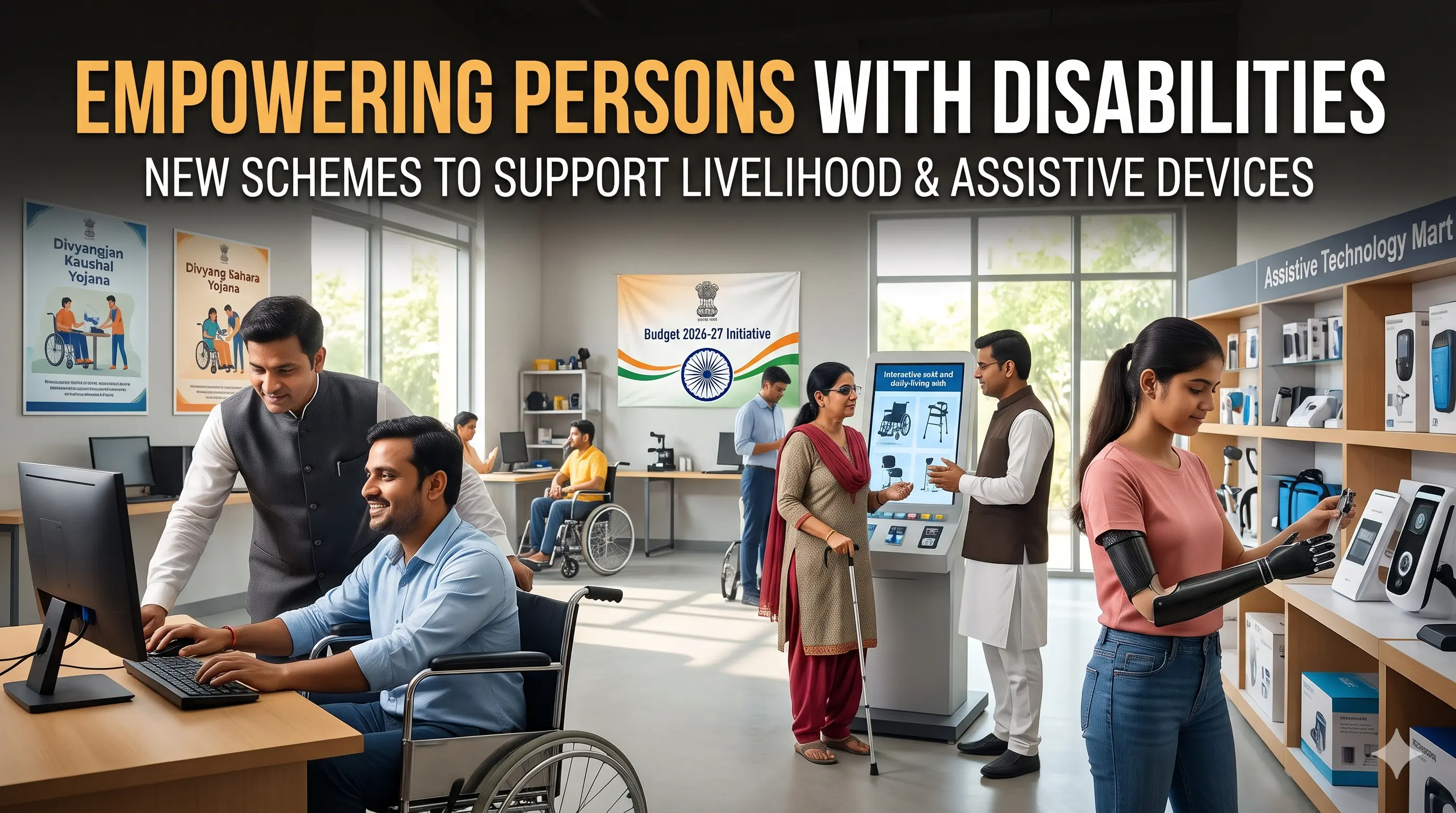
The Union Budget 2026-27 introduces two new schemes—Divyangjan Kaushal Yojana and Divyang Sahara Yojana—to enhance livelihood opportunities and access to assistive technology for persons with disabilities. While the budget allocation has increased by 30%, rights groups have raised concerns about the schemes' exclusionary nature.
Introduction
Context & Background
Key Points
- •Divyangjan Kaushal Yojana: Aims to provide skill development training aligned with emerging sectors of the economy to ensure persons with disabilities (PwDs) are ready for dignified employment.
- •Divyang Sahara Yojana: Focuses on providing timely and affordable access to modern, high-quality assistive devices.
- •Assistive Technology Marts: A novel retail-style mechanism under the Divyang Sahara Yojana where beneficiaries can see, test, compare, and purchase suitable products.
- •Budget Allocation Boost: The Department of Empowerment of Persons with Disabilities (DEPwD) witnessed a roughly 30% hike in its allocation, receiving ₹1,669.72 crore for 2026–27.
New Schemes for Persons with Disabilities (Budget 2026-27)
| Scheme Name | Primary Focus | Key Mechanism / Objective | Bookmark |
|---|---|---|---|
| Divyangjan Kaushal Yojana | Training for dignified livelihood | Skill development, employment readiness, and industry linkages | |
| Divyang Sahara Yojana | Timely access to assistive devices | Setting up modern retail-style Assistive Technology Marts |
Budget Allocation (2026-27)
| Category | Amount / Detail | Bookmark |
|---|---|---|
| Department of Empowerment of Persons with Disabilities | ₹1,669.72 crore | |
| Increase over current fiscal's revised estimates | ~30% | |
| Allocation for the two new schemes | ₹300 crore |
Related Entities
Impact & Significance
- •Economic Independence: By focusing on skill development, PwDs can transition from dependents to active contributors to the economy.
- •Improved Quality of Life: Advanced prosthetics and AI-enabled assistive devices can drastically enhance mobility and independent living.
- •Mainstreaming and Dignity: Assistive Technology Marts destigmatize the procurement of mobility aids by providing a modern, retail-like experience that emphasizes choice and dignity.
Challenges & Criticism
- •Exclusionary Concerns: Organizations like the National Platform for the Rights of the Disabled (NPRD) argue that the budget follows an 'exclusionary trajectory,' alleging it violates disability rights and entrenches existing inequalities.
- •Implementation Bottlenecks: Ground-level implementation, including the prerequisite of issuing valid disability certificates (UDID) to all eligible persons, remains a significant hurdle.
- •Accessibility of Marts: Setting up modern AT Marts might disproportionately benefit urban populations if the infrastructure is not scaled adequately across rural, Tier-2, and Tier-3 areas.
Future Outlook
- •Integration with AI: ALIMCO is expected to be supported to boost the production of AI-enabled and modern assistive devices for better accessibility.
- •Upgrading Service Hubs: Existing Pradhan Mantri Divyasha-Vayoshri Kendras (PMD-VKs) will likely be upgraded into comprehensive service hubs to offer better assessment, customization, repair, and maintenance services.
- •Industry Linkages: The Kaushal Yojana is anticipated to connect trained disabled candidates directly with employers, promoting inclusive workforce participation.
UPSC Relevance
- • GS-2 (Social Justice): Welfare schemes for vulnerable sections of the population by the Centre and States and the performance of these schemes.
- • GS-2 (Governance): Mechanisms, laws, institutions and Bodies constituted for the protection and betterment of vulnerable sections.
- • GS-3 (Employment/Economy): Skill development, inclusive growth, and issues relating to employment.
Sample Questions
Prelims
With reference to the schemes for Persons with Disabilities (PwDs) announced in the Union Budget 2026-27, consider the following statements: 1. Divyangjan Kaushal Yojana aims to provide timely access to modern assistive devices. 2. Divyang Sahara Yojana proposes setting up retail-style Assistive Technology Marts. Which of the statements given above is/are correct?
- (a)1 only
- (b)2 only
- (c)Both 1 and 2
- (d)Neither 1 nor 2
Mains
Critically examine the recent initiatives announced in the Union Budget 2026-27 for the empowerment of Persons with Disabilities. How do they address the existing gaps in livelihood and accessibility?
Introduction: Mention the constitutional mandate (Article 41) for public assistance and the recent introduction of Divyangjan Kaushal Yojana and Divyang Sahara Yojana in Budget 2026-27 with a ₹300 crore allocation.
Body:
• Positives/Initiatives: Focus on economic empowerment via industry-relevant skill training through Divyangjan Kaushal Yojana. Enhancing accessibility via modern Assistive Technology Marts under Divyang Sahara Yojana. Overall ~30% increase in DEPwD budget indicates fiscal commitment.
• Challenges/Criticisms: Concerns raised by NPRD regarding the Budget's 'exclusionary trajectory'. Persistent structural issues like inadequate basic infrastructure, lack of widespread awareness, and the digital divide limiting the ground-level reach of these schemes.
Conclusion: Conclude with the need for a rights-based approach rather than a charity-based one, ensuring strict implementation of the Rights of Persons with Disabilities (RPwD) Act, 2016, to make these schemes truly inclusive.