
Union Budget 2026 and Urban India: Tightening Spending and Its Implications
The Union Budget 2026 has reduced central allocations for urban development by 11.6%, raising concerns about the long-term sustainability of India's urbanization strategy. This article examines the skewed spending priorities, sweeping cuts to flagship welfare schemes like PMAY-U and SBM-U, and the persistent financial weakness of Urban Local Bodies (ULBs).
Introduction
Context & Background
Key Points
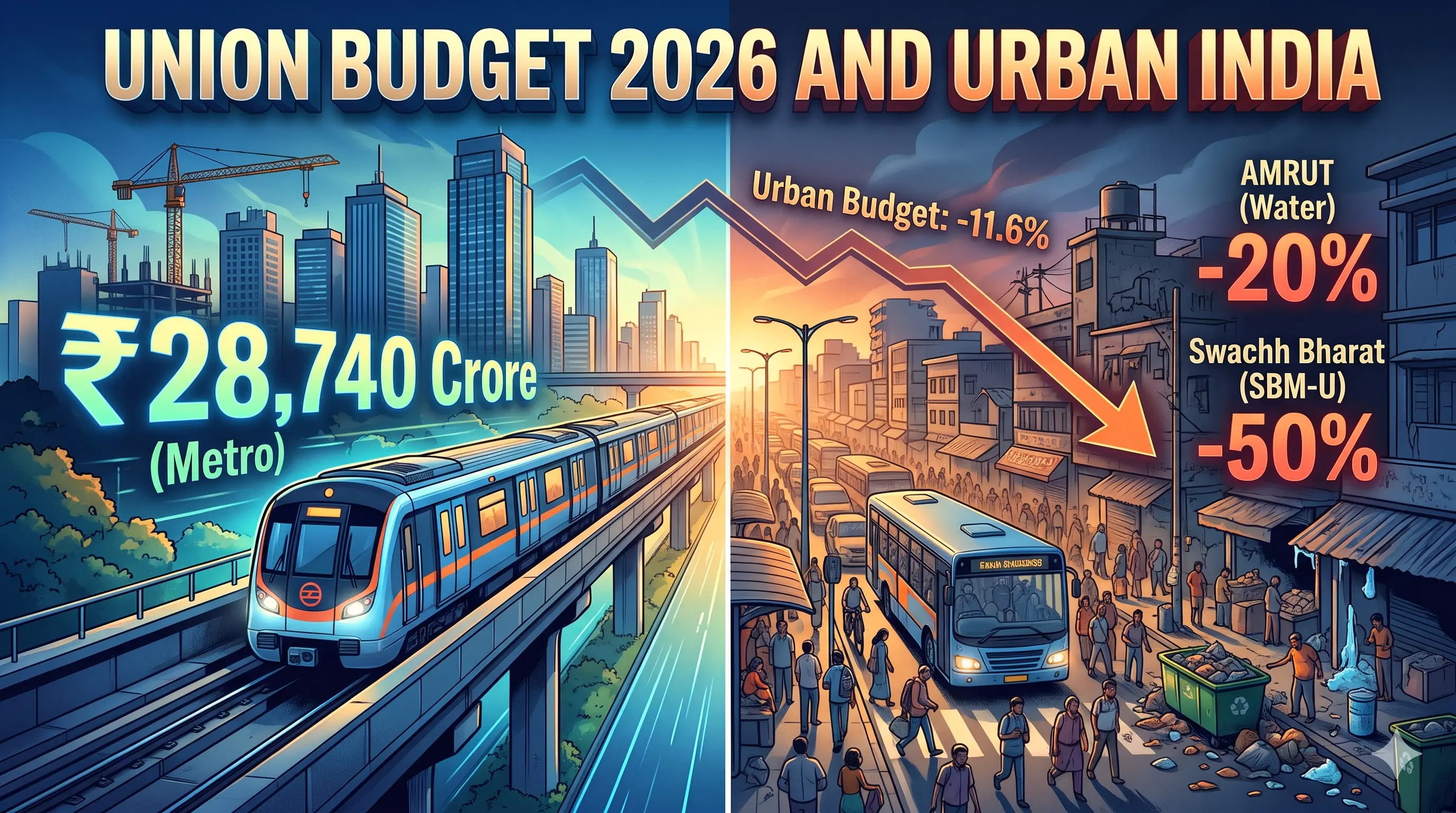
- •Reduction in Central Allocations: Central funding for urban development has been cut by 11.6% (from ₹96,777 crore to ₹85,522 crore), at a time when cities face immense pressure from migration and climate stress.
- •Economic Engines at Risk: Urban regions contribute close to two-thirds of the national GDP and are vital hubs for employment and innovation, making consistent public investment a macroeconomic necessity.
- •Skewed Spending Priorities: A disproportionate share of the budget (₹28,740 crore) is dedicated to high-visibility Metro rail projects, which serve limited geographic areas, while essential routine services like buses and drainage are neglected.
- •Institutional Paralysis of ULBs: Despite the vision of the 74th Constitutional Amendment, Urban Local Bodies (ULBs) lack operational and financial autonomy, relying heavily on central and state transfers.
- •Cuts to Flagship Schemes: Vital initiatives that maintain a baseline of urban living standards—PMAY-U (housing), AMRUT (water), and SBM-U (sanitation)—have faced drastic budget cuts ranging from 6% to 50%.
Reductions in Key Urban Schemes (Budget 2026)
| Scheme/Category | Focus Area | Budget Reduction | Bookmark |
|---|---|---|---|
| Total Urban Allocation | Overall urban development | 11.6% (₹96,777 cr to ₹85,522 cr) | |
| Swachh Bharat Mission-Urban (SBM-U) | Sanitation and waste management | ~50% (Reduced by half) | |
| AMRUT | Water supply and sewerage | 20% | |
| Pradhan Mantri Awas Yojana-Urban (PMAY-U) | Affordable housing | ~6% |
Imbalance in Transport Spending
| Mode of Transport | Primary Beneficiaries | Funding Status | Bookmark |
|---|---|---|---|
| Metro & Mass Rapid Transit | Capital-intensive, formal-sector commuters | ₹28,740 crore (~33% of total budget) | |
| Public Buses & NMT | Broad urban population, informal sector | Comparatively limited support |
Related Entities
Impact & Significance
- •Housing Deficit: A reduction in PMAY-U funding exacerbates shortages in affordable housing, risking the unchecked expansion of informal settlements and slums in metropolises.
- •Public Health Risks: Cutting SBM-U funds by half threatens to derail hard-won progress in urban sanitation and solid waste management.
- •Water and Sanitation Stress: With AMRUT funding slashed by 20%, cities facing acute water shortages and flooding will struggle to upgrade their deteriorating sewerage and drainage networks.
- •Macro-Economic Stagnation: Because urban centers are the primary engines of economic growth, under-investing in their baseline infrastructure can ultimately choke India's broader development ambitions.
Challenges & Criticism
- •Obsession with High-Visibility Projects: Policymakers continue to favor highly visible, capital-intensive infrastructure (like Metro systems) while neglecting 'invisible' routine services like solid waste management and pedestrian walkways.
- •Exclusionary Transport Spending: By allocating one-third of the urban budget to Metros, the government disproportionately benefits formal-sector commuters, starving local bus services and non-motorized transport used by the urban poor.
- •No Push for Financial Devolution: While the Centre reduced its funding footprint, the budget failed to introduce structural reforms that would grant municipalities enhanced, independent revenue-generating powers.
- •Ignoring Climate Realities: Cutting routine infrastructure funds leaves cities highly vulnerable to extreme climate events, such as urban flooding and severe heatwaves, which require resilient everyday systems.
Future Outlook
- •Empowering Urban Local Bodies: True financial devolution is required under the 74th Amendment to give municipalities revenue-generating powers, reducing their dependence on Centre/State transfers.
- •Inclusive Mobility Planning: Shifting financial focus from capital-intensive metro systems to robust public bus networks, last-mile connectivity, and non-motorized transport (NMT) that serve the broader population.
- •Climate-Resilient Infrastructure: Dedicated long-term funding mechanisms for routine urban services like drainage, solid waste management, and water supply to handle extreme heat and flooding.
- •Cities as Growth Catalysts: A macroeconomic shift in perspective is needed, viewing urban investment as the cornerstone of India's long-term economic and social transformation.
UPSC Relevance
- • GS-1 (Indian Society): Issues related to urbanization, their problems, and remedies.
- • GS-2 (Polity & Governance): Devolution of powers and finances up to local levels (74th Amendment); Government policies and interventions for development in various sectors.
- • GS-3 (Economy & Infrastructure): Infrastructure (Energy, Ports, Roads, Airports, Railways, etc.); Inclusive growth and issues arising from it.
- • Essay Topics: 'Urbanization: An Engine of Growth or a Looming Crisis?', 'The Paradox of India's Megacities: Wealth Generators with Poor Governance'.
Sample Questions
Prelims
Consider the following statements regarding urban development financing in India:
- (a)The 74th Constitutional Amendment Act made it mandatory for the Central Government to directly fund all urban infrastructure projects.
- (b)Under the Union Budget 2026, allocations for the Swachh Bharat Mission-Urban (SBM-U) were significantly reduced compared to previous allocations.
- (c)Urban Local Bodies (ULBs) in India generate the majority of their revenue independently through municipal bonds and local taxes.
Mains
“Treating urban development primarily as an expenditure burden rather than a growth catalyst may lead to adverse socio-economic outcomes.” In light of the Union Budget 2026, evaluate the challenges of financing urban infrastructure and the persistent weakness of Urban Local Bodies (ULBs) in India.
Introduction: Start with the context of India's rapid urbanization (cities contributing 2/3rds of GDP) juxtaposed against the recent 11.6% reduction in urban allocations in Budget 2026.
Body:
• Analysis of Budget 2026: Highlight the 11.6% overall cut; sweeping reductions in flagship schemes like SBM-U (50% cut), AMRUT (20%), and PMAY-U (6%); disproportionate focus on Metro projects (₹28,740 cr).
• Challenges in Urban Financing: Discuss skewed spending (high-visibility vs. routine services), lack of inclusive mobility funding, and rising need for climate-resilient infrastructure.
• Institutional Weakness of ULBs: Explain the failure to fully implement the 74th Amendment; lack of financial devolution, functions, and functionaries; heavy reliance on CSS (Centrally Sponsored Schemes).
Conclusion: Conclude by emphasizing that sustainable development requires viewing cities as economic engines. Financial empowerment of ULBs and a balanced focus on basic public infrastructure are crucial for inclusive urban growth.