
International Relations · UPSC Notes
Indo-Pacific and Global Institutions — UPSC International Relations Notes
Free, exam-focused notes for UPSC Prelims and Mains, with Prelims tips and Mains points for every topic. 3 topics.
Open in the interactive reader: bookmarks, progress tracking and read-aloud.
The Indo-Pacific and the Quad
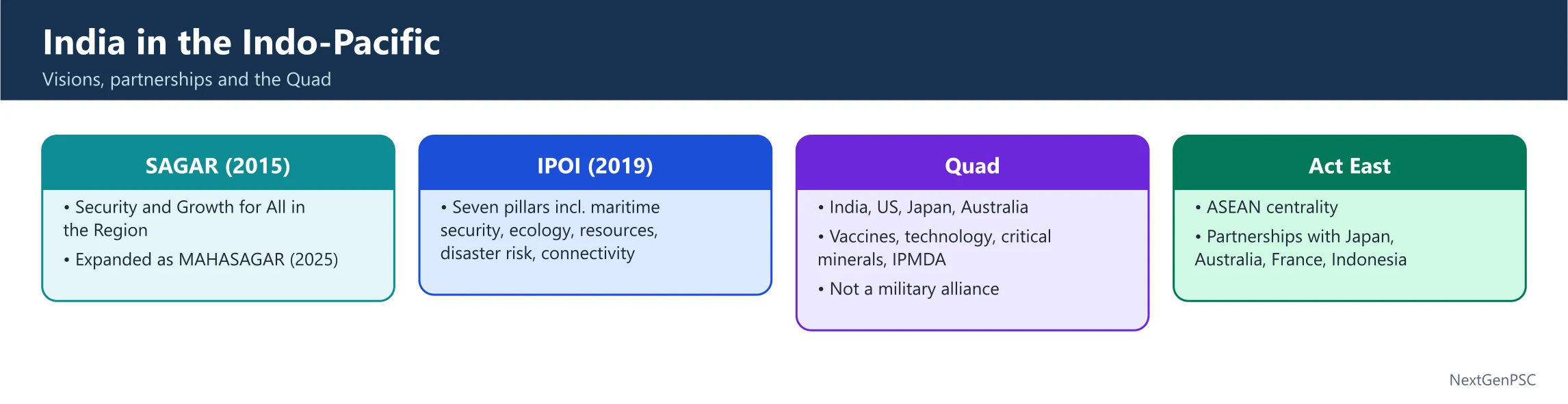
The Indo-Pacific links the Indian and Pacific Oceans into one strategic space, reflecting the shift of global economic and military weight to Asia. India's vision—free, open, inclusive and rules-based, with ASEAN centrality—is expressed through SAGAR (2015)/MAHASAGAR (2025), the Indo-Pacific Oceans Initiative (2019) and the Quad with the US, Japan and Australia, which focuses on practical cooperation rather than military alliance.
1. Why the Indo-Pacific Matters
Major sea lanes carry much of world trade and energy (Strait of Malacca, Hormuz, Bab-el-Mandeb).
Rise of China, territorial disputes in the South China Sea, naval competition, piracy, climate threats to small island states.
2. India's Approach
SAGAR (Security and Growth for All in the Region, 2015), expanded as MAHASAGAR (Mutual and Holistic Advancement for Security and Growth Across Regions, 2025).
Indo-Pacific Oceans Initiative (IPOI, 2019): Seven pillars—maritime security, maritime ecology, maritime resources, capacity building, disaster risk reduction, science and technology, trade and connectivity.
Act East Policy, partnerships with ASEAN, Japan, Australia, France, Indonesia; Information Fusion Centre–Indian Ocean Region (Gurugram); coastal radar networks and naval diplomacy.
3. The Quad
Origin: Tsunami Core Group (2004); first meeting in 2007; revived in 2017; leaders' summits since 2021.
Agenda: Vaccines, critical and emerging technologies, climate and clean energy, infrastructure, cyber security, Indo-Pacific Partnership for Maritime Domain Awareness (IPMDA), critical minerals, humanitarian assistance and disaster relief.
Malabar exercise: Includes all four Quad navies since Australia rejoined in 2020.
Not an alliance: No mutual defence commitment; India emphasises inclusivity.
4. Other Indo-Pacific Frameworks
AUKUS (Australia, UK, US—nuclear submarines), IPEF (India joined except the trade pillar), ASEAN Outlook on the Indo-Pacific, France's and the EU's Indo-Pacific strategies.
5. Challenges
Divergent priorities among Quad members, ASEAN wariness of great-power rivalry, China's opposition, limited resources for delivering infrastructure alternatives, US policy uncertainty.
6. Way Forward
Deliver tangible public goods (health, disaster relief, connectivity), strengthen maritime capabilities, uphold UNCLOS, and deepen ties with island states.
| Instrument | Year | Focus |
|---|---|---|
| SAGAR | 2015 | Security and growth for all in the region |
| IPOI | 2019 | Seven pillars of maritime cooperation |
| Quad leaders' summits | Since 2021 | Vaccines, technology, maritime awareness |
| MAHASAGAR | 2025 | Expanded vision covering the Global South |
Prelims tips
- Quad members: India, USA, Japan, Australia.
- IPOI was announced by India at the East Asia Summit in 2019.
- Malabar exercise began as an India–US exercise in 1992.
- UNCLOS was adopted in 1982.
- IFC-IOR is located in Gurugram.
Mains points
- The Indo-Pacific concept recognises India's central geographic position and elevates its role beyond South Asia.
- The Quad's value lies in delivering public goods and building capacity, not in military confrontation.
- India balances the Quad with membership in BRICS and SCO, reflecting multi-alignment.
- Maritime domain awareness and naval capability are crucial for securing sea lanes and responding to crises.
Did you know?
- Japanese PM Shinzo Abe's 'Confluence of the Two Seas' speech in India's Parliament (2007) helped popularise the Indo-Pacific idea.
- The Indian Navy is often the first responder in Indian Ocean disasters.
- About 95% of India's trade by volume (around 70% by value) moves by sea.
UN Reforms and India's Bid for a Permanent Seat
The UN Security Council still reflects the power structure of 1945, with five permanent members holding a veto. India, along with the G4 (Brazil, Germany, Japan), seeks expansion in both permanent and non-permanent categories. Reform is blocked by the Uniting for Consensus group, divisions over the veto and the need for P5 ratification under Article 108 of the UN Charter.
1. Structure of the UNSC
15 members: 5 permanent (US, UK, France, Russia, China) with veto, and 10 non-permanent members elected for two-year terms; expanded from 11 to 15 in 1965.
India has served as a non-permanent member eight times, most recently in 2021–22.
2. Why Reform Is Needed
Under-representation of Africa, Latin America and Asia; no permanent seat for India, the most populous country; veto paralysis in crises (Syria, Ukraine, Gaza); legitimacy deficit.
3. India's Case
Population and democracy, large economy, one of the largest contributors to UN peacekeeping, nuclear power with a responsible record, leadership of the Global South, consistent support for multilateralism.
4. Reform Positions
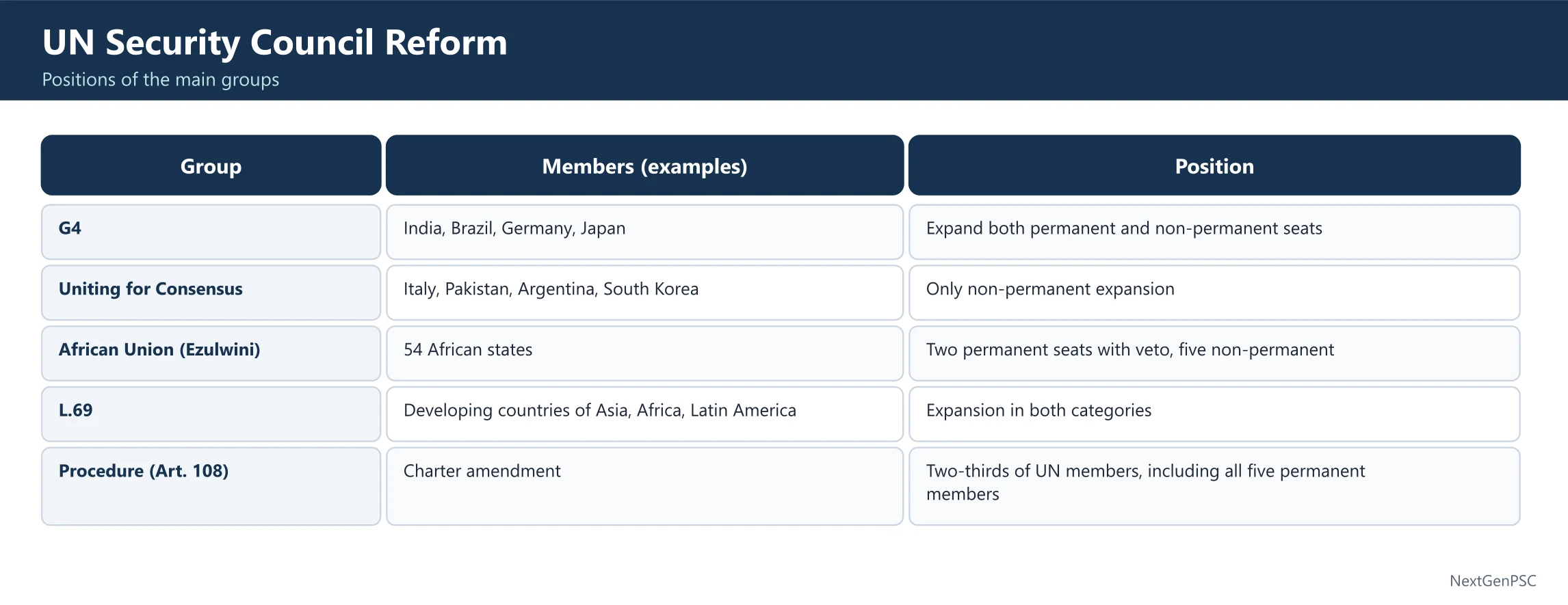
G4 (India, Brazil, Germany, Japan): Expansion in both categories; flexibility on the veto for new members.
Uniting for Consensus ('Coffee Club') (Italy, Pakistan, Argentina, South Korea and others): Only non-permanent expansion.
African Union – Ezulwini Consensus: At least two permanent seats with veto and five non-permanent seats for Africa.
L.69 group of developing countries supports expansion in both categories.
Intergovernmental Negotiations (IGN) in the General Assembly since 2009 have made slow progress; the Pact for the Future (2024) committed to reform without specifics.
5. Procedure and Obstacles
Charter amendment needs two-thirds of the General Assembly and ratification by two-thirds of members, including all five permanent members (Article 108).
China's opposition to India's and Japan's bids; disagreement on the veto; regional rivalries.
6. Broader UN Reform
Revitalising the General Assembly, reforming peacekeeping and financing, strengthening the Human Rights Council, reforming global financial institutions; India pushes for 'reformed multilateralism'.
| Group | Members (examples) | Position |
|---|---|---|
| G4 | India, Brazil, Germany, Japan | Expand permanent and non-permanent seats |
| Uniting for Consensus | Italy, Pakistan, Argentina, South Korea | Only non-permanent expansion |
| African Union | 54 African states | Two permanent seats with veto, five non-permanent |
| L.69 | Developing countries from Asia, Africa, Latin America | Expansion in both categories |
Prelims tips
- UNSC expanded from 11 to 15 members in 1965.
- Article 108 of the UN Charter governs amendments (needs P5 ratification).
- India's latest UNSC term as a non-permanent member was 2021–22.
- G4: India, Brazil, Germany, Japan.
- The Pact for the Future was adopted at the UN Summit of the Future (2024).
Mains points
- An unreformed UNSC risks losing legitimacy as power shifts to the Global South and Asia.
- India's case rests on population, economy, peacekeeping and democratic credentials, but reform is held hostage by P5 interests and regional rivalries.
- Coalition-building with Africa (Ezulwini) and the L.69 group strengthens India's push.
- While pursuing a permanent seat, India should keep shaping global governance through G20, BRICS and issue-based coalitions.
Did you know?
- India was among the founding members of the UN in 1945, before independence.
- Vijaya Lakshmi Pandit was the first woman President of the UN General Assembly (1953).
- India deployed the first all-women formed police unit for UN peacekeeping in Liberia (2007).
Effect of Policies and Politics of Developed and Developing Countries on India's Interests
The GS II syllabus asks how policies and politics of other countries affect India. Key examples include protectionism and tariffs, immigration rules (H-1B visas), the EU's Carbon Border Adjustment Mechanism (CBAM), sanctions on Russia and Iran, China's export controls on critical minerals, the paralysis of the WTO, climate finance politics and debt crises in developing countries. India responds through diversified trade agreements, self-reliance and Global South leadership.
1. Trade Policies
US tariffs (2025): Steep duties on Indian goods affect labour-intensive exports (textiles, gems, shrimp).
EU CBAM: Carbon-linked charges on imports of steel, aluminium, cement, fertilisers etc.; reporting phase from 2023, financial obligations from 2026; seen by India as a unilateral trade barrier.
EU Deforestation Regulation affects exports like coffee and leather.
WTO crisis: Appellate Body non-functional since December 2019, weakening dispute settlement.
2. Immigration Policies
Changes to US H-1B rules and fees, UK and Canadian visa tightening, and Gulf labour policies affect Indian professionals, students and remittances.
3. Sanctions and Geopolitics
US sanctions on Iran affect Chabahar and oil imports; sanctions on Russia complicate defence payments and oil trade; CAATSA threat over the S-400.
Conflicts (Ukraine, West Asia) raise energy and fertiliser prices and disrupt shipping.
4. China's Policies
Export controls on rare earths, gallium and germanium; dumping of cheap goods; BRI debt diplomacy in India's neighbourhood.
5. Climate and Finance Politics
Developed countries' unmet climate finance pledges ($100 billion goal); new collective goal of $300 billion a year by 2035 (COP29, 2024) seen as inadequate by developing countries.
Monetary tightening in the US affects capital flows and the rupee.
6. Policies of Developing Countries
Political instability in neighbours (Bangladesh, Myanmar), debt crises (Sri Lanka 2022), Pakistan's support to terrorism, Chinese influence in smaller states.
7. India's Responses
Trade deals: India–UAE CEPA (2022), India–Australia ECTA (2022), India–EFTA TEPA (2024), India–UK CETA (signed 2025); talks with the EU.
Self-reliance: PLI schemes, critical minerals mission, semiconductor mission.
Diplomacy: Voice of the Global South summits, G20 presidency, push for WTO reform and climate justice (CBDR).
| Policy | Country/bloc | Impact on India |
|---|---|---|
| Tariff increases | USA | Pressure on exports and jobs |
| CBAM | European Union | Costs for steel and aluminium exporters |
| H-1B changes | USA | Effect on IT professionals and remittances |
| Export controls on rare earths | China | Supply risks for EVs and electronics |
| Sanctions on Iran/Russia | USA, EU | Energy, Chabahar and defence payment issues |
Prelims tips
- CBAM's definitive (financial) phase starts in 2026 after a transitional reporting phase from October 2023.
- WTO Appellate Body has been non-functional since December 2019.
- India–EFTA TEPA (2024) includes a commitment of $100 billion investment over 15 years.
- COP29 (Baku, 2024) set a new climate finance goal of $300 billion a year by 2035.
- India–Australia ECTA came into force in December 2022.
Mains points
- In an interdependent world, unilateral policies of major powers directly affect India's growth, jobs and security.
- Diversifying export markets and supply chains reduces vulnerability to any one country's policies.
- India must combine negotiation (FTAs, WTO reform) with domestic competitiveness (logistics, skills, PLI).
- Climate-linked trade measures need a CBDR-based response that protects development space while decarbonising industry.
- Leadership of the Global South amplifies India's voice against unfair global rules.
Did you know?
- EFTA comprises Switzerland, Norway, Iceland and Liechtenstein.
- India hosted the first Voice of the Global South Summit virtually in January 2023.
- The WTO replaced GATT in 1995.
International Relations: All chapters
- India and Its Neighbourhood
- India and Major Powers
- Indo-Pacific and Global Institutions