
Indian Polity & Governance · UPSC Notes
State Legislature — UPSC Polity Notes
Free, exam-focused notes for UPSC Prelims and Mains, with Prelims tips and Mains points for every topic. 11 topics.
Open in the interactive reader: bookmarks, progress tracking and read-aloud.
State Legislature – Composition & Legislative Assembly
The State Legislature is provided in Part VI of the Constitution (Articles 168–212). It consists of the Governor and one or two houses – the Legislative Assembly (Vidhan Sabha) and, in some states, the Legislative Council (Vidhan Parishad). The Legislative Assembly is the directly elected house and forms the core of state-level law-making.
A. Constitutional Basis
1. Part VI (Articles 168–212) of the Constitution deals with the State Legislature .
2. It covers organisation, composition, duration, powers, privileges, procedures, and relationship with the Governor.
3. Every state in India has a legislature — either unicameral or bicameral.
4. Unicameral Legislature: Only Legislative Assembly (e.g., Kerala, Tamil Nadu).
5. Bicameral Legislature: Legislative Assembly + Legislative Council (e.g., UP, Maharashtra, Bihar, Karnataka, Telangana).
6. Parliament has the power to create or abolish the Legislative Council in a state (Article 169).
B. Composition of the State Legislature
The State Legislature consists of three parts:
1. The Governor – Head of the State Legislature (like the President at the Union level).
2. Legislative Assembly (Vidhan Sabha) – Compulsory House; directly elected by the people.
3. Legislative Council (Vidhan Parishad) – Optional Upper House; only in some states (bicameral).
C. State Legislative Assembly (Vidhan Sabha)
1. It is the Lower House but the real legislative authority in the state.
2. It represents the people of the state directly as members are elected on the basis of universal adult franchise (18 years and above).
3. It is the House of the People at the state level, similar to the Lok Sabha at the national level.
4. It exercises control over the executive (Council of Ministers) through motions, debates, and votes.
D. Composition and Strength
1. Article 170 provides that the strength of the Legislative Assembly shall be not more than 500 and not less than 60 members.
2. Actual strength depends on the population of the state as determined by the Delimitation Commission.
3. Smaller states and Union Territories may have fewer than 60 members.
Examples:
Uttar Pradesh: Largest Assembly – 403 members.
Madhya Pradesh: 230 members.
Bihar: 243 members.
Arunachal Pradesh, Sikkim, Goa: 30 members each.
Mizoram: 40 members.
Nagaland: 46 members.
5. Each member represents a single territorial constituency (one MLA = one constituency).
6. Seats are allocated based on the principle of population equality – roughly one MLA per equal population share.
E. Duration and Tenure
1. The normal term of the Legislative Assembly is 5 years from the date of its first sitting (Article 172).
2. The Governor may dissolve the Assembly earlier on the advice of the Chief Minister.
3. During a national emergency (Article 356) , the term may be extended by Parliament for one year at a time , but not beyond six months after the emergency ends.
4. Example: During the Emergency (1975–77), the term of several state assemblies was extended beyond 5 years.
F. Membership Qualifications
To become a Member of Legislative Assembly (MLA):
1. Must be a citizen of India .
2. Must be at least 25 years of age .
3. Must possess qualifications prescribed by Parliament (Representation of the People Act, 1951).
4. Must not hold an office of profit under the state or Union government.
5. Must not be of unsound mind or insolvent.
6. Must not be disqualified under anti-defection law (Tenth Schedule).
7. Election Commission decides on disqualifications in consultation with the Governor.
G. Nomination of Members
1. Earlier, the Governor could nominate one Anglo-Indian member to the Legislative Assembly if the community was not adequately represented (Article 333).
2. This provision was abolished by the Constitution (104th Amendment) Act, 2020 .
3. As of now, there are no nominated members in any State Legislative Assembly.
H. Delimitation and Representation
1. The process of dividing the state into constituencies for elections is called Delimitation .
2. Conducted by an independent Delimitation Commission set up by the Union Government under the Delimitation Act.
3. The last delimitation exercise was based on the 2001 Census (implemented in 2008).
4. Currently, delimitation is frozen till 2026 to ensure population control is not penalized.
5. After 2026, the boundaries and number of seats may be readjusted based on future Census data.
I. Significance of the Legislative Assembly
1. It represents the will of the people and is the foundation of democracy at the state level.
2. It controls the Council of Ministers through questions, debates, and confidence motions.
3. It exercises financial powers – no money bill can be introduced without its consent.
4. It plays a key role in policy formulation and state legislation.
5. It serves as a forum for political accountability, public grievance redressal, and legislative oversight.
6. The Governor and the Assembly together form the law-making authority for the state.
J. Quick Summary for Beginners
1. Articles 168–212 cover State Legislature provisions.
2. Every state has a Legislative Assembly (Vidhan Sabha) ; some have a Legislative Council (Vidhan Parishad) .
3. Minimum strength: 60 | Maximum: 500 (some exceptions for small states).
4. Term: 5 years; can be dissolved earlier or extended during emergency.
5. 104th Amendment (2020): Ended nomination of Anglo-Indian members.
6. Legislative Assembly = real executive control + people’s voice + financial power.
Prelims tips
- Articles 168–212: State Legislature.
- Legislative Assembly: compulsory, directly elected members.
- Maximum strength = 500, minimum = 60 (exceptions for smaller states).
- 104th Amendment (2020): Removed Anglo-Indian nomination in LA.
Mains points
- Legislative Assembly is the democratic core of state legislatures, ensuring representation through direct elections.
- Strength of Assembly reflects federal flexibility, accommodating smaller states with special provisions.
- Abolition of Anglo-Indian nomination reflects the trend towards limiting nominated representation and strengthening elected bodies.
- Governor + Assembly combination ensures checks and balances within state executive-legislature relations.
State Legislative Assembly – Territorial Constituencies, Reservation, and Duration
The Legislative Assembly is constituted on the basis of territorial constituencies, with seats allocated by Delimitation Commissions. Reservations exist for SCs and STs under Article 332. The Assembly normally has a 5-year tenure, extendable during a National Emergency.
A. Territorial Constituencies & Delimitation (सीमांकन)
1. Each state is divided into territorial constituencies for elections to the Legislative Assembly.
2. The aim of delimitation is to ensure equal representation to every citizen by keeping population per constituency roughly the same.
3. Constituency boundaries are redrawn by an independent Delimitation Commission established under the Delimitation Act passed by Parliament.
4. So far, four Delimitation Acts have been passed — in 1952, 1962, 1972, and 2002 .
5. The present delimitation (for all states except J&K) is based on the 2001 Census and implemented in 2008 .
6. Jammu & Kashmir’s delimitation is based on the 2011 Census following the J&K Reorganisation Act, 2019.
7. 1971 Census population data has been used for allocation of seats across states — this is frozen till the first census after 2026 (to avoid penalising states that controlled population growth).
8. As per Article 170(2): The ratio between the population of each constituency and number of seats allotted should be as uniform as possible within a state.
9. This ensures ‘One Vote, One Value’ principle.
10. Example: The Delimitation Commission increased seats in some fast-growing areas (like Bengaluru) to balance population representation.
11. Once the Delimitation Commission finalizes its report, it cannot be challenged in any court (its decision is final and binding).
B. Reservation of Seats in Legislative Assembly
1. Article 332 provides for reservation of seats for Scheduled Castes (SCs) and Scheduled Tribes (STs) in proportion to their population in each state.
2. This ensures political inclusion and representation for historically disadvantaged communities.
3. Example: If a state has 15% SC population, roughly 15% of its Assembly seats are reserved for SC candidates.
4. Reserved constituencies: Only SC/ST candidates can contest, but all voters (including general category) can vote.
5. SC/ST candidates are also free to contest from general (unreserved) seats.
6. No reservation exists in Legislative Councils (upper houses).
7. Reservation for SC/ST seats is reviewed after each Census but will continue as per 104th Constitutional Amendment (2020) till 2030 .
8. Example: In Bihar (243 members), 38 seats are reserved for SCs and 2 for STs.
9. These reserved seats rotate across constituencies based on demographic shifts after each delimitation.
C. Duration (Tenure) of the Legislative Assembly
1. The normal term of every State Legislative Assembly is 5 years from the date of its first sitting (Article 172).
2. This period ensures political stability and a predictable governance cycle.
3. However, the Assembly can be dissolved earlier in the following cases:
(a) By the Governor on the advice of the Council of Ministers headed by the Chief Minister (for early elections).
(b) Automatically, if a No-Confidence Motion is passed and the government loses majority in the House.
4. During a National Emergency (Article 356) , the term of the Assembly can be extended by Parliament for one year at a time .
5. However, such extension cannot continue beyond six months after the end of the emergency.
6. Example: During the Emergency (1975–77), several state assemblies (like Bihar and UP) had their terms extended beyond 5 years.
7. Once the Assembly is dissolved, the Governor’s rule (Article 356) or President’s rule may be imposed until new elections are held.
8. On average, the Assembly is convened for at least three sessions per year – Budget, Monsoon, and Winter sessions.
D. Key Points for Revision
1. Delimitation: Adjusts constituency boundaries for fair representation (last in 2008).
2. Seat Allocation: Based on 1971 Census, frozen till 2026.
3. Reservation: SC/ST representation under Article 332, reviewed after each census.
4. Duration: Normal term – 5 years; may be dissolved earlier or extended during emergency.
5. Core Principle: Equal representation + social justice + stable governance.
Simultaneous elections: the Ram Nath Kovind committee reported in March 2024; the Constitution (129th Amendment) Bill, introduced in December 2024 to align Lok Sabha and Assembly terms, was referred to a Joint Parliamentary Committee.
Prelims tips
- Delimitation Acts: 1952, 1962, 1972, 2002.
- Current delimitation based on 2001 Census (J&K → 2011 Census).
- Seat allocation based on 1971 Census (frozen till 2026).
- Article 332: Reservation for SCs and STs in State Assemblies.
- Assembly term: 5 years; extendable during National Emergency.
Mains points
- Delimitation ensures equitable representation across constituencies but political consensus has frozen seat allocation since 1971 Census.
- Reservation of seats under Article 332 strengthens representation of marginalized communities in state politics.
- Duration of Assembly reflects federal stability but flexibility during national emergency ensures continuity of governance.
- Frequent dissolutions before 5 years often reflect political instability and misuse of Governor’s discretionary powers.
State Legislative Council (Vidhan Parishad)
The State Legislative Council (Vidhan Parishad) is the upper house in a bicameral legislature of certain Indian states. It is a continuing body with indirectly elected and nominated members. Its creation or abolition is governed by Article 169, while composition and election are guided by Article 171.
A. Creation or Abolition of Legislative Council (Article 169)
1. The Legislative Council (Vidhan Parishad) is the Upper House of the State Legislature (similar to the Rajya Sabha at the Centre).
2. It is optional — not all states have it.
3. A state can create or abolish a Legislative Council, but only through a special constitutional procedure.
4. The process:
(a) The State Legislative Assembly must first pass a resolution by special majority — i.e., majority of total membership + two-thirds of members present and voting.
(b) Based on this resolution, Parliament may create or abolish the Council through a simple majority law.
5. Thus, the final decision lies with Parliament , not the state.
6. This process ensures federal balance and prevents misuse by state governments.
8. Examples:
Andhra Pradesh Legislative Council was abolished in 1985 and re-established in 2007 .
Tamil Nadu Assembly passed a resolution in 2021 to revive its Council, but it awaits Parliamentary approval.
7. Current Bicameral States (2025): Andhra Pradesh, Bihar, Karnataka, Maharashtra, Telangana, and Uttar Pradesh.
B. Composition of Legislative Council (Article 171)
1. The composition aims to represent different sections of society — local bodies, teachers, graduates, legislators, and intellectuals.
2. Maximum Strength: Cannot exceed 1/3rd of the total strength of the State Legislative Assembly.
3. Minimum Strength: 40 members.
4. Example: If a State Assembly has 120 members, its Legislative Council can have up to 40 members (1/3rd of 120 = 40).
5. Jammu & Kashmir (before 2019) was an exception — minimum 36 members.
6. Parliament has the power to alter composition through law.
C. Election and Nomination of Members
1. The Council is not directly elected — members are chosen by an indirect election system through proportional representation by single transferable vote (PR-STV) .
2. Distribution of Seats:
(a) 1/3rd elected by members of local bodies (municipalities, district boards, panchayats).
(b) 1/12th elected by graduates of at least 3 years’ standing from Indian universities.
(c) 1/12th elected by teachers of secondary school level or above (with at least 3 years’ experience).
(d) 1/3rd elected by members of the Legislative Assembly (from non-MLAs).
(e) The remaining members are nominated by the Governor — distinguished persons in literature, science, art, social service, or cooperative movement.
3. Example: The Maharashtra Legislative Council has 78 members: 30 from local bodies, 12 from teachers/graduates, 30 from Assembly, and 6 nominated by the Governor.
4. Parliament can modify this distribution pattern by law (Article 171(5)).
D. Duration and Tenure
1. The Legislative Council is a permanent body ; it cannot be dissolved like the Assembly.
2. Members serve for a term of 6 years .
3. Every 2 years, one-third of the members retire — ensuring continuity (similar to the Rajya Sabha).
4. Retiring members are eligible for re-election or re-nomination .
5. The Chairman and Deputy Chairman are elected by the Council members from among themselves.
E. Functions and Powers of the Legislative Council
1. The Council is often called a ‘House of Review’ — it reviews, debates, and suggests improvements to bills passed by the Legislative Assembly.
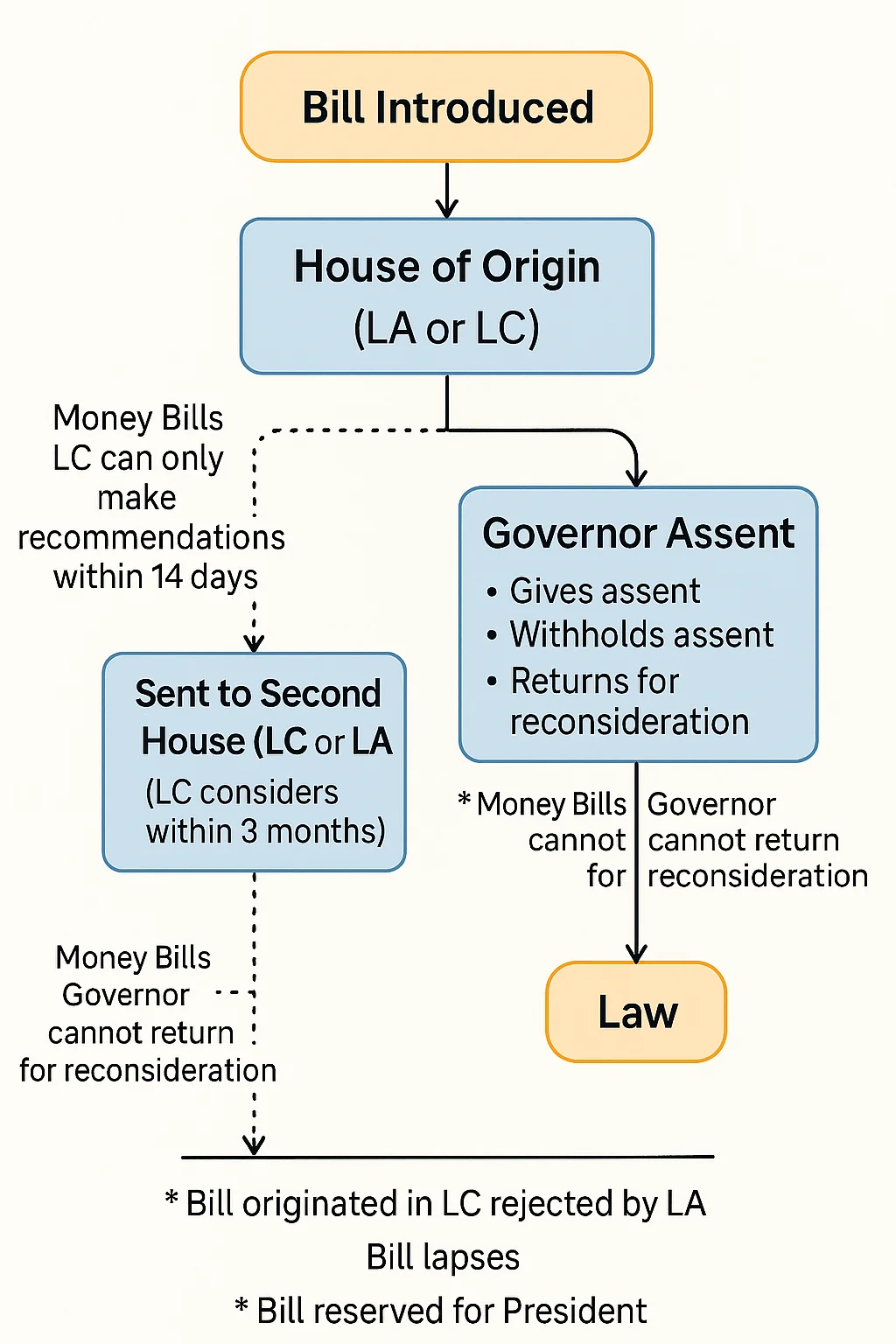
2. Ordinary Bills: The Council can delay a Bill for a maximum of 4 months (3 months in the first instance + 1 month on reconsideration).
3. Money Bills: The Council has no power to reject or amend a Money Bill — it can only make recommendations within 14 days, which the Assembly may accept or ignore.
4. Financial Control: The Council cannot vote on demands for grants, nor does it have any role in the budget passage.
5. Control over Executive: It can question ministers, discuss policies, and suggest improvements — but cannot remove the government (no confidence motion is not allowed).
6. Deliberative Function: Serves as a forum for intellectual discussion and expert review — its debates are more reasoned and less political.
7. Advisory Role: Helps refine legislation and public policies through scrutiny and debate.
8. Example: In Maharashtra and Karnataka, many experts, educationists, and social reformers contribute through the Legislative Council.
F. Importance and Criticism
1. Importance:
Provides checks and balances on the Assembly.
Allows representation of professionals and intellectuals.
Ensures continuity and stability in law-making.
2. Criticism:
Viewed as a ‘burden on the exchequer’ due to limited powers.
Sometimes used for political rehabilitation of defeated leaders.
Can delay legislation unnecessarily (though cannot block it permanently).
3. Still, it plays an important advisory and reforming role in state governance.
| State | Legislative Assembly Strength | Legislative Council Strength |
|---|---|---|
| Andhra Pradesh | 175 | 58 |
| Bihar | 243 | 75 |
| Karnataka | 224 | 75 |
| Maharashtra | 288 | 78 |
| Telangana | 119 | 40 |
| Uttar Pradesh | 403 | 100 |
| Category | Fraction of Members |
|---|---|
| Local bodies (municipalities, district boards) | 1/3rd |
| Graduates (3+ years standing) | 1/12th |
| Teachers (3+ years, secondary school+) | 1/12th |
| MLAs (non-MLAs only) | 1/3rd |
| Nominated by Governor | Remaining |
| Parameter | Legislative Assembly (Vidhan Sabha) | Legislative Council (Vidhan Parishad) |
|---|---|---|
| Status | Compulsory | Optional |
| Members | Directly elected | Indirectly elected + nominated |
| Tenure | 5 years | 6 years (1/3rd retire every 2 years) |
| Dissolution | Can be dissolved by Governor | Permanent body (cannot be dissolved) |
| Role | Real power, controls finances & government | Advisory & revisory body |
| Money Bills | Final authority | Can only recommend amendments |
| Creation/Abolition | Cannot be abolished | Created/abolished by Parliament under Art. 169 |
Prelims tips
- Article 169: Creation/abolition of Legislative Council.
- Article 171: Composition – max 1/3rd of Assembly, min 40 members.
- Council is permanent (like Rajya Sabha) – 1/3rd retire every 2 years.
- Present in 6 states – UP, Bihar, Maharashtra, Karnataka, Andhra Pradesh, Telangana.
Mains points
- Vidhan Parishad represents functional groups (teachers, graduates, professionals) often left out in Assembly elections.
- Its limited powers (esp. over Money Bills) make it subordinate to the Legislative Assembly.
- Criticism: Adds financial burden, delays legislation, and is often used to accommodate political leaders rejected by people.
- Supporters argue it improves legislative quality by revising laws and providing representation to educated groups.
- Federal flexibility: States can demand creation or abolition depending on political/economic needs.
Qualifications, Disqualifications & Vacation of Seats – State Legislature
Members of State Legislative Assembly (LA) and Legislative Council (LC) must meet specific constitutional and statutory qualifications. Disqualifications are laid down in Article 191 and the Representation of the People Act, 1951. Seats may be vacated under Article 190 in cases such as resignation, disqualification, or prolonged absence.
A. Qualifications for Membership
1. To become a member of the State Legislature (Legislative Assembly or Legislative Council), a person must meet certain constitutional and legal criteria.
2. Basic Qualifications:
Must be a citizen of India .
Must satisfy age requirements :
Legislative Assembly (Vidhan Sabha): Minimum 25 years.
Legislative Council (Vidhan Parishad): Minimum 30 years.
Must be a registered voter (elector) in the state constituency.
Must possess other qualifications as prescribed by Parliament through the Representation of the People Act (RPA), 1951 .
3. Reservation: SC/ST candidates can contest only from reserved constituencies for their category (RPA 1951).
4. Example: A 27-year-old Indian citizen registered as a voter in Madhya Pradesh can contest for MLA but not MLC.
B. Disqualifications (Article 191 + RPA 1951)
1. A person shall be disqualified for being chosen or continuing as a member of the State Legislature if they:
Hold an office of profit under the Union or State Government (unless exempted by law).
Have been declared of unsound mind by a competent court.
Are an undischarged insolvent (unable to repay debts).
Are not a citizen of India or have voluntarily acquired the citizenship of a foreign country.
Have been convicted for certain criminal offences under RPA 1951 (e.g., bribery, corruption, promoting enmity, etc.).
Have engaged in corrupt practices or election malpractices .
Have a conflict of interest with public duties (such as government contractors).
C. Disqualification on Grounds of Defection (Anti-Defection Law)
1. Governed by the Tenth Schedule (added by the 52nd Amendment, 1985).
2. A member is disqualified if they:
Voluntarily give up membership of their political party.
Vote (or abstain) contrary to party directions (whip) without permission.
Join another political party after election.
3. Decision-making authority:
Legislative Assembly: Speaker decides.
Legislative Council: Chairman decides.
4. The decision of the Speaker/Chairman is final but subject to judicial review .
5. Landmark Case: Kihoto Hollohan vs. Zachillhu (1992) — Supreme Court upheld the law but allowed court review on fairness and legality.
D. Authority to Decide Disqualification (Article 192)
1. For disqualifications (other than defection), the Governor decides the matter.
2. The Governor must act in consultation with the Election Commission of India (ECI) .
3. ECI’s opinion is binding on the Governor.
4. This ensures that political bias does not influence the disqualification process.
E. Vacation of Seats (Article 190)
1. Double Membership: A person cannot be a member of both Houses of the State Legislature simultaneously.
If elected to both, they must vacate one seat within the prescribed time.
2. Membership of Two States: A person cannot be a member of two different state legislatures. If elected to both, they must choose one; otherwise, both seats become vacant.
3. Resignation:
A member may resign by writing to the Speaker (LA) or Chairman (LC) .
The resignation must be voluntary and genuine ; if found coerced, it can be rejected.
4. Disqualification: If incurred under Article 191, RPA 1951, or the Anti-Defection Law.
5. Absence: If a member is absent for 60 consecutive days without permission, the House may declare their seat vacant (Article 190(4)).
F. Other Cases of Vacancy
1. When the election is declared void by a competent court (e.g., due to malpractice or ineligibility).
2. If the member is expelled from the House for misconduct or breach of privilege.
3. On election or appointment as President, Vice-President, or Governor of a State (must vacate the legislative seat).
4. On death of the member.
| House | Minimum Age | Other Requirements |
|---|---|---|
| Legislative Assembly (LA) | 25 years | Indian citizen + elector in state constituency |
| Legislative Council (LC) | 30 years | Indian citizen + elector in state constituency |
| Ground | Details |
|---|---|
| Office of profit | Holds office under govt. except exempted offices |
| Unsound mind | Declared by competent court |
| Insolvency | Undischarged insolvent |
| Citizenship | Not a citizen of India or acquired foreign citizenship |
| Conviction | Convicted of certain offences (as per RPA 1951) |
| Corrupt practices | Bribery, undue influence during elections |
| Defection | Switching party under 10th Schedule (decided by Speaker/Chairman) |
| Ground | Explanation |
|---|---|
| Double membership | Cannot be member of both Houses of State Legislature |
| Membership in 2 states | Must resign from one; else both become vacant |
| Resignation | To Speaker/Chairman; must be voluntary |
| Disqualification | If incurred under Art. 191 / RPA 1951 / anti-defection |
| Absence | Absent without permission for 60 days |
| Election void | Declared void by court |
| Expulsion | By House resolution |
| Holding high office | Becomes President, VP, or Governor |
Prelims tips
- LA member – minimum age 25; LC member – minimum age 30.
- Article 191: Grounds of disqualification.
- Article 190: Vacation of seats (resignation, double membership, absence, etc.).
- Defection decided by Speaker/Chairman – subject to judicial review (Kihoto Hollohan, 1992).
Mains points
- Qualifications ensure minimum age and representation requirements for Assembly and Council.
- Disqualification provisions maintain legislative integrity and prevent conflicts of interest.
- Anti-defection law (10th Schedule) ensures stability but Speaker’s authority often criticized as partisan.
- Vacation of seats provisions uphold accountability and prevent misuse of legislative position.
- Judicial review of Speaker’s disqualification decisions ensures checks and balances.
Oath of Members & Speaker of Legislative Assembly
Under Article 188, every member of the State Legislature must take an oath/affirmation before taking their seat. The Speaker of the Legislative Assembly (Article 178) is the presiding officer, elected from among members, with key roles in maintaining order, certifying Money Bills, and deciding disqualifications under the Tenth Schedule.
Oath or Affirmation of Members (Article 188)
1. Before taking their seat, every member of the State Legislature must take an oath or affirmation as per the Third Schedule of the Constitution.
2. The oath is administered by the Governor or by a person appointed by him (generally the Speaker Pro Tem ).
3. Without taking the oath:
The member cannot vote in the House.
The member is not entitled to any privileges or immunities of the Legislature.
4. This ensures that every member pledges allegiance to the Constitution of India before performing legislative duties.
Speaker of Legislative Assembly (Article 178)
1. The Speaker is elected from among the members of the Legislative Assembly (Vidhan Sabha).
2. He/she is the presiding officer and principal spokesperson of the Assembly.
3. The Speaker acts as a vital link between the Governor and the Assembly .
4. The Speaker’s powers and functions are defined by both the Constitution and the Rules of Procedure of the Assembly.
Duration of Office (Article 179)
1. The Speaker holds office till the first meeting of the next Legislative Assembly (even after dissolution of the Assembly).
2. The office of the Speaker becomes vacant if:
He/she ceases to be a member of the Assembly.
He/she resigns by writing to the Deputy Speaker .
He/she is removed by a resolution passed by an effective majority (majority of total membership present and voting) after giving a 14-day notice .
3. The Speaker continues in office until a new Speaker is elected.
Powers and Duties of the Speaker
1. Maintains discipline and decorum in the House and can suspend or expel members for disorderly conduct.
2. Certifies whether a Bill is a Money Bill ; the Speaker’s decision is final and cannot be challenged.
3. Decides cases of disqualification of members under the Tenth Schedule (Anti-Defection Law) .
4. Can adjourn or suspend the sitting of the House in the absence of quorum.
5. Committee powers: Appoints chairpersons of all committees and is the ex-officio Chairman of:
Business Advisory Committee,
Rules Committee, and
General Purpose Committee.
6. Can allow a secret sitting of the Assembly if requested by the Leader of the House.
7. Votes only in case of a tie (known as the casting vote ).
8. Acts as the final interpreter of:
The provisions of the Constitution,
The rules of procedure of the House, and
Legislative precedents.
9. The Speaker’s impartiality and integrity are crucial for the smooth functioning of the Assembly.
| Aspect | Details |
|---|---|
| Administered by | Governor or person appointed by him (Speaker Pro Tem) |
| Text | As per Third Schedule |
| Without oath | Cannot vote, cannot enjoy privileges & immunities |
| Ground | Explanation |
|---|---|
| Ceases membership | If no longer member of LA |
| Resignation | Resigns by writing to Deputy Speaker |
| Removal | Resolution of removal passed by effective majority (14 days' notice) |
| Completion of term | Till first meeting of next Assembly |
| Function | Explanation |
|---|---|
| Maintain decorum | Ensures order & discipline in House |
| Certify Money Bill | Final authority; cannot be challenged in court |
| Disqualification | Decides cases under Tenth Schedule (subject to judicial review) |
| Quorum issues | Adjourn/suspend sitting if quorum not met |
| Committee role | Appoints chairmen, ex-officio chairman of key committees |
| Casting vote | Votes only in case of tie |
| Interpretation | Final authority on Constitution, rules, and precedents in Assembly |
Prelims tips
- Article 188 – Oath of members of State Legislature.
- Article 178 – Speaker of Legislative Assembly; Article 179 – his tenure/vacancy.
- Speaker’s certification of Money Bill is final (similar to LS Speaker).
- Anti-defection disqualification decided by Speaker (subject to judicial review).
Mains points
- Speaker ensures smooth legislative functioning and represents authority of House.
- His certification of Money Bill is final and non-justiciable, ensuring financial control lies with LA.
- Speaker’s role in anti-defection law is controversial due to charges of partisan decisions.
- As presiding officer, Speaker balances between government and opposition ensuring legislative accountability.
Deputy Speaker & Presiding Officers of State Legislature
The Deputy Speaker of the Legislative Assembly (Article 178) is elected from among members, performs the Speaker’s functions in his absence, and holds office till dissolution of the Assembly. The Legislative Council elects a Chairman and Deputy Chairman with similar powers, though the Chairman cannot certify a Money Bill.
Deputy Speaker of Legislative Assembly (Articles 178–179)
1. The Legislative Assembly elects one of its members as the Deputy Speaker .
2. The date of election for the Deputy Speaker is fixed by the Speaker .
3. The procedure of election is the same as that of the Speaker — conducted through a motion passed in the Assembly.
4. The Deputy Speaker performs all duties of the Speaker when the Speaker is absent (due to leave, illness, or vacancy).
5. The Deputy Speaker also acts as the Chairperson of Committees or presides over important debates when required.
Tenure of the Deputy Speaker
1. Holds office till the dissolution of the Legislative Assembly.
2. However, the office becomes vacant if:
He/she ceases to be a member of the Assembly, or
He/she resigns by writing to the Speaker, or
He/she is removed by an effective majority resolution after 14 days’ notice .
3. Unlike the Speaker, there is no provision for continuation of the Deputy Speaker after the dissolution of the Assembly.
4. Conventionally, the post of Deputy Speaker is often offered to the Opposition Party to ensure balance and neutrality.
Panel of Chairpersons
1. The Speaker nominates a panel of Chairpersons from among the members of the Legislative Assembly.
2. Any one of them may preside over the sitting of the Assembly in the absence of the Speaker and Deputy Speaker.
3. If both Speaker and Deputy Speaker are absent and no panel member is available, the Governor may appoint any member of the Assembly to preside temporarily.
4. The panel ensures that legislative business continues smoothly without interruptions.
Presiding Officers of the Legislative Council (Articles 182–183)
1. The Legislative Council (Vidhan Parishad) elects a Chairman and a Deputy Chairman from among its members.
2. The process of election, resignation, and removal of these officers is the same as that of the Speaker and Deputy Speaker of the Legislative Assembly.
3. The Chairman performs similar duties to the Speaker, such as maintaining decorum, deciding procedural matters, and presiding over sittings.
4. The Deputy Chairman acts in the Chairman’s absence.
5. Important Difference: The Chairman of the Legislative Council cannot certify a Bill as a Money Bill — only the Speaker of the Legislative Assembly has that power.
6. The Chairman of the Council is expected to maintain impartiality and ensure that the Council acts as a revisory chamber for legislation.
| Aspect | Details |
|---|---|
| Election | Chosen by Assembly members; date decided by Speaker |
| Tenure | Till dissolution of Assembly or earlier removal/resignation |
| Removal | Resolution of effective majority with 14 days’ notice |
| Functions | Acts as Speaker during absence; presides over proceedings |
| Aspect | Details |
|---|---|
| Nomination | By Speaker from Assembly members |
| Role | Preside in absence of Speaker/Deputy Speaker |
| If all absent | Governor appoints a member to preside |
| Position | Details |
|---|---|
| Chairman | Elected by Council members; presiding officer of LC |
| Deputy Chairman | Acts in absence of Chairman |
| Removal | Effective majority resolution with 14 days’ notice |
| Special Note | Chairman cannot certify a Bill as Money Bill |
Prelims tips
- Deputy Speaker – Article 178, tenure rules under Article 179.
- Speaker continues after dissolution till new Assembly meets; Deputy Speaker does not.
- Governor can appoint member to preside if Speaker/Deputy Speaker absent.
- Chairman of LC – does not certify Money Bills.
Mains points
- Deputy Speaker ensures continuity of legislative work in absence of Speaker.
- Unlike Speaker, Deputy Speaker’s role ends with dissolution of Assembly.
- Panel of Chairpersons provides additional presiding support, ensuring smooth conduct.
- In bicameral states, Legislative Council Chairman functions similar to Speaker, but lacks authority on Money Bills.
Sessions of the State Legislature
Article 174 empowers the Governor to summon, prorogue, and dissolve the State Legislature. The Assembly must meet at least once every six months. Adjournment, prorogation, and dissolution differ in scope. Dissolution applies only to Legislative Assembly, with consequences for pending bills.
Frequency & Duration of State Legislature Sessions
1. The State Legislature generally meets three times a year — usually for the Budget Session , Monsoon Session , and Winter Session .
2. The maximum gap between two sessions cannot exceed 6 months .
3. This ensures regular accountability of the government to the Legislature.
Article 174: Governor’s Powers
1. Summoning: The Governor calls a session of the Legislature on the advice of the Council of Ministers headed by the Chief Minister.
2. Prorogation: The Governor formally ends a session of the Legislature, which terminates all pending business for that session but not for the term.
3. Dissolution: This power applies only to the Legislative Assembly (not the Council).
Automatic Dissolution: After completing its 5-year term.
Early Dissolution: When the Governor dissolves the Assembly on the advice of the Council of Ministers or in case of political instability.
4. Dissolution leads to fresh elections for a new Assembly.
Adjournment
1. Adjournment means the suspension of a sitting of the House for a short period (hours, days, or weeks).
2. It is ordered by the Presiding Officer (Speaker/Chairman).
3. The same session may resume later after adjournment.
Adjournment sine die
1. The term means ‘ without fixing a day ’ — when the House is postponed indefinitely .
2. The decision is made by the Presiding Officer .
3. Later, the Governor can prorogue the session formally.
Difference Between Adjournment, Prorogation, and Dissolution
1. Adjournment: Suspends a sitting of the House for a short time; does not affect pending business.
2. Prorogation: Ends a session but not the House; all pending business can resume in the next session.
3. Dissolution: Ends the life of the Legislative Assembly entirely; all pending business lapses.
Status of Bills After Dissolution of Legislative Assembly
Bills that Lapse:
1. Bills pending in the Legislative Assembly (whether originated there or transferred from the Council).
2. Bills passed by the Assembly but still pending in the Council at the time of dissolution.
Bills that Do NOT Lapse:
1. Bills pending in the Legislative Council and not yet passed by the Assembly.
2. Bills that have been passed by both Houses but are awaiting Governor’s or President’s assent .
3. Bills that were returned by the Governor or President for reconsideration — they can be reintroduced in the new Assembly.
| Term | Meaning | By Whom |
|---|---|---|
| Session | Period between first sitting and prorogation/dissolution | Governor summons under Art. 174 |
| Adjournment | Suspension of sitting for a specific time | Presiding Officer |
| Adjournment sine die | Postponement for indefinite time | Presiding Officer |
| Prorogation | Termination of a session | Governor |
| Dissolution | End of Legislative Assembly’s life | Governor (automatic after 5 years or earlier on COM advice) |
| Bill Type | Status |
|---|---|
| Pending in LA (originated or transferred from LC) | Lapses |
| Passed by LA but pending in LC | Lapses |
| Pending in LC only | Does not lapse |
| Awaiting Governor/President’s assent | Does not lapse |
| Returned by Governor/President for reconsideration | Does not lapse |
Prelims tips
- Article 174 – Governor’s power to summon, prorogue, and dissolve.
- Max gap between sessions: 6 months.
- Only Legislative Assembly can be dissolved, not Legislative Council.
- Bills awaiting assent or pending in LC do not lapse after dissolution.
Mains points
- Governor has discretion to summon/prorogue but usually acts on aid and advice of COMs.
- Difference between adjournment, prorogation, and dissolution is vital for legislative functioning.
- Dissolution directly impacts status of bills – highlighting separation between temporary and permanent houses.
- Ensures accountability by limiting Assembly’s term to 5 years unless extended during emergency.
Working of State Legislature – Ordinary Bills
Ordinary bills in the State Legislature can originate in either House (if bicameral). However, the Legislative Assembly has overriding power in their passage. The Legislative Council can delay an ordinary bill for a maximum of 4 months (3 months + 1 month), but cannot permanently block it.
Ordinary Bill – Key Features
1. An Ordinary Bill is a bill that deals with any matter other than money or finance (i.e., not related to taxes, borrowing, or expenditure).
2. It can be introduced in either House of the State Legislature – the Legislative Assembly (LA) or the Legislative Council (LC) (if the state is bicameral).
3. It can be introduced by any minister or even a private member (an MLA or MLC who is not a minister).
4. The bill goes through three stages of reading :
First Reading: Introduction and publication of the bill.
Second Reading: Detailed examination, debate, and possible amendments.
Third Reading: Final discussion and voting on the bill.
5. After being passed by one House, the bill goes to the other House for consideration.
Role of Legislative Assembly (LA) and Legislative Council (LC)
Case 1: Bill originated and passed in Legislative Assembly (LA), then sent to Legislative Council (LC)
When the LA passes an ordinary bill and sends it to the LC, the Council has four options :
1. Pass the bill without amendments: It becomes a law.
2. Pass the bill with amendments: It goes back to LA –
If the LA accepts the amendments → the bill is passed.
If the LA rejects the amendments and passes the bill again in its original form →
The LC may reject, amend again, or take no action, but after 1 month , the bill is deemed to be passed in the form approved by the LA.
3. Reject the bill completely: The LA can re-pass it; if LC again rejects or does not act within 1 month, it is deemed passed.
4. Keep the bill pending for 3 months: After 3 months, if LA passes the bill again and LC still delays beyond 1 month, it is deemed passed.
➡ Thus, the LC can only delay the bill, not block it permanently.
Case 2: Bill originated in Legislative Council (LC) and sent to Legislative Assembly (LA)
1. If the bill is rejected by the LA → it fails and cannot become law.
2. Hence, the Legislative Assembly holds ultimate power over ordinary bills.
Implications
1. The Legislative Assembly is the more powerful chamber in the State Legislature.
2. The Legislative Council acts as a revisory body — it can only delay a bill for a maximum of 4 months (3 months + 1 month).
3. There is no provision for a joint sitting of both Houses in the State Legislature (unlike Parliament).
4. The structure ensures that law-making remains democratic but avoids unnecessary delays.
| Option | Consequence |
|---|---|
| Pass without amendments | Bill becomes law immediately |
| Pass with amendments | Returned to LA → if LA accepts, bill passed; if rejects, LA’s version prevails after re-passage |
| Reject bill | If LA re-passes, bill deemed passed in LA’s form after 1 month |
| No action for 3 months | If LA re-passes, bill deemed passed in LA’s form after 1 month |
| Stage | Maximum Time Delay |
|---|---|
| First instance (LC keeps pending) | 3 months |
| Second instance (LC again rejects/amends/ignores) | 1 month |
| Total maximum delay possible | 4 months |
| Aspect | State Legislature | Union Parliament |
|---|---|---|
| Final authority | Legislative Assembly | Lok Sabha (in joint sitting) |
| Delay possible | Max 4 months (by LC) | Unlimited if disagreement persists until joint sitting |
| Joint sitting provision | Not available | Available under Article 108 |
Prelims tips
- Ordinary bill can originate in either House of State Legislature.
- LC can delay for maximum 4 months (3+1) but cannot block bill.
- If originated in LC and rejected by LA → Bill lapses.
- No joint sitting provision at State level (unlike Parliament).
Mains points
- Ordinary bill process shows legislative supremacy of elected Assembly over partially elected Council.
- Unlike Union Parliament, States lack joint sitting, reflecting limited role of LC.
- Provision ensures Council acts as revising chamber but cannot obstruct governance.
- Highlights federal asymmetry in law-making structure.
Money Bill in State Legislature
Under Article 198, a Money Bill can only be introduced in the Legislative Assembly with the Governor’s prior recommendation. The Legislative Council, in bicameral states, has only a recommendatory role. The ultimate power lies with the Legislative Assembly.
Money Bill – Key Features (Article 198)
1. A Money Bill deals exclusively with financial matters such as taxation, borrowing, expenditure, or Consolidated Fund of the State .
2. It can be introduced only in the Legislative Assembly (LA) — the directly elected House of the people.
3. The Governor’s prior recommendation is mandatory before introducing a Money Bill.
4. A Minister (not a private member) can introduce a Money Bill.
5. The Speaker of the Legislative Assembly has the final authority to decide whether a bill is a Money Bill or not.
6. Once certified by the Speaker, this decision cannot be challenged in any court .
7. Examples of Money Bill topics:
Imposition, abolition, or regulation of any tax.
Borrowing of money by the state government.
Expenditure charged on the Consolidated Fund of the State.
Receipt or custody of state funds or audit of state accounts.
Role of Legislative Council (LC) in Bicameral States
1. After the Money Bill is passed by the Legislative Assembly (LA) , it is sent to the Legislative Council (LC) for consideration.
2. The LC cannot reject or amend a Money Bill.
3. It can only make recommendations for changes to the Assembly.
4. The LC must return the Bill to the LA within 14 days of its receipt.
5. The Assembly may then choose to:
Accept the recommendations of the LC – and include them in the final law, OR
Reject all or some recommendations – in which case, the Bill is deemed passed in the original form approved by the Assembly.
6. If the LC does not return the Bill within 14 days, it is automatically deemed passed by both Houses in the original Assembly form.
➡ Therefore, the Legislative Council has only advisory power in financial matters, not legislative control.
Significance of Money Bill Procedure
1. It establishes the supremacy of the elected Legislative Assembly in financial matters.
2. It ensures that public money is controlled only by directly elected representatives of the people.
3. It prevents the indirectly elected Legislative Council from blocking financial legislation.
4. This principle follows the same democratic concept as at the Union level – where the Lok Sabha has supremacy over the Rajya Sabha in financial bills.
5. It also ensures executive accountability since the government cannot raise or spend money without Assembly approval.
| Stage | Role |
|---|---|
| Introduction | Only in LA, with prior recommendation of Governor |
| Passage in LA | Debated and passed by Assembly |
| Sent to LC | LC can only make recommendations |
| Return from LC | Must be returned within 14 days |
| Final decision | LA may accept or reject recommendations; LA’s decision final |
| Aspect | Ordinary Bill | Money Bill |
|---|---|---|
| Origin | Either House (in bicameral states) | Only LA |
| Governor’s recommendation | Not required | Mandatory before introduction |
| Role of LC | Can delay up to 4 months | Only recommendatory; must return in 14 days |
| Final Authority | Legislative Assembly (after delays) | Legislative Assembly (absolute supremacy) |
| Joint Sitting | Not provided | Not provided |
Prelims tips
- Article 198 – Money Bill in State Legislature.
- Can only be introduced in Legislative Assembly, with Governor’s prior recommendation.
- LC cannot reject a Money Bill; can only make recommendations.
- LC must return within 14 days – else deemed passed in LA’s form.
Mains points
- Money Bill provision ensures financial supremacy of directly elected Legislative Assembly.
- Legislative Council has no real power in financial legislation – only advisory role.
- Mirrors the principle of Union Parliament where Lok Sabha has primacy in financial matters.
- Strengthens democratic accountability of the executive to the people’s representatives.
Comparison of Powers of Legislative Assembly and Legislative Council
The Legislative Assembly (Vidhan Sabha) holds more powers than the Legislative Council (Vidhan Parishad), particularly in financial and executive control. The Council mainly serves as a revisory body with limited powers.
A. Role of Legislative Councils in Indian States: A Critical Analysis
Background
India has a federal system with both the Union (Centre) and the States having legislatures. Some states have a unicameral legislature (only one house – the Legislative Assembly), while others have a bicameral legislature (two houses – Legislative Assembly and Legislative Council).
The Legislative Council (Vidhan Parishad) is the upper house in a state legislature, just as the Rajya Sabha is in Parliament.
The purpose of having two houses is to ensure that laws are carefully examined and not passed in haste. However, the effectiveness and necessity of these councils have often been debated.
Significance (Importance of Legislative Councils)
1. Acts as a Revisory House: The Legislative Council reviews and reconsiders bills passed by the Legislative Assembly. This helps in preventing hurried or poorly drafted laws from being implemented.
2. Provides a Platform for Experts: Many individuals with experience in fields like education, science, art, social service, and literature cannot contest direct elections. The Council allows such experts to contribute their knowledge to law-making.
3. Ensures Wider Representation: Members are elected or nominated from various groups — teachers, graduates, and local bodies — ensuring that different sections of society have a say in governance.
4. Promotes Balanced Decision-Making: Since the Council is not directly controlled by political majority, it can provide unbiased and reasoned opinions on laws.
5. Strengthens Checks and Balances: Like the Rajya Sabha at the national level, the Legislative Council ensures that the Assembly does not misuse its majority. This helps maintain a healthy balance of power within the state.
6. Continuity in Governance: Since the Council is a permanent body and one-third of its members retire every two years, it provides administrative continuity even when the Legislative Assembly is dissolved.
Criticisms (Limitations and Problems)
1. Ineffectiveness in Practice: In many states, the Council’s debates and discussions have little impact on actual decision-making. Sometimes, it is seen as a formality rather than a useful institution.
2. Political and Partisan Appointments: Nominations to the Council are often made to reward political allies rather than qualified experts. This reduces its credibility.
3. Limited Powers: The Council cannot reject Money Bills and has no role in forming or dissolving the government. It only has a recommendatory or advisory role in most cases.
4. Duplication of Work: Since both houses discuss the same bills, it sometimes leads to repetition and unnecessary delay in law-making.
5. Narrow Representation: The method of indirect election (teachers, graduates, etc.) limits participation to certain educated or privileged sections, excluding large parts of society.
6. Safe Haven for Politicians: Many defeated or retired politicians are nominated to the Council, turning it into a ‘retirement house’ rather than a serious legislative body.
7. Financial Burden: Maintaining the Council involves significant expenditure of public money, leading to criticism that it is not cost-effective.
Contemporary Debates (Current Issues and Discussions)
1. Demand for Abolition: Some states like Tamil Nadu and West Bengal have demanded abolition of their Councils, arguing that they are expensive, slow down governance, and lack real utility.
2. Arguments for Retention: Supporters argue that instead of abolishing Councils, they should be reformed — by making them more representative, transparent, and effective.
3. Need for Reform: Suggestions include improving the nomination process, expanding the electorate base, giving Councils a stronger review role, and ensuring expert participation.
4. Example of Balanced Federalism: Bicameralism in states with large populations (like Uttar Pradesh, Bihar, Karnataka, Maharashtra, Telangana) ensures better deliberation and checks on hasty decisions.
Significance in Indian Democracy
Despite their weaknesses, Legislative Councils play a crucial role in strengthening democratic processes. They ensure thoughtful debate, inclusiveness, and continuity in governance.
The debate should therefore focus on reforming the Councils to make them more relevant and effective, rather than abolishing them entirely.
| Dimension | Provisions |
|---|---|
| Legislative Assembly has more powers | Process of creation/abolition of LC starts with LA resolution. Money Bill cannot be introduced in LC and it cannot reject it. LC cannot vote on demand for grants. LA has overriding powers in case of disagreement over ordinary bills. Members of LC not part of electoral college of President. Only LA members elect Rajya Sabha MPs. No-confidence motion can only be introduced in LA. |
| Legislative Assembly and Legislative Council have equal powers | Introduction and passage of ordinary bills (though LA has final say in disagreements). Approval of Governor’s ordinances. Consideration of reports of State Finance Commission, SPSC, CAG, etc. |
Prelims tips
- Article 169 – creation/abolition of Legislative Council.
- Currently, 6 states have Legislative Councils.
- Money Bills cannot be introduced in LC – only recommendatory role.
- No-confidence motion only in Legislative Assembly.
Mains points
- Legislative Assembly is the real seat of power – controls finances, executive responsibility, and legislation.
- Legislative Council acts as a revisory body but has weak powers in practice.
- Debate continues whether Legislative Councils add value or duplicate Assembly functions.
- Reforms suggested: better representation of professionals, curbing misuse as political rehabilitation houses.
Subordinate Judiciary – Family Courts
Family Courts are part of the subordinate judiciary established under the Family Courts Act, 1984, to promote conciliation and secure speedy settlement of disputes related to marriage, family, and associated matters. These courts adopt a less formal and more empathetic approach to resolve disputes, unlike regular civil courts.
A. Legal Basis and Objective
1. Constitutional Status: Family Courts fall under the Subordinate Judiciary (Articles 233–237) and are established under the Family Courts Act, 1984 .
2. Mandate: The primary objective is to promote conciliation and ensure the speedy settlement of disputes relating to marriage and family affairs.
3. Focus: The courts prioritize conciliation and mediation over adversarial litigation, adopting a less rigid and more humane approach to family disputes.
4. The State Governments are mandated to establish a Family Court in every city or town where the population exceeds one million (ten lakh) .
B. Jurisdiction and Procedures
1. Jurisdiction: Family Courts deal with:
Matrimonial Relief: Nullity of marriage, judicial separation, divorce, and restitution of conjugal rights.
Property: Determination of property of parties or either of them.
Guardianship: Declaration of guardianship of a minor.
Maintenance: Orders for maintenance of the wife, children, and parents.
2. Special Features:
Legal Representation: The parties often cannot engage lawyers as a matter of right. The court encourages direct communication to facilitate conciliation.
Procedures: The courts are not strictly bound by the Code of Civil Procedure (CPC) or the Indian Evidence Act , allowing for flexibility in collecting evidence.
Counselling: The courts mandate the presence of counsellors, social workers, and welfare experts to assist the judge in resolving disputes in the best interest of the family.
C. Significance
1. Humanitarian Approach: Family Courts ensure that family disputes are handled with sensitivity and psychological care , focusing on the welfare of women and children (Article 15(3)).
2. Speedy Justice: By prioritizing conciliation and simple procedures, they reduce the time taken for dispute resolution.
3. Gender Justice: They uphold the rights of women regarding maintenance, divorce, and property, contributing to gender justice.
| Aspect | Details |
|---|---|
| Founding Act | Family Courts Act, 1984 |
| Jurisdiction | Matrimonial disputes, maintenance, guardianship, property of parties |
| Primary Goal | Conciliation and speedy settlement (mediation) |
| Mandate | Establish in areas with population > 1 million |
| Procedural Rule | Not strictly bound by CPC/Evidence Act |
| Special Feature | Mandatory presence of counsellors/social workers |
Prelims tips
- Family Courts established under the Family Courts Act, 1984 (not a constitutional body).
- Mandatory in areas with population exceeding 1 million.
- Primary focus is on conciliation and mediation, not adversarial litigation.
- Counselling is mandatory in the procedure.
- Deals with matrimonial relief, maintenance, and guardianship.
Mains points
- Family Courts are a progressive step towards humanizing the justice system for family disputes, moving away from rigid legal procedures.
- They promote conciliation (mediation) as a preferred mode of dispute resolution, which is essential for preserving family ties.
- The role of counsellors and social workers ensures that judicial decisions are guided by humanitarian and psychological considerations.
- The flexibility in procedure helps reduce judicial delays and overcrowding in civil courts.
- Challenges include lack of sufficient infrastructure and need for specialized training for judges and counsellors.
Indian Polity & Governance: All chapters
- Making of the Constitution
- Salient Features of the Indian Constitution
- Preamble
- Evolution of States & Union Territories
- Citizenship
- Fundamental Rights
- Directive Principles of State Policy (DPSP)
- Amendment and Basic Structure
- Parliamentary System of Government
- Union Executive
- State Executive
- State Legislature
- Centre-State Relations
- Inter-State Relations
- Emergency Provisions
- Supreme Court
- High Court
- Local Government
- Union Territories, Scheduled and Tribal Areas