
Indian Polity & Governance · UPSC Notes
Supreme Court — UPSC Polity Notes
Free, exam-focused notes for UPSC Prelims and Mains, with Prelims tips and Mains points for every topic. 26 topics.
Open in the interactive reader: bookmarks, progress tracking and read-aloud.
Supreme Court of India – Composition and Qualifications
The Supreme Court of India, established under Part V (Articles 124–147) of the Constitution, is the highest court of appeal and the final interpreter of the law. It ensures an integrated judiciary in India, with the Chief Justice of India (CJI) and currently 33 other judges.
A. Constitutional Provision and Status
1. The Supreme Court of India is the apex court of the integrated judicial system established by the Constitution of India .
2. It is provided under Part V (Articles 124–147) of the Constitution.
3. The Indian judiciary follows a single integrated structure , unlike the United States which follows a dual system (separate federal and state courts).
4. The Supreme Court stands at the top of this hierarchy, followed by the High Courts and then the Subordinate Courts (District and lower courts).
5. It is the final court of appeal and the ultimate interpreter of the Constitution and law in India.
6. Its decisions are binding on all courts throughout the country under Article 141 (Law declared by the Supreme Court shall be binding on all courts within the territory of India).
B. Composition of the Supreme Court (Article 124)
1. The Supreme Court consists of the Chief Justice of India (CJI) and a number of other judges as prescribed by Parliament.
2. At the time of commencement of the Constitution in 1950, the Court had 7 judges (CJI + 6 other judges).
3. Parliament increased this number several times through the Supreme Court (Number of Judges) Act, 1956 and its subsequent amendments.
4. Current sanctioned strength (as of 2024): 34 judges – including the Chief Justice of India and 33 other judges.
5. The strength is periodically reviewed by Parliament to address increasing case backlogs and workload.
6. The Supreme Court usually sits in benches of 2 or 3 judges; however, Constitution Benches of at least 5 judges are formed under Article 145(3) to decide cases involving substantial questions of constitutional interpretation.
C. Qualifications for Appointment (Article 124(3))
To be appointed as a judge of the Supreme Court, a person must:
1. Be a citizen of India .
2. Have been a Judge of a High Court (or of two or more High Courts in succession) for at least five years ; or
3. Have been an Advocate of a High Court (or of two or more High Courts in succession) for at least ten years ; or
4. Be, in the opinion of the President, a distinguished jurist — though no such appointment has been made so far.
5. No minimum age limit is prescribed in the Constitution for appointment as a Supreme Court judge.
D. Tenure and Independence (Brief Overview)
1. Judges of the Supreme Court hold office until the age of 65 years (Article 124(2)).
2. They can be removed only by a process of impeachment by Parliament on grounds of proven misbehaviour or incapacity (Article 124(4)).
3. Their independence is ensured by:
Fixed service conditions and salary charged on the Consolidated Fund of India.
Security of tenure.
Prohibition on further employment after retirement.
4. These safeguards protect the judiciary from executive and legislative influence — a cornerstone of the doctrine of Separation of Powers .
| Aspect | Details |
|---|---|
| Part of Constitution | Part V (Articles 124–147) |
| Original Strength | 7 judges (1950) |
| Current Strength | 34 judges (CJI + 33) |
| Qualifications | 5 years as HC judge OR 10 years as HC advocate OR distinguished jurist |
| Minimum Age | No minimum age prescribed |
Prelims tips
- Supreme Court established under Part V, Articles 124–147.
- Present strength: 34 judges (CJI + 33).
- Qualifications include 5 years as HC judge or 10 years as HC advocate or being a distinguished jurist.
- No minimum age required.
Mains points
- The Supreme Court ensures an integrated judiciary in India, acting as the final interpreter of law.
- The strength of judges has been progressively increased by Parliament to handle rising caseloads.
- Qualifications ensure judicial experience, legal expertise, or scholarly distinction.
- Absence of minimum age allows flexibility in appointments but may raise debates about maturity and experience.
Judges Cases and the Collegium System
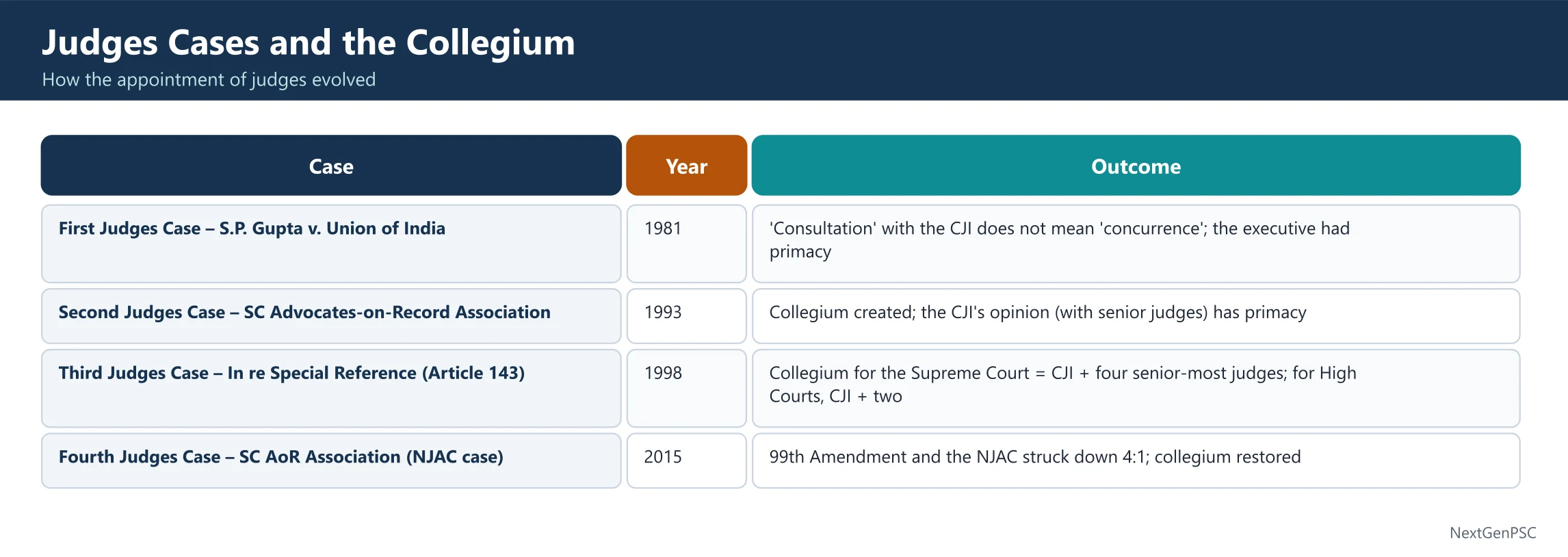
The Second Judges Case (1993) and the Presidential Reference (Third Judges Case, 1998) redefined the process of appointment of judges in India. They established judicial primacy in appointments, evolved the collegium system, and made the advice of the Chief Justice of India (CJI) binding, but only when given collectively with senior-most judges.
Background: From Consultation to Collegium
1. Under Article 124(2) and 217(1), the President appoints judges of the Supreme Court and High Courts after 'consultation' with judges and authorities as prescribed.
2. However, the term 'consultation' led to multiple interpretations, giving rise to three major judicial pronouncements — popularly known as the Three Judges Cases .
3. The First Judges Case (S.P. Gupta vs Union of India, 1981) had ruled that 'consultation' did not mean 'concurrence' — giving the Executive primacy over appointments.
4. Dissatisfaction with executive dominance led to the Second Judges Case (1993) , which transformed the meaning of 'consultation' and laid the foundation for the Collegium System .
Supreme Court Advocates-on-Record vs Union of India, 1993 (Second Judges Case)
1. The Supreme Court overruled the 1981 verdict and held that 'consultation' means 'concurrence' — i.e., the President is bound by the advice of the Chief Justice of India (CJI).
2. CJI’s opinion would have primacy in judicial appointments and transfers.
3. However, the advice of the CJI should not be his individual opinion; it must be given in consultation with the two senior-most judges of the Supreme Court.
4. Thus, the decision-making shifted from the Executive to a collective judicial body — forming the early version of the Collegium System .
5. It was also held that the Chief Justice of India should be appointed based on seniority and not executive discretion.
6. Hence, the 1993 judgment established that CJI + 2 senior-most judges would act collectively in all appointments and transfers of judges.
Presidential Reference, 1998 (Third Judges Case)
1. To clarify ambiguities from the 1993 case, the President of India made a reference to the Supreme Court under Article 143 (Advisory Jurisdiction) .
2. The Supreme Court expanded the collegium to strengthen collective decision-making.
3. It held that the sole opinion of the CJI is not binding on the President.
4. Instead, the CJI must consult a Collegium of 4 senior-most judges of the Supreme Court (total 5 members including the CJI).
5. If two judges of the Collegium express an adverse opinion, the recommendation should not be sent to the Government.
6. This judgment formalized the Collegium System in its present structure.
7. Therefore:
Appointment of Supreme Court Judges: Recommended by a Collegium comprising the CJI + 4 senior-most SC judges.
Appointment of High Court Judges: Recommended by a Collegium comprising the CJI + 2 senior-most SC judges.
Significance
1. These judgments established the judicial primacy and independence in appointments — a key feature of the Basic Structure of the Constitution.
2. However, they also triggered debates over transparency and accountability , leading to later controversies such as the National Judicial Appointments Commission (NJAC) Act, 2014 and its subsequent striking down in 2015 .
| Case | Key Outcome |
|---|---|
| First Judges Case (1981) | Executive had primacy; consultation with CJI not binding. |
| Second Judges Case (1993) | Judiciary got primacy; CJI’s advice (with 2 judges) binding. |
| Third Judges Case (1998) | Collegium system established: CJI + 4 senior-most judges for SC appointments; CJI + 2 judges for HC appointments. |
Prelims tips
- Second Judges Case (1993): CJI’s advice binding, must consult 2 senior-most judges.
- Third Judges Case (1998): Collegium system – CJI + 4 senior-most SC judges.
- CJI’s sole opinion is not binding on the President.
- Appointment of HC judges: CJI + 2 senior-most SC judges.
Mains points
- Second and Third Judges Cases shifted power of judicial appointments from executive to judiciary.
- Established collegium system ensuring collective decision-making.
- Ensured primacy of judiciary in preserving independence of courts.
- Critics argue the collegium lacks transparency and accountability.
- Debates continue on reforming or replacing the collegium system.
Collegium System – Critical Evaluation
The collegium system, evolved through the Second and Third Judges Cases, ensures judicial primacy in the appointment of judges. While it protects judicial independence, it has been criticized for lack of transparency, accountability, and checks and balances. Attempts to reform it, such as the NJAC, were struck down by the Supreme Court in 2015 for violating judicial independence.
Criticism of Collegium System
1. Lack of transparency: No official procedure or secretariat; decisions taken behind closed doors.
2. Lack of accountability: No explanation or record of reasons for accepting or rejecting candidates.
3. Violation of checks and balances: Executive is completely excluded from the process, upsetting the constitutional balance.
4. Burden on judges: Judges handle appointments along with case pendency, increasing administrative workload.
5. No public scrutiny: Names of shortlisted candidates are not disclosed, leading to perception of favoritism or nepotism.
Benefits of Collegium System
1. Judicial independence: Protects the judiciary from political or executive interference.
2. Merit-based appointments: Ensures selection of deserving candidates with strong legal acumen.
3. Institutional integrity: Secrecy preserves dignity, avoids political lobbying or external pressure.
4. Continuity: Provides consistency and stability in appointments through an established system evolved by the judiciary itself.
New Memorandum of Procedure (MoP)
1. The Memorandum of Procedure (MoP) is the official document guiding judicial appointments.
2. Original MoP was issued in 1947 and revised in 1999 following the Second Judges Case.
3. After the NJAC judgment (2015) , the Supreme Court directed the Government and Collegium to reform the MoP for greater transparency.
4. Key suggested reforms:
Define eligibility criteria (age, credentials, reputation, integrity).
Publish selection procedure and criteria on the Supreme Court website .
Establish a permanent secretariat in every High Court and the Supreme Court.
Create a grievance redressal mechanism for rejected or overlooked candidates.
5. However, as of now, the revised MoP remains unfinalized due to lack of consensus between the judiciary and the government.
Aspects Considered by the Collegium
1. Seniority: Both within the parent High Court and in overall all-India seniority list.
2. Merit: Based on performance, integrity, and public reputation.
3. Diversity: Consideration of representation from underrepresented High Courts, women, minorities, and marginalized communities.
4. Regional balance: Ensures equitable representation from all parts of India.
National Judicial Appointments Commission (NJAC)
1. The 99th Constitutional Amendment Act, 2014 established the National Judicial Appointments Commission (NJAC) to replace the Collegium System.
2. It aimed to make judicial appointments more transparent and participatory by involving non-judicial members.
3. Composition of NJAC (6 Members):
Chief Justice of India (Chairperson).
Two senior-most judges of the Supreme Court.
Union Law Minister.
Two eminent persons (selected by a committee of PM, CJI, and Leader of Opposition in Lok Sabha).
4. Procedure: Seniority-based selection for CJI and High Court judges; merit-based for others; any two members could exercise a veto .
5. Purpose: Introduce checks and balances, increase transparency, and ensure public confidence in appointments.
Striking Down of NJAC (Supreme Court, 2015)
1. In the Supreme Court Advocates-on-Record Association vs Union of India (2015) , a 5-judge Bench (4:1 verdict) struck down the NJAC Act and the 99th Amendment.
2. Court held that the NJAC violated the Basic Structure of the Constitution by compromising judicial independence .
3. Key reasons:
The two ‘eminent persons’ could outvote the judges — diluting judicial primacy.
Executive presence (Law Minister) reintroduced political influence in appointments.
Judicial independence is part of the Basic Structure Doctrine (Kesavananda Bharati case, 1973).
4. As a result, the Collegium System was revived and continues to function today.
5. The Court, however, acknowledged the need for reforms to enhance transparency and accountability in judicial appointments.
| Aspect | Collegium System | NJAC |
|---|---|---|
| Transparency | Opaque, internal consultation only | Greater inclusion with non-judicial members |
| Accountability | Judiciary accountable to itself | Shared accountability with executive & eminent persons |
| Judicial Independence | Strongly protected | Threatened by involvement of non-judicial members |
| Composition | CJI + senior SC judges | CJI + 2 SC judges + Law Minister + 2 eminent persons |
| Status | In force | Struck down by SC in 2015 as unconstitutional |
Prelims tips
- Collegium system evolved through Second (1993) and Third Judges Case (1998).
- Criticisms: lack of transparency, accountability, checks & balances.
- Benefits: judicial independence, merit-based appointments.
- NJAC (99th Amendment, 2015) was struck down as unconstitutional.
Mains points
- Collegium system secures judicial independence but lacks transparency and accountability.
- MoP reforms suggested in 2015 remain unimplemented due to deadlock between judiciary and executive.
- Aspects like seniority, merit, and diversity are considered in appointments.
- NJAC aimed to reform appointments but was struck down to preserve judicial independence.
- Debate continues over striking balance between independence, transparency, and accountability.
Appointment, Tenure, and Conditions of Supreme Court Judges
The Constitution provides for appointment of ad-hoc and retired judges, their oath, salary, allowances, and tenure. While ad-hoc judges ensure functioning of the Court in case of quorum shortage, retired judges may also be requested to assist. Supreme Court judges serve until the age of 65, with conditions safeguarding independence.
Appointment of Ad-Hoc Judges (Article 127)
1. This provision ensures that the Supreme Court can function smoothly even if it faces a temporary shortage of judges.
2. When the quorum of judges required for a case cannot be met, the Chief Justice of India (CJI) may request a sitting High Court judge to act as an ad-hoc judge of the Supreme Court.
3. Such appointment requires the prior consent of the President .
4. The CJI must also consult the Chief Justice of the concerned High Court before making the appointment.
5. Only a sitting judge of a High Court can be appointed; retired judges or other persons are not eligible.
6. Ad-hoc judges have all the powers, jurisdiction, and duties of a regular Supreme Court judge during their term.
7. Purpose: to avoid delay in justice delivery when vacancies or workload create temporary gaps.
Attendance of Retired Judges (Article 128)
1. The CJI, with the consent of the President, can request a retired judge of the Supreme Court or of a High Court (qualified to be a SC judge) to sit and act as a judge of the Supreme Court .
2. The consent of the concerned retired judge is mandatory.
3. While sitting, they exercise all powers of a Supreme Court judge , but they are not considered regular judges of the Court for any other purpose.
4. Their allowances and jurisdiction are determined by the President of India.
5. Purpose: to utilize the experience and expertise of retired judges when needed for speedy disposal of pending cases.
Oath or Affirmation (Article 124(6))
1. Every judge of the Supreme Court must take an oath or affirmation before entering office.
2. The oath is administered by the President of India or a person appointed by the President for this purpose.
3. The oath affirms faithfulness to the Constitution of India and the duty to discharge judicial functions without fear, favor, or ill-will.
Ban on Practice after Retirement
1. Retired Supreme Court judges cannot practice law in any court or before any authority in India.
2. This is to maintain judicial impartiality and independence even after retirement.
3. However, they can hold constitutional or quasi-judicial posts (e.g., Governor, NHRC Chairperson, Lokpal, Tribunal Head, etc.).
4. Example: Justice S. Abdul Nazeer (part of Ayodhya verdict) was appointed as Governor of Andhra Pradesh in 2023.
Salary and Allowances (Article 125)
1. Salaries, pensions, and allowances of Supreme Court judges are determined by Parliament by law .
2. They are charged on the Consolidated Fund of India — ensuring financial independence from the executive.
3. Their salaries and privileges cannot be varied to their disadvantage after appointment, except during a Financial Emergency (Article 360).
4. This protects judges from executive pressure or influence through financial means.
Tenure of Supreme Court Judges (Article 124)
1. A judge of the Supreme Court holds office until attaining the age of 65 years .
2. There is no fixed term — tenure depends solely on age.
3. A judge may resign at any time by writing to the President of India .
4. A judge may be removed by the President on grounds of proved misbehaviour or incapacity through a special procedure (Article 124(4)).
5. No minimum age limit is prescribed for appointment as a judge of the Supreme Court.
6. Any dispute regarding a judge’s age is decided by Parliament — and its decision is final.
| Provision | Details |
|---|---|
| Article 127 | Appointment of ad-hoc judges from sitting HC judges when quorum not met. |
| Article 128 | Attendance of retired judges with President’s consent. |
| Article 125 | Salary and allowances fixed by Parliament; not disadvantageously altered post-appointment. |
| Article 124 | Tenure until 65 years, resignation to President, removal as per constitutional procedure. |
Prelims tips
- Article 127: Ad-hoc judges can be appointed from sitting HC judges.
- Article 128: Retired judges may be requested to attend SC sittings.
- Tenure: SC judges retire at 65 years.
- No minimum age prescribed for appointment as SC judge.
- Retired SC judges cannot practice as lawyers but can hold constitutional posts.
Mains points
- Ad-hoc judges ensure functioning of SC in absence of quorum, ensuring continuity.
- Retired judges can contribute expertise, preventing delays in justice delivery.
- Salary and tenure safeguards ensure independence of judiciary.
- Ban on practice post-retirement prevents conflict of interest, though debate continues over post-retirement appointments.
- Absence of minimum age allows flexibility but raises concerns on maturity and experience.
Removal of Supreme Court Judges
Under Article 124(4), a Supreme Court judge can be removed only by the President on grounds of proved misbehaviour or incapacity, after a special majority in both Houses of Parliament. The process is regulated by the Judges Enquiry Act, 1968. Despite multiple attempts, no SC judge has been removed till date.
Constitutional Provision (Article 124(4))
1. A judge of the Supreme Court can be removed only by an order of the President of India .
2. Grounds for removal: proved misbehaviour or incapacity — these are the only constitutional grounds.
3. ‘Proved misbehaviour’ means misconduct established through a judicial inquiry; it cannot be removed on political or moral grounds.
4. The process ensures judicial independence by preventing arbitrary removal.
5. The order of removal is issued only after a special majority is passed by both Houses of Parliament.
Special majority = majority of total membership of the House + two-thirds of members present and voting.
6. Article 124(5) empowers Parliament to make a law to regulate the procedure — this led to the Judges (Inquiry) Act, 1968 .
Judges (Inquiry) Act, 1968
1. This Act governs the entire procedure for the investigation and removal of judges of the Supreme Court and High Courts.
2. A removal motion can be introduced in either House of Parliament (Lok Sabha or Rajya Sabha).
3. The motion must be signed by:
At least 100 members of Lok Sabha , or
At least 50 members of Rajya Sabha .
4. The motion is submitted to the Speaker (Lok Sabha) or Chairman (Rajya Sabha) .
5. The presiding officer may either admit or reject the motion.
6. If admitted, a three-member inquiry committee is formed, consisting of:
The Chief Justice of India or a judge of the Supreme Court,
The Chief Justice of a High Court , and
A distinguished jurist (nominated by the Speaker or Chairman).
7. The committee investigates the charges and submits its report to the Speaker/Chairman.
8. If the committee finds the judge not guilty , the motion lapses — no further action is taken.
9. If the judge is found guilty of misbehaviour or incapacity , the motion is taken up for debate and voting in both Houses.
10. The motion must be passed in both Houses separately by special majority .
11. After successful passage in both Houses, the President issues an order removing the judge from office.
12. The procedure applies equally to judges of the High Courts .
Key Safeguards in the Process
1. The process is deliberately made difficult and elaborate to protect judicial independence.
2. Political majority alone cannot remove a judge without proper inquiry.
3. The involvement of a judicial inquiry committee ensures fair trial and due process.
4. Judges are not answerable in any court for actions done in their judicial capacity (Article 121).
5. These safeguards maintain the principle of Separation of Powers and judicial dignity.
Historical Impeachment Attempts
1. Justice V. Ramaswami (1993) – First impeachment motion against a Supreme Court judge for misuse of funds; inquiry committee found him guilty, but the motion failed in Lok Sabha due to abstentions by ruling party MPs.
2. Justice Soumitra Sen (2011) – Calcutta High Court judge; motion passed in Rajya Sabha , but he resigned before Lok Sabha vote .
3. Justice J. B. Pardiwala (2015) – Motion over controversial remarks; later withdrawn after his apology.
4. Justice C. V. Nagarjuna Reddy (2017) – Motion rejected by Rajya Sabha Chairman for lack of sufficient grounds.
5. Till date, no Supreme Court judge has been formally removed from office through impeachment in India.
Significance
1. The removal procedure preserves judicial independence by shielding judges from political pressure.
2. At the same time, it provides a mechanism for accountability against proven misconduct.
3. It reflects the constitutional balance between judicial integrity and parliamentary oversight.
| Aspect | Details |
|---|---|
| Article | Article 124(4) |
| Grounds | Proved misbehaviour or incapacity |
| Process Law | Judges Enquiry Act, 1968 |
| Motion Support | 100 LS MPs or 50 RS MPs |
| Committee | CJI/SC Judge + HC CJ + Distinguished Jurist |
| Majority Required | Special majority in both Houses |
| Final Authority | President of India |
Prelims tips
- Removal under Article 124(4) on grounds of misbehaviour or incapacity.
- Regulated by Judges Enquiry Act, 1968.
- Requires special majority in both Houses.
- No SC judge has been removed till date.
Mains points
- Judicial independence safeguarded by stringent removal procedure.
- High threshold ensures judges are not removed for political reasons.
- Judges Enquiry Act institutionalizes the process through a balanced committee.
- Past impeachment attempts show difficulty in securing political consensus.
- Despite attempts, no SC judge has been removed, reflecting both safeguards and challenges.
Seat of the Supreme Court and National Court of Appeal
Article 130 provides that the seat of the Supreme Court is in Delhi, though the CJI may hold sittings elsewhere with the President’s approval. To address the backlog and improve access to justice, the idea of a National Court of Appeal (NCA) with regional benches has been debated. While it promises efficiency and better jurisprudence, it faces constitutional, financial, and administrative challenges.
Seat of the Supreme Court (Article 130)
1. According to Article 130 , the seat of the Supreme Court shall be at Delhi .
2. However, the Chief Justice of India (CJI) may, with the approval of the President , hold sittings of the Court at any other place in India.
3. This flexibility ensures that the Court can hold hearings outside Delhi if required for administrative convenience or public interest.
National Court of Appeal (NCA)
1. The National Court of Appeal is a proposed judicial body to serve as an intermediate appellate court between High Courts and the Supreme Court.
2. Suggested regional benches: Chennai, Mumbai, and Kolkata .
3. It would act as the final court of appeal in civil, criminal, labor, and revenue matters decided by High Courts and tribunals.
4. The Supreme Court would then focus primarily on constitutional and public law issues , reducing its routine case burden.
Need for the NCA
1. Excessive appellate load on the Supreme Court — around 70,000 cases pending as of recent data.
2. Justice delayed due to backlog of routine appeals from across the country.
3. Unequal access to justice — citizens from distant states face difficulty approaching Delhi.
4. Rising number of Public Interest Litigations (PILs) crowding the docket.
5. Law Commission (1986, 229th Report – 2009) and several committees have recommended creation of regional benches to reduce pendency.
Advantages of Establishing NCA
1. Better access to justice: Citizens from southern, western, and eastern India can appeal without traveling to Delhi.
2. Reduced workload: Supreme Court can concentrate on constitutional interpretation and national importance issues.
3. Balanced judicial structure: Helps distribute cases evenly across regions.
4. Improved efficiency: Quicker disposal of appeals and special leave petitions (SLPs).
5. Enhanced trust: Citizens see judiciary as more accessible and responsive.
6. Development of regional jurisprudence: Promotes diversity and local perspectives in law.
Challenges and Criticisms
1. Financial burden: Requires new infrastructure, staff, and large budget allocations.
2. Complex administration: Coordination among regional benches may lead to inconsistency in judgments.
3. Constitutional issues: May require amendment to Article 130 — altering the Supreme Court’s structure.
4. Judicial independence concerns: Could dilute the unity and authority of the Supreme Court.
5. Possible inefficiency: May not significantly reduce backlog — instead, add another appellate layer.
6. Institutional resistance: Several CJIs have opposed it, calling it unconstitutional and impractical.
Supreme Court’s Position
1. 1986 Law Commission Report and later recommendations suggested regional benches at Chennai, Mumbai, and Kolkata.
2. However, successive Chief Justices have opposed bifurcation of the Supreme Court’s powers to maintain its integrity.
3. In 2016 , a PIL by V. Vasanth Kumar sought establishment of an NCA — the Supreme Court admitted the petition and referred it to a Constitution Bench for consideration.
4. The Court observed that creation of an NCA is a policy matter requiring legislative and constitutional action .
Government’s Position
1. The Government has relied on objections by former CJIs to oppose the proposal.
2. It believes NCA would require major constitutional amendments and disrupt the existing judicial hierarchy.
3. The Government instead favors internal reforms like faster case disposal, more judges, and digitalization.
Way Forward
1. Strengthen existing hierarchy — empower High Courts, fill vacancies, and expand benches before adding a new judicial layer.
2. Technological efficiency: Use of the National Judicial Data Grid (NJDG) , e-courts, and AI-based case management.
3. Judicial accountability and procedural reforms can reduce pendency without structural overhaul.
4. Establishment of the NCA remains a policy decision — it cannot be directed judicially.
5. As per current NJDG estimates, it could take 30+ years to clear criminal case backlog in lower courts — underscoring the need for systemic reform before expansion.
| Aspect | Details |
|---|---|
| Need | High appellate load, backlog, growing PILs |
| Advantages | Access to justice, reduce SC workload, better jurisprudence |
| Challenges | Financial burden, adds new layer, constitutional issues, weakens SC independence |
| SC Position | Mixed: 1986 recommendation vs later opposition, petition in 2016 |
| Government Position | Rejected citing constitutional changes and opposition by CJIs |
Prelims tips
- Article 130: SC seat in Delhi; CJI can sit elsewhere with President’s approval.
- National Court of Appeal (NCA) – proposed with benches in Chennai, Mumbai, Kolkata.
- NCA would handle civil, criminal, revenue, and tribunal appeals.
- SC restricted to constitutional/public law matters.
- Petition for NCA admitted in 2016 (V. Vasanth Kumar case).
Mains points
- Article 130 places SC seat in Delhi, but decentralization debate continues.
- NCA proposed to reduce SC burden and improve access to justice.
- Advantages: relief to SC, diversity in jurisprudence, better justice delivery.
- Challenges: financial, constitutional, and administrative feasibility.
- Policy decision: strengthen current judicial hierarchy (HCs, tribunals) before creating NCA.
- NJDG shows massive pendency: reforms needed for efficiency before new structures.
Independence of the Supreme Court
The independence of the Supreme Court is ensured through constitutional safeguards like security of tenure, financial autonomy, immunity from criticism, separation from the executive, and procedural freedom. It functions as the guardian of the Constitution and final interpreter of the law, with mechanisms like Constitution Benches ensuring consistency in constitutional interpretation.
Constitutional Safeguards for an Independent Judiciary
1. The Constitution provides multiple safeguards to maintain the independence of the judiciary from the legislature and executive.
2. These provisions ensure that judges can act freely and fairly, without external pressure or political influence.
1. Security of Tenure
Judges of the Supreme Court and High Courts can be removed only on the constitutional grounds of proved misbehaviour or incapacity (Article 124(4)).
They cannot be removed arbitrarily by the executive, ensuring job security and independence .
2. Financial Security
Judges’ salaries, allowances, and pensions are charged on the Consolidated Fund of India , meaning they are not subject to Parliament’s annual vote.
This prevents financial control by the legislature or executive.
3. Immunity and Protection
Judges are protected from public criticism and political discussion regarding their conduct.
Under Article 121 , their conduct cannot be discussed in Parliament except during a motion for removal.
Judges also have the power to punish for Contempt of Court , ensuring respect and authority of the judiciary.
4. Separation from Executive (Article 50)
Article 50 of the Directive Principles mandates the separation of the judiciary from the executive in public services, ensuring neutrality in judicial functioning.
5. Freedom to Regulate its Own Functioning
The Supreme Court has administrative independence — it appoints its own staff and frames its own procedural rules (Article 146).
This autonomy helps maintain efficiency and independence from external influence.
6. Restriction on Practice after Retirement
Retired Supreme Court judges cannot practice in any court of law in India.
This prevents the possibility of conflict of interest and maintains impartiality.
7. Jurisdiction Protection
The jurisdiction of the Supreme Court cannot be curtailed by Parliament.
Under Article 138 , Parliament can only expand, not reduce, its powers.
Procedure of the Supreme Court (Article 145)
1. The Supreme Court makes its own rules for practice and procedure with the approval of the President .
2. Constitutional cases and Presidential references (Article 143) must be heard by a bench of at least five judges .
3. All judgments are decided by majority opinion — dissenting opinions are also recorded for transparency.
Constitution Bench
1. A Constitution Bench refers to a bench of five or more judges of the Supreme Court (Article 145(3)).
2. It hears cases involving:
Interpretation of the Constitution,
Important questions of law, or
Presidential references under Article 143.
3. The Chief Justice of India (CJI) has the power to decide which judges will sit on which benches — known as the ‘Master of the Roster’ power.
4. Decisions may be unanimous or by majority .
5. Currently, over 40 major constitutional and legal cases (e.g., Uniform Civil Code, same-sex marriage, etc.) are pending before Constitution Benches.
Other Types of Benches
1. Division Bench: Usually consists of 2–3 judges; deals with important appeals and regular cases.
2. Single Judge Bench: Introduced in 2020 for hearing minor appeals like bail and anticipatory bail cases to improve efficiency.
3. Larger Benches: In rare cases involving significant constitutional interpretation, 7, 9, or even 13-judge benches are formed (e.g., Kesavananda Bharati Case, 1973).
Recusal of Judges
1. Recusal means a judge voluntarily withdrawing from hearing a case to avoid bias or conflict of interest .
2. There are no formal laws or written rules on recusal — it is based on principles of natural justice and fairness .
3. Judges may recuse themselves if:
They have a personal or professional connection to a party involved,
They have expressed prior opinion on the issue, or
Their impartiality could reasonably be questioned.
4. This practice enhances public confidence in the neutrality and integrity of the judiciary.
| Safeguard | Details |
|---|---|
| Security of Tenure | Judges removed only by constitutional process (misbehaviour/incapacity). |
| Financial Security | Salaries charged on Consolidated Fund of India, not subject to Parliament. |
| Immunity | Contempt powers, conduct not discussed in Parliament. |
| Jurisdiction | Cannot be curtailed, only expanded by Parliament (Art. 138). |
| Separation from Executive | Independent functioning and staffing. |
| Freedom of Procedure | Rule-making under Article 145 with President’s approval. |
Prelims tips
- Article 130: SC seat in Delhi; Article 145: SC rules of procedure.
- Minimum 5 judges required for constitutional cases (Constitution Bench).
- Judges cannot be discussed in Parliament except for removal proceedings.
- CJI is the 'Master of the Roster'.
- Bengal Immunity Co. v. State of Bihar (1955): under Article 141 the Supreme Court is not bound by its own earlier decisions and can overrule them.
Mains points
- Judicial independence is protected through tenure, financial security, and immunity.
- Parliament cannot curtail SC’s jurisdiction, ensuring separation of powers.
- CJI’s role as 'Master of the Roster' ensures administrative independence.
- Constitution Benches maintain consistency in constitutional interpretation.
- Recusal practice ensures impartiality though lacks codified procedure.
- Reforms needed to reduce pendency before Constitution Benches.
Jurisdiction and Powers of the Supreme Court
The Supreme Court of India has original, appellate, and discretionary jurisdiction. Article 131 confers exclusive original jurisdiction in Centre-State and inter-State disputes. Articles 132–134 provide appellate jurisdiction in constitutional, civil, and criminal cases, while Article 136 empowers the Court to grant Special Leave Petitions (SLPs) in matters of substantial justice.
Jurisdiction of the Supreme Court (Articles 131–139A)
The Supreme Court of India is the final interpreter of the Constitution and the highest court of appeal. Its jurisdiction can be classified into several types — Original, Appellate, Advisory, Writ, Review, and Curative .
Original Jurisdiction (Article 131)
1. The Supreme Court has exclusive jurisdiction in disputes involving:
– The Government of India and one or more States,
– The Government of India and one or more States on one side and other States on the other,
– Two or more States.
2. Scope: Any question of law or fact on which the existence or extent of a legal right depends.
3. This ensures federal balance between the Centre and the States.
4. Example: State of Karnataka vs Union of India (1977) — dispute over constitutional relations.
5. Non-applicable to:
– Disputes arising from treaties, covenants, or agreements signed before the Constitution,
– Inter-State water disputes (covered under Inter-State Water Disputes Act, 1956),
– Matters referred to the Finance Commission ,
– Ordinary commercial or contractual disputes between Centre and States,
– Recovery of damages by a State against the Union.
6. Hence, the Court deals only with matters of constitutional significance under this jurisdiction.
Appellate Jurisdiction (Articles 132–134)
The Supreme Court acts as the highest court of appeal in constitutional, civil, and criminal cases decided by High Courts.
1. Constitutional Matters (Article 132)
1. Appeal lies to the Supreme Court if a substantial question of law regarding the interpretation of the Constitution arises.
2. A certificate from the High Court is mandatory declaring that such a question exists.
3. If the Supreme Court believes the question was wrongly decided, it can overrule or modify the judgment.
4. Example: Disputes over interpretation of Fundamental Rights.
2. Civil Matters (Article 133, read with 134A)
1. Appeal lies if the High Court certifies that the case involves a substantial question of law of general importance .
2. The High Court must also believe that the question needs to be decided by the Supreme Court.
3. Parliament can further define and expand this jurisdiction under ordinary law.
4. Example: Property disputes involving interpretation of central laws.
3. Criminal Matters (Article 134)
1. Appeals lie to the Supreme Court in the following cases:
– When the High Court reverses an acquittal and sentences the accused to death,
– When the High Court tries a case itself and convicts the accused to death,
– When the High Court certifies that the case is fit for appeal to the Supreme Court.
2. Example: Death penalty confirmations or reversal of acquittal in serious offences.
Power of Parliament
Parliament may, by law, extend the appellate jurisdiction of the Supreme Court to any other matter (Article 134A).
Special Leave Petition (SLP) – Article 136
1. The Supreme Court has discretionary power to grant special leave to appeal against any judgment, decree, determination, or order of any court or tribunal in India.
2. It is a unique power — not a right, but a privilege granted at the discretion of the Court.
3. It applies to constitutional, civil, criminal, tax, labour, revenue, and other matters.
4. However, SLP does not apply to judgments of courts or tribunals related to Armed Forces .
5. The SLP mechanism allows the Supreme Court to ensure justice in exceptional cases even when no appeal lies by right.
6. Example: Keshavananda Bharati (1973) and Maneka Gandhi (1978) both began as SLPs.
Additional Appellate Powers (Articles 135–139A)
1. Article 135: SC can exercise jurisdiction and powers of the Federal Court (before 1950) in matters not covered by the Constitution.
2. Article 136: Grants special leave to appeal (SLP).
3. Article 137: Power of review of its own judgments.
4. Article 138: Parliament may enlarge SC’s jurisdiction.
5. Article 139: SC can issue directions to any court to secure Fundamental Rights.
6. Article 139A: Power to transfer cases from one High Court to another or to itself to ensure uniformity in constitutional interpretation.
| Type | Key Provisions | Exclusions |
|---|---|---|
| Original Jurisdiction | Article 131 – Centre-State/State-State disputes | Inter-State water disputes, Finance Commission matters |
| Appellate – Constitutional | Article 132 – Substantial question of law | Requires HC certificate |
| Appellate – Civil | Article 133 – Substantial question of law + HC certification | Commercial disputes unless certified |
| Appellate – Criminal | Article 134 – HC reversals, death sentence, certification | No automatic appeal otherwise |
| Special Leave Petition | Article 136 – SC’s discretionary power | Armed Forces Tribunal judgments |
Prelims tips
- Article 131: Exclusive original jurisdiction for Centre-State disputes.
- Article 132: Appeals in constitutional matters require HC certification.
- Article 133: Civil appeals require substantial question of law + HC certification.
- Article 134: Criminal appeals – HC reversal/acquittal/death sentence.
- Article 136: Special Leave Petition – wide discretionary power.
Mains points
- Supreme Court acts as the final arbiter in Centre-State and inter-State disputes under Article 131.
- Appellate jurisdiction strengthens uniform interpretation of law across constitutional, civil, and criminal cases.
- Special Leave Petition under Article 136 expands access to SC but adds to its pendency.
- Exclusions like inter-State water disputes and Armed Forces tribunal decisions balance federalism and efficiency.
- The broad powers highlight SC’s central role in maintaining constitutional order.
Advisory, Writ, and Other Jurisdictions of the Supreme Court
The Supreme Court of India exercises advisory jurisdiction under Article 143, writ jurisdiction under Article 139, and functions as a Court of Record under Article 129. It also wields the power to punish for contempt under constitutional provisions and the Contempt of Courts Act, 1971, ensuring judicial authority, respect, and constitutional supremacy.
Advisory Jurisdiction (Article 143)
1. The President of India can refer matters to the Supreme Court for advice under Article 143.
2. The reference can be on:
– Any question of law or fact of public importance (advisory opinion is optional), or
– Disputes arising out of pre-Constitution treaties, agreements, or covenants (opinion is mandatory).
3. The advice of the Supreme Court is not binding on the President.
4. Purpose: to help the executive obtain a judicial opinion on complex or sensitive constitutional issues.
5. Examples:
– Re Berubari Union Case (1960): Presidential reference on ceding Indian territory to Pakistan.
– Ayodhya Land Dispute Reference (1993): Whether a Hindu temple existed before Babri Masjid demolition (SC declined to answer).
– Special Courts Bill Reference (1979): Constitutionality of creating special courts under Article 143.
Writ Jurisdiction (Article 32 and 139)
1. The Supreme Court has power to issue writs under Article 32 for the enforcement of Fundamental Rights .
2. Under Article 139 , Parliament can confer additional writ powers on the SC.
3. High Courts (under Article 226) have wider writ jurisdiction — for both Fundamental Rights and other legal rights .
4. This dual system ensures both national and state-level protection of rights.
5. Parliament may expand but not curtail this power.
6. Types of writs:
– Habeas Corpus: Release of unlawfully detained persons.
– Mandamus: Command public authority to perform its duty.
– Prohibition: Prevent lower courts from exceeding jurisdiction.
– Certiorari: Transfer case to higher court for review of legality.
– Quo Warranto: Challenge illegal occupation of public office.
7. Example: Maneka Gandhi vs Union of India (1978) – strengthened Article 21; Sunil Batra vs Delhi Administration (1980) – protection of prisoners’ rights.
Court of Record (Article 129)
1. The Supreme Court is a Court of Record , meaning its judgments, proceedings, and acts are preserved permanently.
2. These records have evidentiary value — they cannot be challenged in any court.
3. SC’s decisions serve as precedents (binding interpretations of law).
4. The Court has power to punish for contempt of court to maintain authority, discipline, and respect within the judicial system.
Contempt of Court – Meaning and Scope
1. Purpose: To protect the dignity, independence, and authority of the judiciary.
2. The Constitution does not define contempt — definition is provided in the Contempt of Courts Act, 1971 .
3. Under Article 142(2) , the Supreme Court can make any order necessary for the punishment of contempt of itself.
4. Under Article 129 and Article 215 , both SC and HCs are courts of record and can punish for contempt.
5. Article 144: All civil and judicial authorities must act in aid of the Supreme Court.
6. Article 141: Law declared by the Supreme Court is binding on all courts in India.
Types of Contempt (Contempt of Courts Act, 1971)
1. Civil Contempt: Willful disobedience of any judgment, decree, direction, order, writ, or other process of a court.
– Example: Ignoring a Supreme Court or High Court order intentionally.
2. Criminal Contempt: Publication or acts that:
– Scandalise or lower the authority of any court,
– Prejudice or interfere with judicial proceedings, or
– Obstruct the administration of justice.
3. Example Cases:
– Arundhati Roy Contempt Case (2002) : Criticism of judiciary.
– Prashant Bhushan Case (2020) : Tweets considered as lowering the authority of the SC.
Exceptions (Not Considered Contempt)
1. Innocent publication or distribution of material that does not intend to prejudice proceedings.
2. Fair and accurate reporting of judicial proceedings.
3. Fair criticism of judicial acts in good faith.
4. Good faith complaints against subordinate court officials.
5. Example: Legitimate academic or journalistic analysis of a judgment is not contempt if respectful and factual.
Significance of Contempt Powers
1. Ensures compliance with court orders and upholds the rule of law.
2. Protects the dignity of the judiciary and public confidence in the justice system.
3. However, misuse must be avoided — SC has itself acknowledged the need to balance free speech and judicial authority .
| Jurisdiction | Article | Scope |
|---|---|---|
| Advisory | Article 143 | President may seek opinion – optional in public matters, mandatory in pre-constitution agreements. |
| Writ | Article 139 | SC writs for FR; HC writs for FR + other purposes. |
| Court of Record | Article 129 | SC records as precedents; contempt powers. |
| Contempt of Court | Articles 129, 142(2), 215, 141, 144 | Powers to punish contempt; binding force of SC’s decisions. |
Prelims tips
- Article 143: Advisory jurisdiction of SC.
- Article 139: Parliament can expand SC’s writ powers.
- Article 129: SC as Court of Record, contempt powers.
- Contempt of Courts Act, 1971: defines civil and criminal contempt.
- Articles 141 & 144: SC’s decisions binding; all authorities to aid SC.
Mains points
- Advisory jurisdiction ensures President can seek SC’s legal guidance, though advice is not binding.
- SC’s writ jurisdiction is narrower than HCs, confined only to Fundamental Rights.
- Court of Record status ensures precedential value of SC rulings and contempt powers.
- Contempt of Courts Act, 1971 provides statutory clarity on contempt with safeguards.
- Balance between judicial authority and freedom of expression achieved through exclusions from contempt.
Critical Analysis of Contempt Power and Other Powers of the Supreme Court
The Supreme Court’s contempt power is a constitutional safeguard to uphold judicial authority and ensure compliance with its orders. However, it faces criticism for clashing with democratic freedoms, having a broad scope, and being outdated compared to other democracies. Alongside this, the Supreme Court also wields powers of judicial review, election dispute resolution, self-review, and supervisory control, making it the final interpreter and guardian of the Constitution.
Critical Analysis of Contempt Power
The power to punish for contempt of court (Articles 129 and 215) is essential for maintaining the dignity and authority of the judiciary. However, it often raises questions about its compatibility with democratic freedoms.
Arguments Against
1. Conflict with Fundamental Rights: Contempt powers, especially against 'scandalising the court,' can restrict freedom of speech and expression (Article 19(1)(a)).
2. Vague Definition: The wide and subjective definition of ‘criminal contempt’ under the Contempt of Courts Act, 1971, creates uncertainty and potential misuse .
3. Suo Motu Powers: The court can initiate contempt cases on its own, raising concerns about judges acting as both victim and prosecutor.
4. Outdated in Modern Democracies:
– England abolished the offence of ‘scandalising the court’ in 2013 (Crime and Courts Act, 2013).
– The USA rarely invokes contempt for public criticism; strong protection for free speech exists under the First Amendment.
5. Chilling Effect: Fear of contempt proceedings discourages legitimate criticism and public debate on judicial accountability.
6. Accountability Concerns: Judiciary exercises contempt powers without external oversight, which may appear undemocratic.
Arguments in Support
1. Protection of Judicial Authority: Weakening contempt powers may erode public confidence in the judiciary and harm the rule of law.
2. Constitutional Basis: The power of contempt flows directly from the Constitution (Articles 129 & 215); the 1971 Act only provides procedure and safeguards.
3. Safeguards Against Misuse: Contempt proceedings are quasi-judicial; fair hearing and appeal opportunities exist.
4. Public Faith: Strict contempt enforcement deters irresponsible attacks and ensures respect for judicial orders.
5. India’s Context: Given low public awareness and executive dominance, judicial authority still needs strong protection.
6. Example: Re: Prashant Bhushan (2020) – SC upheld criticism as permissible but punished tweet that ‘undermined the institution.’
Balanced View
Reform, not repeal, is ideal. The contempt law should preserve dignity but allow constructive and fair criticism to promote accountability and transparency in the judiciary.
Power of Judicial Review
1. The Supreme Court holds the power of Judicial Review — the authority to examine the constitutionality of legislative enactments and executive actions.
2. Objective: To ensure the supremacy of the Constitution and protection of Fundamental Rights .
3. Constitutional Basis:
– Articles 13, 32, 226, 245–246, 131–136 .
4. Types:
– Legislative Review: To check validity of laws (e.g., striking down unconstitutional laws).
– Administrative Review: To ensure executive actions comply with law and fairness.
– Judicial Review of Judicial Decisions: Through review and curative petitions under Article 137.
5. Landmark Cases:
– Kesavananda Bharati vs State of Kerala (1973): Judicial Review made part of the Basic Structure.
– Indira Gandhi vs Raj Narain (1975): Judicial review cannot be removed by constitutional amendment.
– Minerva Mills vs Union of India (1980): Reinforced balance between Fundamental Rights and Directive Principles.
6. Significance: Ensures that no organ of the government acts beyond its constitutional limits .
Other Powers of the Supreme Court
1. Election Disputes
– The Supreme Court decides disputes regarding the election of the President and Vice-President of India under Article 71.
– Example: Indira Gandhi vs Raj Narain (1975) indirectly led to this power being reaffirmed.
2. Advisory Role over UPSC
– Under Article 317(1), the President can refer questions of misbehaviour or incapacity of UPSC members or Chairman to the SC.
– The Court conducts an inquiry and its advice is binding on the President.
3. Review of Its Own Judgments (Article 137)
– The SC can review its own judgments to correct errors of law or fact.
– Example: Nirbhaya Case Review (2017) – Review petition rejected.
– Review is filed under Article 137 read with Order XLVII of the Supreme Court Rules.
4. Withdrawal and Transfer of Cases
– The SC can withdraw cases pending in High Courts if they involve substantial constitutional questions (Article 139A).
– It may transfer cases between High Courts or to itself to ensure uniform interpretation of law.
5. Binding Nature of Law (Article 141)
– The law declared by the Supreme Court is binding on all courts across India.
– Ensures uniformity, stability, and predictability in the legal system.
– Example: Doctrine of Basic Structure and Right to Privacy decisions apply nationwide.
6. Guardian of the Constitution
– The SC acts as the final interpreter of the Constitution.
– It ensures that the spirit of the Constitution is preserved through its judgments.
7. Control over Other Judicial Bodies
– Parliament can enlarge the jurisdiction of the SC for Union List matters under Article 138(1).
– Under special agreements between the Centre and States (Article 138(2)), the SC’s jurisdiction can be extended for other matters.
– This flexibility helps adapt judicial structure to new constitutional challenges.
| Aspect | Arguments Against | Arguments For |
|---|---|---|
| Democracy | Conflicts with free speech | Protects judicial authority |
| Scope | Overbroad definition, suo motu powers | Safeguards against misuse |
| Comparative Perspective | Abolished/rarely used in UK & US | Essential in Indian context to avoid vacuum |
| Respect for Judiciary | May be eroded by criticism | Maintains dignity and authority of courts |
Prelims tips
- Contempt power derived from Constitution; 1971 Act only procedural.
- England abolished 'scandalising the court' in 2013.
- SC’s advice in UPSC inquiries is binding on President.
- Article 137: SC can review its own judgments.
- Article 141: Law declared by SC is binding on all courts.
Mains points
- Contempt power ensures respect for judicial authority but can clash with democratic freedoms.
- Balance needed between judicial dignity and freedom of expression.
- Judicial review strengthens constitutional supremacy and rights protection.
- SC has wide-ranging powers: resolving election disputes, reviewing judgments, binding legal authority.
- Final interpreter role cements SC as guardian of Constitution.
Judicial Accountability
Judicial accountability refers to ensuring transparency, impartiality, and responsibility in judicial decision-making. While independence of the judiciary is essential, accountability is equally vital to maintain public trust, reduce corruption, and uphold the rule of law.
Need for Judicial Accountability
1. Public confidence in the judiciary depends on its impartiality, efficiency, and transparency.
2. Speedy justice is a part of Fundamental Rights under Article 21 (as held in Hussainara Khatoon vs State of Bihar, 1979).
3. A massive backlog of cases — over 4.5 crore cases (as per recent data) — undermines credibility and justice delivery.
4. Increasing citizen awareness and media scrutiny have strengthened demands for transparency.
5. Courts are only partially covered under the Right to Information Act, 2005 — disclosure is often restricted citing ‘judicial independence’.
6. The Constitution lacks a direct mechanism to review Supreme Court rulings apart from limited powers under Article 137.
7. Accountability ensures independence with responsibility — an essential democratic principle.
Challenges
1. Impeachment procedure is impractical: Though provided under Article 124(4) and Judges Inquiry Act, 1968, it has never successfully removed a judge.
– Example: Justice V. Ramaswami (1993) — motion failed due to political abstentions.
2. Contempt of Court: Limits public criticism of judiciary, creating tension between judicial independence and freedom of expression (Article 19) .
3. RTI exemptions: Courts resist disclosure of internal records and deliberations; Supreme Court vs Subhash Chandra Agarwal (2019) extended RTI but with limitations.
4. Lack of transparency in judicial appointments (Collegium System) and absence of performance evaluation raise suspicion of bias.
5. Corruption risk: Without external oversight, allegations of misconduct remain unresolved.
6. Article 142 powers: While enabling ‘complete justice’, it raises concerns about judicial overreach without accountability.
7. No external audit: Judiciary does not publish annual performance or expenditure reports unlike other institutions.
Advantages of Judicial Accountability
1. Strengthens the rule of law by ensuring judges remain answerable for actions and decisions.
2. Improves institutional integrity and public trust in the justice system.
3. Prevents misuse of power and reduces scope for corruption or arbitrariness.
4. Promotes efficiency, transparency, and fairness in judicial processes.
5. Ensures Fundamental Rights are protected by a responsible and ethical judiciary.
6. Restores confidence in democracy by balancing independence with accountability.
Measures Needed and Possible Reforms
1. Code of Judicial Conduct: Adopt and enforce clear ethical standards — the Restatement of Judicial Values (1999) and the Bangalore Principles of Judicial Conduct (2002) can serve as models.
2. Judicial Standards and Accountability Bill, 2010: Proposed declaration of assets and establishment of a National Judicial Oversight Committee — but lapsed.
3. In-house procedure: Strengthen mechanisms for internal inquiry against judges for misconduct or conflict of interest.
4. Transparency in Collegium System: Publish reasons for appointments, transfers, and rejections — as per 2015 SC directive.
5. Independent oversight body: Create a Judicial Performance Commission to monitor efficiency, conduct, and case disposal rates.
6. RTI compliance: Ensure full disclosure of non-confidential administrative information.
7. Digitisation and data management: Regularly update National Judicial Data Grid (NJDG) for public monitoring of case pendency.
8. Annual reporting: Judiciary should publish performance and expenditure reports to enhance accountability.
9. Civil society engagement: NGOs, legal academia, and media can contribute to judicial reform through informed public discourse.
10. Balance independence with accountability: Judicial independence is meaningful only when coupled with responsibility and transparency.
Way Forward
– Judicial accountability should be self-regulated yet transparent .
– Strengthen internal mechanisms before introducing external controls.
– Build a culture of ethical responsibility and public service among judges.
– Ensure that accountability mechanisms do not undermine judicial independence but rather enhance public faith.
| Aspect | Details |
|---|---|
| Need | Ensure impartiality, speedy justice, reduce case backlog, transparency. |
| Challenges | Impeachment impractical, RTI exemptions, contempt power issues, corruption risk. |
| Advantages | Strengthens rule of law, reduces corruption, promotes responsibility. |
| Measures | Judicial code of conduct, civil society role, balance independence with accountability. |
Prelims tips
- Judicial accountability ensures transparency and public trust.
- Impeachment under Article 124(4) is the only constitutional removal method but impractical.
- RTI Act applies to judiciary with limited disclosure.
- Article 142 gives SC wide powers impacting accountability.
Mains points
- Judicial accountability balances independence with transparency and responsibility.
- Impeachment provision is impractical; reforms needed for alternative accountability mechanisms.
- RTI disclosures and annual reporting should be institutionalized.
- Civil society and media play a crucial role in ensuring accountability.
- Judicial accountability is key for upholding rule of law and protecting citizens’ rights.
Way Forward for Contempt Power and Judicial Accountability
While contempt powers of the Supreme Court are essential to maintain judicial authority, they require reforms to align with democratic principles and contemporary needs. A balanced approach involving legal clarity, institutional reforms, and greater transparency can strengthen both judicial dignity and accountability.
Way Forward
1. Clear Guidelines and Legal Clarity
– The definition of ‘criminal contempt’ should be narrowed and clarified to prevent misuse and protect freedom of speech under Article 19(1)(a).
– Specifically define the term ‘scandalising the court’ to include only acts that directly obstruct justice or lower public confidence through falsehood.
– The Law Commission (2018, 274th Report) recommended retaining contempt powers but limiting their scope to ensure proportionality and clarity.
2. Strengthen Transparency and Reporting
– Courts should publish annual reports detailing contempt proceedings, judicial performance, and reasons for disciplinary actions.
– Enhance Right to Information (RTI) applicability — administrative and non-judicial records must be publicly accessible.
– Mandate the publication of Collegium decisions and reasons for judicial appointments and transfers to build public trust.
3. Balance Judicial Independence with Accountability
– Introduce a uniform Code of Judicial Conduct for judges, enforceable through an independent oversight mechanism.
– Reform internal processes to ensure self-regulation and timely disciplinary action without executive interference.
– Maintain the delicate balance between independence (Article 50) and public accountability .
4. Restrict Contempt to Genuine Obstruction
– The power of contempt should be used sparingly and proportionately , reserved only for cases where justice delivery is actually obstructed.
– Criticism of judgments, if made in good faith and public interest , should not attract contempt charges.
– Encourage judges to adopt a culture of constitutional tolerance towards constructive criticism.
5. Institutional and Legislative Reforms
– Revive or reintroduce the Judicial Standards and Accountability Bill with stronger provisions for transparency and disciplinary oversight.
– Establish an independent National Judicial Oversight Commission to address complaints against judges without undermining independence.
– Promote digitisation and public disclosure of case data through the National Judicial Data Grid (NJDG).
6. Learn from Global Best Practices
– Adopt international models where contempt powers are confined to obstruction of justice rather than criticism (as in the UK and US).
– Encourage open judicial communication and engagement with civil society to promote trust through dialogue, not silence.
7. Overall Vision
– The goal is not to weaken the judiciary but to strengthen its credibility through openness, fairness, and self-restraint.
– A transparent and accountable judiciary is essential for a vibrant democracy and for preserving the people’s faith in the Constitution.
| Area | Proposed Reform |
|---|---|
| Definition | Narrow scope of criminal contempt |
| Transparency | Publish reasons and annual reports |
| Accountability | Introduce codes of conduct, RTI coverage |
| Use | Restrict contempt to obstruction of justice |
| Reforms | Judicial Standards & Accountability Bill |
| Global Learning | Adopt best practices from UK, US |
Prelims tips
- 44th Amendment safeguarded FR under Articles 20 & 21 from suspension even during emergencies.
- UK abolished 'scandalising the court' contempt offence in 2013.
- Judicial Standards and Accountability Bill was proposed but lapsed.
- Contempt power in India is constitutionally derived (Art. 129, 142).
Mains points
- Judicial contempt powers should be redefined to balance free speech with judicial dignity.
- Greater transparency and reporting can improve accountability without undermining independence.
- Judicial reforms like a code of conduct and accountability law are needed.
- Global practices suggest limiting contempt to obstruction of justice, not criticism.
- Balancing independence with accountability is key to strengthening democracy and rule of law.
Judicial Review in India
Judicial Review is the power of the judiciary to assess the constitutionality of laws and executive actions of both Central and State governments. Though not explicitly mentioned in the Constitution, it forms part of the basic structure doctrine and ensures the supremacy of the Constitution and protection of Fundamental Rights.
Judicial Review: Meaning and Significance
Judicial Review refers to the power of the judiciary to examine the constitutionality of legislative enactments and executive actions.
It ensures that laws and administrative decisions conform to the Constitution, thereby protecting citizens’ Fundamental Rights and upholding the rule of law.
Judicial Review is a cornerstone of constitutional democracy and an essential safeguard against arbitrary governance.
Constitutional Provisions for Judicial Review
– The term ‘Judicial Review’ is not explicitly mentioned in the Constitution.
– However, it is implicit in several provisions and forms part of the Basic Structure Doctrine (as established in Kesavananda Bharati Case, 1973).
– Powers are conferred primarily upon the Supreme Court and High Courts.
– Major Constitutional Articles conferring judicial review powers:
Article 13 – Declares laws inconsistent with Fundamental Rights as void.
Article 32 – Empowers the Supreme Court to enforce Fundamental Rights.
Article 136 – Grants Special Leave to appeal to the Supreme Court against any judgment or order.
Article 226 – Empowers High Courts to issue writs for enforcement of Fundamental and other legal rights.
Article 131 – Original jurisdiction of the Supreme Court in Centre-State disputes.
Article 245–246 – Distribution of legislative powers between Union and States subject to constitutional limitations.
Article 372 – Continuance of pre-constitutional laws subject to judicial review.
Types of Judicial Review in India
1. Review of Legislative Actions and Constitutional Amendments
– The judiciary examines whether a law or amendment violates Fundamental Rights or the Basic Structure of the Constitution.
– Example: Indira Gandhi vs Raj Narain (1975) – The Supreme Court struck down Clause 4 of the 39th Constitutional Amendment, which sought to immunize the Prime Minister’s election from judicial scrutiny.
– Example: Minerva Mills vs Union of India (1980) – Upheld balance between Fundamental Rights and Directive Principles as part of Basic Structure.
– Example: I.R. Coelho vs State of Tamil Nadu (2007) – Judicial Review of laws placed under the Ninth Schedule if they violate the Basic Structure.
2. Review of Administrative Actions
– The judiciary ensures that executive decisions are legal, reasonable, and not arbitrary.
– Grounds for review include mala fide intention, violation of natural justice, or excess of authority.
– Example: Anuradha Bhasin vs Union of India (2020) – Supreme Court held that indefinite suspension of internet services violates freedom of speech and right to trade under Article 19.
– Example: Maneka Gandhi vs Union of India (1978) – Expanded scope of Article 21 to include procedural fairness in administrative action.
3. Review of Judicial Decisions
– The Supreme Court can review its own previous judgments (Article 137) or overrule earlier decisions.
– Example: Kesavananda Bharati vs State of Kerala (1973) – Overruled Golaknath vs State of Punjab (1967).
Golaknath Case gave Fundamental Rights a ‘transcendental and immutable’ status.
Kesavananda Bharati established that Parliament can amend the Constitution, but not its Basic Structure.
– Example: S.R. Bommai vs Union of India (1994) – Reinforced judicial review over proclamation of President’s Rule.
Importance of Judicial Review
– Protects Fundamental Rights of citizens.
– Maintains supremacy of the Constitution.
– Prevents misuse of power by legislature or executive.
– Upholds separation of powers and checks and balances.
– Ensures that every authority remains within its constitutional limits.
Global Context
– The doctrine of Judicial Review originated in the US in Marbury vs Madison (1803).
– India adopted the concept but gave it broader scope through explicit constitutional provisions and Basic Structure protection.
Conclusion
Judicial Review is the ultimate safeguard of constitutional morality and democratic governance.
It ensures that no authority, not even Parliament, can act beyond the framework of the Constitution.
| Type | Example | Significance |
|---|---|---|
| Legislative Actions | Indira Gandhi Case (1975) | Struck down amendment excluding PM’s election disputes from courts |
| Administrative Actions | Anuradha Bhasin Case (2020) | Prohibited indefinite internet suspension |
| Judicial Decisions | Kesavananda Bharati Case (1973) | Established Basic Structure Doctrine |
Prelims tips
- Judicial Review is not explicitly mentioned in the Constitution.
- Articles 13, 32, 136, and 226 provide the basis of Judicial Review.
- Kesavananda Bharati Case (1973) established the Basic Structure Doctrine.
- Indira Gandhi Case (1975) struck down 39th Amendment provisions.
Mains points
- Judicial Review upholds the supremacy of the Constitution and protects Fundamental Rights.
- It acts as a check on legislative and executive overreach.
- Part of the Basic Structure, hence cannot be amended away.
- Has evolved through landmark cases like Kesavananda Bharati, Indira Gandhi, and Anuradha Bhasin.
- Judicial Review balances constitutional governance with rule of law.
Comparison of Judicial Review in India and USA
Judicial Review in India is narrower in scope compared to the USA. The American Constitution is based on 'Due Process of Law', while the Indian Constitution follows 'Procedure Established by Law'. However, over time, the Indian judiciary has expanded its interpretation to incorporate fairness and justice, synthesizing American judicial supremacy with British parliamentary sovereignty.
Constitutional Context (Article 21)
Article 21 of the Indian Constitution: 'No person shall be deprived of his life or personal liberty except according to procedure established by law.'
This clause protects individuals from arbitrary State action but originally had a narrow interpretation.
Due Process of Law (USA)
– Origin: 5th and 14th Amendments of the U.S. Constitution.
– Meaning: The law and its procedure must be fair, just, and reasonable — not arbitrary or oppressive.
– Scope: Includes both substantive due process (fairness of the law itself) and procedural due process (fairness of how it is implemented).
– Protects individuals from both arbitrary laws and unfair procedures.
– Formula: Due Process = Procedure Established by Law + fairness + justice + non-arbitrariness.
– Example: In the U.S., even if a law is enacted by Congress, it can be struck down if it violates principles of liberty or fairness.
Procedure Established by Law (India)
– Origin: Inspired by the Japanese Constitution, adopted in India under Article 21.
– Meaning: If a law is properly enacted by a competent legislature, deprivation of life or liberty is valid.
– The focus is on whether procedure is legally established , not on its fairness.
– Originally, courts could not question the reasonableness or morality of the law itself.
– Thus, it had a narrower scope compared to the U.S. doctrine.
– Example: A.K. Gopalan vs State of Madras (1950) – SC held that as long as procedure prescribed by law is followed, it cannot be challenged on grounds of reasonableness.
Evolution in Indian Context
– Over time, the Supreme Court expanded Article 21 through judicial interpretation.
– Maneka Gandhi vs Union of India (1978): SC held that ‘procedure established by law’ must be ‘just, fair, and reasonable’, integrating the essence of due process.
– Sunil Batra vs Delhi Administration (1978): Expanded scope of ‘life and liberty’ to include dignity of prisoners.
– Francis Coralie Mullin vs UT of Delhi (1981): Right to life includes right to live with human dignity.
– Olga Tellis vs Bombay Municipal Corporation (1985): Right to livelihood included under right to life.
– Thus, Article 21 now embodies both procedural and substantive due process.
Indian Synthesis
– India developed a unique blend of the U.S. Due Process and U.K. Parliamentary Sovereignty models.
– Borrowed U.S. principles of judicial supremacy and fairness — courts can strike down arbitrary laws.
– Retained U.K.’s concept of legislative supremacy , but within constitutional limits.
– Today, Indian jurisprudence treats ‘procedure established by law’ as procedure that is just, fair, and reasonable , effectively merging with the due process concept.
Conclusion
The evolution from ‘Procedure Established by Law’ to ‘Due Process of Law’ marks a transformation in India’s constitutional philosophy.
It ensures that the State cannot deprive any person of life or liberty through unjust, arbitrary, or oppressive laws, reinforcing the principle of substantive justice under Article 21.
| Aspect | Procedure Established by Law (India) | Due Process of Law (USA) |
|---|---|---|
| Meaning | Law valid if proper procedure followed | Law must be just, fair, reasonable |
| Scope | Checks only authority and procedure | Checks both substance and procedure |
| Fairness Test | Not originally included | Essential part of review |
| Impact | Even unjust law valid if procedure followed | Unjust law declared null and void |
| Judicial Philosophy | Narrower scope, limited review | Broader scope, deeper review |
Prelims tips
- Judicial Review in India is narrower than in USA.
- US Constitution uses 'Due Process of Law', Indian Constitution uses 'Procedure Established by Law'.
- Maneka Gandhi Case (1978) expanded scope of 'procedure established by law' to include fairness and justice.
- India synthesises US judicial supremacy and UK parliamentary sovereignty.
Mains points
- Judicial Review in USA is based on due process, giving courts wider authority.
- India originally adopted narrower scope but later expanded it through judicial interpretation.
- Indian system balances parliamentary sovereignty with judicial supremacy.
- Key cases like Maneka Gandhi broadened Indian judicial review closer to US model.
- Ensures Constitution remains supreme while respecting democratic law-making.
Judicial Review – Grounds, Ninth Schedule, Importance and Limitations
Judicial review safeguards the supremacy of the Constitution by ensuring laws and executive actions conform to constitutional limits. It protects fundamental rights, ensures accountability, and maintains checks and balances, but also faces limitations like judicial delays, political pressures, and concerns of judicial overreach.
Constitutional Basis of Judicial Review
Judicial Review derives its authority from multiple constitutional provisions — Articles 13, 32, 131–136, 226, 246, 254, and 368 .
It ensures that every legislative and executive act conforms to the Constitution, the supreme law of the land.
It flows from the principle that the Constitution, not Parliament, is supreme in India.
Grounds to Challenge the Constitutional Validity of a Law
1. Violation of Fundamental Rights (Part III): Any law inconsistent with Fundamental Rights is void under Article 13.
2. Lack of Legislative Competence: A law enacted by Parliament or a State Legislature beyond its jurisdiction (as per Seventh Schedule) is invalid.
3. Violation of Constitutional Provisions: A law contrary to any other constitutional mandate (e.g., separation of powers, federalism, or procedure) can be struck down.
4. Violation of the Basic Structure Doctrine: Even a constitutional amendment can be invalidated if it damages the basic features of the Constitution.
Judicial Review of the Ninth Schedule
– The Ninth Schedule was inserted by the First Constitutional Amendment Act, 1951 to protect certain agrarian reform laws from judicial scrutiny.
– Article 31B grants immunity to laws placed in the Ninth Schedule from being invalidated for violating Fundamental Rights.
– However, this immunity is not absolute.
– I.R. Coelho vs State of Tamil Nadu (2007):
Held that laws inserted in the Ninth Schedule after April 24, 1973 (the date of Kesavananda Bharati judgment) are open to judicial review.
Any such law that violates the Basic Structure (e.g., judicial review, Fundamental Rights, rule of law) can be struck down.
– This judgment harmonised parliamentary sovereignty with constitutional supremacy.
Evolution Through Landmark Judgments
– Shankari Prasad vs Union of India (1951): Constitutional amendments not subject to Article 13.
– Golaknath vs State of Punjab (1967): Parliament cannot amend Fundamental Rights.
– Kesavananda Bharati vs State of Kerala (1973): Established the Basic Structure Doctrine — Parliament can amend the Constitution but cannot alter its basic features.
– Minerva Mills vs Union of India (1980): Reaffirmed that judicial review and Fundamental Rights are part of the Basic Structure.
– I.R. Coelho (2007): Ninth Schedule laws also subject to judicial review for Basic Structure violations.
Importance of Judicial Review
1. Protection of Individual Rights: Ensures citizens can challenge unconstitutional laws and executive actions.
2. Maintains Constitutional Supremacy: Reinforces that the Constitution is above all institutions.
3. Checks and Balances: Prevents concentration of power among the organs of government.
4. Accountability and Good Governance: Promotes transparency and accountability in public decision-making.
5. Uniformity in Law: Ensures consistent interpretation and application of constitutional provisions across the country.
6. Safeguard of Federalism: Maintains the constitutional balance between the Centre and the States.
Limitations of Judicial Review
1. Separation of Powers Concern: Excessive intervention in policy matters may be seen as judicial overreach, undermining the legislature and executive.
2. Democratic Legitimacy Issue: Unelected judges may overturn laws passed by elected representatives, raising questions of accountability.
3. Subjectivity in Interpretation: Judicial decisions depend on personal reasoning and philosophy, sometimes leading to inconsistency.
4. Delay and Pendency: The effectiveness of judicial review is reduced by case backlog and procedural delays.
5. Resource and Institutional Limitations: Courts may lack technical expertise to evaluate complex socio-economic policies.
6. Political and Public Pressure: In sensitive cases, external influences may indirectly shape judicial behavior.
Conclusion
Judicial Review remains the guardian of the Constitution — ensuring that no authority acts beyond its mandate.
However, it must operate within the bounds of judicial restraint, balancing constitutional supremacy with democratic governance.
| Aspect | Importance | Limitations |
|---|---|---|
| Fundamental Rights | Protects individual rights | Subjective interpretation may dilute rights |
| Checks and Balances | Controls legislative and executive excesses | May undermine separation of powers |
| Governance | Promotes transparency and accountability | Judicial delays reduce impact |
| Federal Structure | Protects state-centre balance | Political pressures may restrict review |
Prelims tips
- Article 31B protects Ninth Schedule laws, but subject to basic structure review (I.R. Coelho, 2007).
- Judicial review is part of the basic structure of the Constitution.
- Article 13 declares laws inconsistent with FR as null and void.
- First Constitutional Amendment Act, 1951 introduced the Ninth Schedule.
Mains points
- Judicial review ensures constitutional supremacy and protection of fundamental rights.
- Ninth Schedule review balances socio-economic reforms with constitutional principles.
- Important in maintaining checks and balances and preventing arbitrary governance.
- However, limitations like delays, subjectivity, and political pressures restrict its effectiveness.
- A balance must be struck to avoid judicial overreach while maintaining accountability.
Judicial Activism in India
Judicial activism refers to the proactive role of the judiciary in interpreting the Constitution and laws to protect rights, ensure accountability, and uphold constitutional supremacy. Emerging strongly in the mid-1970s under Justice P.N. Bhagwati, it has evolved from a passive judiciary to one actively shaping governance through landmark judgments.
Meaning and Concept
Judicial Activism refers to the proactive role of the judiciary in protecting citizens’ rights and promoting justice, often going beyond traditional interpretation of law.
It allows courts to fill legislative or executive gaps where fundamental rights or constitutional values are at stake.
No explicit mention of judicial activism in the Constitution; it evolved through judicial interpretation and practice.
The foundation was laid during the 1970s under Justices P.N. Bhagwati and V.R. Krishna Iyer, with the rise of Public Interest Litigations (PILs).
Constitutional Basis
– Article 32: Right to Constitutional Remedies (empowers citizens to approach SC for enforcement of Fundamental Rights).
– Article 226: Power of High Courts to issue writs for Fundamental and other legal rights.
– Article 142: Enables Supreme Court to pass any order necessary to do 'complete justice' in a case.
– Article 141: Law declared by SC binding on all courts in India.
Evolution of Judicial Activism in India
Phase I – Era of Executive Dominance (1950–1970)
– Judiciary was largely conservative and adopted judicial restraint.
– Executive and legislature dominated the constitutional landscape.
– Courts followed strict interpretation (A.K. Gopalan case).
Phase II – Phase of Conflict and Assertion (1970–2000)
– Turning point: Kesavananda Bharati (1973) – established Basic Structure Doctrine.
– Judiciary asserted itself as guardian of the Constitution.
– Rise of judicial activism through expansion of Fundamental Rights (Articles 14, 19, 21).
– Birth of PILs to ensure social justice and access to justice for marginalized groups.
– Examples: Maneka Gandhi (1978), Hussainara Khatoon (1979), Vishaka (1997).
Phase III – Era of Judicial Dominance (2000–Present)
– Judiciary often issues directions in policy domains – administration, environment, education, and governance.
– Examples: Prakash Singh (Police Reforms, 2006), TSR Subramaniam (Civil Services Reforms, 2013), MC Mehta (environmental cases).
– Judicial activism extended to areas like corruption (2G Scam, Coal Allocation), transparency (RTI), and ethics in sports (Lodha Committee).
– Critics argue that excessive activism has sometimes turned into 'judicial overreach'.
Landmark Judgments Reflecting Judicial Activism
– Kesavananda Bharati v. State of Kerala (1973): Basic Structure Doctrine.
– Maneka Gandhi v. Union of India (1978): Expanded 'procedure established by law' into due process; widened Article 21.
– Hussainara Khatoon v. State of Bihar (1979): Recognised 'Right to Speedy Trial' as part of Article 21.
– Minerva Mills v. Union of India (1980): Upheld judicial review as part of Basic Structure.
– S.R. Bommai v. Union of India (1994): Introduced floor test principle and limited Article 356 misuse.
– Vishaka v. State of Rajasthan (1997): Framed Vishaka Guidelines for prevention of sexual harassment at workplace.
– Prakash Singh v. Union of India (2006): Directed police reforms to ensure autonomy and accountability.
– Lodha Committee (2015): Reformed BCCI governance to curb corruption and improve transparency.
– Supreme Court Advocates-on-Record Association v. Union of India (2015): Struck down NJAC Act to uphold judicial independence.
Judicial Activism and Public Interest Litigation (PIL)
– PILs became the key tool of judicial activism.
– Introduced in the late 1970s to make justice accessible to disadvantaged sections.
– Famous PIL cases: M.C. Mehta (environment), Bandhua Mukti Morcha (bonded labour), Vishaka (gender equality), PUCL (right to food).
– PIL expanded the meaning of Article 21 – covering environment, health, education, and dignity.
Judicial Activism vs Judicial Overreach vs Judicial Restraint
– Judicial Activism: Courts act to protect rights or enforce accountability in absence of effective legislation or executive action.
– Judicial Overreach: When courts cross the constitutional boundary by interfering excessively in policy-making or administrative functions.
– Judicial Restraint: Principle that judiciary should respect the domain of other organs and intervene only when rights or constitutional values are at risk.
Merits of Judicial Activism
– Strengthens rule of law and democracy.
– Ensures accountability of executive and legislature.
– Protects the rights of marginalized groups.
– Promotes social and environmental justice.
– Bridges the gap between law and justice.
Criticisms of Judicial Activism
– May violate separation of powers and undermine democratic legitimacy.
– Judges are unelected, yet they influence policy decisions.
– Risks inconsistency and subjectivity in judgments.
– May create administrative paralysis if overused.
– Some argue it replaces parliamentary will with judicial preferences.
Way Forward
– Maintain balance between activism and restraint; courts should not assume legislative or executive functions.
– Institutional reforms to reduce dependency on judicial intervention (e.g., independent regulators, strong Lokpal, transparent administration).
– Strengthen accountability mechanisms without compromising judicial independence.
– Judicial activism should serve as a constitutional corrective, not as an alternative government.
Conclusion
Judicial activism has emerged as a vital instrument for social transformation and protection of rights in India.
However, excessive intervention risks blurring the separation of powers. True judicial statesmanship lies in balancing activism with restraint to preserve constitutional harmony.
| Phase | Key Features |
|---|---|
| 1950–1970 (Dominant Executive) | Judiciary passive, activism absent |
| 1970–2000 (Judiciary vs Executive) | Judiciary asserted power post-Kesavananda; safeguarded Constitution |
| 2000–Present (Dominant Judiciary) | Judicial activism prominent; guidelines in governance; criticism of overreach |
Prelims tips
- Judicial activism in India began prominently under Justice P.N. Bhagwati in the 1970s.
- Kesavananda Bharati (1973): Basic Structure Doctrine.
- Maneka Gandhi (1978): Expanded Article 21 with ‘due process of law’.
- Vishaka (1997): Guidelines for protection of women in workplace.
Mains points
- Judicial activism ensures constitutional supremacy and protection of rights.
- It evolved from passive judiciary to assertive constitutional guardian.
- Landmark cases demonstrate its role in expanding rights and governance reforms.
- However, activism has raised concerns about judicial overreach and balance of powers.
- Way forward: Ensure transparency, self-restraint, and dialogue with legislature and executive.
Reasons and Manifestations of Judicial Activism in India
Judicial activism in India emerged due to constitutional mandate, failure of other government organs, rise of Public Interest Litigations (PILs), progressive interpretation of law, and judicial independence. It manifests through PILs, judicial review, constitutional interpretation, and adoption of international conventions in legal framework.
Reasons for Emergence of Judicial Activism
1. Constitutional Mandate
The judiciary is the guardian of the Constitution and the protector of Fundamental Rights (Articles 13, 32, and 226).
It is empowered to strike down unconstitutional laws and ensure justice under Article 142 (‘complete justice’).
2. Failure or Inaction of Other Organs
Frequent legislative and executive inaction led the judiciary to intervene in matters affecting citizens’ rights.
Judicial activism often emerged as a response to political corruption, inefficiency, and lack of governance.
Example: Intervention in environmental regulation and administrative reforms due to executive apathy.
3. Rise of Public Interest Litigation (PIL)
During the late 1970s and early 1980s, PILs democratized access to justice.
Enabled courts to address issues of social injustice, environmental degradation, and human rights violations.
Example: S.P. Gupta vs Union of India (1981) – expanded locus standi, allowing any concerned citizen to file a petition for public welfare.
4. Progressive and Liberal Interpretation of Law
Courts expanded the scope of Fundamental Rights beyond their textual meaning.
Example: Maneka Gandhi vs Union of India (1978) – read ‘procedure established by law’ to mean ‘fair, just, and reasonable procedure’.
New rights recognized through interpretation: right to education (Unnikrishnan Case, 1993), right to privacy (Puttaswamy Case, 2017), and LGBTQ rights (Navtej Johar Case, 2018).
5. Judicial Independence
Constitutional guarantees like fixed tenure, security of salaries, and protection from arbitrary removal ensured judicial independence.
Enabled judges to act without fear of political retaliation, promoting constitutional integrity.
6. Political Instability and Hung Parliaments
In times of coalition politics and weak governance, judiciary acted as the stabilizing force upholding democratic values.
Example: S.R. Bommai vs Union of India (1994) – judicial scrutiny of Article 356 proclamations ensured constitutional federalism.
7. Prevention of Abuse of Power
Judiciary intervened to check arbitrary use of power, ensuring rule of law.
Example: Indira Gandhi vs Raj Narain (1975) – struck down provisions that attempted to immunize PM’s election from judicial scrutiny.
Manifestation of Judicial Activism in India
1. Public Interest Litigation (PIL)
– Tool for enforcing collective rights and social justice.
– Expanded access to justice by relaxing the rule of locus standi.
– Example: S.P. Gupta vs Union of India (1981), Bandhua Mukti Morcha (1984), and M.C. Mehta series (environmental protection).
2. Judicial Review
– Courts exercised constitutional review power to preserve the Basic Structure and prevent unconstitutional laws.
– Example: Kesavananda Bharati vs State of Kerala (1973) – established Basic Structure Doctrine.
– Example: Minerva Mills (1980) – reaffirmed that judicial review is part of Basic Structure.
3. Constitutional Interpretation
– Judiciary expanded the meaning of constitutional provisions to suit changing times.
– Example: Maneka Gandhi vs Union of India (1978) – integrated Articles 14, 19, and 21, ensuring fairness in administrative action.
– Example: Olga Tellis (1985) – right to livelihood included under right to life.
4. Incorporation of International Conventions
– Judiciary relied on international instruments to strengthen human rights jurisprudence.
– Example: Vishaka vs State of Rajasthan (1997) – relied on CEDAW and Universal Declaration of Human Rights (1948) to frame guidelines on sexual harassment.
– Reflected India’s commitment to global human rights principles under Article 51(c) (Directive Principles).
5. Expanding Horizons of Justice
– Judiciary addressed non-traditional areas: environment (MC Mehta), education (TMA Pai), sports (Lodha Committee), and governance (Prakash Singh).
– These interventions reflect the judiciary’s evolving role from adjudication to social transformation.
Conclusion
Judicial activism in India evolved as a constitutional necessity rather than judicial arrogance.
It arose from the judiciary’s duty to protect constitutional morality, ensure accountability, and uphold the rule of law when other institutions faltered.
However, sustained activism must be balanced with judicial restraint to prevent encroachment on legislative and executive domains.
| Reasons | Manifestations |
|---|---|
| Constitutional mandate | Judicial Review (Kesavananda Bharati Case) |
| Failure of legislature & executive | Public Interest Litigations (S.P. Gupta Case) |
| Progressive interpretation of law | Constitutional interpretation (Maneka Gandhi Case) |
| Judicial independence | Use of international conventions (UDHR, 1948) |
Prelims tips
- Judicial activism in India grew with rise of PILs in the 1980s.
- Kesavananda Bharati Case (1973) laid foundation with Basic Structure Doctrine.
- Maneka Gandhi Case (1978) expanded Article 21 with due process.
- S.P. Gupta Case broadened scope of PIL.
Mains points
- Judicial activism emerged due to constitutional mandate and failure of political institutions.
- PIL mechanism enabled judiciary to directly address public grievances.
- Through progressive interpretation, judiciary expanded scope of fundamental rights.
- Judicial activism manifested in PILs, judicial review, constitutional interpretation, and use of international principles.
- Balance needed to avoid judicial overreach while ensuring accountability of other branches.
Judicial Review, Judicial Activism and Judicial Overreach
Judicial Review, Judicial Activism, and Judicial Overreach represent different aspects of judicial functioning in India. While judicial review is constitutionally backed, judicial activism arises from judicial interpretation, and judicial overreach occurs when the judiciary intrudes into the domain of legislature or executive, undermining separation of powers.
Judicial Review
Meaning:
Judicial Review refers to the power of the judiciary to examine the constitutionality of legislative enactments and executive actions.
It ensures that all organs of the state act within their constitutional limits.
Constitutional Basis:
– Originates from Article 13 of the Constitution: 'Any law inconsistent with Fundamental Rights shall be void.'
– Empowered further through Articles 32 and 226, giving Supreme Court and High Courts authority to issue writs for enforcement of rights.
Purpose:
– To uphold the supremacy of the Constitution.
– To protect Fundamental Rights and maintain the rule of law.
– To prevent arbitrary exercise of power by the legislature or executive.
Examples:
Kesavananda Bharati v. State of Kerala (1973): Established the Basic Structure Doctrine.
Minerva Mills v. Union of India (1980): Reaffirmed judicial review as part of the basic structure.
Indira Gandhi v. Raj Narain (1975): Struck down an unconstitutional amendment restricting election challenges.
Judicial Activism
Meaning:
Judicial Activism is the proactive role of the judiciary in promoting justice, protecting rights, and filling gaps where legislature or executive fail to act.
Features:
– No explicit constitutional provision, but derived from judicial interpretation and Articles 32, 142, and 226.
– Strengthened through the mechanism of Public Interest Litigations (PILs).
– Enables the judiciary to expand the scope of Fundamental Rights and ensure social justice.
Examples:
Maneka Gandhi v. Union of India (1978): Broadened 'procedure established by law' to include fairness and due process.
Vishaka v. State of Rajasthan (1997): Framed guidelines for prevention of sexual harassment at workplace (PIL-based activism).
M.C. Mehta v. Union of India (1986 onwards): Environmental protection through judicial directives.
Difference between Judicial Review and Judicial Activism
1. Nature: Judicial Review is a constitutional function; Judicial Activism is an interpretative approach.
2. Basis: Judicial Review is explicitly recognized under Article 13; Judicial Activism has no explicit constitutional mention.
3. Purpose: Judicial Review ensures constitutional validity of laws; Judicial Activism aims to promote justice and accountability when other branches fail.
4. Scope: Judicial Review is limited to constitutional questions; Judicial Activism extends to social, environmental, and administrative concerns.
5. Example: Judicial Review – Kesavananda Bharati (1973); Judicial Activism – Vishaka (1997), M.C. Mehta (1986).
Judicial Overreach
Meaning:
Judicial Overreach occurs when the judiciary crosses its constitutional limits by encroaching upon the domains of the legislature or executive.
It undermines the principle of separation of powers and creates institutional imbalance.
Characteristics:
– Courts make or enforce policy decisions that should belong to elected representatives.
– Excessive use of Article 142 or PILs without legal or constitutional backing.
– Leads to tension between branches of government.
Examples:
2016: Supreme Court ban on sale of liquor along national highways – criticised as intrusion into state policy domain.
2012: Cancellation of 122 telecom licences – criticised as judicial overreach affecting economic policy.
2018: Ban on firecrackers timing and sale (though intended for environment, criticised as excessive interference).
Difference between Judicial Activism and Judicial Overreach
1. Objective: Judicial Activism protects rights and upholds rule of law; Judicial Overreach disregards institutional boundaries.
2. Nature: Activism complements governance; Overreach competes with governance.
3. Impact: Activism strengthens democracy; Overreach weakens separation of powers.
4. Example: Activism – Vishaka Guidelines (1997); Overreach – 2016 Liquor Ban on Highways.
Constitutional Principle: Separation of Powers (Article 50)
– Ensures that the legislature, executive, and judiciary perform distinct functions.
– Judicial overreach violates this principle, whereas judicial activism supports it by ensuring accountability.
Balanced Approach Needed
Judicial Review and Judicial Activism are essential for maintaining constitutional supremacy and protecting citizens’ rights.
However, judicial overreach must be avoided to preserve institutional harmony.
Judicial self-restraint, transparency, and adherence to constitutional boundaries ensure that activism remains constructive, not intrusive.
| Aspect | Judicial Review | Judicial Activism |
|---|---|---|
| Definition | Checking constitutional validity of laws | Proactive role when other branches fail |
| Origin | Article 13 of Indian Constitution | Derived from USA judiciary, no constitutional mention |
| Purpose | Maintain constitutional supremacy | Protect rights, fill governance gaps |
| Aspect | Judicial Activism | Judicial Overreach |
|---|---|---|
| Impact on Democracy | Upholds rule of law and strengthens democracy | Impairs democracy by interfering excessively |
| Relation to Separation of Powers | Adheres to checks and balances | Violates separation of powers |
| Nature | Judicial prudence for public welfare | Judicial interference in legislative/executive domain |
Prelims tips
- Judicial Review derives from Article 13, 32, 136, 226 of the Constitution.
- Judicial Activism lacks explicit constitutional basis but emerged strongly in India from the 1970s.
- Judicial Overreach refers to judiciary crossing into executive/legislative functions.
Mains points
- Judicial Review is constitutionally backed, while Judicial Activism is a product of judicial interpretation.
- Judicial Overreach occurs when judiciary undermines separation of powers by intruding in legislative/executive matters.
- Activism strengthens democracy by protecting rights, but overreach weakens democratic institutions.
- Key challenge is to maintain balance between judicial independence and democratic accountability.
Judicial Activism: Responsible Factors and Areas
Judicial Activism in India has expanded due to rising awareness of Fundamental Rights, governmental failures in addressing social inequalities, and the active participation of civil society. It spans across issues concerning vulnerable groups, weaker sections, democratic institutions, environment, and civil rights.
## Responsible Factors for Judicial Activism
1. Increasing awareness of Fundamental Rights among citizens, especially after landmark cases expanding Article 21.
2. Government’s failure to address pressing social issues such as gender inequality, poverty, unemployment, and corruption.
3. Active participation of civil society organizations and rights-based advocacy groups in seeking judicial remedies.
4. Expansion of Public Interest Litigation (PIL): Courts began addressing issues of marginalized and voiceless groups.
5. Globalization and emergence of new rights such as privacy, environment, and digital rights have expanded the scope of judicial interpretation.
## Areas of Judicial Activism
Judicial activism now covers a wide range of domains influencing governance, public policy, and citizens’ lives.
1. Human Rights: Protection of life, liberty, and dignity under Article 21 (e.g., right to education, right to livelihood).
2. Environment: Cases like M.C. Mehta v. Union of India led to major environmental reforms.
3. Gender Justice: Vishaka Guidelines (1997) established legal norms for women’s safety at workplaces.
4. Good Governance: Directives in cases like Prakash Singh (Police Reforms) improved administrative accountability.
5. Transparency and Anti-Corruption: Judicial directions ensured fair investigations in cases like 2G Scam and Coal Allocation .
6. Technology and Privacy: Justice K.S. Puttaswamy v. Union of India (2017) recognized privacy as a Fundamental Right.
| Group/Section | Activators | Issues |
|---|---|---|
| Vulnerable Sections (Women, Children) | Women’s Rights Groups, Child Rights Groups | Gender inequality, Domestic violence, Illiteracy, Juvenile custody |
| Historical Depressed Sections (SC/ST) | Indigenous Rights Groups | Illegal land transfers, Exploitation by moneylenders |
| Economically Weaker Sections (EWS) | Poverty Rights Groups, Bonded Labour Groups | Exclusion from welfare schemes, Wage slavery, Exploitation |
| Pillars of Democracy | Lawyer Groups, Bar Associations, Media Groups | Judicial inefficiency, Case pendency, Media ethics |
| Global Common Challenges | Environmental Action Groups | Large irrigation projects, Economy vs Ecology, Pollution, Growth vs Development |
| Civil and Political Rights | Consumer Rights Groups, Civil Rights Activists, Custodial Rights Groups | Socio-economic development, Civil & political rights, Prisoners' rights |
Prelims tips
- Judicial Activism in India gained prominence post-Kesavananda Bharati (1973).
- PILs have been the main instrument of judicial activism.
- Environmental activism cases: Ganga pollution case, MC Mehta cases.
Mains points
- Judicial activism fills governance gaps left by legislature and executive.
- It has empowered marginalized sections like women, SC/ST, and EWS.
- Activism in environment and governance reflects judiciary’s evolving role.
- However, unchecked activism risks slipping into judicial overreach.
- Balancing activism with separation of powers is essential for healthy democracy.
Judicial Activism vs Judicial Restraint
Judicial Activism reflects the proactive role of courts in filling governance gaps, ensuring justice, and protecting rights, while Judicial Restraint emphasizes constitutional limits, separation of powers, and deference to the legislature and executive. The balance between these two doctrines defines the judiciary’s role in democracy.
Judicial Restraint – Supreme Court Observations
P. Ramachandra Rao case: The judiciary’s primary function is to interpret law.
It may lay down principles in areas left open by legislation but cannot encroach upon the legislative domain.
Key Cases:
– Almitra H. Patel vs Union of India (2000): The Supreme Court rejected directions to the Delhi Municipal Corporation regarding city cleanliness, stating such matters lie outside judicial purview.
– K. Priyadarshini vs Director of Elementary Education (2016): The Court emphasised judicial restraint and cautioned against acting as a super-legislature.
Purpose of Judicial Activism
1. Aid in policy design and implementation where the executive or legislature fails to act.
2. Provide relief to disadvantaged citizens who lack access to justice.
3. Adapt justice delivery to meet evolving societal needs.
4. Prevent arbitrariness of the state and ensure rule of law.
5. Address rights violations in the context of globalization and technological change.
Apprehensions of Judicial Activism
1. Judicial intervention may extend into the functioning of the legislature or executive.
2. Disturbance of equilibrium among the three organs of the State – Legislature, Executive, and Judiciary.
3. Lack of accountability may lead to overuse or misuse of judicial powers, blurring institutional boundaries.
| Aspect | Judicial Activism | Judicial Restraint |
|---|---|---|
| Role | Proactive role in governance | Passive role; strict interpretation of law |
| Purpose | Ensure justice, protect rights, fill governance gaps | Maintain separation of powers, respect legislature/executive domain |
| Cases | Bandhua Mukti Morcha, Vishaka, Kesavananda Bharati | Almitra Patel, K. Priyadarshini |
| Risks | Judicial overreach, lack of accountability | Possibility of ignoring social justice needs |
Prelims tips
- P. Ramachandra Rao case defines judicial restraint principles.
- Judicial activism often invoked through Public Interest Litigations (PILs).
- Bandhua Mukti Morcha, Vishaka Guidelines – key examples of activism.
- Almitra Patel case – example of restraint.
Mains points
- Judicial activism helps in ensuring justice but may risk judicial overreach.
- Judicial restraint maintains separation of powers and prevents judiciary from becoming a super-legislature.
- The judiciary must balance activism and restraint to preserve democracy.
- Landmark cases illustrate both approaches – activism in Vishaka, restraint in Almitra Patel.
Public Interest Litigation (PIL)
Public Interest Litigation (PIL) is a legal action initiated in court for enforcing public or general interest, particularly where rights of marginalized groups are affected. It emerged in India during the 1980s through judicial activism, pioneered by Justice V.R. Krishna Iyer and Justice P.N. Bhagwati, and has since become a crucial tool for social justice and constitutional remedies.
Evolution and Concept of Public Interest Litigation (PIL)
Meaning: Public Interest Litigation (PIL) is a legal action filed in a court of law for the protection of public interest — such as the environment, human rights, or government accountability.
It is not filed for personal gain but to help those who cannot approach the court themselves.
Origin: The concept of PIL originated in the United States in the 1960s as a way to promote social justice and ensure equal access to law for all.
Introduction in India: PIL was introduced in India during the early 1980s by the Supreme Court under the leadership of Justice V.R. Krishna Iyer and Justice P.N. Bhagwati .
It emerged as part of the judicial activism movement , where courts began to actively protect citizens’ rights even without a formal complaint.
Other Names: Social Action Litigation (SAL), Social Interest Litigation (SIL), and Class Action Litigation (CAL).
Objectives of PIL
1. To make justice accessible to all sections of society, especially the poor, illiterate, and disadvantaged.
2. To ensure government accountability and transparency in governance.
3. To protect the environment, public health, and human rights.
4. To strengthen the rule of law and good governance.
5. To check corruption, abuse of power, and misuse of public funds.
Features of PIL
1. Access to Justice: Anyone can file a PIL on behalf of those who cannot do so themselves (e.g., poor laborers, prisoners, children).
2. Relaxed Locus Standi: Traditional rule that only the affected person can file a case does not apply to PILs.
3. Simple Procedure: A letter or even a newspaper report can be treated as a PIL by the court.
4. Judicial Creativity: Courts can create new laws or directions to ensure justice, such as guidelines for pollution control or women’s safety.
5. Constitutional Remedies: PILs are usually filed under Article 32 (Supreme Court) or Article 226 (High Court) for the protection of Fundamental Rights.
6. Wide Coverage: PILs deal with issues like environment, human rights, education, corruption, governance, and health.
Landmark Cases of PIL in India
– Hussainara Khatoon vs State of Bihar (1979): Recognized the right to a speedy trial as part of the Fundamental Right to life under Article 21.
– M.C. Mehta vs Union of India: Led to significant environmental reforms such as pollution control, cleaning of the Ganga, and regulation of industries.
– Vishaka vs State of Rajasthan (1997): Established Vishaka Guidelines to prevent sexual harassment at workplaces.
– Bandhua Mukti Morcha vs Union of India (1984): Ordered the release of bonded laborers and emphasized workers’ rights.
– People’s Union for Democratic Rights vs Union of India (1982): Focused on the rights of construction workers at the Asiad Games sites.
Benefits of PIL
1. Democratization of Justice: Made courts accessible to all citizens, not just the rich or educated.
2. Accountability: Made the government answerable for its actions and negligence.
3. Social Change: Helped in improving conditions in prisons, hospitals, schools, and the environment.
4. Empowerment: Enabled NGOs, activists, and citizens to take up issues of public concern.
5. Public Awareness: Increased knowledge about constitutional rights and duties.
Criticism and Misuse of PIL
1. Some people misuse PILs for personal or political gain .
2. Courts often face overload of unnecessary PILs that delay genuine cases.
3. Sometimes PILs result in judicial overreach , where courts interfere in administrative functions.
4. Lack of proper verification of facts before filing PILs can lead to false or exaggerated claims.
Guidelines to Prevent Misuse
– The Supreme Court has framed strict rules to ensure only genuine PILs are heard.
– Courts can impose penalties on those who file frivolous or politically motivated PILs.
– PILs must be filed in good faith and only in matters of public importance .
Conclusion
Public Interest Litigation has become a powerful tool for social justice in India.
It strengthens democracy, ensures accountability, and protects the rights of the weakest sections of society.
However, citizens and courts must use it responsibly to maintain the balance between judicial activism and judicial restraint .
| Aspect | Details |
|---|---|
| Accessibility | Provides access to justice for marginalized sections |
| Flexibility | Not bound by strict procedural rules |
| Public Participation | Any person can approach the court for public interest |
| Scope | Covers rights, environment, corruption, and administration |
| Nature | Filed for the benefit of public, not individual interest |
Prelims tips
- PIL introduced in India during 1980s.
- Justice V.R. Krishna Iyer and Justice P.N. Bhagwati are pioneers of PIL.
- Also known as SAL, SIL, CAL.
- PIL ensures access to justice for marginalized groups.
Mains points
- PIL is an instrument of social justice and constitutional enforcement.
- It enhances access to justice for marginalized communities.
- Flexible and participatory mechanism for addressing public grievances.
- Helps judiciary ensure accountability of executive and legislature.
- Contributes to democratic deepening through legal interventions.
Judicial Activism vs Judicial Restraint
Judicial Activism reflects the proactive role of courts in filling governance gaps, ensuring justice, and protecting rights, while Judicial Restraint emphasizes constitutional limits, separation of powers, and deference to the legislature and executive. The balance between these two doctrines defines the judiciary’s role in democracy.
Judicial Restraint – Supreme Court Observations
Meaning: Judicial restraint means that judges should limit the use of their power and avoid interfering in the roles of the legislature (law-making) and executive (law-implementation).
It is based on the principle of separation of powers — each organ of the State must function within its own domain.
P. Ramachandra Rao Case (2002): The Supreme Court stated that the judiciary’s main role is to interpret and apply the law, not to make laws or policies. It may fill gaps left by the legislature but cannot take over legislative powers.
Key Cases Illustrating Judicial Restraint:
– Almitra H. Patel vs Union of India (2000): The Supreme Court refused to issue directions to the Delhi Municipal Corporation for cleaning the city, saying that such functions belong to the executive, not the judiciary.
– K. Priyadarshini vs Director of Elementary Education (2016): The Court emphasized that it should not act like a ‘super-legislature’ and must respect the boundaries of judicial authority.
Purpose and Importance of Judicial Activism
Judicial activism means the proactive role of the judiciary in ensuring justice, particularly when the legislature or executive fails to act.
1. Policy Support: Helps in designing or implementing policies when other organs of government are inactive or inefficient.
2. Protection of Rights: Provides relief to citizens, especially marginalized and disadvantaged groups.
3. Social Justice: Expands the scope of Fundamental Rights, adapting justice to modern challenges.
4. Prevention of Arbitrariness: Ensures the government acts fairly and within the law.
5. Global Context: In the era of globalization, judicial activism helps protect citizens from violations of privacy, environment, and digital rights.
Apprehensions and Risks of Judicial Activism
Although judicial activism strengthens democracy, it can also lead to problems if not balanced with restraint:
1. Interference in Governance: Courts may start performing legislative or executive functions, disturbing the constitutional balance.
2. Disruption of Separation of Powers: Excessive intervention can blur the distinction between the three organs of the State.
3. Lack of Accountability: Judges are not elected, so unlimited activism can raise questions of democratic legitimacy.
4. Judicial Overreach: When activism crosses limits, it becomes overreach — an encroachment on policy matters reserved for the government.
Balancing Activism and Restraint
– Judicial activism and judicial restraint are two sides of the same coin.
– Activism ensures justice, fairness, and protection of rights, while restraint ensures respect for democratic processes and institutional harmony.
– The ideal approach is to maintain a balanced judiciary — active enough to uphold the Constitution, yet restrained enough to respect separation of powers.
Conclusion
Judicial restraint protects democracy by ensuring that the judiciary does not exceed its powers.
Judicial activism ensures justice when other institutions fail.
Together, they uphold the spirit of the Constitution and maintain a healthy balance between freedom, responsibility, and accountability.
| Aspect | Judicial Activism | Judicial Restraint |
|---|---|---|
| Role | Proactive role in governance | Passive role; strict interpretation of law |
| Purpose | Ensure justice, protect rights, fill governance gaps | Maintain separation of powers, respect legislature/executive domain |
| Cases | Bandhua Mukti Morcha, Vishaka, Kesavananda Bharati | Almitra Patel, K. Priyadarshini |
| Risks | Judicial overreach, lack of accountability | Possibility of ignoring social justice needs |
Prelims tips
- P. Ramachandra Rao case defines judicial restraint principles.
- Judicial activism often invoked through Public Interest Litigations (PILs).
- Bandhua Mukti Morcha, Vishaka Guidelines – key examples of activism.
- Almitra Patel case – example of restraint.
Mains points
- Judicial activism helps in ensuring justice but may risk judicial overreach.
- Judicial restraint maintains separation of powers and prevents judiciary from becoming a super-legislature.
- The judiciary must balance activism and restraint to preserve democracy.
- Landmark cases illustrate both approaches – activism in Vishaka, restraint in Almitra Patel.
Public Interest Litigation (PIL) in India
PIL enables courts under Articles 32 and 226 to ensure justice for disadvantaged groups, relax locus standi, and address constitutional violations. It has played a key role in human rights, environment, and gender justice, though misuse and frivolous petitions are serious concerns.
Principles of Public Interest Litigation (PIL)
Meaning: PIL allows courts to hear cases that concern the rights and welfare of the public, especially poor and disadvantaged sections of society.
It is based on the idea that justice should be accessible to all , not only those who can afford lawyers or understand legal procedures.
Constitutional Basis:
– The Supreme Court and High Courts can accept PILs under Article 32 and Article 226 of the Constitution.
– These Articles give citizens the right to approach courts for the enforcement of Fundamental Rights.
Key Principles of PIL:
1. Relaxation of Locus Standi: Normally, only the person directly affected can file a case. In PILs, this rule is relaxed. Anyone acting in public interest (like an NGO, activist, or citizen) can file a PIL.
2. Focus on Public Welfare: PILs must concern collective rights — such as environmental protection, human rights, or welfare of the poor — not private disputes.
3. Protection of Fundamental Rights: The court can intervene if there is a violation of basic rights such as the right to life, equality, or dignity.
4. Judicial Investigation: Courts can appoint committees or commissions to collect facts and report on the issue (e.g., bonded labour, pollution).
5. Respect for Jurisdiction: The judiciary avoids interfering in government policy decisions but ensures that actions remain constitutional and fair.
6. Access to Justice: PILs are often filed on behalf of those who cannot represent themselves, like child labourers, prisoners, or marginalized communities.
7. Evidence and Credibility: Courts act only if the petition is genuine, supported by facts, and filed with good intentions (bona fide).
Against Whom PIL Can Be Filed?
PILs can be filed against:
1. State or Central Government – for failing to perform duties or violating rights.
2. Municipal or Local Authorities – for poor administration, pollution, or lack of basic amenities.
However, PILs cannot be filed directly against private individuals or companies unless the government or a public authority is also a party to the case.
Definition of 'State' under Article 12 includes:
– The Government of India and Parliament.
– The Government and Legislature of each State.
– Local authorities like municipalities, panchayats, or development boards.
– Other authorities working under the control of the Government of India (for example, PSUs or statutory bodies).
Examples:
– A PIL can be filed against a municipal corporation for improper waste management affecting citizens' health.
– A PIL can be filed against a state government for not implementing education or healthcare schemes properly.
Guidelines for Admitting a PIL
To prevent misuse, the Supreme Court and High Courts have laid down clear guidelines:
1. The PIL must be genuine and filed in public interest , not for publicity or political motives.
2. The credentials of the petitioner should be verified to ensure they have no personal gain involved.
3. The facts mentioned in the petition must be true, supported by evidence, and filed in good faith.
4. The issue must involve a substantial public interest that affects a large number of people.
5. High Courts have been encouraged to make rules to promote authentic and responsible PILs while rejecting frivolous ones.
Conclusion
PILs have become a powerful tool for achieving social and economic justice in India.
However, courts must ensure that only genuine petitions serving the public good are entertained — maintaining a balance between activism and restraint.
| Case | Year | Significance |
|---|---|---|
| Hussainara Khatoon vs State of Bihar | 1979 | Highlighted inhuman prison conditions, rights of undertrial prisoners. |
| S.P. Gupta vs Union of India | 1981 | Expanded locus standi; allowed any citizen to approach SC/HC for others. |
| M.C. Mehta vs Union of India | 1988 | Stopped Ganga pollution; broadened PIL to environmental issues. |
| Vishaka vs State of Rajasthan | 1997 | Recognized sexual harassment as violation of Articles 14, 15, 21; led to 2013 workplace law. |
| Aspect | Merits of PIL | Concerns of PIL |
|---|---|---|
| Access to Justice | Ensures marginalized groups can seek remedies. | Frivolous petitions waste time and resources. |
| Locus Standi | Relaxation allows NGOs/citizens to represent public interest. | Misuse for personal or political motives. |
| Judicial Role | Judiciary addresses social justice, environment, rights. | Overburdens judiciary; interference in policy-making. |
| Impact | Major reforms in prison, environment, gender justice. | Conflict with separation of powers; judicial overreach risk. |
| Accountability | Strengthens democracy by checking executive/legislature inaction. | Lack of accountability for those filing frivolous PILs. |
Prelims tips
- Articles 32 & 226 provide the constitutional basis of PILs.
- Hussainara Khatoon – fair trial, prison reforms.
- S.P. Gupta – expanded locus standi.
- M.C. Mehta – environment-focused PILs.
- Vishaka – workplace sexual harassment law.
Mains points
- PIL ensures social justice by giving voice to marginalized groups.
- Relaxed locus standi increases access to judiciary.
- Landmark PILs shaped human rights, environment, gender reforms.
- Concerns: misuse, frivolous PILs, burden on judiciary, threat to separation of powers.
National Legal Services Authority (NALSA)
The National Legal Services Authority (NALSA) is a statutory body established under the Legal Services Authorities Act, 1987. It is headed by the Chief Justice of India (CJI) as Patron-in-Chief and focuses on providing free and competent legal services to the weaker sections of society, realizing the Directive Principle under Article 39A.
A. Legal Basis and Mandate
1. Constitutional Mandate: The establishment of NALSA is based on the Directive Principle under Article 39A , which mandates the State to secure equal justice and provide free legal aid to its citizens.
2. Statutory Body: NALSA was established under the Legal Services Authorities Act, 1987 .
3. Objective: To provide free and competent legal services to the eligible weaker sections of society and organize Lok Adalats for amicable settlement of disputes.
B. Composition and Structure
1. Patron-in-Chief: The Chief Justice of India (CJI) is the Patron-in-Chief of NALSA.
2. Executive Chairman: A sitting or retired Supreme Court Judge is nominated by the President in consultation with the CJI to be the Executive Chairman (real working head).
3. Hierarchy: NALSA works through a decentralized network:
- State Legal Services Authority (SLSA) at the State level.
- District Legal Services Authority (DLSA) at the District level.
- Taluk Legal Services Committee at the sub-division level.
C. Functions and Role in Justice Delivery
1. Legal Aid: Provides legal assistance and representation to marginalized groups in judicial proceedings.
2. Lok Adalats: Organizes Lok Adalats (People’s Courts) which are informal forums for quick, consensual, and affordable dispute resolution. Decisions of Lok Adalats are final and binding on the parties and are deemed to be a civil court decree .
3. Para-Legal Volunteers (PLVs): Trains and deploys PLVs to spread legal awareness and help marginalized individuals access legal aid.
4. Tele-Law Initiative: Utilizes technology to provide legal advice in rural areas.
5. Significance: NALSA is the primary instrument for bridging the gap between legal rights and social reality, ensuring that poverty does not become a barrier to accessing justice (as held in Hussainara Khatoon vs State of Bihar).
| Aspect | Details |
|---|---|
| Constitutional Basis | Article 39A (DPSP: Free Legal Aid) |
| Legal Basis | Legal Services Authorities Act, 1987 (Statutory) |
| Head | Patron-in-Chief: CJI; Executive Chairman: SC Judge |
| Key Mechanism | Lok Adalats (Decisions are final & binding) |
| Goal | Equal Justice and access to justice for weaker sections |
Prelims tips
- NALSA is a Statutory Body (Legal Services Authorities Act, 1987).
- Constitutional foundation: Article 39A (DPSP).
- Patron-in-Chief is the CJI.
- Organizes Lok Adalats; Lok Adalat decisions are final and binding.
Mains points
- NALSA operationalizes Article 39A, ensuring that poverty does not deny justice, strengthening the socio-economic dimension of democracy.
- Lok Adalats promote amicable and speedy dispute resolution, reducing the burden on conventional courts.
- The role of NALSA is crucial for implementing social justice and protecting the rights of the marginalized, often relying on the directions of the Supreme Court.
- Strengthening NALSA and its network is vital for improving access to justice and legal awareness in rural India.
National Green Tribunal (NGT)
The National Green Tribunal (NGT) is a specialized statutory body established under the National Green Tribunal Act, 2010. It deals with environmental protection, conservation of forests and other natural resources, and provides relief and compensation for damages to persons and property. It ensures speedy and expert environmental justice.
A. Legal Basis and Status
1. Statutory Body: The NGT was established in 2010 under the National Green Tribunal Act, 2010 . It is not a constitutional body.
2. Unique Status: India is the third country in the world (after Australia and New Zealand) and the first developing country to establish a specialized environmental tribunal.
3. Objective: To provide effective and speedy environmental justice, reducing the burden on High Courts under Article 226/227.
4. Principle: It is guided by the principles of natural justice (fairness) and the 'polluter pays' principle (responsibility for pollution damage).
B. Composition and Jurisdiction
1. Composition: Consists of a Chairperson (a retired Supreme Court Judge or Chief Justice of a High Court), Judicial Members , and Expert Members (with professional experience in environmental fields).
2. Headquarters: Principal Bench in New Delhi , with four regional benches (Bhopal, Pune, Kolkata, and Chennai).
3. Jurisdiction: Deals with all civil cases where a substantial question relating to the environment is involved, arising out of seven key environmental laws:
- The Water Act (1974), Water Cess Act (1977), Forest (Conservation) Act (1980), Air Act (1981), Environment (Protection) Act (1986), Public Liability Insurance Act (1991), and Biological Diversity Act (2002).
4. Exclusion: NGT does not have jurisdiction over matters related to the Wildlife (Protection) Act, 1972 , and the Scheduled Tribes and Other Traditional Forest Dwellers (Recognition of Forest Rights) Act, 2006 (FRA) .
C. Powers and Significance
1. Tribunal Status: The NGT is a tribunal; appeals against its final orders lie before the Supreme Court of India (Article 136).
2. Time Limit: It is mandated to dispose of applications and appeals within six months .
3. Awards: Can pass orders for relief, compensation, and restitution of damaged property or environment.
4. Judicial Activism: NGT often acts proactively, issuing directions for pollution control, conservation of rivers, and waste management, supporting judicial activism in the environmental domain.
| Aspect | Details |
|---|---|
| Founding Act | National Green Tribunal Act, 2010 |
| Status | Statutory Body (Specialized Environmental Tribunal) |
| Composition | Chairperson (SC Judge/HC CJ) + Judicial Members + Expert Members |
| Time Limit | 6 months for disposal of cases |
| Key Principle | Polluter Pays Principle |
| Appeal | Supreme Court (Article 136) |
Prelims tips
- NGT is a Statutory Body (NGT Act, 2010); not constitutional.
- India is the third country to establish a specialized environmental tribunal.
- Disposal mandate: within 6 months.
- NGT applies the Polluter Pays Principle and Natural Justice.
- Jurisdiction excludes Wildlife Act and FRA.
Mains points
- NGT ensures speedy and expert environmental justice, crucial for sustainable development (DPSP Art. 48A).
- The multidisciplinary composition (judges + experts) ensures decisions are scientifically informed and legally sound.
- Its role is vital for reducing the environmental litigation burden on High Courts and Supreme Court.
- The application of the Polluter Pays Principle reinforces accountability for environmental damage.
Judicial Pendency and Judicial Reforms
'Justice delayed is justice denied.' Indian courts have over five crore pending cases, most of them in district courts. Causes include too few judges, vacancies, frequent adjournments, the government as the biggest litigant and weak infrastructure. Reforms range from e-Courts and Lok Adalats to the Mediation Act, 2023 and the proposal for an All India Judicial Service.
1. Scale of the Problem
The National Judicial Data Grid (NJDG) tracks pendency; total pendency across courts exceeds five crore cases, with the large majority in subordinate courts.
Undertrials: About three-quarters of India's prisoners are undertrials (NCRB Prison Statistics).
2. Causes
Judge strength: Roughly 21 judges per million people, against the Law Commission's 120th Report (1987) recommendation of 50 per million.
Vacancies in High Courts and district courts due to delays in appointments.
Adjournments despite limits in the CPC; procedural complexity.
Government litigation: The state is party to a very large share of cases; routine appeals clog courts.
Infrastructure: Shortage of courtrooms, staff and digital tools.
Rising awareness and new laws create more litigation.
3. Constitutional and Legal Tools
Article 39A: Equal justice and free legal aid; Legal Services Authorities Act, 1987 created NALSA and Lok Adalats.
Article 224A: Retired judges can sit as ad hoc High Court judges; Lok Prahari (2021) laid down guidelines for this.
Gram Nyayalayas Act, 2008, Commercial Courts Act, 2015, fast-track courts, family courts.
Mediation Act, 2023: Framework for pre-litigation mediation.
Article 312: Permits an All India Judicial Service, which has not been created due to disagreement among states and High Courts.
4. Technology
e-Courts Mission Mode Project (Phase III approved in 2023): digitisation, virtual hearings, e-filing, live streaming and AI-assisted translation (SUVAS).
5. Way Forward
Fill vacancies on time; raise judge strength in district courts; National Litigation Policy to cut government appeals; case management and strict adjournment rules; strengthen ADR; judicial impact assessment for new laws (recommended by the Jagannatha Rao committee); regular court working hours and support staff.
| Mechanism | Legal basis | Nature |
|---|---|---|
| Lok Adalat | Legal Services Authorities Act, 1987 | Award is final; no appeal |
| Arbitration | Arbitration and Conciliation Act, 1996 | Binding award by arbitrator |
| Mediation | Mediation Act, 2023 | Voluntary settlement with mediator |
| Gram Nyayalaya | Gram Nyayalayas Act, 2008 | Mobile village-level courts |
Prelims tips
- Article 39A (42nd Amendment) provides for free legal aid.
- Law Commission's 120th Report recommended 50 judges per million population.
- Article 224A allows appointment of retired judges as ad hoc High Court judges.
- A Lok Adalat award has the force of a civil court decree and is not appealable.
- Article 312 permits creation of an All India Judicial Service.
Mains points
- Pendency violates the right to speedy trial (Hussainara Khatoon, 1979) under Article 21 and hurts the poor and undertrials most.
- Delays raise the cost of doing business and weaken contract enforcement, affecting investment.
- Reducing government litigation is the quickest lever, since the state is the largest litigant.
- Technology helps, but without more judges, staff and process reform it only digitises delay.
- ADR and mediation can divert disputes away from courts, but need trained mediators and public trust.
Did you know?
- Hussainara Khatoon (1979) began as a PIL based on newspaper reports of undertrials jailed longer than their maximum possible sentence.
- National Lok Adalats are held on fixed days across the country and settle lakhs of cases in a single day.
- Courts began live-streaming Constitution Bench hearings of the Supreme Court in 2022.
Indian Polity & Governance: All chapters
- Making of the Constitution
- Salient Features of the Indian Constitution
- Preamble
- Evolution of States & Union Territories
- Citizenship
- Fundamental Rights
- Directive Principles of State Policy (DPSP)
- Amendment and Basic Structure
- Parliamentary System of Government
- Union Executive
- State Executive
- State Legislature
- Centre-State Relations
- Inter-State Relations
- Emergency Provisions
- Supreme Court
- High Court
- Local Government
- Union Territories, Scheduled and Tribal Areas