
$100 Oil: Why Supply Security Matters More for India
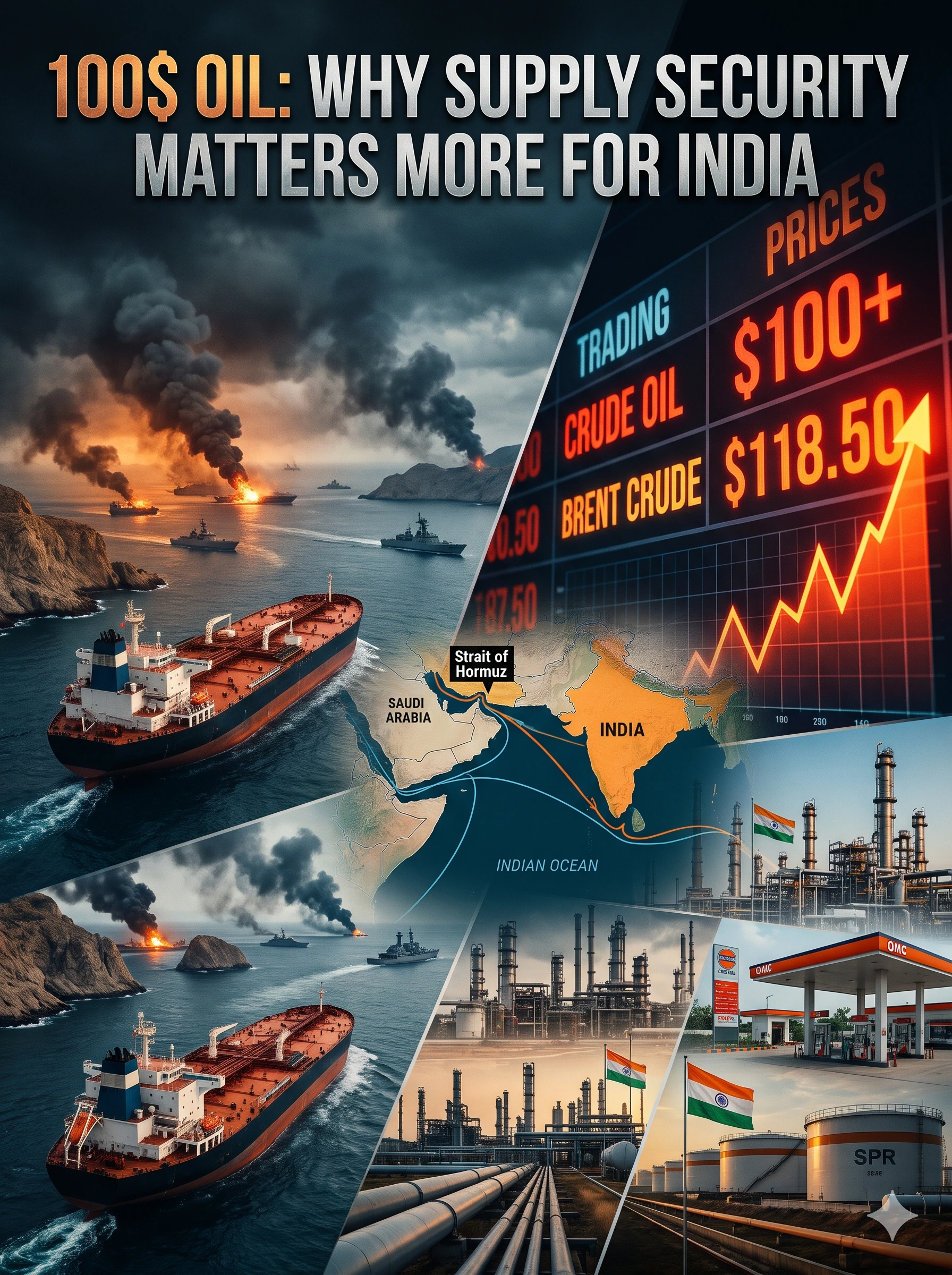
Crude oil prices spiked past $100 per barrel following geopolitical escalation in West Asia and near-total disruption in the Strait of Hormuz. For India, which imports over 85-88% of its crude requirements, safeguarding immediate physical energy supply has overtaken retail price stability as the primary economic imperative.
Introduction
Context & Background
Key Points
- •Geopolitical Trigger: Intensified military strikes in West Asia and the succession of Mojtaba Khamenei as Iran’s Supreme Leader cemented geopolitical continuity and escalation, driving crude prices above $100/barrel (briefly touching $120/barrel).
- •Chokepoint Paralysis: Tanker traffic through the Strait of Hormuz—the vital transit corridor connecting the Persian Gulf with the Gulf of Oman—has been effectively halted, stranding roughly 15 million barrels per day of transit crude.
- •Upstream Production Cuts: Regional storage limits in Gulf producers (Iraq, Kuwait, Saudi Arabia, UAE) are forcing involuntary output shut-ins, worsening physical availability beyond mere speculative price pressures.
- •Critical Macro Linkages: India imports 1.8 to 2.0 billion barrels of oil annually; every $1/barrel hike raises India's import bill by up to $2 billion, putting severe downward pressure on the Indian Rupee and widening the Current Account Deficit.
- •Shift to Supply Security: While pricing pressures induce imported inflation, New Delhi's immediate administrative priority has pivoted to physical availability, preventing dry pumps and gas shortages over price adjustments.
- •LPG and LNG Vulnerabilities: More than 80% of India's LPG imports and over 50% of LNG pass through the Strait of Hormuz, forcing immediate interventions under the Essential Commodities Act to protect household fuel access.
Key Dimensions of India's Oil Vulnerability
| Indicator / Parameter | Metric / Exposure | Strategic Implication | Bookmark |
|---|---|---|---|
| Crude Import Dependency | 85% – 88% | High exposure to external price spikes and transit disruption. | |
| Strait of Hormuz Dependency | ~2.5–2.7 million bpd (~50% of crude; >80% of LPG) | Primary maritime chokepoint vulnerability for hydrocarbons. | |
| Price Sensitivity | 1.8–2.0 billion barrels imported annually | A $1/bbl increase expands annual import bill by ~$2 billion. | |
| Macroeconomic Impact | +10% crude price increase | Widens Current Account Deficit (CAD) by ~0.4% of GDP. | |
| Strategic Petroleum Reserves (SPR) | ~5.33 MMT (Vizag, Mangaluru, Padur) | Provides limited buffer alongside commercial stocks (6–8 weeks). |
Key Transit & Domestic Infrastructure Overview
| Entity / Infrastructure | Operational Role | Vulnerability / Current Status | Bookmark |
|---|---|---|---|
| Strait of Hormuz | Handles ~1/5th of global oil & LNG (~15 million bpd) | Transit suspended; ~9 million bpd remains at risk despite bypass pipelines. | |
| Oil Marketing Companies (OMCs) | State-run retailers (IOCL, BPCL, HPCL) managing fuel distribution | Absorbing retail price gaps under state guidance to suppress domestic inflation. | |
| Very Large Crude Carriers (VLCCs) | High-capacity crude transport vessels (2–3.2 lakh tonnes) | India's limited domestic VLCC fleet increases exposure to volatile charter rates. |
Related Entities
Impact & Significance
- •Widening Current Account Deficit (CAD): With annual imports around 1.8 to 2 billion barrels, higher outlays directly strain foreign exchange reserves and weaken the Rupee.
- •Imported Inflation: Elevated input costs for transportation, petro-derivatives, and agricultural inputs threaten to filter into generalized consumer price inflation.
- •Industrial & Household Gas Disruption: Curtailments in LNG throughput force industrial units onto costlier alternative fuels and endanger steady residential cooking gas availability.
- •Fiscal Burden on Downstream Entities: Freezing retail fuel rates shields consumers but forces state-owned OMCs to absorb marketing losses on diesel and petrol.
Challenges & Criticism
- •Limited SPR Capacity: India's existing strategic storage (~5.33 MMT) covers only a fraction of national emergency demand compared to IEA member targets of 90 days.
- •Chokepoint Concentration: High historical dependence on Persian Gulf terminals leaves supply lines exposed whenever regional conflict flares.
- •Tanker Logistics Constraints: Low proportion of national-flagged VLCC tonnage leaves domestic refiners reliant on high international spot charter shipping during wartime.
- •Fiscal Trade-off in Price Controls: Freezing pump prices protects short-term inflation metrics but damages OMC balance sheets and delays fiscal pass-through.
Future Outlook
- •Supply Diversification: Accelerating crude procurement from non-Hormuz origins (West Africa, North America, and non-Gulf routes), which historically constitute about 40–60% of import flows.
- •Expansion of Strategic Petroleum Reserves (SPR): Accelerating Phase II underground salt cavern and rock cavern storage to expand the current 5.33 MMT buffer.
- •Fleet Expansion (VLCCs): Bolstering domestic crude carrier tonnage under the Indian flag to insulate state refiners from extreme commercial charter market volatility during maritime crises.
- •Demand-Side Prioritisation: Long-term institutionalization of fuel switching in industrial gas corridors, reprioritizing natural gas allocations to city gas distribution and critical fertilizer units.
UPSC Relevance
- • GS-3 (Indian Economy): Energy security, balance of payments, inflation dynamics, and Current Account Deficit (CAD) sensitivities.
- • GS-2 (International Relations): Geopolitics of West Asia, maritime chokepoints, and India's diaspora and supply dependencies in the Persian Gulf.
- • Prelims Focus: Strategic Petroleum Reserve (SPR) locations, geographical features surrounding the Strait of Hormuz, and open market operations (OMOs).
- • Mains Focus: 'Energy security is national security'—evaluating policy trade-offs between fiscal stability, fuel subsidies, and supply resilience.
Sample Questions
Prelims
With reference to India's energy infrastructure and strategic reserves, consider the following statements: 1. India's underground Strategic Petroleum Reserves (SPRs) are located at Visakhapatnam, Mangaluru, and Padur. 2. The Strait of Hormuz directly links the Persian Gulf with the Red Sea. 3. The Essential Commodities Act can be invoked by the Central Government to regulate and prioritize the supply of liquefied petroleum gas (LPG). Which of the statements given above are correct?
- (a)1 and 2 only
- (b)1 and 3 only
- (c)2 and 3 only
- (d)1, 2 and 3
Mains
“In times of severe geopolitical instability, energy supply security supersedes price stability for net-importing economies.” In this context, analyze India’s strategic vulnerabilities in the hydrocarbon sector and evaluate policy measures required to build long-term resilience.
Introduction: Highlight India's 85-88% crude import reliance and contextualize the vulnerability using the Strait of Hormuz chokepoint crisis.
Body:
• Immediate Economic & Supply Shocks: Widening CAD (0.4% per 10% price rise), currency depreciation, imported inflation, and physical shortfalls in domestic LPG/LNG supply.
• Strategic Chokepoint Risks: Vulnerability of the Persian Gulf maritime route, regional output shut-ins, and limited domestic VLCC logistics.
• Mitigation Measures: Leveraging the Essential Commodities Act, diversifying sourcing away from Hormuz, utilizing SPR buffers, and insulating domestic pump prices.
Conclusion: Emphasize accelerating renewable transition, expanding Phase-II SPR capacities, and securing long-term non-chokepoint crude contracts as foundational pillars of strategic autonomy.