
100 Years of CPI: Tracing the Century-Long Journey of the Communist Movement in India
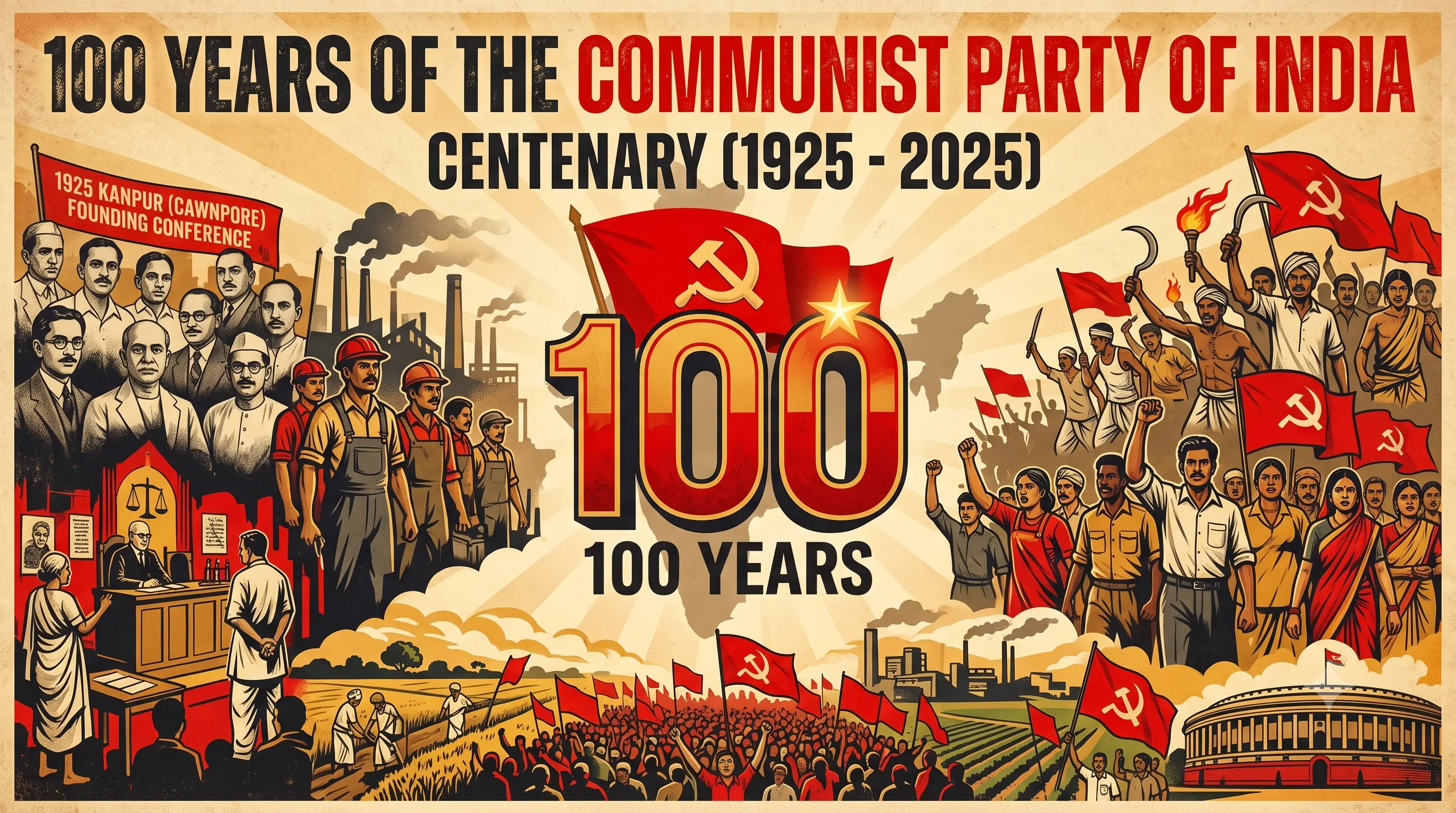
On December 26, 2025, the Communist Party of India (CPI) marked 100 years since its formation at the Kanpur conference. This article explores the CPI's ideological roots, its pivotal role in India's freedom struggle through mass peasant and worker movements, and its post-independence journey within parliamentary democracy.
Introduction
Context & Background
Key Points
- •Foundation and Ideology: The Communist Party of India (CPI) traces its origins on Indian soil to the Kanpur Conference of December 26, 1925. Drawing inspiration from the 1917 Russian Revolution, its foundational goals were to end British colonial rule and establish a Workers' and Peasants' Republic.
- •Role in Freedom Struggle: The CPI mobilized the masses largely through trade union and agrarian platforms. The formation of the All India Trade Union Congress (AITUC) and various peasant bodies served as the mass base for left-wing anti-imperialist resistance.
- •Colonial Repression: Viewing communism as a major threat, the British colonial government launched severe crackdowns. Prominent communist leaders were tried in infamous cases such as the Kanpur Bolshevik Case (1923) and the Meerut Conspiracy Case (1929).
- •Mass Peasant Uprisings: Towards the end of British rule, the party spearheaded radical agrarian revolts, most notably the Tebhaga Movement in Bengal (demanding a fair share for sharecroppers) and the Telangana Peasant Struggle against the Nizam of Hyderabad.
- •Post-Independence Democratic Path: After independence, the CPI transitioned from revolutionary politics to parliamentary democracy. In 1957, it formed the world's first democratically elected communist government in Kerala under E.M.S. Namboodiripad, initiating pioneering land and education reforms.
- •The 1964 Split: Ideological and strategic differences regarding the path forward in Indian politics and international geopolitical alignment culminated in a major division, resulting in the creation of the Communist Party of India (Marxist) [CPI(M)].
Historical Milestones of the CPI
| Event / Phase | Year | Key Significance | Bookmark |
|---|---|---|---|
| Kanpur Conference | Dec 1925 | Official foundation of the CPI on Indian soil. | |
| Meerut Conspiracy Case | 1929 | Major colonial repression targeting early communist and labor leaders. | |
| Tebhaga & Telangana Movements | 1946-1951 | Mass peasant armed uprisings against feudal landlords and Nizam rule. | |
| Kerala State Government | 1957 | Formation of the world's first democratically elected communist government. | |
| Party Split | 1964 | Ideological and strategic division leading to the formation of the CPI(M). |
Core Ideologies and Objectives
| Ideology | Core Objective | Bookmark |
|---|---|---|
| Marxism-Leninism | To guide class struggle and challenge capitalist/imperialist exploitation. | |
| Democratic Socialism | To pursue radical land, education, and social reforms through parliamentary democracy. | |
| Anti-Imperialism | To attain complete independence and establish a Workers' and Peasants' Republic. |
Related Entities
Impact & Significance
- •Pioneering Land Reforms: Communist-led governments fundamentally altered agrarian relations through radical land distribution and tenant protection laws, particularly in Kerala and West Bengal.
- •Labour Rights and Welfare: By consistently championing trade unionism, the CPI played a vital role in institutionalizing statutory labor protections, minimum wages, and better working conditions.
- •Deepening Democracy: The CPI's successful transition into parliamentary politics proved that radical ideological parties could adapt to and strengthen democratic constitutional frameworks.
- •Policy Influence at the Centre: Through strategic coalitions, particularly during the UPA-I era (2004-2008), the Left bloc was instrumental in the passage of landmark rights-based legislations like MGNREGA, the Forest Rights Act, and the RTI Act.
Challenges & Criticism
- •Electoral Marginalization: The party has faced a severe decline in its mass base across India, culminating in the Election Commission withdrawing its 'National Party' status in 2023.
- •Ideological Fragmentation: The historic split of 1964 into CPI and CPI(M), followed by further splintering over strategic differences, deeply weakened the collective bargaining power of the Left.
- •Disconnect with the Youth: Critics argue that the party suffers from ideological rigidity, struggling to present a modern narrative that resonates with today's youth, gig workers, and middle-class aspirations.
- •Geopolitical Dilemmas: Historically, the party's ideological alignment with international communist movements sometimes led to friction with nationalistic sentiments, notably causing internal fractures during incidents like the 1962 Sino-Indian War.
Future Outlook
- •Reinventing Mass Mobilization: Shifting focus to the modern informal sector, including gig workers and agricultural laborers, to rebuild its grassroots base.
- •Addressing Contemporary Issues: Re-aligning Marxist ideology with modern socio-economic challenges such as youth unemployment, rising inequality, and social justice.
- •Strengthening Democratic Alliances: Consolidating secular and democratic forces to challenge right-wing hegemony and protect constitutional values.
- •Youth and Issue-Based Politics: Moving away from rigid ideological dogma towards pragmatic, issue-based politics at the local level to attract the younger generation.
UPSC Relevance
- • GS-1 (Modern History): Role of the Left movement, trade unions, and peasant uprisings (Tebhaga, Telangana) in India's freedom struggle.
- • GS-2 (Polity): Evolution of political parties, regional governance models (Kerala land reforms), and the ideological shift towards parliamentary democracy.
- • Essay Topics: 'The relevance of ideological politics in 21st-century India' or 'From revolution to democracy: The journey of the Left in India'.
- • Mains Focus: Analyzing the ideological divide of 1964 and evaluating the socio-economic contributions of Left-front governments post-independence.
Sample Questions
Prelims
With reference to the history of the Communist Party of India (CPI), consider the following statements: 1. The party was officially founded at the Kanpur Communist Conference in December 1925. 2. The early communist leaders were completely immune from colonial prosecution due to their underground nature. 3. In 1957, the CPI formed the world's first democratically elected communist government in Kerala.
1. 1 and 2 only
2. 2 and 3 only
3. 1 and 3 only
4. 1, 2, and 3
Answer: Option 3
Explanation: Statement 1 is correct; the CPI traces its formal beginning on Indian soil to the December 1925 Kanpur conference. Statement 2 is incorrect; the British heavily repressed the movement through famous trials like the Kanpur Bolshevik Case (1923) and Meerut Conspiracy Case (1929). Statement 3 is correct; E.M.S. Namboodiripad led the historic 1957 communist government in Kerala.
Mains
Trace the ideological and political journey of the Communist Party of India (CPI) since its inception in 1925. Evaluate its role in the Indian national movement and its contributions to post-independence socio-economic reforms.
Introduction: Highlight the centenary of CPI in December 2025. Briefly mention its dual roots (Tashkent 1920 and Kanpur 1925) and how the 1917 Russian Revolution inspired its foundation on Marxist-Leninist ideals.
Body:
• Role in Freedom Movement: Emphasize the mobilization of the working class and peasantry (AITUC, Kisan Sabhas); leading the Tebhaga and Telangana movements; demanding 'Poorna Swaraj'; and enduring colonial repression (Meerut Conspiracy Case).
• Post-Independence Contributions: Transition from armed struggle to parliamentary democracy; forming the 1957 Kerala government; pioneering land, education, and labor reforms; and supporting progressive central legislations like RTI and MGNREGA during the UPA-I era.
• Challenges & Present Reality: Address the 1964 split [CPI and CPI(M)], continuous electoral marginalization leading to the loss of National Party status in 2023, and the struggle to connect with modern aspirations.
Conclusion: Conclude that despite recent electoral setbacks, the CPI's legacy in institutionalizing labor rights, agrarian reforms, and embedding the discourse of socio-economic justice into India's constitutional framework remains indispensable.