
16th India-EU Summit: Strategic Partnership and Free Trade Agreement
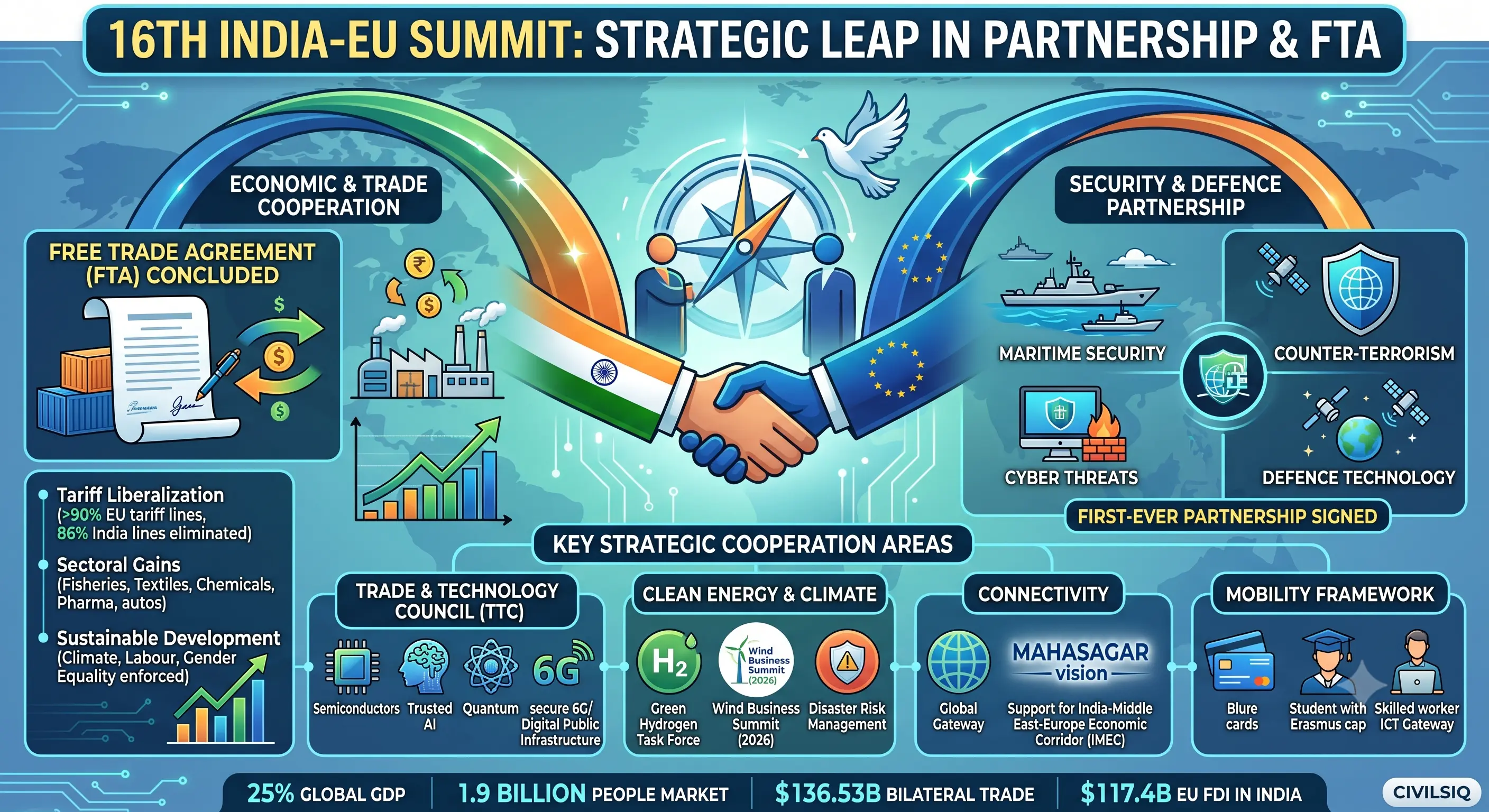
The 16th India-EU Summit witnessed the historic conclusion of the India-EU Free Trade Agreement (FTA) and the signing of the first-ever Security and Defence Partnership. With EU leaders attending as Republic Day Chief Guests, the summit elevated bilateral ties across trade, technology, clean energy, and migration.
Introduction
Context & Background
Key Points
- •Elevation of Strategic Partnership: Leaders committed to deepening the partnership based on democracy, the rule of law, human rights, and a UN-centric global order.
- •Security & Defence Milestone: Signed the first-ever India-EU Security and Defence Partnership covering maritime security (ESIWA+), cyber threats, space, and counter-terrorism. Negotiations for a Security of Information Agreement were also launched.
- •Trade and Technology Council (TTC): Reaffirmed as the primary platform to prevent working in silos. Focus areas include diversifying semiconductors, developing ethical AI, 6G deployment, and secure Digital Public Infrastructure.
- •Space and Scientific Synergies: The S&T Agreement was extended till 2030. Key milestones include ISRO launching the EU's PROBA-3 mission and ongoing cooperation for Chandrayaan-3, Aditya-L1, and the Gaganyaan mission.
- •Mobility and Migration: Adopted a Comprehensive Framework on Mobility. The launch of the European Legal Gateway Office will serve as a single window for skilled Indian workers, starting with the ICT sector.
Key Provisions of the India-EU Free Trade Agreement (FTA)
| FTA Aspect | Core Provision | Significance | Bookmark |
|---|---|---|---|
| Tariffs Liberalisation | EU to eliminate tariffs on >90% tariff lines (99.3% by value); India on 86% lines. | Significant market access while protecting highly sensitive domestic sectors. | |
| Rules of Origin | Benefits restricted to substantially produced/processed goods. | Prevents third-country dumping; self-certification aids SMEs. | |
| Sanitary & Phytosanitary (SPS) | Strict EU health/food safety rules retained; clear timelines for audits. | Streamlines compliance and integrates SPS disputes under the FTA. | |
| Intellectual Property Rights | Strong IP protection for copyrights, trademarks, and plant varieties. | Promotes investments; aligned with domestic laws to balance access. | |
| Trade & Sustainable Development | Integrates trade with climate action, worker's rights (ILO norms), and gender equality. | Legally binding commitments enforced via structured consultations. |
India-EU Economic Snapshot
| Parameter | Value/Data | Context | Bookmark |
|---|---|---|---|
| Bilateral Trade (2024-25) | $136.53 billion | EU is India's largest trading partner for goods. | |
| EU FDI in India | $117.4 billion | Accounts for 16.6% of total FDI in India (April 2000 - Sept 2024). | |
| Indian FDI in EU | $40.04 billion | Showcases growing Indian corporate presence in Europe. | |
| Combined Economic Size | 25% of Global GDP | Integration of a 1.9 billion population market. |
Related Entities
Impact & Significance
- •Global Economic Anchor: By creating a free trade zone integrating 1.9 billion people and a quarter of global GDP, the deal offers certainty amidst global supply chain disruptions.
- •Export Competitiveness: The FTA offers crucial market access for employment-intensive Indian sectors like textiles, footwear, fisheries, and pharmaceuticals.
- •Geopolitical Alignment: The addition of a Security and Defence Partnership signals a move beyond mere trade, aligning Europe and India against shared threats in maritime security, cyber domains, and terrorism.
- •Technological Sovereignty: Joint efforts in semiconductors, AI, and 6G reduce mutual reliance on monopolistic tech suppliers and ensure trusted digital infrastructure.
Challenges & Criticism
- •Carbon Border Adjustment Mechanism (CBAM): India views the EU's incoming carbon tax as a protectionist measure that unfairly penalizes developing nations and reduces the competitiveness of Indian steel and aluminum.
- •Data and Privacy Clashes: The EU's strict GDPR mandate conflicts with India's preference for data localization and sovereign oversight over citizen data.
- •Intellectual Property Rights: The EU consistently pushes for 'TRIPS-plus' IP protections, which India resists to prevent price surges in life-saving drugs and protect its generic pharmaceutical industry.
- •Asymmetrical Market Demands: The EU seeks entry into India's protected banking, legal, and government procurement sectors, while India struggles to secure smooth 'Mode 4' visa regimes for its service professionals.
Future Outlook
- •Complementary Economic Pacts: Commitment to the early conclusion of the Investment Protection Agreement (IPA) and Geographical Indications (GI) Agreement.
- •Clean Energy Transition: Establishment of the India-EU Task Force on Green Hydrogen and plans for the India-EU Wind Business Summit in 2026 to accelerate renewable investments.
- •Strategic Connectivity: Aligning the EU’s Global Gateway initiative with India’s MAHASAGAR vision, alongside active support for the India-Middle East-Europe Economic Corridor (IMEC).
- •Education and Skilling: The launch of the Education and Skills Dialogue (2026) to focus on academic mobility and mutual recognition of qualifications.
UPSC Relevance
- • GS-2 (International Relations): Bilateral agreements, India's relations with the European Union, and global groupings affecting India's interests.
- • GS-3 (Economy & Technology): Free Trade Agreements, IPR issues (TRIPS-plus), AI, space technology (PROBA-3), and environmental challenges (CBAM).
- • Mains Focus: Analyzing the hurdles in India-EU relations (data localization, CBAM, IPR) vs. the strategic gains from the FTA and Defence Partnership.
Sample Questions
Prelims
Consider the following statements regarding India-EU bilateral relations: 1. The Trade and Technology Council (TTC) is a key mechanism established to align policies on technology and trade security. 2. Under the recently concluded FTA, both India and the EU have agreed to eliminate tariffs on 100% of traded goods. 3. ISRO successfully launched the EU's PROBA-3 space mission. Which of the statements given above is/are correct?
1. 1 and 2 only
2. 2 and 3 only
3. 1 and 3 only
4. 1, 2, and 3
Answer: Option 3
Explanation: Statement 1 is correct: TTC was established in 2022. Statement 2 is incorrect: Tariff elimination is partial (EU on >90% lines, India on 86%), with sensitive sectors protected. Statement 3 is correct: ISRO launched PROBA-3 in December 2024.
Mains
The conclusion of the India-EU Free Trade Agreement is a landmark achievement, yet non-trade barriers and regulatory divergences continue to pose challenges to the strategic partnership. Analyze.
Introduction: Highlight the context of the 16th India-EU Summit where the FTA was concluded, emphasizing that the EU is India's largest trading partner. Mention how the combined economic heft accounts for 25% of Global GDP.
Body:
• Significance of the FTA & Strategic Gains: Tariff elimination on over 90% of EU lines and 86% of Indian lines; boost to Indian textiles, fisheries, and pharma. The first-ever Security & Defence Partnership and cooperation in space (PROBA-3) and critical tech (TTC) anchor the alliance.
• Regulatory Divergences (The Friction Points): The EU's Carbon Border Adjustment Mechanism (CBAM) acts as a de facto tax on Indian steel/cement exports. Conflicts over data localization (India) vs. free data flows (EU GDPR).
• Market Access & IP Issues: EU demands for TRIPS-plus patent rules threaten India's generic medicine sector. Disagreements persist over EU access to Indian public procurement and Indian demands for easier Mode 4 visas for professionals.
Conclusion: Conclude that while the FTA provides the institutional bedrock for economic integration, platforms like the Trade and Technology Council (TTC) must be actively leveraged to harmonize digital, environmental, and intellectual property standards.