
Agri-photovoltaics (agriPV): Balancing Food Security and Renewable Energy
With the 2026-27 Budget increasing the PM-KUSUM outlay to ₹5,000 crore and the proposition of a 10 GW National Agri-photovoltaics Mission, agriPV is emerging as a critical solution to resolve India's land-use conflict between food production and its 300 GW solar target for 2030.
Introduction
Context & Background
Key Points
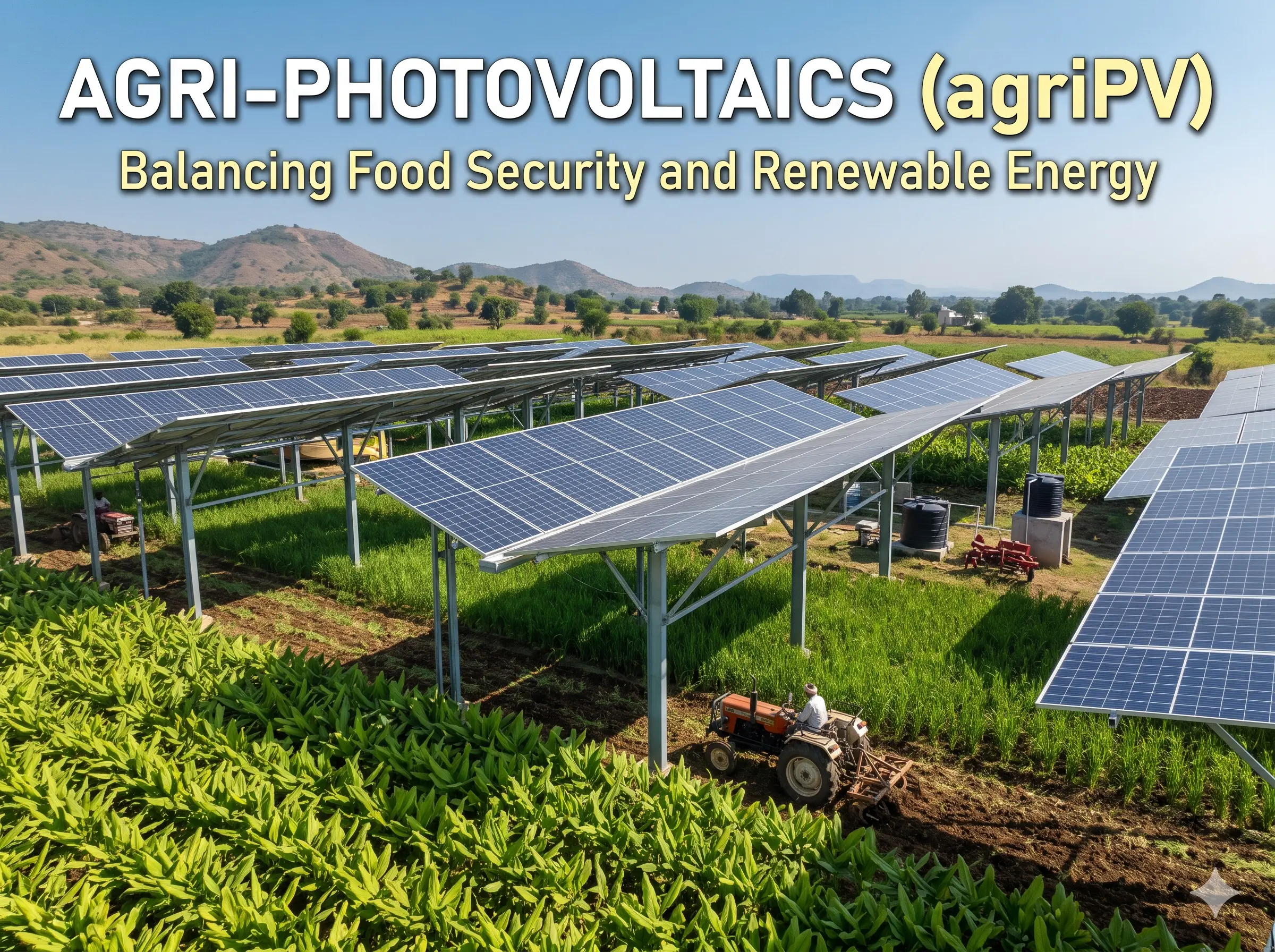
- •Dual-Use Approach: Agri-photovoltaics (agriPV) allows for the simultaneous use of land for agricultural production and solar photovoltaic power generation.
- •Solving the Land Conflict: It acts as a primary solution to India’s land-use conflict, addressing the food vs. fuel debate by utilizing existing agricultural land for solar without diverting it from food security.
- •Micro-Climate Benefits: By providing overhead cover, the solar panels create a micro-climate that helps regulate soil temperature, shielding sensitive crops from extreme weather events.
- •Technological Flexibility: AgriPV systems are highly adaptable, utilizing elevated mounting for tractor access, row-based designs, or vertical bifacial panels that capture sunlight from both sides.
- •Optimized for Growth: The systems require precise technical optimization, calculating specific spacing and panel tilts to perfectly balance the Light Saturation Point of the crops beneath with maximum energy capture.
Key Features of AgriPV Systems
| Feature | Description | Bookmark |
|---|---|---|
| Elevated Mounting | Panels are fixed several meters high to ensure clearance for farmers, laborers, and tractors. | |
| Variable Design | Row-based (panels between crops), vertical (bifacial panels), or greenhouse-integrated. | |
| Micro-climate Control | Shading reduces soil temperature and protects crops from extreme weather like hail. | |
| Technical Optimization | Specific spacing and tilt to balance the Light Saturation Point of crops with solar capture. |
Initiatives Promoting Agri-photovoltaics
| Initiative | Details | Bookmark |
|---|---|---|
| PM-KUSUM 2.0 | Budget 2026-27 increased funding to ₹5,000 crore for decentralized solar power on farms. | |
| National Agri-photovoltaics Mission | A proposed dedicated 10-GW component aimed at scaling the technology beyond pilot stages. | |
| Viability Gap Funding (VGF) | Government plans to provide financial support to offset high initial capital costs. | |
| Pilot Installations | ~50 national-level pilots evaluating different panel-crop combinations across agro-climatic zones. |
Related Entities
Impact & Significance
- •Income Diversification: Farmers gain a secondary, stable revenue stream from selling surplus power or leasing land to developers.
- •Water Conservation: Partial shading reduces evapotranspiration, allowing the soil to retain moisture longer and reducing irrigation needs.
- •Land Neutrality: It solves the food vs. fuel debate by utilizing existing agricultural land for solar without diverting it from food production.
- •Rural Industrialization: Generated power can run on-farm ancillary services like cold storage, reducing post-harvest losses.
- •Climate Resilience: Panels act as a physical shield against increasing instances of heatwaves and unseasonal heavy rainfall.
Challenges & Criticism
- •High Capital Intensity: Elevated structures require more steel and specialized engineering, making them costlier than ground-mounted solar.
- •Yield Uncertainty: Incorrect shading or poor design can lead to reduced photosynthesis and lower agricultural output.
- •Regulatory Hurdles: Lack of clear guidelines on land-use classification (Agri vs. Industrial) can lead to legal and tax complications.
- •Technical Skill Gap: Maintaining both a high-tech solar array and a sensitive crop matrix requires a dual skill set that most farmers currently lack.
- •Grid Connectivity: Many remote farms lack the last-mile infrastructure to feed surplus power back into the national grid.
Future Outlook
- •Region-Specific Planning: Develop a Crop-Matrix for different states (e.g., Ragi for Karnataka, Turmeric for MP) to optimize shade-yield ratios.
- •Clear Governance Frameworks: Establish uniform Dual-Use land laws to protect farmer land rights and provide long-term revenue clarity.
- •Accessible Finance: Create low-interest Agri-Solar Loans and involve Farmer Producer Organizations (FPOs) to aggregate small landholdings for better bargaining power.
- •Standardization of Design: The CWC and Ministry of Power should issue benchmark designs for mounting structures to reduce investor uncertainty.
- •R&D Expansion: Increase the number of Live Labs across all 15 agro-climatic zones to gather more empirical evidence on long-term soil health.
UPSC Relevance
- • GS-3 (Indian Economy): Renewable energy financing, doubling farmers' income, and infrastructure development.
- • GS-3 (Agriculture): Farming technology, irrigation (water conservation), and e-technology in the aid of farmers.
- • GS-3 (Environment): Renewable energy targets (300 GW solar by 2030), climate resilience, and adaptation strategies.
- • Mains Focus: Analyzing the food vs. fuel debate and evaluating AgriPV as a sustainable policy intervention.
Sample Questions
Prelims
With reference to Agri-photovoltaics (agriPV), consider the following statements: 1. The partial shading provided by solar panels increases evapotranspiration, thereby requiring higher irrigation for crops. 2. The system can utilize vertical bifacial panels to capture sunlight from both sides without severely disrupting row-based farming. Which of the statements given above is/are correct?
- (a)1 only
- (b)2 only
- (c)Both 1 and 2
- (d)Neither 1 nor 2
Mains
“Agri-photovoltaics (agriPV) offers a sustainable pathway to resolve India's land-use conflict between food security and its ambitious renewable energy targets.” Discuss. What are the key bottlenecks in its widespread adoption?
Introduction: Introduce Agri-photovoltaics and provide context using the 2026-27 Budget's doubling of PM-KUSUM allocation and the proposed 10 GW National Agri-photovoltaics Mission.
Body:
• Potential and Benefits: Explain Land Neutrality (solving food vs. fuel); Income Diversification for farmers; Water Conservation through reduced evapotranspiration; and Climate Resilience against heatwaves.
• Bottlenecks/Challenges: Highlight High Capital Intensity due to elevated steel structures; Yield Uncertainty from improper shading; Regulatory Hurdles (Agri vs. Industrial land use laws); and Grid Connectivity issues in remote areas.
Conclusion: Conclude by emphasizing the need for clear Dual-Use land governance frameworks, region-specific crop matrices, and accessible finance through FPOs to realize the full potential of agriPV.