
Amendment to Foreign Contribution (Regulation) Act (FCRA)
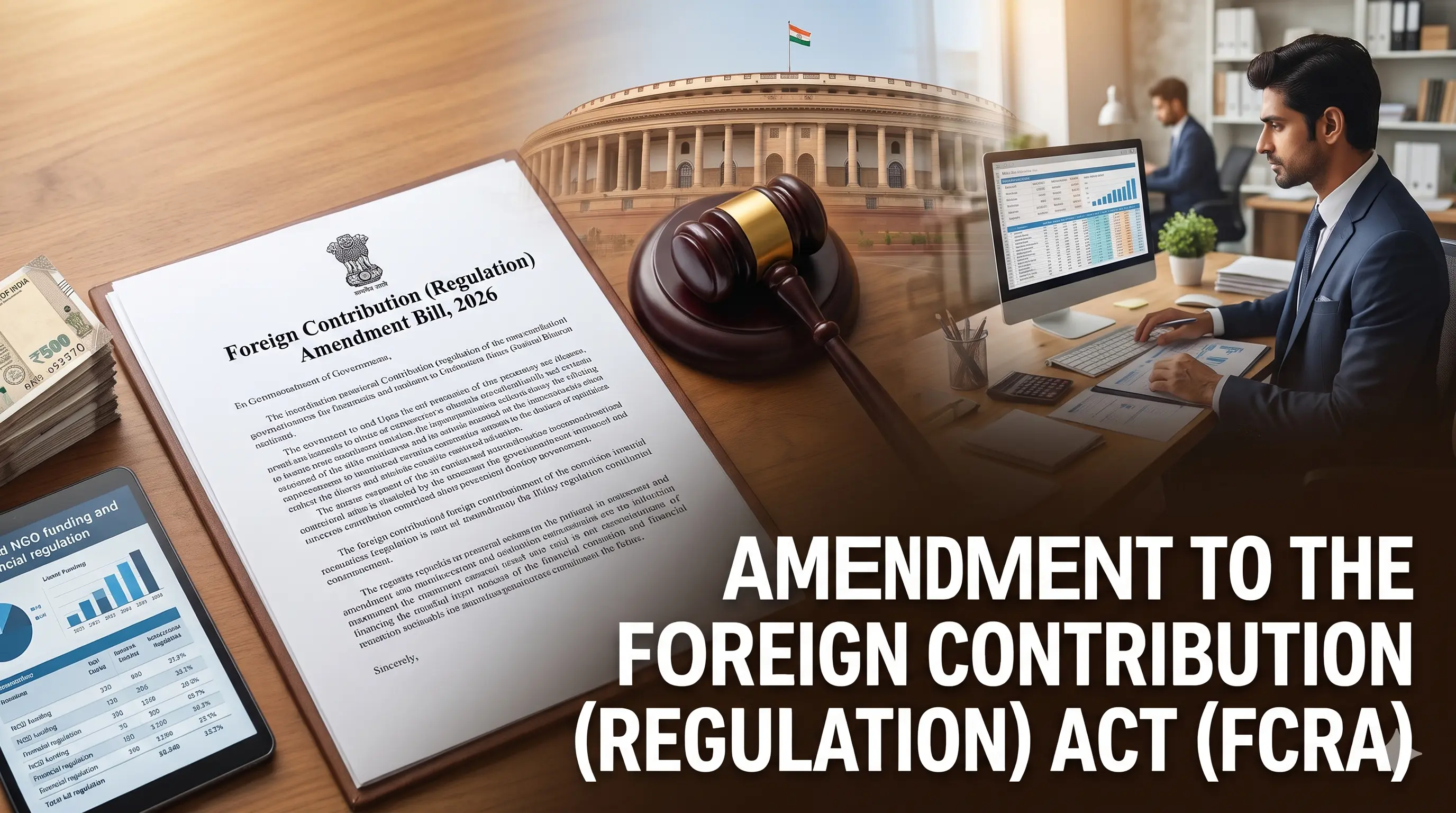
The Government proposes changes to the Foreign Contribution (Regulation) Act, 2010 to address gaps in managing foreign funds received by NGOs. The amendments aim to improve oversight, ensure proper use of funds, manage assets, and remove administrative uncertainties.
Introduction
Context & Background
Key Points
- •Creation of a 'Designated Authority': A special authority will handle assets created from foreign funds. Earlier, there was no mechanism to manage these assets if an NGO's license was cancelled or suspended.
- •Liability of Key Functionaries: Decision-makers (directors, trustees, partners) can be held personally liable for violations unless they prove a lack of knowledge or that proper care was taken.
- •Centralisation of Investigations: State police and agencies must now get prior approval from the Central government to probe FCRA-related matters, aiming to prevent multiple or overlapping inquiries.
- •Timelines for Fund Utilisation: NGOs receiving funds under prior permission are now required to utilize them within a fixed time period, preventing indefinite hoarding.
- •Automatic Expiry: Registration will automatically expire if not renewed, removing ambiguity about the operational status of inactive NGOs.
- •Shift to Administrative Compliance: By reducing the maximum jail term from 5 years to 1 year, the state is shifting focus toward administrative compliance rather than harsh criminal punishments.
Evolution of the Foreign Contribution (Regulation) Act
| Year / Act | Key Objective / Provision | Impact | Bookmark |
|---|---|---|---|
| FCRA, 1976 | Introduced during the Emergency to limit foreign influence in India's internal affairs. | Created a regulatory framework to monitor fund inflow and safeguard national interests. | |
| FCRA, 2010 | Replaced the 1976 law with a more comprehensive framework for NGOs and individuals. | Ensured foreign funding did not adversely affect sovereignty, internal security, or public interest. | |
| FCRA Amendment, 2020 | Mandated Aadhaar for functionaries, designated SBI accounts, and banned sub-granting. | Reduced administrative cap to 20%; extended suspension periods up to 360 days. | |
| FCRA Rules, 2022 | Revised to strengthen regulatory safeguards while easing specific compliance areas. | Raised the threshold for receiving foreign funds from relatives without prior intimation to ₹10 lakh. |
Key Proposals in the FCRA 2026 Amendment
| Proposed Change | Objective / Implication | Bookmark |
|---|---|---|
| Designated Authority | To manage or dispose of assets created from foreign funds when an NGO's registration is suspended or cancelled. | |
| Wider 'Key Functionary' Definition | Now includes directors, trustees, partners, and committee members to ensure clear accountability. | |
| Central Approval for State Probes | State agencies or police need prior approval from the Central government to investigate FCRA matters. | |
| Rationalisation of Penalties | Maximum jail term for violations proposed to be reduced from 5 years to 1 year. |
Related Entities
Impact & Significance
- •Ensures National Security: Prevents foreign money from being weaponized to influence domestic political processes or cause internal instability.
- •Enhanced Transparency: Mandatory Aadhaar linking and routing funds through a single SBI branch ensures complete traceability, addressing historic gaps in NGO audits.
- •Maximized Development Impact: By capping administrative overheads at 20% (down from 50%), the law forces organizations to channel more funds directly to end-beneficiaries in health, education, etc.
- •Closes Asset Loopholes: The 2026 creation of a Designated Authority ensures that physical infrastructure built with foreign money isn't abandoned or misused when a license is revoked.
Challenges & Criticism
- •Shrinking Civil Society Space: International bodies and critics argue that the FCRA is often used as a tool to target dissenting advocacy groups and human rights organizations.
- •Suffocates Grassroots NGOs: The absolute ban on sub-granting has crippled small, local NGOs who do not have the capacity to secure foreign funding directly and relied on larger umbrella organizations.
- •Threat to Federalism: The 2026 proposal requiring prior Central approval for state police to investigate FCRA matters increases centralization and weakens state autonomy.
- •Operational Paralysis: Extended suspension periods (up to 360 days) and heavy compliance burdens disrupt vital humanitarian work, as seen during the COVID-19 pandemic relief efforts.
Future Outlook
- •Streamlined NGO Ecosystem: With automatic expiry and strict compliance mandates, the sector is likely to see a consolidation, resulting in fewer but highly regulated active NGOs.
- •Focus on Core Developmental Activities: The strict 20% cap on administrative expenses and the ban on sub-granting will force organizations to directly execute grassroots projects rather than acting as intermediary funding bodies.
- •Asset Oversight: The Government will have unprecedented control over the physical and financial assets created by NGOs using foreign money, ensuring these assets remain secure even if the organization is penalized.
UPSC Relevance
- • GS-2 (Polity & Governance): Government policies and interventions for development in various sectors and issues arising out of their design and implementation.
- • GS-2 (Social Justice): Development processes and the development industry — the role of NGOs, SHGs, various groups and associations.
- • GS-3 (Internal Security): Challenges to internal security, money laundering, and the role of non-state actors.
- • Mains Focus: Analyzing the balance between national security and the shrinking space for civil society organizations in India.
Sample Questions
Prelims
Consider the following statements regarding the Foreign Contribution (Regulation) Act (FCRA):
- (a)Under the FCRA framework, an NGO is allowed to transfer a maximum of 20% of its foreign contributions to another registered NGO.
- (b)All foreign funds must be received exclusively in a designated branch of the State Bank of India located in New Delhi.
- (c)State police can independently initiate investigations into any FCRA violations without prior Central government approval.
Mains
“While the regulation of foreign funding is essential to safeguard national sovereignty, overly stringent FCRA provisions threaten the developmental and humanitarian mandate of civil society.” Critically analyze this statement in the context of the proposed 2026 amendments.
Introduction: Define the primary objective of the FCRA. Briefly outline the context of the evolving regulatory framework culminating in the 2026 amendment proposals.
Body:
• Need for Regulation: Protecting internal security, ensuring transparency, preventing diversion of funds (as highlighted by CAG), and tracking assets via the proposed 'Designated Authority'.
• Impact on Civil Society: Ban on sub-granting starves grassroots NGOs lacking capacity to access foreign funds directly; excessive compliance burdens and potential targeting of dissenting advocacy groups.
• Analysis of 2026 Proposals: Centralized approval for state probes may strain federalism, but rationalizing penalties (reducing jail time to 1 year) indicates a positive shift towards administrative compliance rather than criminalization.
Conclusion: Conclude that a balanced regulatory architecture is required—one that targets malicious non-state actors without stifling genuine NGOs operating in critical sectors like health, education, and disaster relief.