
Bill to Codify IPS Deputation in CAPFs
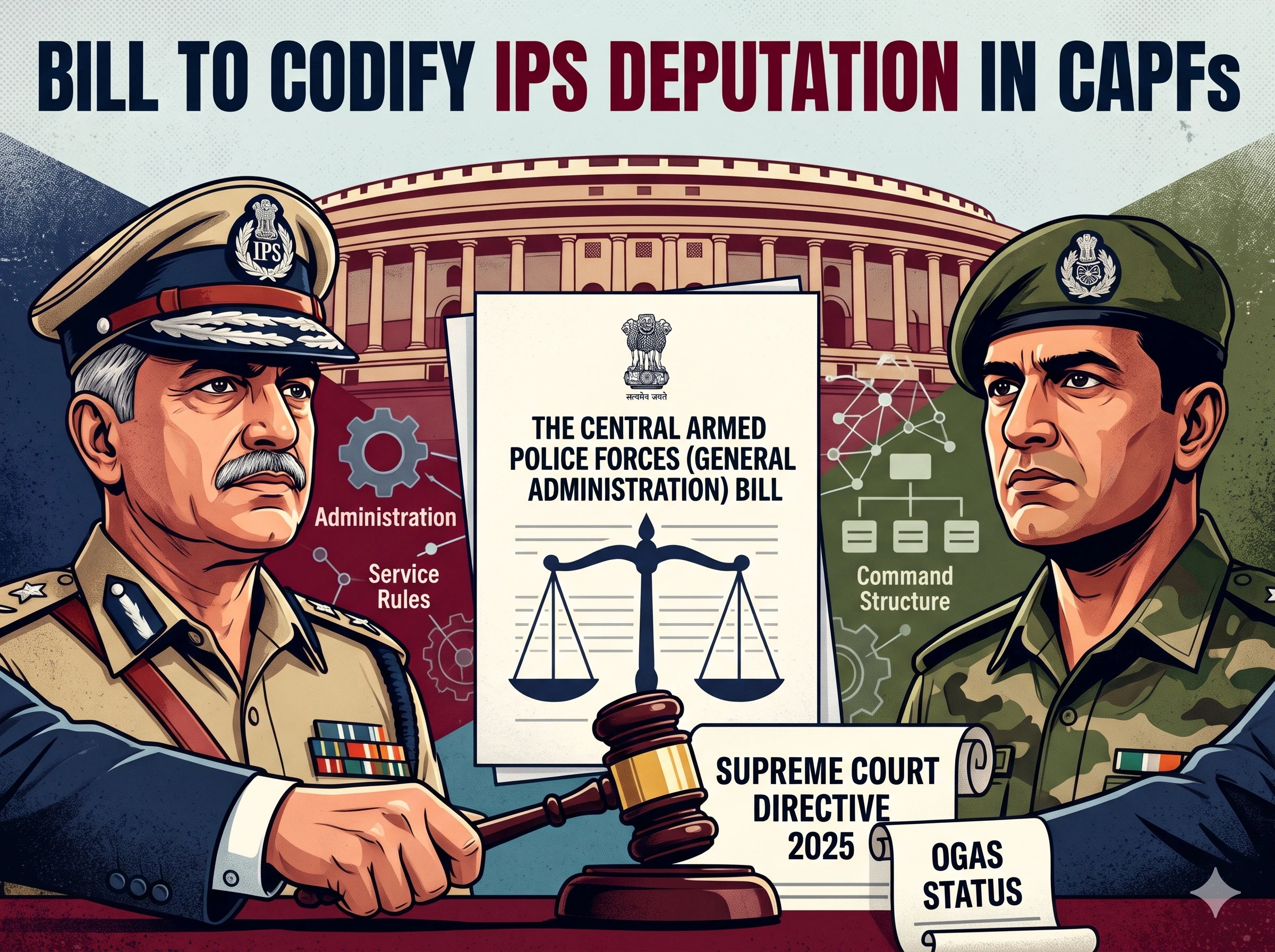
The Union government is preparing to introduce the Central Armed Police Forces (General Administration) Bill to establish a statutory framework for CAPF administration and regulate the deputation of Indian Police Service (IPS) officers, following a pivotal 2025 Supreme Court ruling.
Introduction
Context & Background
Key Points
- •Statutory Framework for CAPFs: The proposed law aims to codify the functioning of CAPFs, shifting them from executive orders to a formal legal structure covering cadre management, promotions, and deputation.
- •Legalising IPS Deputation: The Bill seeks to provide statutory backing to the existing practice of deputing IPS officers into senior CAPF roles, which currently relies merely on executive service rules.
- •Institutionalising the Command Structure: The legislation is expected to formalise the arrangement where senior leadership and command positions are predominantly held by IPS officers.
- •MHA Integration: The authority of the Ministry of Home Affairs (MHA), functioning as the cadre-controlling authority for both IPS and CAPF officers, will likely be further solidified.
- •Clarifying Service Rules: By establishing clear statutory rules governing recruitment and deputation, the Bill attempts to resolve existing ambiguities and balance cadre interests.
Current Issues in the CAPF Deputation System
| Issue | Details | Consequence | Bookmark |
|---|---|---|---|
| Limited Promotion Opportunities | 20% of DIG posts and 50% of IG posts are reserved for IPS officers on deputation. | Severe promotion stagnation for native CAPF cadre officers. | |
| Administrative Duality | Presence of two distinct cadres (CAPF and deputed IPS) in command roles. | Administrative friction and ambiguity in command authority. | |
| Career Progression Disparity | CAPF officers spend decades in harsh operational roles while top leadership goes to IPS. | Lowered morale and concerns over institutional identity among CAPF ranks. |
Related Entities
Impact & Significance
- •Legal Certainty: Moving from executive orders to a statutory framework will shield the administrative operations of CAPFs from frequent legal challenges.
- •Operational Efficiency: Clear service rules will reduce administrative friction between IPS and CAPF cadres, leading to more cohesive command during internal security and border operations.
- •Career Trajectory: Granting OGAS status and rationalizing deputation quotas directly impacts the career progression and retirement benefits of thousands of CAPF personnel.
Challenges & Criticism
- •Undermining the Supreme Court: Retired and serving CAPF officers have expressed fears that the Bill is a tool to legally bypass the Supreme Court's directive to reduce IPS deputation.
- •Morale Deficit: Critics argue that perpetuating the dominance of IPS officers at the top echelon demoralizes CAPF officers who brave hostile conditions throughout their careers.
- •Administrative Efficiency vs. Specialization: While supporters state IPS officers bring vital broader policing experience, detractors argue that modern border guarding and counter-insurgency require specialized, homegrown CAPF leadership.
Future Outlook
- •Cadre Review Mechanism: The MHA is initiating a cadre review process to reassess the strength and distribution of posts, determining how leadership roles will be allocated going forward.
- •Balancing Acts: Future frameworks will need to delicately balance the administrative and state policing expertise of IPS officers with the career progression rights of dedicated CAPF officers.
- •Strict Legal Compliance: The legislative changes will act as a mechanism to comply with judicial mandates while ensuring there is no sudden administrative vacuum in national security forces.
UPSC Relevance
- • GS-3 (Security Forces): Various Security Forces and Agencies and their Mandate.
- • GS-2 (Governance & Administration): Role of Civil Services in a Democracy, statutory frameworks, and judicial interventions in administrative functioning.
- • Mains Focus: Analyzing the friction between IPS deputation and CAPF cadre officers, and evaluating the need for structural reforms in internal security management.
Sample Questions
Prelims
With reference to the administration of Central Armed Police Forces (CAPFs) in India, consider the following statements: 1. The command structure and deputation rules in CAPFs have historically been governed entirely by parliamentary statutes. 2. The Ministry of Home Affairs acts as the cadre-controlling authority for both IPS officers and CAPF services. 3. The Supreme Court recently directed the Union to grant Organised Group A Services (OGAS) status to CAPF cadre officers. Which of the statements given above is/are correct?
- (a)1 and 2 only
- (b)2 and 3 only
- (c)1 and 3 only
- (d)1, 2, and 3
Mains
The administrative duality in the Central Armed Police Forces (CAPFs) has often led to friction between cadre officers and deputed IPS officers. Analyze the issues surrounding IPS deputation in CAPFs and discuss how the proposed General Administration Bill aims to resolve them.
Introduction: Briefly introduce the CAPFs and the context of the Central Armed Police Forces (General Administration) Bill, highlighting the 2025 Supreme Court ruling regarding OGAS status.
Body:
• Issues with Deputation: Highlight promotion stagnation (reserving DIG/IG posts), administrative friction between the two cadres, and the morale deficit among CAPF officers engaged in frontline operations.
• Role of the Bill: Discuss the shift from executive orders to a statutory framework, legalizing IPS deputation, clarifying service rules, and the MHA's cadre review mechanism.
• Concerns & Debate: Mention opposition from CAPF associations regarding the dilution of the SC directive versus the argument that IPS officers bring vital state policing and administrative expertise.
Conclusion: Conclude on the need for a balanced approach that respects the operational sacrifices of CAPF officers while integrating the administrative experience of IPS officers to ensure robust national security.