
Challenges of the Global Nuclear Order: Iran, Israel, and the Future of NPT
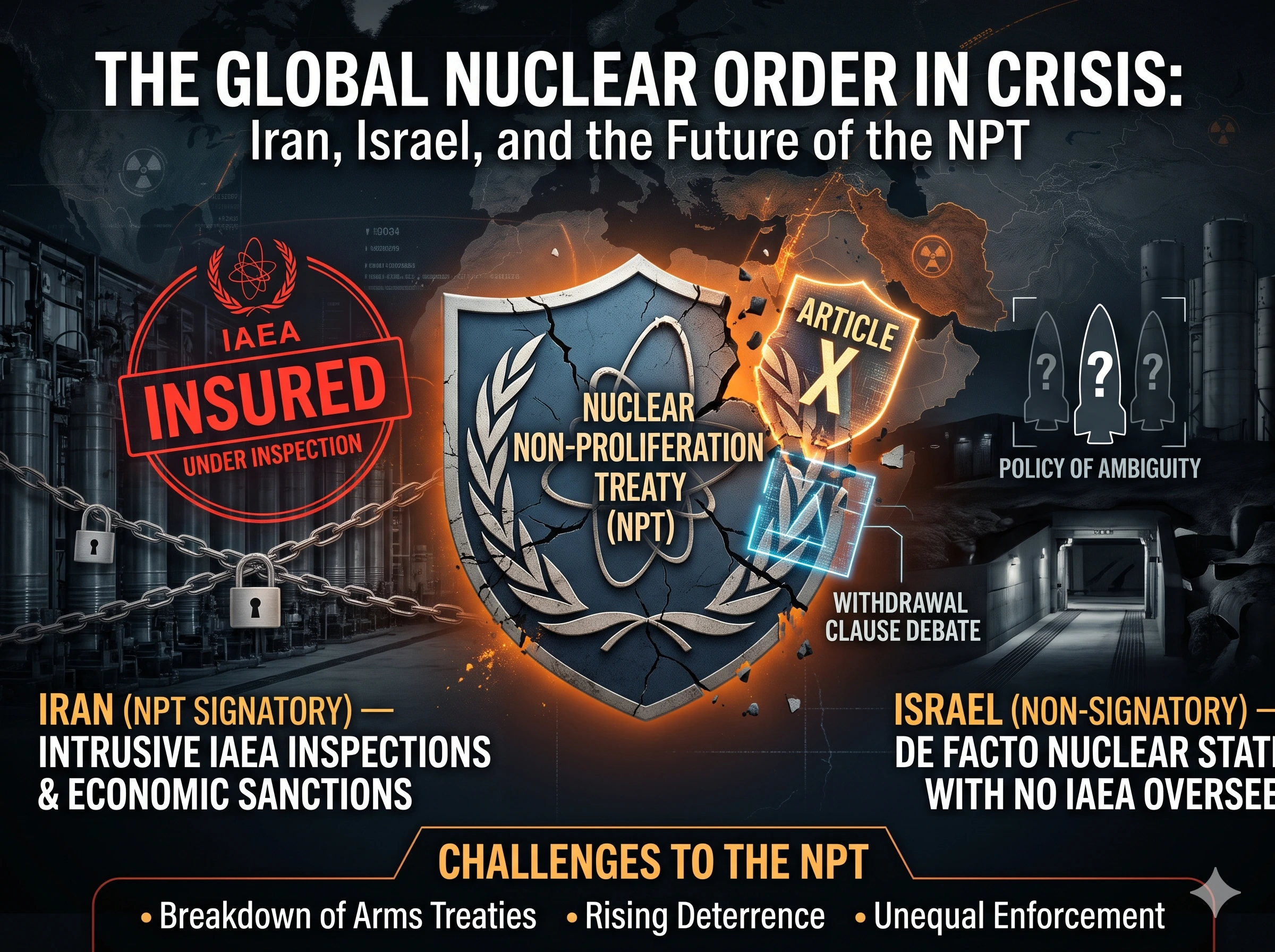
Escalating geopolitical friction—marked by tensions between Iran and Israel, attacks on nuclear installations, and discussions within Iran's parliament regarding withdrawal under Article X of the NPT—highlights deep structural cracks in the global nuclear order, double standards in treaty enforcement, and the renewal of strategic nuclear deterrence.
Introduction
Context & Background
Key Points
- •Foundational Framework of the NPT: Signed in 1968 and enforced in 1970 (191 parties), the NPT rests on three central pillars: non-proliferation, peaceful use of nuclear energy, and disarmament. It enforces a strict legal division between five recognized Nuclear-Weapon States (pre-1967) and Non-Nuclear Weapon States.
- •The Non-Signatory Landscape: Four nuclear-armed nations never signed the NPT: India, Pakistan, and Israel (along with South Sudan). North Korea acceded in 1985 but invoked Article X to withdraw in 2003.
- •India's Principled Stance: India opposes the NPT as inherently discriminatory, arguing it institutionalizes a permanent division between nuclear 'haves' and 'have-nots' while placing verification burdens solely on non-nuclear states. India advocates non-discriminatory, universal, complete nuclear disarmament.
- •Article X Vulnerability: Article X allows withdrawal if extraordinary regional security developments jeopardize a state's supreme interests. Iranian legislative reviews regarding potential exit demonstrate how regional conflicts and direct strikes on nuclear facilities threaten the treaty's remaining legal guardrails.
- •Breakdown of Bilateral Arms Control: Key Cold War-era agreements between the US and Russia, including the expiration and suspension of mechanisms around New START, have hollowed out multilateral arms caps and verification inspections.
- •Resurgence of Extended Deterrence: Heightened conflicts across Eastern Europe, West Asia, and the Indo-Pacific have driven major powers (China, Russia, the US) to modernize delivery systems and led non-nuclear regional states to reassess the necessity of sovereign deterrence.
Comparison of Iran and Israel in the Global Nuclear Order
| Aspect | Iran | Israel | Bookmark |
|---|---|---|---|
| NPT Status | Member of NPT; accepts treaty obligations and safeguards. | Non-signatory; outside the global non-proliferation treaty framework. | |
| IAEA Inspections | Subject to IAEA monitoring; facilities are regularly inspected. | No mandatory inspections; nuclear programme operates outside IAEA safeguards. | |
| Nuclear Capability | Threshold nuclear state; possesses uranium enrichment capability without declared warheads. | De facto nuclear weapons state; estimated to possess 80–90 nuclear warheads. | |
| International Response | Extensive economic sanctions, monitoring, and sustained diplomatic pressure. | Minimal international scrutiny or penalties despite suspected arsenal. | |
| Declared Policy | Maintains civilian and peaceful intent under IAEA oversight. | Policy of deliberate nuclear ambiguity (amimut); neither confirms nor denies possession. |
NPT Categorization & Institutional Architecture
| Category / Provision | Criteria / Mechanism | Significance / Critique | Bookmark |
|---|---|---|---|
| Nuclear-Weapon States (NWS) | Manufactured and detonated a nuclear device prior to 1 January 1967 (US, Russia, UK, France, China). | Recognized nuclear monopoly; bound by Article VI to pursue disarmament in good faith. | |
| Non-Nuclear Weapon States (NNWS) | All other state parties; forfeit right to acquire or manufacture nuclear warheads. | Guaranteed inalienable right to peaceful civilian nuclear technology under IAEA safeguards. | |
| Article X (Withdrawal Clause) | Permits exit if 'extraordinary events' jeopardize supreme national interests; requires 3 months notice to parties & UNSC. | Only exercised by North Korea (2003); currently debated in Iran's parliament amid escalating strikes. |
Related Entities
Impact & Significance
- •Erosion of Treaty Credibility: Disparities in oversight between signatories and non-signatories erode global confidence in the IAEA and NPT framework.
- •Proliferation Cascades: If non-nuclear states conclude that international treaties fail to deter external military strikes, incentives to cross the nuclear threshold and acquire sovereign deterrence accelerate.
- •Expansion of Global Arsenals: Modernization programs pursued by China, Russia, and the United States reverse decades of phased reductions, reviving qualitative and quantitative arms races.
- •Elevated Escalation Risk: The dismantling of verification protocols and hotlines heightens the danger of miscalculation, accidental launches, or tactical escalations during regional crises.
Challenges & Criticism
- •Perception of Double Standards: Western security umbrellas and strategic partnerships shield certain undeclared nuclear-capable nations from sanctions, while strict penalties are imposed on others.
- •Article VI Deficit: The five recognized nuclear-weapon states have failed to deliver demonstrable progress toward total disarmament, keeping the treaty fundamentally asymmetrical.
- •Asymmetric Safeguards: IAEA Additional Protocols impose comprehensive intrusive monitoring on compliant states, while non-signatories operate reactors, reprocessing facilities, and stockpiles completely outside international purview.
- •Geopolitical Weaponization: Multilateral bodies such as the UN Security Council face institutional paralysis, preventing coordinated enforcement or uniform punitive action.
Future Outlook
- •Multilateral Verification Revamp: Rebuilding independent, resilient verification frameworks that operate beyond geopolitical blockades and unilateral sanctions.
- •Regional Nuclear-Weapon-Free Zones (NWFZ): Revitalizing long-stalled initiatives such as the Middle East WMDFZ to balance security guarantees without treaty exits.
- •Universal Disarmament Protocols: Bridging the structural gap between the NPT and newer disarmament mechanisms such as the Treaty on the Prohibition of Nuclear Weapons (TPNW).
- •Institutional Safeguards for Facilities: Reinforcing international humanitarian laws and IAEA norms prohibiting armed attacks against declared peaceful nuclear installations.
UPSC Relevance
- • GS-2 (International Relations): Bilateral, regional, and global agreements involving India and affecting India's interests; effect of policies and politics of developed/developing countries.
- • Internal Security & Defence: Nuclear doctrine, deterrence stability, 'No First Use' (NFU) policy, and credibility of minimum credible deterrence.
- • Essay Topics: 'The Illusion of Global Non-Proliferation', 'Geopolitics, Sovereignty, and the Nuclear Umbrella'.
- • Mains Focus: Analyzing India's refusal to sign the NPT, the failure of NPT Article VI (disarmament), and emerging security dynamics in West Asia.
Sample Questions
Prelims
With reference to the Nuclear Non-Proliferation Treaty (NPT), consider the following statements: 1. Non-nuclear weapon states party to the treaty are entitled to peaceful civilian nuclear technology under IAEA safeguards. 2. Under Article X of the NPT, a State Party can withdraw immediately without providing prior notice to the UN Security Council. 3. India, Pakistan, and Israel have never been signatories to the NPT. Which of the statements given above are correct?
- (a)1 and 2 only
- (b)1 and 3 only
- (c)2 and 3 only
- (d)1, 2, and 3
Mains
“The global nuclear non-proliferation architecture is structurally constrained by institutional double standards and asymmetric disarmament obligations.” Critically evaluate this statement with reference to the contrasting treatment of Iran and Israel, and discuss India's long-standing position on the NPT.
Introduction: Introduce the 1968 NPT framework, highlighting its tripartite pillars (non-proliferation, peaceful uses, disarmament) and noting how contemporary conflicts in West Asia have exposed its structural inequities.
Body:
• Double Standards & Structural Faults: Contrast Iran (NPT member facing rigorous IAEA monitoring and sanctions) with Israel (non-signatory possessing an undeclared arsenal protected by geopolitical alliances); explain how selective compliance enforcement erodes regime legitimacy.
• Implications of Treaty Erosion: Discuss parliamentary debates on Article X withdrawal, heightened risks of a nuclear domino effect across regional rivals, and the paralysis of bilateral disarmament treaties (e.g., New START).
• India's Principled Position: Detail India's rejection of the NPT as discriminatory (institutionalizing nuclear apartheid); emphasize India's commitment to universal, non-discriminatory disarmament, alongside its voluntary No First Use (NFU) doctrine.
Conclusion: Conclude by emphasizing that sustainable non-proliferation requires moving beyond selective containment toward universal disarmament commitments and non-discriminatory security guarantees.