
The Structural Transformation of the Indian Monsoon: Adaptation and Resilience
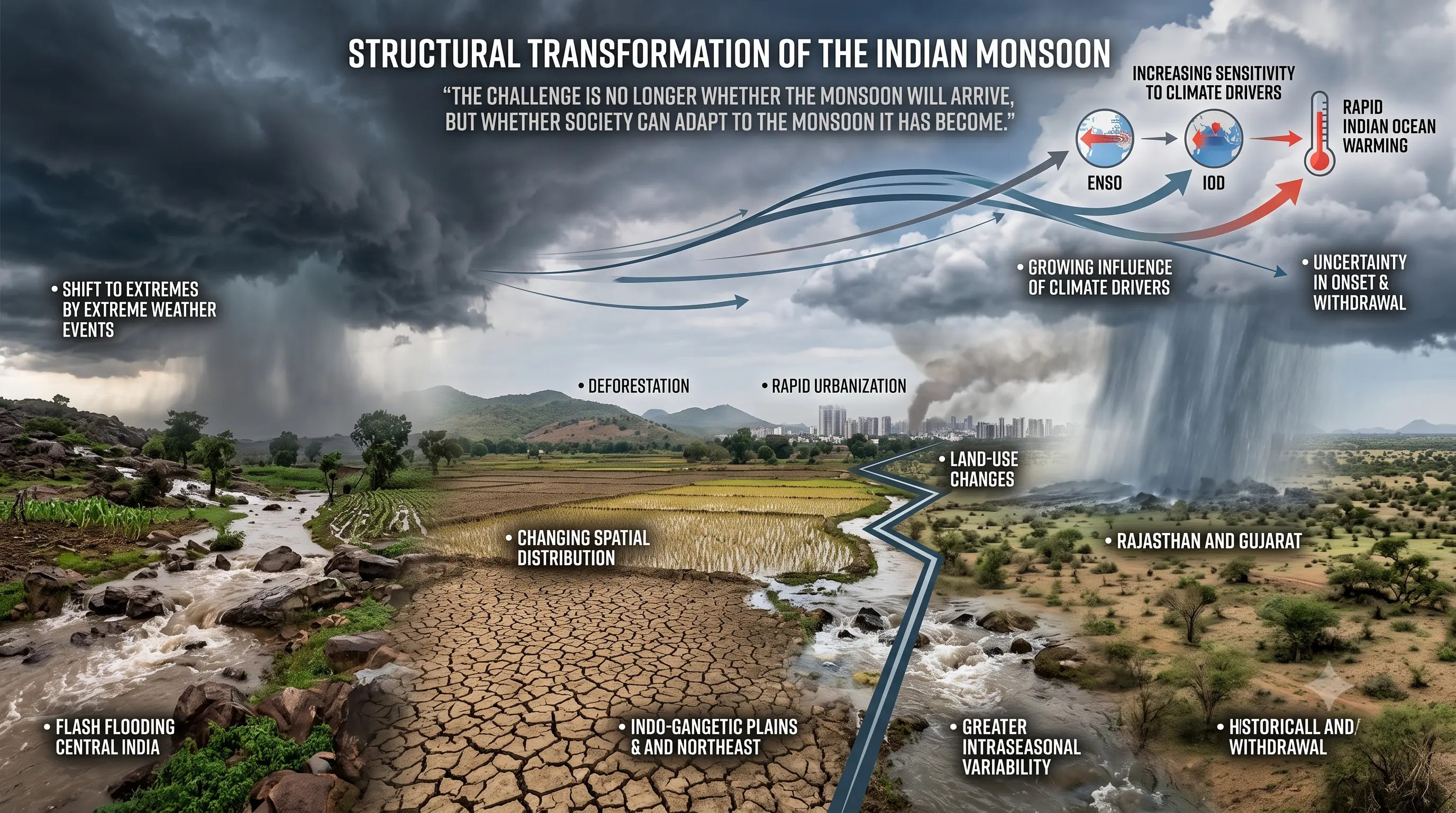
The Indian monsoon is undergoing a profound structural transformation marked by spatial, temporal, and intensity-related variability. As human-induced landscape changes amplify climate-driven disruptions, the challenge has shifted from predicting the monsoon's arrival to adapting to the extreme and erratic weather system it has become.
Introduction
Context & Background
Key Points
- •Shift from Moderate Rainfall to Extremes: The monsoon now brings fewer rainy days but more intense downpours, separated by longer dry spells. An IITM–Nature Communications study found that extreme rainfall events in Central India tripled (1950–2015) despite a 10–20% decline in average monsoon rainfall.
- •Changing Spatial Distribution: Rainfall is becoming increasingly uneven. Traditional monsoon regions like the Indo-Gangetic Plains and Northeast India have witnessed a decline, while historically arid areas like Rajasthan and Gujarat have experienced unusually heavy rainfall and flash floods.
- •Greater Intraseasonal Variability: Rainfall is becoming more uneven within the season itself, characterized by prolonged dry spells followed by intense, damaging wet periods.
- •Growing Influence of Climate Drivers: The monsoon is increasingly sensitive to global climate phenomena like ENSO, the Indian Ocean Dipole (IOD), and rapid Indian Ocean warming, drastically increasing year-to-year variability.
- •Increasing Uncertainty in Onset and Withdrawal: The traditional timelines for monsoon arrival and withdrawal are becoming highly erratic, heavily disrupting agricultural planning and water management.
Key Changes in the Behaviour of the Indian Monsoon
| Change Dimension | Description | Evidence / Example | Bookmark |
|---|---|---|---|
| Shift to Extremes | Fewer rainy days but more intense downpours. | IITM study: Extreme rainfall in Central India tripled (1950–2015). | |
| Spatial Distribution | Traditional regions receive less rain; arid areas get more. | Decline in IGP/Northeast (0.5–1.5 mm/day); flash floods in Rajasthan/Gujarat. | |
| Intraseasonal Variability | Prolonged dry spells followed by intense wet periods. | 2019: June received 67% of LPA, while August recorded 130%. | |
| Climate Drivers | High sensitivity to ENSO and Indian Ocean Dipole (IOD). | 2023: Strong El Niño weakened the monsoon despite a positive IOD. | |
| Erratic Onset/Withdrawal | Uncertain arrival and retreat timelines. | 2025: Delayed onset followed by intense rain disrupted kharif operations. |
Related Entities
Impact & Significance
- •Agricultural Disruption: Erratic onset and withdrawal timelines severely disrupt the sowing and harvesting of Kharif crops, threatening food security.
- •Water Management Crises: Prolonged dry spells followed by extreme downpours make reservoir management difficult, leading to simultaneous drought and flood conditions.
- •Economic Losses: Flash floods in historically arid zones and crop failures in traditional agricultural belts lead to massive economic instability for vulnerable populations.
Challenges & Criticism
- •Anthropogenic Amplification: Global warming is not the sole culprit. Human-induced landscape changes like massive deforestation, unchecked urbanization, and aerosol pollution are actively worsening the monsoon's unpredictability.
- •Reactive Policy Making: Policies are largely reactive to individual flood or drought events, lacking a cohesive, long-term strategy for building systemic climate resilience.
- •Inadequate Local Forecasting: While national forecasting has improved, there remains a critical gap in hyper-local forecasting required to manage intraseasonal variability effectively.
Future Outlook
- •Ecosystem Restoration: Actively restoring degraded landscapes to naturally buffer against extreme weather and regulate local microclimates.
- •Climate-Resilient Infrastructure: Designing urban and rural infrastructure capable of withstanding intense, sudden downpours and prolonged dry spells.
- •Advanced Scientific Forecasting: Investing in hyper-local, real-time meteorological tracking to better predict intraseasonal variability and erratic onset/withdrawal.
- •Sustainable Land Management: Reforming agricultural and land-use practices to adapt to the changing spatial distribution of rainfall.
UPSC Relevance
- • GS-1 (Geography): Important Geophysical phenomena, changes in critical geographical features, and monsoon dynamics.
- • GS-3 (Environment & Agriculture): Climate change impacts, cropping patterns, food security, and disaster management (floods/droughts).
- • Essay Topics: 'Climate change and the Indian agrarian economy', 'Adapting to the new normal of extreme weather'.
- • Mains Focus: Analyzing spatial/temporal variations in the monsoon and the anthropogenic amplification of these changes.
Sample Questions
Prelims
Consider the following statements regarding the changing behaviour of the Indian Monsoon:
1. The Indo-Gangetic Plains have consistently recorded increased monsoon rainfall over the last decade.
2. A positive Indian Ocean Dipole (IOD) always results in a weaker southwest monsoon.
3. Aerosol pollution and human-induced land-use changes can amplify climate-driven disruptions to the monsoon system.
Answer: Option 3
Explanation: Statement 1 is incorrect; the IGP has witnessed a decline in rainfall. Statement 2 is incorrect; a positive IOD generally aids the monsoon and can partially offset El Niño's negative impact. Statement 3 is correct, as anthropogenic factors amplify structural changes.
Mains
“The Indian monsoon is undergoing a structural transformation, driven by both global climate phenomena and local anthropogenic factors.” Analyze this statement, highlighting how spatial and temporal changes in the monsoon are impacting India's socio-economic landscape.
Introduction: Define the traditional importance of the monsoon and state the core thesis: it is moving from predictable moderate rainfall to highly variable extremes.
Body:
• Structural Changes: Detail the shift to extreme rainfall, intraseasonal variability, shifting spatial patterns (dry IGP, flooded Rajasthan), and delayed onset/withdrawal.
• Drivers of Change: Global (ENSO, IOD, Ocean warming) vs. Local/Human-induced (deforestation, urbanization, aerosol pollution, land-use change).
• Impact & Adaptation: Disruption of Kharif sowing, water management challenges. Need for climate-resilient infrastructure and sustainable land management.
Conclusion: Conclude that adapting to the 'new monsoon' requires a paradigm shift from reactive disaster management to proactive ecosystem restoration and scientific forecasting.