
Community-Based Disaster Risk Management: Empowering Panchayats for Local Resilience
The Union Government has approved a ₹507.37 crore National Project to strengthen Community-Based Disaster Risk Reduction (CBDRR) in Panchayati Raj Institutions (PRIs). This initiative aims to institutionalize local resilience by empowering communities and local bodies as frontline responders during disaster events.
Introduction
Context & Background
Key Points
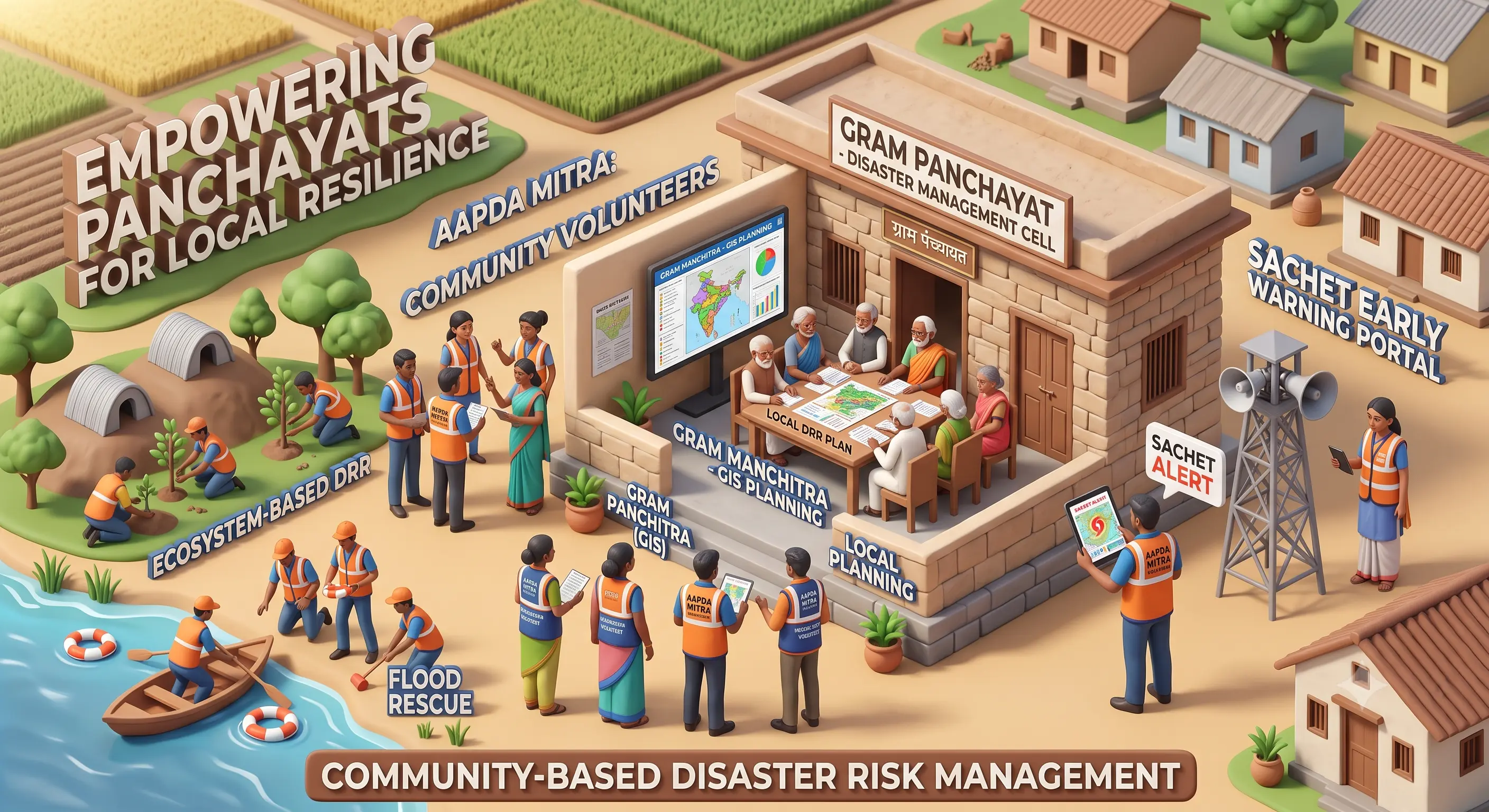
- •National CBDRR Project in PRIs: Jointly implemented by the Ministry of Panchayati Raj (MoPR) and the National Disaster Management Authority (NDMA) across 81 disaster-prone districts in 20 states. It aims to build model Gram Panchayats focused on six major hazard themes (e.g., floods, earthquakes, cyclones).
- •Integration with Local Governance: Integrates Disaster Management Plans (DMP-MoPR) directly into Gram Panchayat Development Plans (GPDP), ensuring disaster risk reduction is mainstreamed into local development planning.
- •Aapda Mitra Scheme: Trains local community volunteers in search, rescue, and first aid to strengthen Panchayat-led emergency response during critical golden hours.
- •Digital and Geospatial Tools: Leverages eGramSwaraj (work-based accounting platform for transparency), Gram Manchitra (GIS-based spatial planning tool for hazard mapping), and the SACHET Portal (National Disaster Alert Portal based on Common Alerting Protocol standards).
- •Core Features of CBDRM: Emphasizes participatory risk assessment, usage of indigenous local knowledge, effective last-mile warning dissemination, and community-led first responder preparedness.
Key Digital & Policy Initiatives for Local Disaster Management
| Initiative / Tool | Implementing Agency | Key Objective / Function | Bookmark |
|---|---|---|---|
| National CBDRR Project in PRIs | MoPR & NDMA | Creates model Gram Panchayats in 81 disaster-prone districts across 20 states. | |
| Aapda Mitra Scheme | NDMA | Trains community volunteers in search, rescue, and first aid for golden-hour response. | |
| SACHET Portal | NDMA / ITU | National emergency alert system adhering to Common Alerting Protocol (CAP) standards. | |
| Gram Manchitra | Ministry of Panchayati Raj | GIS-based spatial mapping tool for local hazard identification and planning. |
Best Practices in Community-Based Disaster Risk Management
| Location / Model | Scope | Key Strategy & Impact | Bookmark |
|---|---|---|---|
| Odisha | National | Last Mile Connectivity using trained Cyclone Warning Volunteers with megaphones and sirens. | |
| Bihar | National | Community-led Flood Management Committees (FMCs) trained in rescue and early evacuation. | |
| Senegal (Tostan Model) | International | Non-formal education empowering communities for disaster preparedness and resilience. | |
| Mexico | International | Civil Protection Brigades trained for rapid search and rescue during earthquakes. |
Related Entities
Impact & Significance
- •First Responders at Frontlines: Prepares local communities during the crucial early hours of a disaster when state emergency services may face accessibility delays.
- •Context-Specific Risk Management: Leverages traditional knowledge and local geography to devise tailored, effective disaster mitigation strategies.
- •Inclusive and Equitable Resilience: Ensures vulnerable groups—such as women, elderly, children, and persons with disabilities—are actively involved in planning and response.
- •Cost-Effective and Sustainable: Utilizes local resources and nature-based solutions, significantly reducing long-term post-disaster recovery expenses.
- •Strengthening Social Capital: Fosters collective action, trust, and civic engagement within local self-governance frameworks.
Challenges & Criticism
- •Capacity and Skill Gaps: Low disaster literacy and limited technical knowledge at the Panchayat level constrain effective risk mapping and execution.
- •Financial Constraints: Inadequate and delayed disbursement from State Disaster Mitigation Funds (SDMF) impairs timely local risk-reduction measures.
- •Institutional Coordination Deficit: Overlapping mandates and weak coordination among local, district, and state authorities cause delays and duplication.
- •Digital Divide: Uneven internet connectivity and digital illiteracy in remote rural areas restrict real-time alert dissemination via digital tools.
- •Scaling and Replication Bottlenecks: Diverse socio-ecological landscapes across Indian states make replicating model Panchayat success stories challenging without deep customization.
Future Outlook
- •Mainstreaming CBDM in Governance: Make disaster risk reduction a mandatory component of GPDPs, rural infrastructure design, and local budgeting.
- •Scaling Model Panchayats: Replicate best practices from model Gram Panchayats across 2.5 lakh+ Panchayats via structured peer learning and institutional handholding.
- •Ecosystem-Based DRR (Eco-DRR): Restore natural buffers like wetlands, mangroves, and watersheds as cost-effective protection against floods, cyclones, and droughts.
- •Deepening Technological Integration: Equip rural local bodies with user-friendly GIS mapping tools and continuous capacity-building programs.
UPSC Relevance
- • GS-3 (Disaster Management): Community-based disaster management, Sendai Framework, and local risk reduction strategies.
- • GS-2 (Governance & PRIs): Decentralization of powers, devolution of functions under 11th Schedule, and role of Panchayati Raj Institutions.
- • Mains Focus: Analyzing PRIs as first responders and proposing reforms to bridge financial and technical gaps in grassroot DRR.
Sample Questions
Prelims
With reference to Community-Based Disaster Risk Reduction (CBDRR) in India, consider the following statements: 1. The National Project for Strengthening CBDRR in PRIs is jointly implemented by the Ministry of Panchayati Raj and the NDMA. 2. The SACHET Portal is based on the Common Alerting Protocol (CAP) standard adopted by the International Telecommunication Union (ITU). 3. The Sendai Framework explicitly calls for empowering local communities as the foundation of disaster resilience. Which of the statements given above is/are correct?
1. 1 and 2 only
2. 2 and 3 only
3. 1 and 3 only
4. 1, 2 and 3
Answer: Option 4
Explanation: All three statements are correct. Statement 1 describes the joint implementation of the ₹507.37 crore CBDRR project by MoPR and NDMA. Statement 2 correctly identifies the CAP standard used by SACHET. Statement 3 accurately states the Sendai Framework's emphasis on local empowerment.
Mains
“Local communities are the true frontline responders during disaster events.” Examine how Community-Based Disaster Risk Management (CBDRM) can bridge governance gaps in India and suggest steps to strengthen Panchayati Raj Institutions (PRIs) in disaster risk reduction.
Introduction: Define CBDRM and cite the recent approval of the ₹507.37 crore National CBDRR Project for PRIs. Highlight its alignment with Sendai Framework Priority 2 (Strengthening disaster risk governance).
Body:
• Why CBDRM is Critical: Immediate response capability during golden hours; utilization of indigenous terrain knowledge; inclusive planning for vulnerable sections; cost-effective nature-based solutions.
• Governance Gaps Bridged by PRIs: Solves last-mile early warning communication bottlenecks (SACHET/Aapda Mitra); integrates hazard mitigation into GPDPs; enables spatial planning (Gram Manchitra).
• Challenges & Way Forward: Address PRI financial constraints through State Disaster Mitigation Funds; build technical capacity; scale model Panchayats across 2.5 lakh+ PRIs; integrate Ecosystem-Based DRR.
Conclusion: Conclude by stating that transitioning from top-down disaster relief to bottom-up, community-led resilience is essential for achieving India's goal of zero preventable disaster casualties.