
How Computer Warfare is Becoming a Lethal Part of Pentagon’s Arsenal
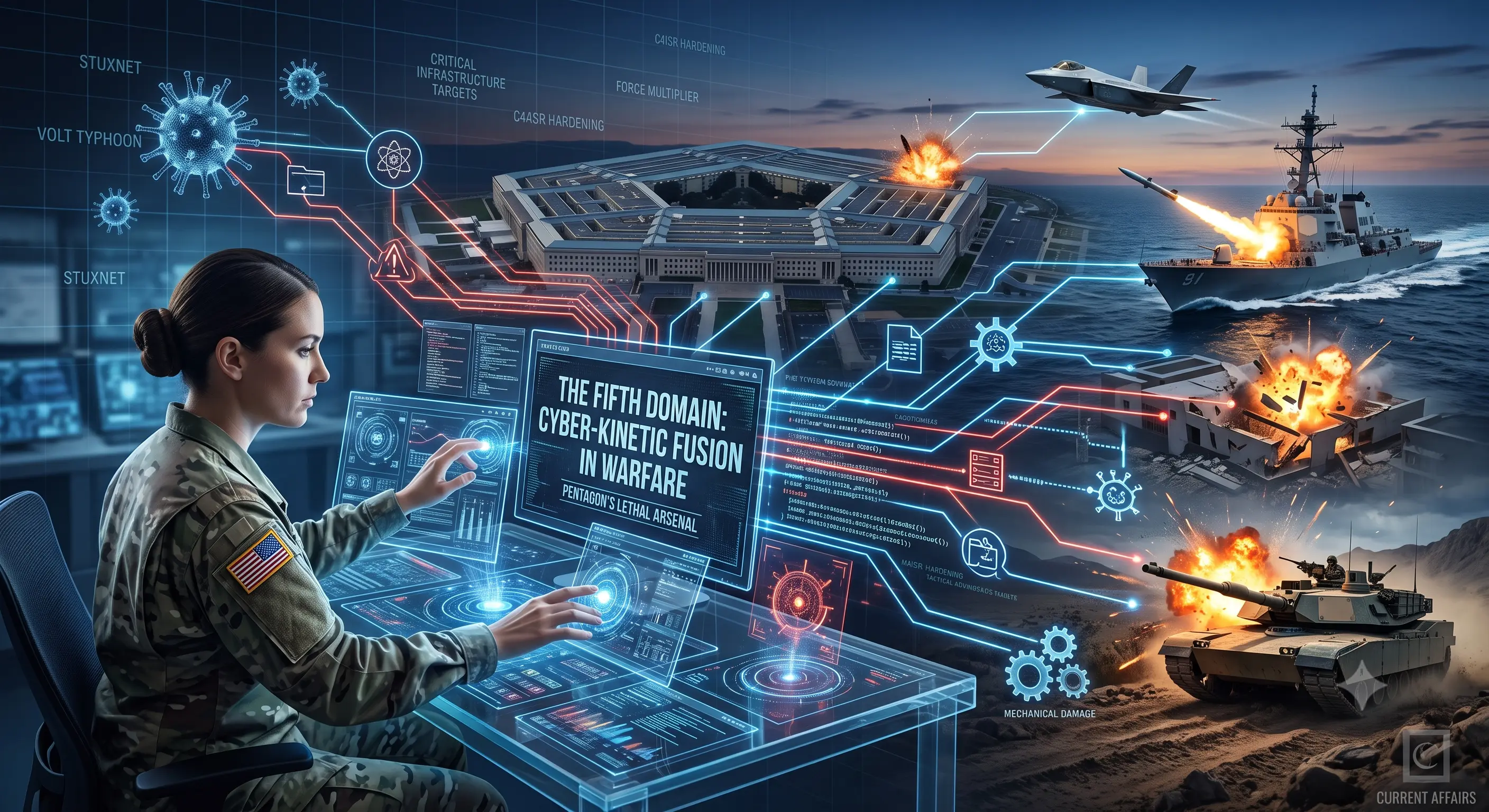
With increasing reliance on IT infrastructure, cyberspace has emerged as the fifth domain of warfare. This article explores the conceptual evolution of cyber operations from espionage to lethal strike capabilities, global cyber expansions like China's Volt Typhoon, and India's preparedness through institutions like the Defence Cyber Agency.
Introduction
Context & Background
Key Points
- •The Fifth Domain of Warfare: Cyberspace now stands alongside land, sea, air, and space as a recognized domain of military operations, enabling invisible internet-based forces to conduct sabotage and espionage.
- •From Support to Strike Capability: Cyber tools have rapidly evolved beyond intelligence gathering. Operations like Stuxnet prove that cyber weapons can cause physical destruction and yield real-world, lethal consequences.
- •Cyber-Kinetic Fusion: Modern military strategies increasingly deploy cyberattacks alongside airstrikes and special forces to disable enemy defenses—such as radars and power grids—before physical engagement.
- •Pre-positioning Strategy: Adversaries are infiltrating critical infrastructure well in advance of conflicts. For example, China’s Volt Typhoon campaign targeted US networks to disrupt power and communications, aiming to delay military mobilization.
- •India’s Institutional Architecture: India has officially recognized cyber threats as military challenges, establishing the Defence Cyber Agency to coordinate joint-services cyber operations under the Integrated Defence Staff.
- •Cyber-Space-AI Convergence: Future defense relies heavily on the integration of artificial intelligence and data analytics for predictive cyber defense and rapid response to complex attacks.
Key Differences Between Cyber Warfare and Traditional Warfare
| Aspect | Cyber Warfare | Traditional Warfare | Bookmark |
|---|---|---|---|
| Theatre of War | Conducted in cyberspace, recognised as the fifth domain of warfare. | Conducted in physical domains such as land, sea and air. | |
| Nature of Space | Borderless and undefined, with no clear national boundaries. | Geographically defined by territorial, air and maritime boundaries. | |
| Attribution of Attack | Difficult to identify attackers due to anonymity and spoofing. | Relatively easy attribution through visible military forces. | |
| Physical Contact | No direct physical engagement between opposing forces. | Direct physical confrontation between armed forces. | |
| Casualties | Usually no immediate loss of life, though indirect impacts exist. | Involves direct human casualties and physical destruction. | |
| Threshold of Conflict | Operates below declared war, enabling deniability. | Often involves clear acts of war or formal conflict. |
Related Entities
Impact & Significance
- •Paralysis of Critical Infrastructure: Cyber operations can shut down power grids, water supplies, and radar systems, paralyzing a nation without firing a single physical shot.
- •Delaying Crisis Mobilization: Pre-positioning tactics are used to target communications and logistics, significantly slowing down military responses during geopolitical standoffs.
- •Force Multiplication: Disabling an adversary's electronic defenses enhances the survivability and impact of conventional airstrikes and ground forces.
- •Escalation Risks: The ambiguity of cyber thresholds means that an unchecked digital attack on civilian infrastructure could quickly spiral into an open, kinetic war.
Challenges & Criticism
- •Attribution Ambiguity: Due to advanced spoofing and anonymity, it is incredibly difficult to definitively trace a cyberattack to a specific state actor, complicating retaliation.
- •Lack of Global Norms: The international legal framework for cyberspace remains underdeveloped, leaving gray areas regarding what constitutes an 'act of war' online.
- •Dependence on Foreign Technology: Relying on imported hardware and software creates inherent vulnerabilities and 'backdoors' that adversaries can exploit.
- •Resource and Skill Gap: Developing cutting-edge indigenous cyber tools and maintaining a highly skilled workforce is a continuous, resource-intensive challenge for defense establishments.
Future Outlook
- •Military Network Hardening: Upgrading and securing C4ISR (command, control, communications, computers, intelligence, surveillance, and reconnaissance) systems against sophisticated infiltration.
- •Technological Sovereignty: Accelerating efforts to build indigenous cyber tools and software to minimize reliance on foreign technology and close security vulnerabilities.
- •International Cyber Norms: Expanding active participation in UN processes and multilateral dialogues to establish clear, responsible state behavior and accountability in cyberspace.
- •AI-Driven Defense: Widespread deployment of artificial intelligence to enable predictive threat detection and autonomous defense mechanisms against high-speed cyber threats.
UPSC Relevance
- • GS-3 (Defence Technology / Internal Security): Basics of cyber security; role of external state and non-state actors in creating challenges to internal security.
- • GS-2 (International Relations): Geopolitics of technology and bilateral/multilateral agreements regarding cyberspace governance.
- • Essay Topics: 'Cyberspace: The Invisible Battlefield of the 21st Century', 'Technological Sovereignty and National Security'.
- • Mains Focus: Analyzing India's institutional preparedness for cyber warfare and the integration of AI in defense.
Sample Questions
Prelims
Which of the following statements regarding cyber warfare is/are correct?
1. Cyber warfare involves direct physical engagement between opposing armed forces.
2. The Defence Cyber Agency coordinates cyber operations across the Indian Army, Navy, and Air Force.
3. Stuxnet was a cyber operation intended to disrupt power grids in Venezuela.
Answer: Option 2
Explanation: Statement 1 is incorrect because cyber warfare operates in a borderless domain without direct physical contact. Statement 3 is incorrect because Stuxnet targeted Iranian nuclear facilities, not Venezuelan power grids. Statement 2 is correct as the Defence Cyber Agency acts as the nodal body for joint-services cyber operations.
Mains
“Cyber warfare has blurred the lines between conventional and non-conventional conflict, becoming a lethal component of modern arsenals.” Discuss the evolution of cyber warfare and evaluate India's institutional preparedness to tackle cyber-military threats.
Introduction: Define cyber warfare as the fifth domain of conflict. Briefly mention its significance in recent geopolitical events as a tool for strategic sabotage below the threshold of declared war.
Body:
• Evolution to Lethality: Discuss the transition from espionage to strike capability (e.g., Stuxnet); define 'Cyber-kinetic fusion' and the use of cyber tools as force multipliers.
• Global Threat Landscape: Highlight pre-positioning strategies by major powers (e.g., Volt Typhoon, Venezuela grid attacks) and the difficulty in attribution.
• India's Preparedness: Detail the establishment of the Defence Cyber Agency; efforts in military network hardening (C4ISR); focus on Cyber-Space-AI convergence and indigenous capability building.
Conclusion: Conclude that while India has established the necessary institutional architecture, continuous investment in technological sovereignty and active participation in shaping global cyber norms are critical to securing national interests.